- Recommendations
- The Shift From Fixed Roles to Skills-Based Organizations
- Why Outcome-Based Work Is Replacing Time-Based Supervision
- Hybrid Work Is Reshaping Operational Coordination
- Hybrid Work Also Introduced New Organizational Risks
- AI Is Accelerating the Transformation of Work
- The Future Workplace Is Built Around Adaptability
Recommendations
- Map the critical skills required to execute your strategy and identify where capabilities are concentrated, missing, or becoming obsolete as technology and business priorities change.
- Replace activity-based performance measures with clearly defined outcomes, focusing managers on deliverables, business results, and accountability rather than visibility, hours, or physical presence.
- Establish explicit operating rules for hybrid work that define how teams communicate, document decisions, manage handoffs, share knowledge, and determine when synchronous collaboration is necessary.
- Identify business-critical processes that depend heavily on informal knowledge and document the ownership, decisions, dependencies, and procedures required to execute them consistently across a distributed workforce.
The modern workplace is undergoing a structural transformation that extends far beyond remote work trends or post-pandemic flexibility debates.
Organizations are increasingly discovering that many traditional work structures were designed for an industrial and administrative economy that no longer reflects how modern knowledge work actually operates. Fixed job descriptions, rigid schedules, centralized supervision, and location-dependent productivity models are becoming increasingly difficult to sustain inside fast-moving digital environments.
The workplace is no longer organized primarily around physical presence.
It is increasingly organized around adaptability, coordination, skills, and operational visibility.
Research from the McKinsey Global Institute continues to show that automation, AI adoption, and digital transformation are reshaping both workforce skill requirements and organizational operating structures across industries.
This transition is not theoretical.
It is already reshaping organizational coordination, workforce expectations, leadership structures, operational workflows, and the relationship between employees and institutions themselves.
The organizations adapting successfully are not simply allowing employees to work remotely.
They are redesigning how work is coordinated altogether.
The Shift From Fixed Roles to Skills-Based Organizations
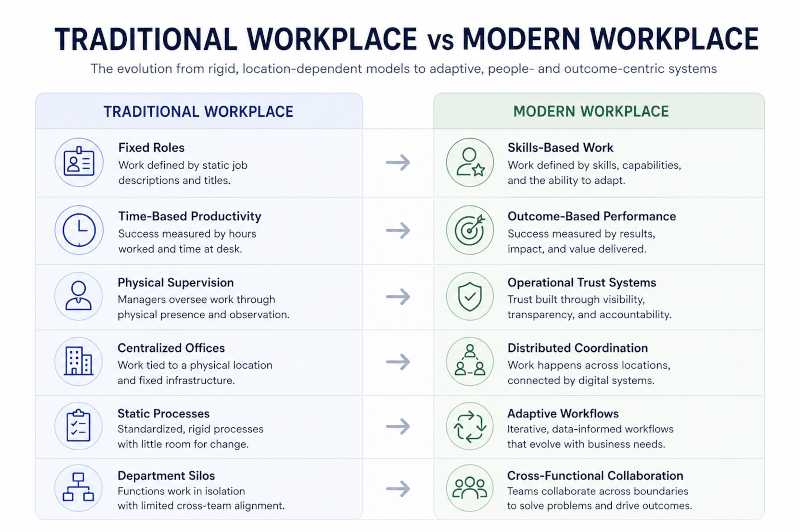
One of the most significant changes occurring inside modern organizations is the gradual movement away from rigid role structures toward more dynamic skill-based operational models.
Traditional organizations were built around relatively stable job functions. Employees were assigned narrowly defined responsibilities, reporting structures were hierarchical, and work was coordinated through clearly separated departments.
That model becomes increasingly difficult to maintain in rapidly evolving digital environments where technologies, workflows, and business priorities continuously shift.
As automation expands across administrative and repetitive tasks, organizations increasingly require employees who can adapt across multiple domains rather than operate inside highly static responsibilities.
According to McKinsey Global Institute, demand for technological, social, emotional, and higher cognitive skills is expected to continue accelerating as automation reshapes workforce structures globally.
This is changing how organizations think about workforce design itself.
Increasingly, organizations are shifting toward cross-functional collaboration, project-based execution, adaptable workforce structures, and distributed expertise networks. What matters now is often less about a formal title and more about transferable capabilities, operational adaptability, communication, coordination, and problem-solving capacity.
Employees increasingly work across operational boundaries rather than inside narrowly isolated functions.
This transition is also changing leadership expectations. Managers are gradually evolving from task supervisors into operational coordinators responsible for aligning people, systems, communication flows, and institutional knowledge across distributed environments.
The future workplace is becoming less hierarchical and more network-oriented.
Why Outcome-Based Work Is Replacing Time-Based Supervision
For decades, organizational productivity was closely tied to physical visibility.
Employees were expected to work within centralized offices where managers could directly supervise activity, coordinate communication, and measure productivity through time spent working.
That operational model becomes increasingly difficult to maintain inside distributed digital work environments.
Modern knowledge work is far less dependent on physical presence than industrial-era management systems assumed.
As a result, organizations are increasingly shifting toward outcome-based performance models where success is measured through operational results rather than hours observed.
This represents a deeper transformation than many organizations initially realized.
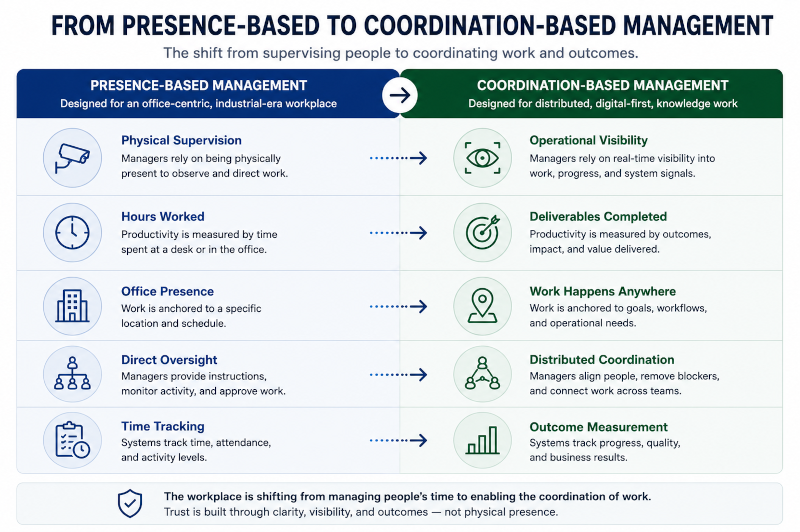
The rise of distributed work environments forced companies to redesign operational trust systems. Instead of relying on physical supervision, organizations increasingly depend on visibility systems, workflow coordination, deliverable tracking, communication architecture, and accountability structures.
The workplace is gradually shifting from:
- presence-based management
to - coordination-based management.
This transition has not been entirely smooth.
Many organizations continue struggling with how to maintain operational visibility, institutional cohesion, collaboration quality, and accountability inside distributed environments.
The operational tensions surrounding distributed work became especially visible across large financial institutions. Executives at Goldman Sachs repeatedly argued that fully remote environments weaken collaboration, mentorship, apprenticeship-style learning, and institutional culture. The company’s aggressive return-to-office posture highlighted how many organizations continue struggling to balance workforce flexibility with operational coordination, visibility, and long-term organizational cohesion inside distributed work environments
This tension became especially visible during return-to-office conflicts across major corporations.
Companies including Amazon and Goldman Sachs implemented stricter return-to-office mandates partly out of concern that fully distributed environments reduce collaboration, mentorship, institutional culture, and operational coordination.
At the same time, employee research consistently shows that workers increasingly prioritize flexibility, autonomy, and hybrid arrangements when evaluating employers.
The result is a growing organizational balancing act between flexibility, coordination, operational visibility, and institutional control.
Hybrid Work Is Reshaping Operational Coordination
Hybrid work is often discussed primarily as a workplace flexibility issue.
In reality, it represents a much larger operational coordination challenge.
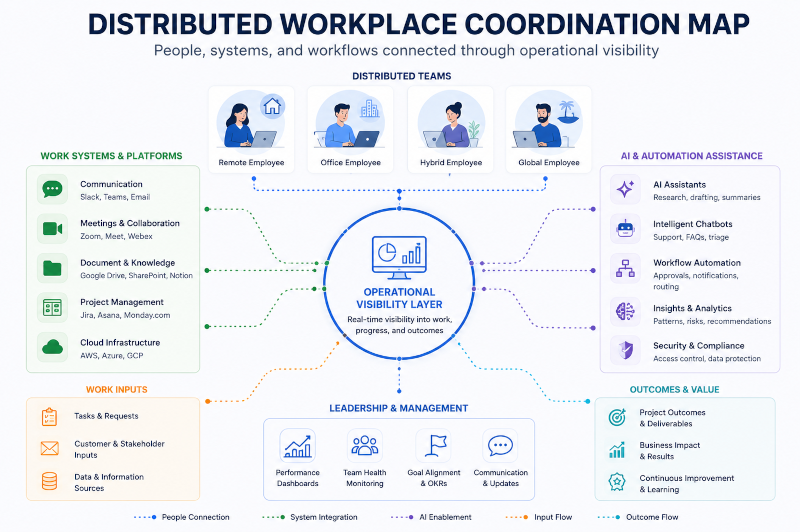
Distributed work environments fundamentally change how organizations manage communication, collaboration, knowledge transfer, visibility, onboarding, and decision-making.
Research published in Frontiers in Organizational Psychology emphasizes that hybrid work is not simply a combination of home and office work, but a broader restructuring of physical, virtual, social, and temporal coordination systems inside organizations.
This is one reason many organizations continue struggling with hybrid execution despite widespread adoption.
The challenge is not merely where employees work.
The challenge is how operational systems function when employees, information, and workflows become geographically distributed.
Many organizations initially approached hybrid work as a scheduling problem.
It is increasingly becoming clear that hybrid work is actually an operational architecture problem.
Communication fragmentation, meeting overload, inconsistent documentation practices, and visibility gaps often emerge when organizations attempt to scale distributed work without redesigning underlying coordination systems.
Research from Harvard Business Review similarly notes that organizations increasingly rely on data-driven coordination strategies to manage hybrid work environments effectively.
The organizations adapting most successfully are not simply offering remote work.
They are redesigning workflows, communication norms, operational visibility, and institutional knowledge systems around distributed execution.
Hybrid Work Also Introduced New Organizational Risks
While hybrid work increased flexibility for many employees, it also exposed operational weaknesses that were previously hidden inside centralized office environments.
One major challenge is institutional visibility.
Inside distributed work environments, organizations often struggle to maintain awareness around workload distribution, communication bottlenecks, onboarding quality, employee burnout, and knowledge accessibility.
This becomes especially dangerous when organizations rely heavily on undocumented workflows or informal communication channels.
Studies on hybrid work environments increasingly show that operational clarity, documentation quality, and communication structures play a major role in both employee wellbeing and organizational performance.
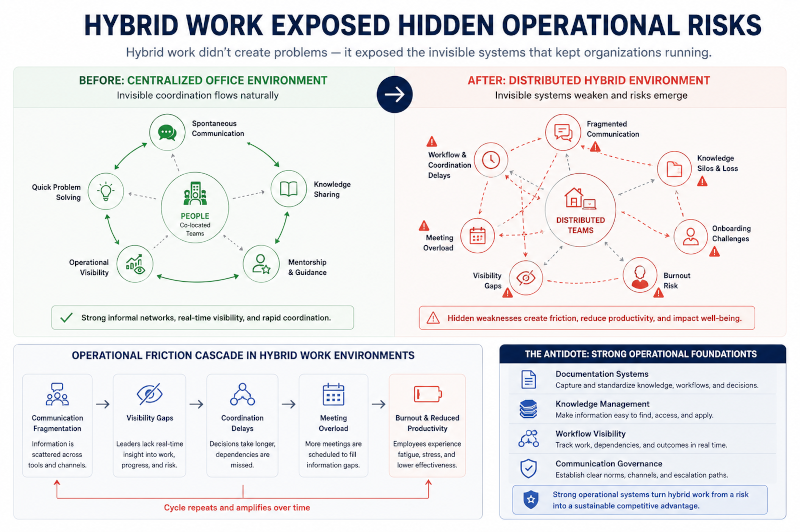
The shift toward distributed work has also intensified concerns around meeting fatigue, digital overload, collaboration fragmentation, and work-life boundary erosion.
Findings published in the Microsoft Work Trend Index similarly show that employees operating inside highly digital work environments increasingly experience communication overload driven by constant meetings, messaging notifications, fragmented collaboration tools, and continuous digital interruptions. The report noted that many organizations continue struggling to balance flexibility with sustainable coordination practices as hybrid work environments expand across distributed operational systems.
Recent workforce studies continue finding that hybrid work can improve employee satisfaction and retention when implemented effectively, but poorly coordinated digital environments often create significant operational friction.
Many organizations underestimated how heavily traditional office structures silently supported informal coordination, spontaneous knowledge sharing, mentorship, and operational visibility.
Once employees became distributed, those invisible coordination systems weakened significantly.
Organizations increasingly realized they needed stronger documentation systems, knowledge management practices, workflow visibility, and communication governance to maintain operational coordination across distributed environments.
This is one reason operational documentation and workflow orchestration are becoming increasingly strategic inside modern enterprises.
AI Is Accelerating the Transformation of Work
Artificial intelligence is further accelerating many of these organizational shifts.
AI systems are increasingly automating administrative work, information retrieval, reporting, scheduling, content generation, and workflow coordination.
However, AI is not simply replacing work.
It is redistributing how work is performed.
Research examining AI-enabled work environments increasingly suggests that successful organizations will depend heavily on augmentation models where humans collaborate with AI systems rather than fully surrendering operational decision-making to automation.
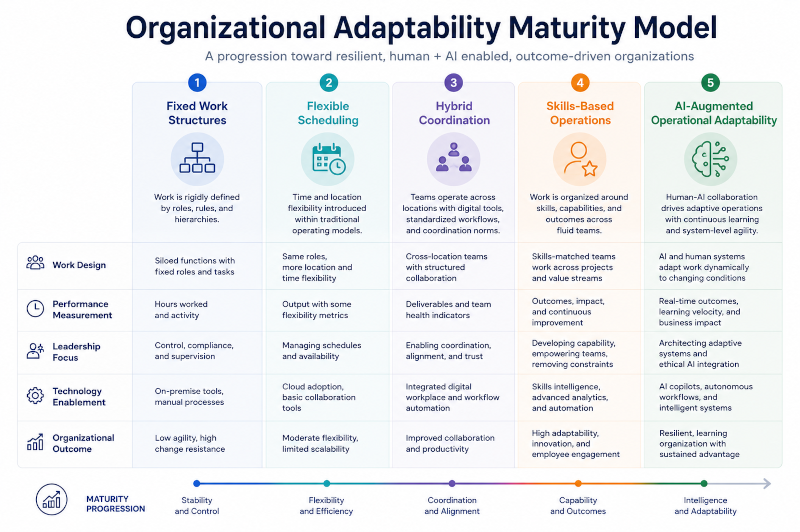
This has major implications for workforce structure.
As AI systems handle more repetitive cognitive tasks, human work increasingly shifts toward judgment, coordination, creativity, relationship management, strategic thinking, and complex decision-making.
Organizations are therefore redesigning workforce models around adaptability rather than repetition.
The future workplace may ultimately depend less on rigid job specialization and more on the ability of employees to operate effectively inside AI-augmented operational systems.
The Future Workplace Is Built Around Adaptability
The future of work is not defined by remote work alone.
It is defined by operational adaptability.
Organizations are increasingly moving toward systems built around distributed coordination, flexible execution, continuous learning, skills-based collaboration, and digitally enabled operational visibility.
This transformation extends far beyond workplace preferences.
It represents a structural redesign of how organizations coordinate human capability inside increasingly digital operational environments.
The future of work is not defined by remote work alone. It is defined by operational adaptability.
The companies adapting successfully are not merely implementing flexible work policies.
They are redesigning operational systems, communication structures, leadership models, documentation practices, and institutional workflows around a more distributed and adaptable workforce.
The workplace is no longer organized primarily around where employees sit.
It is increasingly organized around how effectively organizations coordinate people, systems, and knowledge at scale.
1 thought on “Why Traditional Work Structures No Longer Scale”