
- Start With Workflow Clarity Before Scaling Technology
- Treat Pilot Programs as Operational Stress Tests
- Expect Temporary Friction During Adoption
- Focus on Operational Clarity, Not Just Change Management
- Simplify Legacy Complexity Before Adding More Systems
- Build Governance Before Scaling Automation
- Technology Amplifies Existing Operational Systems
- Closing the Adoption Gap
Most organizations no longer struggle to access technology.
They struggle to integrate it operationally.
Modern enterprises now have access to powerful AI systems, automation platforms, analytics tools, cloud infrastructure, and digital collaboration technologies. Yet many organizations continue experiencing a widening gap between technological capability and operational execution.
The issue is rarely the software itself.
More often, organizations underestimate the operational redesign required to make new systems function effectively inside real workflows.
Technology adoption is commonly treated as a technical deployment initiative. In practice, it is usually an operational coordination challenge.
A company may successfully purchase a platform, launch an AI pilot, or automate part of a workflow while still struggling to integrate those systems into communication structures, governance models, documentation environments, and day-to-day execution processes.
This is one reason many digital transformation initiatives fail to scale beyond isolated experimentation.
Organizations often move faster implementing technology than redesigning the operational systems surrounding it.
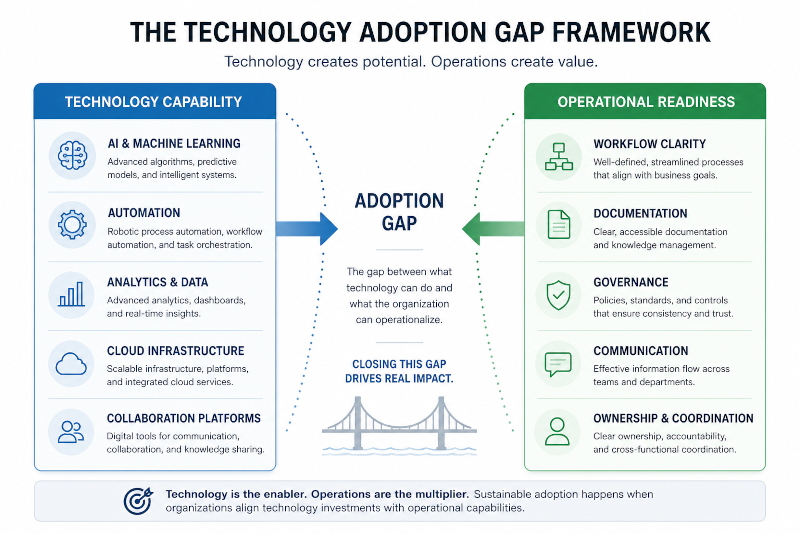
Without proper orchestration, automation can actually increase fragmentation by layering new systems on top of already disconnected workflows.
High-performing organizations approach technology adoption differently.
Instead of beginning with tools, they begin by examining how work moves across the organization itself.
Start With Workflow Clarity Before Scaling Technology
One of the most common mistakes organizations make during digital transformation is attempting to automate unclear workflows.
Technology rarely fixes operational ambiguity.
In many cases, it amplifies it.
Before scaling automation or AI systems, organizations should first evaluate:
- where workflows break down,
- how information moves between teams,
- where approvals create delays,
- and which processes rely heavily on undocumented institutional knowledge.
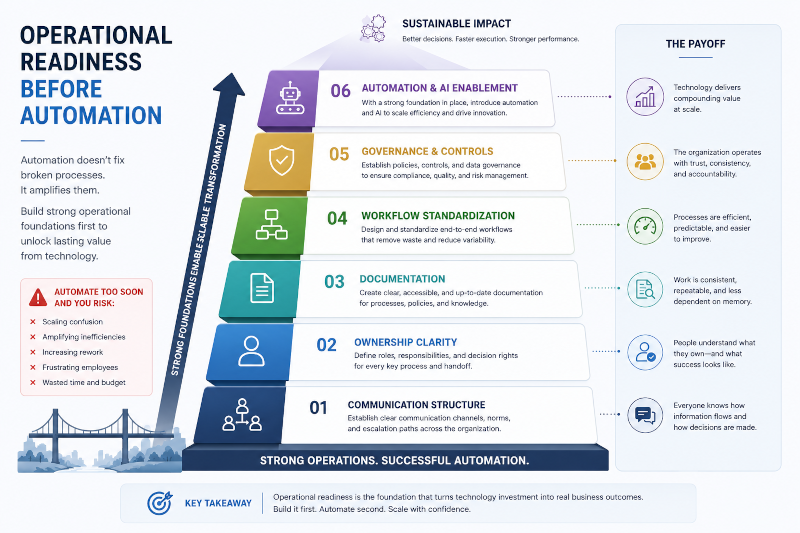
A new system may function perfectly from a technical perspective while still failing operationally because employees lack visibility into ownership structures, escalation paths, or workflow expectations.
This pattern has become especially visible during enterprise AI adoption.
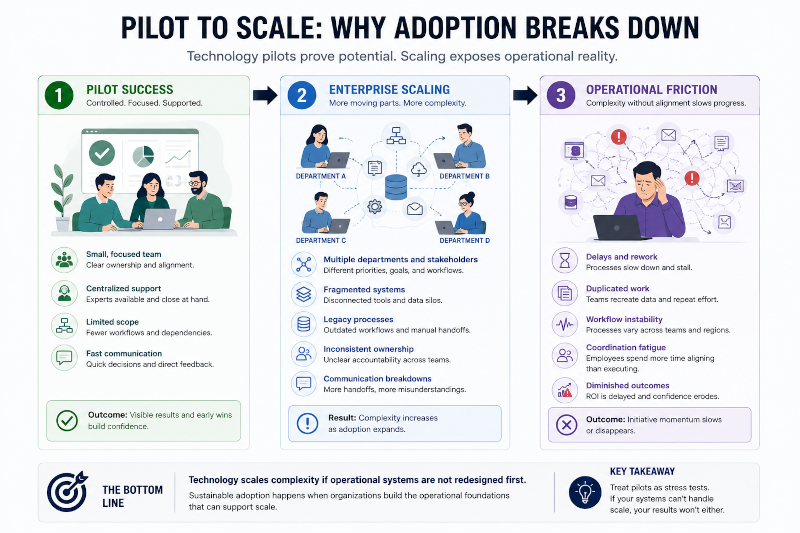
Many organizations successfully launch pilot programs but struggle to scale those systems across departments or operational environments.
Early experimentation often generates excitement. Enterprise-wide integration is significantly more difficult.
Studies examining advanced technology adoption among manufacturing firms similarly found that organizations often struggle to integrate AI and automation systems effectively when operational coordination, workforce readiness, and workflow integration remain underdeveloped.
A more effective approach is simplifying operational complexity before introducing additional systems. Organizations that establish workflow clarity early typically encounter fewer coordination problems as technology adoption expands across the enterprise.
Treat Pilot Programs as Operational Stress Tests
Pilot programs are useful, but organizations frequently misunderstand what pilots actually prove.
A successful pilot does not necessarily mean enterprise-wide adoption will succeed smoothly.
Small environments naturally contain less complexity.
Workflows are easier to coordinate, communication remains more centralized, and teams often receive concentrated support during early implementation stages.
The real challenge begins when organizations attempt to scale technology across departments with different systems, priorities, governance models, and operational habits.
This is where fragmented processes, unclear ownership, disconnected data environments, and coordination gaps begin slowing adoption.
A useful strategy is treating pilot programs as operational stress tests rather than technology demonstrations.
Instead of only measuring software functionality, organizations should evaluate:
- workflow stability,
- communication clarity,
- approval bottlenecks,
- documentation quality,
- and cross-functional coordination.
This helps identify operational weaknesses before scaling complexity across larger environments.
A rapid evidence review published by the UK Government similarly noted that organizations frequently struggle to scale advanced technologies because implementation often requires significant operational change, workforce adaptation, and restructuring of existing business processes.
Organizations that fail to establish operational clarity early often experience the same workflow fragmentation and coordination bottlenecks discussed in SpirZon’s analysis of operational friction.
Expect Temporary Friction During Adoption
One of the most unrealistic assumptions surrounding digital transformation is the expectation of immediate productivity improvements.
Operational performance often becomes less efficient temporarily during adoption periods.
Employees must learn unfamiliar systems, adjust to changing workflows, rebuild communication habits, and navigate new coordination structures.
This adjustment period is normal.
Organizations that recognize this early tend to manage transformation more effectively.
MIT Sloan Management Review has discussed this phenomenon in relation to AI adoption, noting that organizations often experience a temporary “productivity paradox” before long-term gains emerge as workflows stabilize and systems mature.
A practical mistake many organizations make is introducing new technology while simultaneously maintaining outdated operational processes.
This frequently creates:
- duplicated work,
- overlapping systems,
- communication overload,
- and coordination fatigue.
Instead, organizations should gradually redesign workflows alongside implementation.
High-performing teams often reduce operational friction during transitions by:
- simplifying approval chains,
- clarifying ownership structures,
- centralizing documentation,
- and establishing realistic implementation timelines.
The goal is not simply introducing technology.
It is stabilizing the operational environment surrounding the technology.
Focus on Operational Clarity, Not Just Change Management
Technology adoption discussions often reduce employee resistance to a vague concept called “change management.”
In reality, employees rarely resist technology simply because it is unfamiliar.
More often, they struggle with operational uncertainty.
When organizations introduce new systems without redesigning workflows clearly, employees frequently experience inconsistent expectations, unclear responsibilities, communication overload, and reduced operational visibility.
This creates coordination fatigue.
Workers may spend increasing amounts of time clarifying ownership, compensating for unstable workflows manually, or navigating fragmented communication environments.
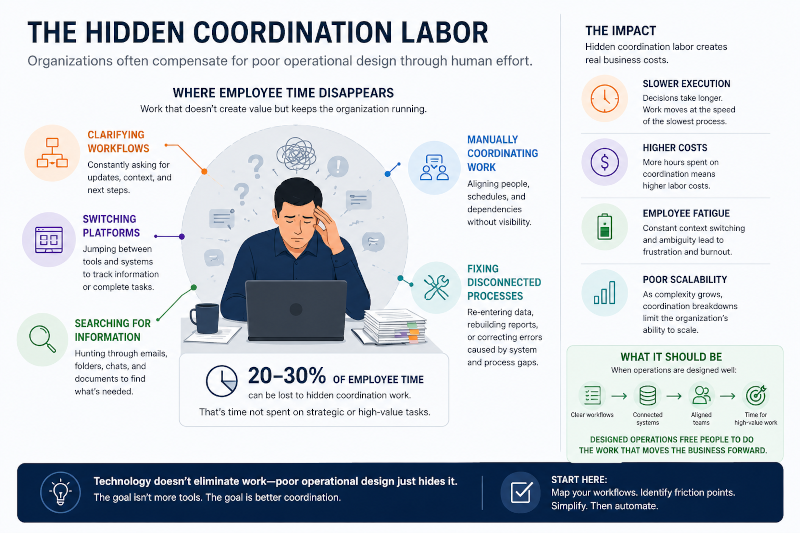
In these situations, even highly capable systems can become associated with frustration rather than improvement.
The Technology Acceptance Model developed by Information Systems researcher Fred Davis identified perceived usefulness as one of the strongest predictors of adoption behavior.
Employees are significantly more likely to adopt technology when they clearly understand:
- how the system improves their work,
- what problems it solves,
- and how it fits into existing workflows.
This becomes especially important inside distributed and hybrid work environments where operational visibility is naturally weaker.
A useful starting point is improving operational clarity before introducing additional systems.
Organizations should ensure employees understand:
- workflow expectations,
- ownership boundaries,
- escalation paths,
- and communication structures before adoption scales.
Simplify Legacy Complexity Before Adding More Systems
Many organizations attempt to modernize technology while leaving operational architecture largely unchanged.
This creates long-term complexity problems.
Legacy systems are not only technical environments.
They are operational structures built over years of layered processes, disconnected platforms, approval chains, institutional workarounds, and fragmented documentation.
As organizations add new technologies on top of already fragmented operational environments, complexity often compounds faster than coordination improves.
A practical strategy is reducing unnecessary operational complexity before introducing large-scale automation or AI systems.
This may involve:
- consolidating redundant tools,
- standardizing workflows,
- simplifying approvals,
- centralizing documentation,
- and clarifying ownership structures.
Technology integration becomes significantly easier when workflows are already coordinated.
Organizations with weak documentation environments frequently struggle to maintain operational consistency as systems scale, reinforcing why documentation increasingly functions as operational infrastructure rather than administrative overhead.
Many organizations compensate for inefficient systems through human effort instead of redesigning the systems themselves.
That approach becomes increasingly unstable as operational complexity grows.
Build Governance Before Scaling Automation
Organizations frequently focus heavily on deployment speed while underinvesting in governance structures.
This creates long-term operational instability.
Before scaling new technologies broadly, organizations should establish:
- clear ownership models,
- operational standards,
- documentation requirements,
- escalation procedures,
- and visibility into how workflows move between teams.
Technology adoption becomes significantly more difficult when departments pursue disconnected transformation initiatives without shared operational objectives.
High-performing organizations usually coordinate adoption centrally even when implementation occurs gradually across multiple teams.
This helps maintain consistency while reducing fragmentation.
The Unified Theory of Acceptance and Use of Technology (UTAUT) similarly emphasized that organizational adoption depends heavily on facilitating conditions, leadership support, operational usability, and institutional alignment rather than technical functionality alone.
Importantly, governance should support operational clarity rather than obstruct execution through excessive oversight.
The goal is coordination.
Not bureaucracy.
Technology Amplifies Existing Operational Systems
One of the most important realities organizations must recognize is that technology often amplifies the quality of existing operational systems.
Organizations with fragmented workflows, weak documentation, unclear ownership structures, and poor coordination frequently struggle to realize meaningful value from advanced tools because instability already exists beneath the surface.
Technology cannot fully compensate for unclear systems.
In some cases, it exposes them more aggressively.
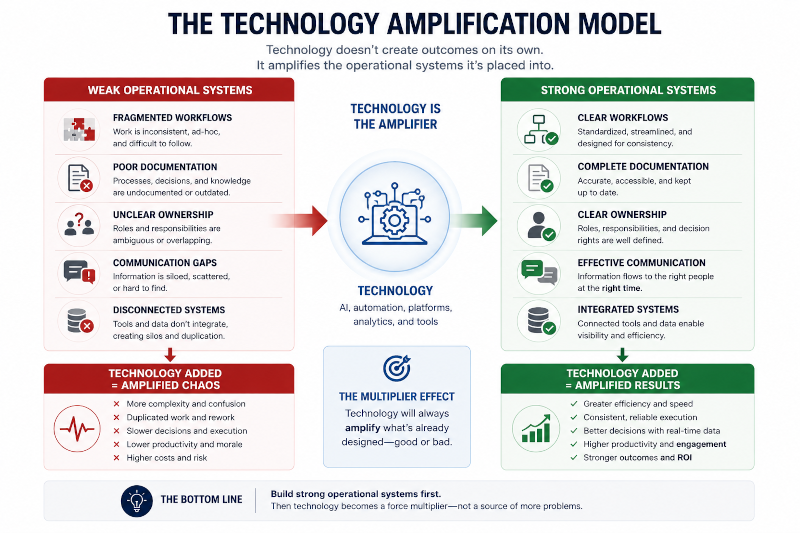
This helps explain why organizations with similar technology investments often experience dramatically different outcomes.
The difference frequently lies in operational maturity rather than software capability.
Companies that scale transformation successfully usually invest heavily in:
- workflow coordination,
- documentation quality,
- operational visibility,
- communication clarity,
- and governance structures.
They recognize that sustainable transformation depends on how effectively people, processes, and systems operate together.
Technology adoption therefore becomes less about purchasing tools and more about redesigning organizational execution itself.
Closing the Adoption Gap
The gap between technological availability and operational adoption remains one of the defining organizational challenges of the modern economy.
Most companies now have access to powerful digital tools.
Far fewer have successfully integrated those systems into stable, scalable operational environments.
Organizations that scale transformation effectively rarely begin with technology alone.
More often, they begin by simplifying workflows, clarifying ownership, strengthening documentation, reducing operational friction, and improving coordination structures before introducing additional systems.
“Technology scales most effectively when organizations simplify operations before expanding systems.”
High-performing organizations rarely operationalize technology successfully by accident.
They do so intentionally by redesigning how work moves across the organization itself.
Digital transformation succeeds when organizations improve operational systems alongside the technology supporting them.