- Recommendations
- AI Is Not Eliminating Cognitive Work. It Is Redistributing It.
- The New Skill of the AI Era May Be Cognitive Supervision
- The Risk Leaders May Be Underestimating: Cognitive Debt
- Automation Bias Is Becoming a Workflow Problem
- AI Governance Needs a Human Dimension
- Building Organizations That Think Better With AI
Recommendations
- Map several high-value AI-assisted workflows and distinguish between cognitive effort that can safely be reduced and judgment that the organization needs employees to continue exercising.
- Redesign AI training around judgment and verification, using real work scenarios where employees must decide whether to accept, investigate, or reject an AI-generated output.
- For critical processes, identify the knowledge and reasoning employees must still be able to perform without AI assistance, and deliberately maintain those capabilities.
- Examine the performance measures surrounding AI-assisted work and make sure employees are rewarded for accurate judgment, not simply for accepting machine-generated output quickly.
- Add cognitive considerations to AI governance reviews by explicitly documenting decision ownership, required human judgment, verification expectations, and the consequences of an incorrect AI output.
Artificial intelligence is changing more than how quickly organizations complete work. It is beginning to change the work itself.
Generative AI can now draft reports, summarize meetings, analyze documents, write code, organize research, and produce recommendations in seconds. For knowledge workers, activities that once required sustained attention can increasingly be delegated to a system that produces a usable first answer almost immediately.
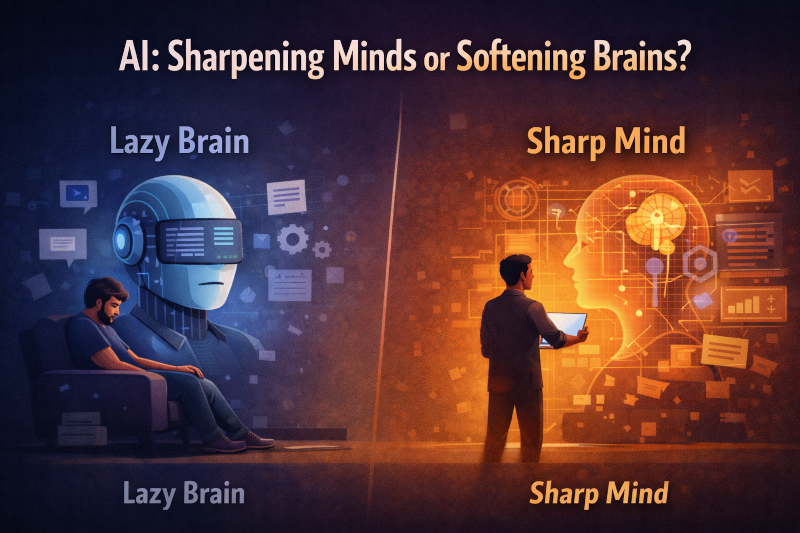
The obvious question for business leaders is whether these capabilities will improve productivity. A less obvious question may prove more consequential: What happens to human judgment when employees no longer need to perform as much of the thinking themselves?
That question is becoming harder to dismiss as AI moves from experimentation into everyday workflows. Research published by Microsoft Research at the 2025 CHI Conference, based on 319 knowledge workers and 936 examples of AI-assisted work, found that generative AI changes not only the amount of critical thinking people report doing, but also the nature of that thinking. Workers described spending less effort on some routine tasks while shifting more of their attention toward verifying information, integrating AI responses, and taking responsibility for the final task. Higher confidence in AI, however, was associated with less reported critical thinking.
The implication is not that AI is making people less capable. It is that organizations are beginning to redistribute cognitive work between people and machines. The challenge for leaders is making sure that redistribution strengthens rather than erodes the capabilities the organization depends on.
AI Is Not Eliminating Cognitive Work. It Is Redistributing It.
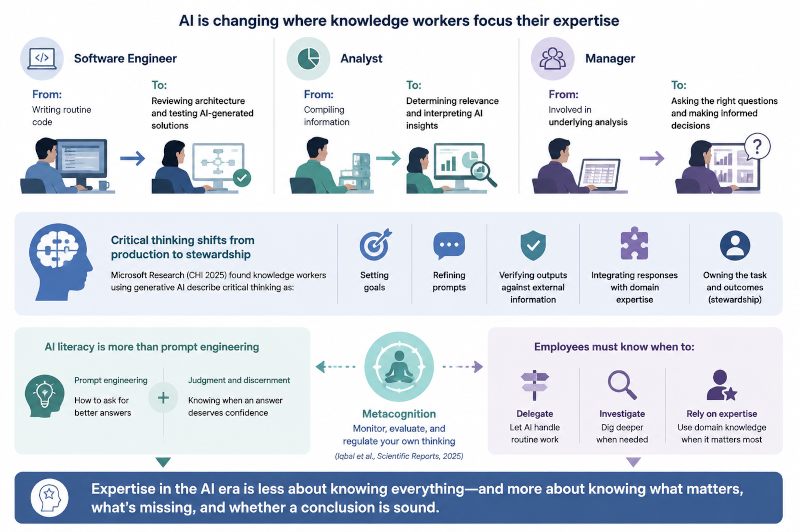
People have always used tools to reduce the mental effort required to accomplish a task. A calculator removes the need to perform arithmetic manually. A search engine reduces the need to remember where information is stored. A navigation system takes much of the work out of route planning.
Cognitive offloading is therefore not inherently problematic. In many circumstances, it is precisely what makes people more effective. A recent review in Nature Reviews Psychology found that externalizing information can improve performance, while also noting that people can become vulnerable when the external support they have come to rely on is unavailable.
Generative AI extends this dynamic into areas that have traditionally required substantially more human reasoning. Instead of simply helping someone retrieve information, it can synthesize that information, propose an interpretation, draft an argument, or recommend a course of action.
That distinction matters.
If an analyst uses AI to process a large volume of documents and then spends the recovered time interpreting the implications, the organization may have gained both efficiency and capacity. If the analyst simply accepts the AI’s interpretation without developing an independent understanding of the underlying material, the organization has gained speed but potentially weakened its own ability to reason about the problem.
The difference is subtle because both activities can produce the same immediate output.
This is why measuring AI adoption solely through productivity metrics can be misleading. An employee who completes a report 30% faster may be demonstrating genuine productivity improvement. But if the organization has also reduced the employee’s opportunity to develop domain knowledge or recognize flawed assumptions, some of the apparent gain may represent a transfer of cognitive responsibility rather than an increase in organizational capability.
The question leaders should therefore ask is not simply, “How much work can we automate?” It is “Which parts of the work should we automate, and which parts should remain an intentional exercise of human expertise?”
Recommendation: Map several high-value AI-assisted workflows and distinguish between cognitive effort that can safely be reduced and judgment that the organization needs employees to continue exercising.
The New Skill of the AI Era May Be Cognitive Supervision
As AI handles more of the mechanics of knowledge work, the role of the knowledge worker begins to change.
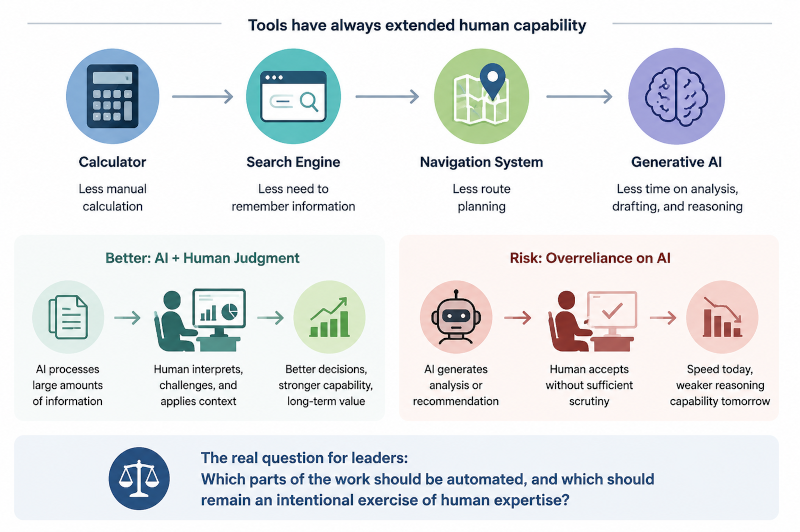
A software engineer may spend less time writing routine code and more time reviewing architecture and testing AI-generated solutions. An analyst may spend less time compiling information and more time determining whether an AI-generated interpretation is actually relevant to the business. A manager may receive a polished operational summary without having participated in the underlying analysis, increasing the importance of knowing which questions to ask before acting on it.
This is not simply a shift from manual work to automated work. It is a shift in where expertise is applied.
Microsoft’s research found that knowledge workers using generative AI described critical thinking as involving activities such as setting goals, refining prompts, verifying outputs against external information, and integrating responses with their own expertise. The researchers characterized this as a shift toward information verification, response integration, and task stewardship.
That suggests an important change in what organizations should mean by AI literacy.
Much of the early conversation focused on prompt engineering: how to formulate better instructions and get better answers. That remains useful, but it is only part of the capability required.
The more consequential skill is knowing when an answer deserves confidence.
That requires metacognition—the ability to monitor and regulate one’s own thinking. Recent research examining generative AI use has similarly connected effective use of these systems with shared metacognition and cognitive offloading.
In practical terms, employees need to know when to delegate, when to investigate further, and when their own domain knowledge should take precedence over an AI-generated response.
This changes the meaning of expertise. In an AI-enabled workplace, expertise may increasingly be less about knowing every piece of information and more about knowing which information matters, recognizing what is missing, and judging whether a conclusion is sound.
Recommendation: Redesign AI training around judgment and verification, using real work scenarios where employees must decide whether to accept, investigate, or reject an AI-generated output.
The Risk Leaders May Be Underestimating: Cognitive Debt
Technical debt accumulates when organizations make short-term technology decisions that create future costs. Process debt emerges when workarounds and exceptions gradually make processes harder to manage.
AI introduces a similar possibility: cognitive debt.
Cognitive debt is the gradual loss of organizational reasoning capability that can occur when efficiency repeatedly takes precedence over the development and maintenance of human expertise.
The risk is difficult to see because it may not appear in conventional performance measures. A team can become faster while becoming less capable of operating independently.
Consider a hypothetical finance organization that uses AI to produce monthly variance analysis. Initially, the change looks like an obvious success. Analysts spend less time preparing reports and more time discussing results. But over several years, new analysts may learn to interpret AI-generated explanations without developing the underlying financial reasoning that earlier employees acquired through doing the analysis themselves.
The organization has improved throughput, but some of its institutional expertise has moved into the AI system.
That creates a different kind of dependency. If the system changes, produces an incorrect interpretation, or becomes unavailable, the organization may discover that fewer people understand how to reconstruct the analysis independently.
Research on AI-supported learning offers a related warning. A 2025 review in Nature Reviews Psychology noted that performance gains from generative AI should not automatically be interpreted as evidence of learning or deeper cognitive development.
For businesses, the parallel is worth considering. Better output does not necessarily mean greater organizational capability.
This is particularly relevant to knowledge management. As discussed in SpirZon’s Why Organizational Memory Matters More Than Ever in the AI Era, organizations need more than repositories of information; they need mechanisms that preserve the knowledge required to operate and make decisions.
AI can strengthen that institutional memory, but it can also obscure where expertise resides if employees stop developing a direct understanding of the work.
Recommendation: For critical processes, identify the knowledge and reasoning employees must still be able to perform without AI assistance, and deliberately maintain those capabilities.
Automation Bias Is Becoming a Workflow Problem
The concern about overreliance on AI is often framed as a problem with users: people trust machines too much.
That explanation is incomplete.
The way an organization designs a workflow can make automation bias more or less likely.
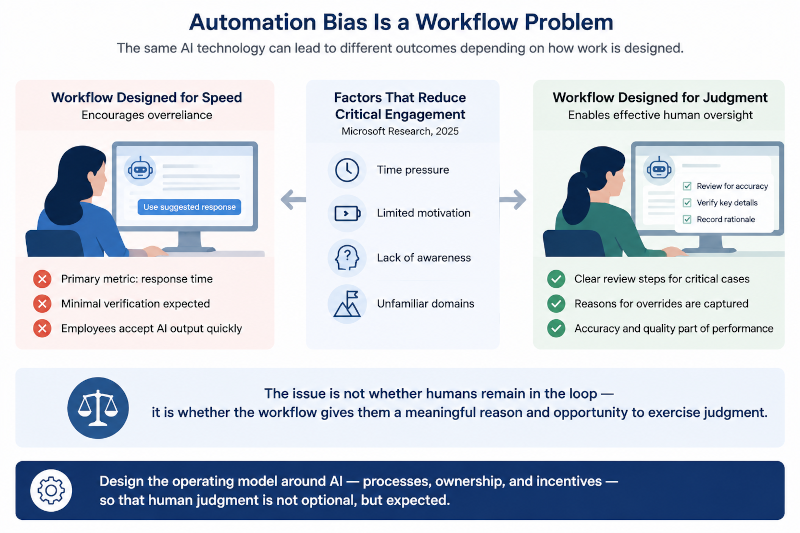
Imagine a customer service team using AI to recommend responses. If employees are measured primarily on response time, the incentives favor accepting the recommendation quickly. If the workflow instead requires verification for certain categories of customer requests and records the reasons for overrides, employees have both the opportunity and the expectation to exercise judgment.
The technology is the same. The operating model is different.
Microsoft’s 2025 study found that time pressure, limited motivation, lack of awareness, and difficulty working in unfamiliar domains can all inhibit critical engagement with AI outputs.
That finding has a direct implication for AI implementation. Asking employees to “review the AI” is not enough. If review adds significant time without being reflected in performance expectations, employees will naturally treat it as optional.
The issue is therefore not simply whether humans remain in the loop. It is whether the workflow gives them a meaningful reason and sufficient opportunity to exercise judgment.
This builds on the broader operational problem explored in SpirZon’s Why Your Automation Strategy Is Creating Operational Chaos: automation does not exist independently of the processes, ownership structures, and incentives around it.
Recommendation: Examine the performance measures surrounding AI-assisted work and make sure employees are rewarded for accurate judgment, not simply for accepting machine-generated output quickly.
AI Governance Needs a Human Dimension
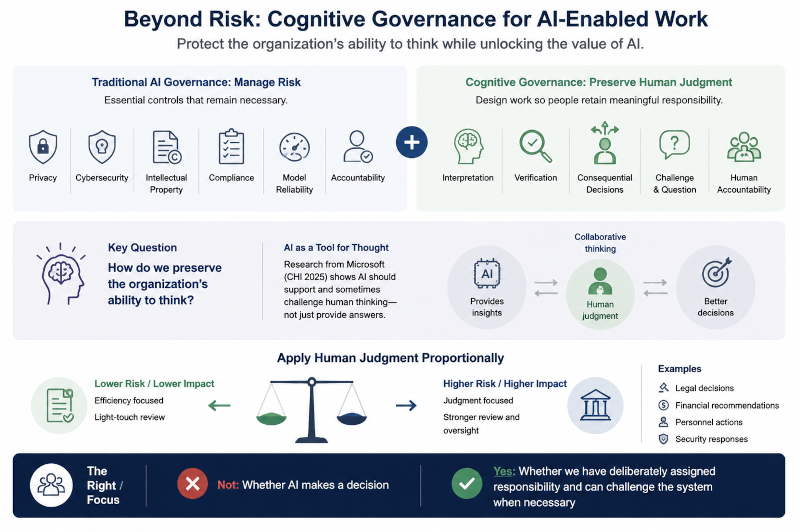
Most corporate AI governance programs understandably begin with risk: privacy, cybersecurity, intellectual property, compliance, model reliability, and accountability.
Those controls remain necessary. But as AI becomes embedded in knowledge work, another question deserves a place in the governance conversation:
How do we preserve the organization’s ability to think?
This is the idea behind cognitive governance.
Cognitive governance is not another compliance layer. It is a way of designing AI-enabled work so that humans retain meaningful responsibility for interpretation, verification, and consequential decisions.
The concept is consistent with a growing body of research exploring AI as a “tool for thought.” Microsoft Research’s work presented at CHI 2025 argues that AI systems should be designed not simply to provide answers but to support and sometimes challenge human thinking.
That distinction is important for enterprise adoption. The goal should not be to keep humans involved everywhere simply because a governance framework says “human in the loop.” It should be to determine where human judgment creates genuine value and then design the workflow around it.
For a low-risk administrative task, extensive review may add little value. For a legal decision, financial recommendation, personnel action, or security response, the standard should be very different.
The right question is therefore not whether AI makes a decision.
It is whether the organization has deliberately assigned responsibility for the decision and preserved the capability to challenge the system when necessary.
Recommendation: Add cognitive considerations to AI governance reviews by explicitly documenting decision ownership, required human judgment, verification expectations, and the consequences of an incorrect AI output.
Building Organizations That Think Better With AI
The most productive organizations of the AI era will not necessarily be those that automate the most work.
They may be the ones that understand where automation creates capacity and where it can quietly erode capability.
That requires a more mature view of AI adoption. The objective is not to preserve every traditional task in the name of human judgment, nor is it to automate every task that technology can perform. It is to redesign work around the complementary strengths of people and machines.
“The real AI advantage isn’t more capacity to produce. It’s more capacity to think.”
AI is particularly well suited to processing large amounts of information, generating alternatives, identifying patterns, and accelerating routine production. Humans remain responsible for context, accountability, interpretation, and decisions where consequences extend beyond the information immediately available to the system.
Research on human-AI collaboration has demonstrated that combined human and machine performance can exceed the performance of either alone, but the benefits depend on effective delegation. In other words, knowing when to rely on the machine—and when not to—is itself a capability.
That may ultimately be the most important organizational lesson.
AI does not make human judgment obsolete. It makes the quality of that judgment more consequential.
As machines take on more of the work involved in producing information, organizations will have to become more deliberate about developing the people who interpret it. The competitive advantage will belong not simply to companies with access to capable AI systems, but to those that know how to structure the relationship between machine output and human expertise.
The question facing leaders is therefore broader than how much productivity AI can deliver.
It is whether the organization will emerge from AI adoption with more capacity to think—or simply more capacity to produce.
Recommendation: Treat human judgment as an organizational capability that should be deliberately developed alongside AI adoption, rather than assuming it will remain intact as more cognitive work is delegated to machines.
3 thoughts on “AI Is Changing How We Think at Work: Why Organizations Need Cognitive Governance”