- Recommendations
- Knowledge Loss Is Becoming an Operational Risk
- Organizations Often Lose Context, Not Just Employees
- Fragmented Knowledge Systems Quietly Slow Organizations
- Training Alone Does Not Operationalize Knowledge
- AI Is Increasingly Exposing Weak Knowledge Systems
- Organizational Memory Requires Continuous Governance
- Organizational Memory Is Becoming Strategic Infrastructure
Recommendations
- Identify critical workflows that depend heavily on specific individuals rather than documented systems.
- Consolidate fragmented documentation into searchable, operationally maintained knowledge environments.
- Integrate knowledge capture directly into everyday workflows instead of relying on post-project documentation.
- Regularly audit outdated procedures, duplicate repositories, and inconsistent “sources of truth.”
- Design onboarding around real operational scenarios rather than isolated training modules.
- Treat organizational memory as operational infrastructure that requires continuous governance and maintenance.
Knowledge Loss Is Becoming an Operational Risk
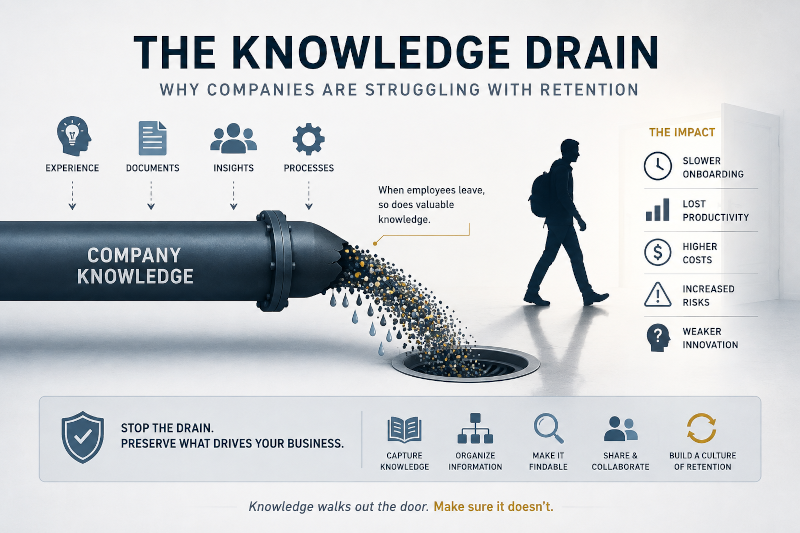
Most organizations still relegate knowledge loss to the HR department—a routine byproduct of retirements, restructures, and standard employee turnover.
But in the modern enterprise, the real danger isn’t people leaving. It is the gradual, structural erosion of operational context over time. When a key player exits, they don’t just take their job description; they take the invisible layer of institutional intelligence that actually makes the systems run.
In modern enterprises, the larger issue is not simply employee turnover. It is the gradual erosion of operational context that organizations fail to capture structurally over time.
In practice, organizations rarely lose only documented procedures. They lose the informal operational intelligence that keeps systems functioning smoothly:
- escalation judgment,
- undocumented workarounds,
- cross-functional coordination habits,
- troubleshooting intuition,
- historical decisions,
- and contextual understanding that employees accumulate through experience.
As organizations become more digitally interconnected, this hidden layer of operational knowledge increasingly determines how effectively work actually moves across the enterprise.
This challenge is becoming more visible as companies accelerate automation, remote work, outsourcing, AI adoption, and organizational restructuring simultaneously. Operational environments are evolving faster than many institutional knowledge systems can adapt.
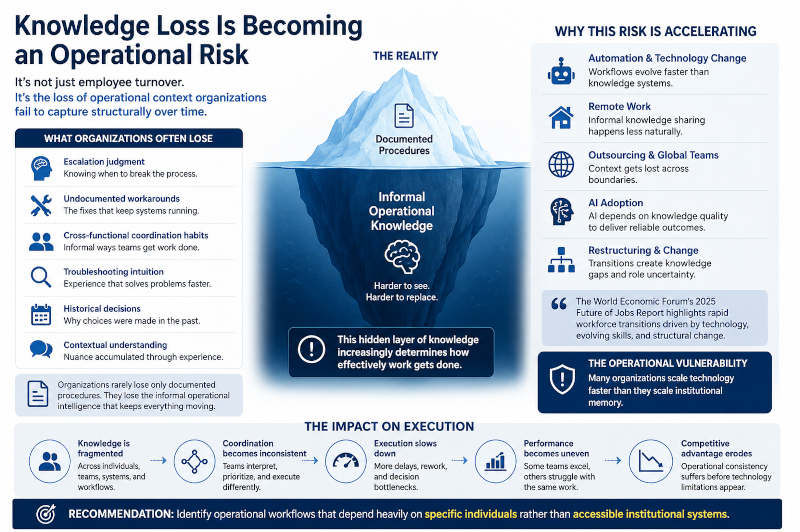
Research from the World Economic Forum’s 2025 Future of Jobs Report similarly noted that organizations are experiencing rapid workforce transition pressures driven by technological change, evolving skill requirements, and structural business transformation.
The result is a growing operational vulnerability:
many organizations scale technology faster than they scale institutional memory.
Increasingly, the organizations struggling most with execution consistency are not necessarily lacking talent. They are struggling because operational knowledge remains fragmented across individuals, teams, systems, and disconnected workflows.
This overlaps closely with broader operational coordination problems discussed previously in SpirZon’s analysis of How High-Performing Organizations Reduce Operational Friction, where fragmented systems and unclear workflows quietly reduced organizational execution speed long before technology limitations appeared.
Recommendation: Identify operational workflows that depend heavily on specific individuals rather than accessible institutional systems.
Organizations Often Lose Context, Not Just Employees
One of the biggest misconceptions surrounding organizational knowledge is the assumption that documentation alone captures how work operates.
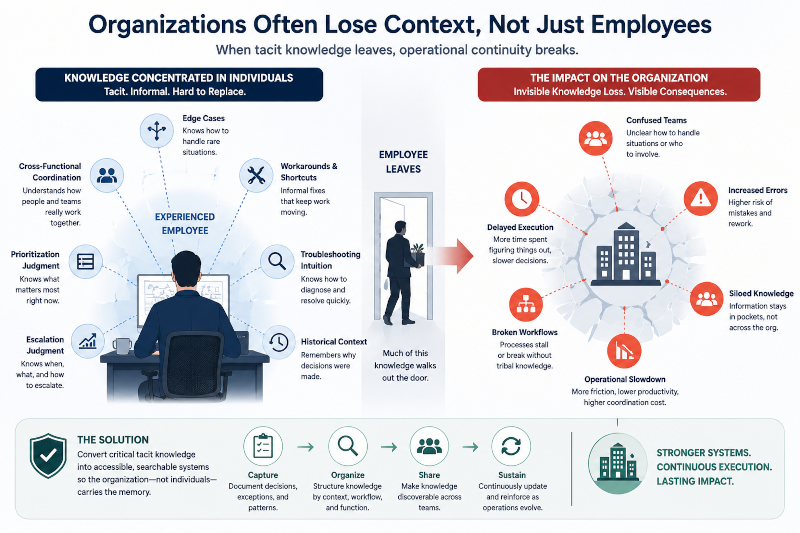
In reality, much of the most valuable operational knowledge is tacit rather than explicit.
Employees often develop informal systems for:
- resolving edge cases,
- coordinating across departments,
- prioritizing competing requests,
- escalating operational risks,
- and navigating workflow exceptions that rarely appear in formal documentation.
Over time, organizations unintentionally become dependent on these invisible coordination patterns.
This creates a fragile operational environment where execution quality depends heavily on individuals rather than systems.
The aerospace industry has confronted this issue repeatedly as experienced engineering and manufacturing personnel retire. Public reporting surrounding Boeing and broader aerospace workforce transitions has highlighted growing concerns around the loss of experienced institutional expertise, particularly in highly specialized operational environments where undocumented judgment and historical process knowledge remain difficult to replace quickly.
The problem is not simply technical skill loss. It is operational continuity loss.
Many organizations underestimate how much coordination knowledge exists only inside employee behavior rather than inside institutional systems.
This becomes especially dangerous during periods of rapid growth, restructuring, or leadership transition when organizations discover that critical workflows were never structurally operationalized in the first place.
Research from MIT Sloan Management Review increasingly emphasizes that organizational knowledge systems, workflow coordination, and retrieval quality are becoming critical operational capabilities as enterprises scale generative AI adoption.
Organizations that scale effectively usually reduce dependency on individual memory over time by converting high-value operational knowledge into accessible, searchable systems that other employees can apply consistently.
Recommendation: Capture recurring operational decisions, workflow exceptions, and troubleshooting patterns before they remain dependent on individual employees.
Fragmented Knowledge Systems Quietly Slow Organizations
Many organizations technically possess enormous amounts of institutional information.
The larger problem is fragmentation.
Operational knowledge is often scattered across:
- email threads,
- Slack channels,
- meeting recordings,
- PDFs,
- spreadsheets,
- SaaS platforms,
- onboarding materials,
- departmental repositories,
- and undocumented employee habits.
This creates what could be described as hidden knowledge systems: information exists, but employees cannot reliably locate, trust, or operationalize it efficiently.
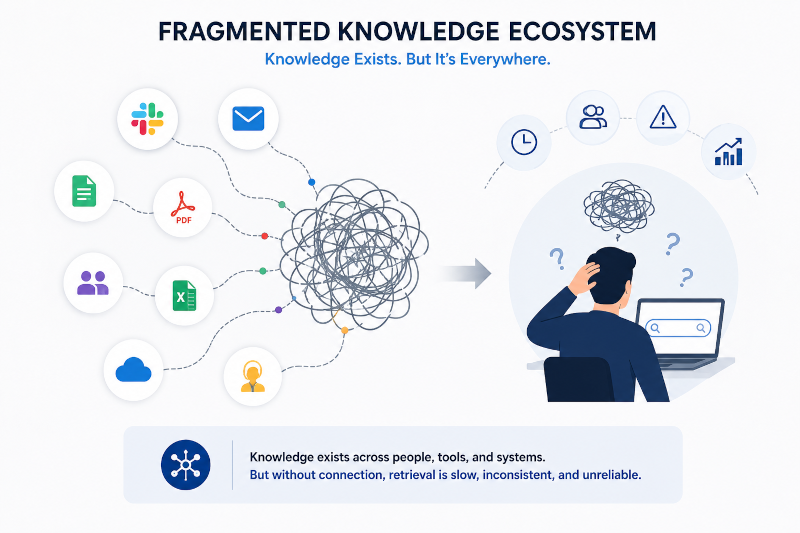
In practice, this creates substantial coordination overhead across the enterprise.
Employees spend time:
- searching for information,
- clarifying ownership,
- confirming outdated procedures,
- duplicating work,
- and validating conflicting “sources of truth.”
As organizations scale, these inefficiencies compound.
Research from Gartner has increasingly emphasized that poorly structured knowledge bases, fragmented information environments, and weak retrieval systems reduce employee effectiveness and undermine both human and AI-assisted knowledge management environments. This challenge becomes even more important as organizations deploy AI copilots, enterprise search systems, and retrieval-augmented AI workflows. AI systems depend heavily on retrieval quality, and when organizational knowledge remains fragmented, AI outputs often inherit those same inconsistencies.
This issue connects directly with SpirZon’s earlier analysis in Why Organizational Memory Matters More Than Ever in the AI Era, where fragmented operational memory systems increasingly weakened AI reliability, retrieval quality, and enterprise coordination.
The operational consequence is significant: organizations increasingly lose time reconstructing knowledge that already exists somewhere inside the enterprise.
Recommendation: Consolidate fragmented repositories into searchable systems with clear ownership and continuously maintained operational standards.
Training Alone Does Not Operationalize Knowledge
Many organizations attempt to solve knowledge gaps through expanded training programs.
The problem is rarely training volume itself. The larger issue is whether knowledge transfers successfully into operational execution environments.
Employees often complete onboarding programs, certification courses, workshops, or learning modules successfully while still struggling to apply that information consistently inside real workflows.
This disconnect emerges because operational environments contain:
- exceptions,
- dependencies,
- competing priorities,
- informal coordination patterns,
- and contextual decisions that standardized training rarely captures fully.
As a result, organizations frequently create environments where employees understand processes conceptually but cannot execute them consistently under operational pressure. Research examining workplace learning transfer increasingly shows that operational support systems, workflow reinforcement, and knowledge-sharing environments strongly influence whether training translates into real-world execution behavior.
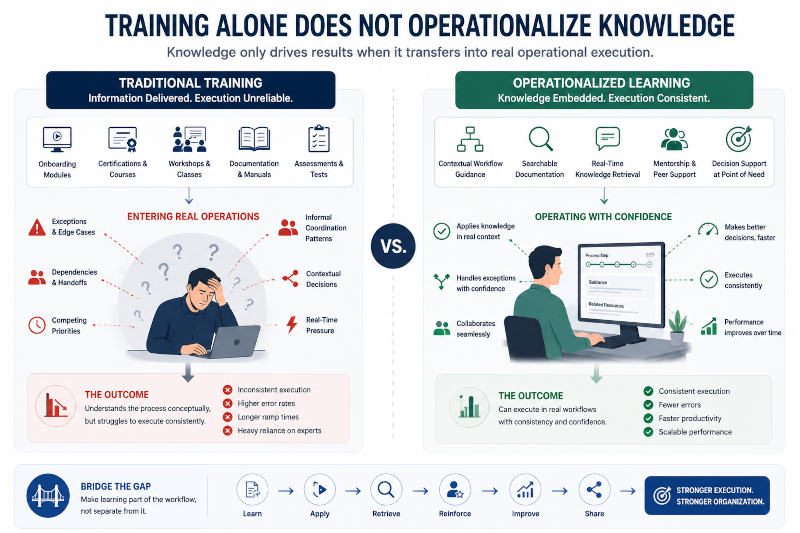
High-performing organizations increasingly recognize that training alone is insufficient unless operational systems reinforce knowledge continuously during execution itself.
This often includes:
- contextual workflow guidance,
- embedded operational documentation,
- real-time knowledge retrieval,
- mentorship integration,
- and systems that support decision-making at the point of need.
The strongest organizations increasingly treat learning as part of workflow architecture rather than a separate activity disconnected from operations.
Recommendation: Design onboarding and training around real operational scenarios, workflow exceptions, and live execution environments rather than isolated information delivery.
AI Is Increasingly Exposing Weak Knowledge Systems
Artificial intelligence is making organizational knowledge problems far more visible.
Many organizations initially assumed AI systems would compensate for fragmented documentation, inconsistent processes, and disconnected operational knowledge automatically.
In practice, AI often amplifies those weaknesses instead.
Enterprise AI systems increasingly depend on:
- retrieval quality,
- searchable documentation,
- structured terminology,
- governance consistency,
- and reliable institutional memory.
When operational knowledge remains fragmented, outdated, or poorly governed, AI systems frequently generate inconsistent outputs, inaccurate retrieval, or unreliable recommendations.
This is one reason many organizations are discovering that AI readiness depends less on model sophistication and more on organizational knowledge quality itself.
Research from McKinsey’s 2025 State of AI report similarly noted that organizations achieving the strongest AI outcomes often invest heavily in workflow redesign, governance structures, and knowledge architecture rather than focusing exclusively on model deployment.
The issue is increasingly operational rather than technical.
Organizations deploying AI without improving organizational memory systems may simply scale confusion faster.
This overlaps directly with SpirZon’s earlier discussion in How AI Is Reshaping Human Cognitive Work, where AI systems increasingly redistributed cognitive effort toward verification, oversight, contextual interpretation, and operational judgment.
As AI becomes more embedded into enterprise workflows, organizational memory is gradually transforming from passive documentation into active operational infrastructure.
Recommendation: Audit outdated documentation, inconsistent terminology, and fragmented retrieval systems before scaling AI initiatives broadly.
Organizational Memory Requires Continuous Governance
One of the most common organizational mistakes is treating knowledge management as a one-time initiative rather than an ongoing operational discipline. A repository gets created, documentation is uploaded, processes are recorded, and training materials are published. But while those systems remain relatively static, operational environments continue evolving through new workflows, reorganizations, technology changes, and shifting business priorities.
Over time, even well-designed knowledge environments gradually become fragmented, outdated, and less reliable if they are not actively maintained. This creates what could be described as documentation debt: a growing gap between how operations actually function and how institutional systems describe them.
Large technical organizations have increasingly confronted this challenge directly. NASA has publicly discussed long-term efforts around institutional knowledge preservation, particularly in highly specialized operational environments where mission-critical expertise can disappear across generations of engineers, contractors, and program transitions.
The challenge is not simply storing information. It is preserving operational continuity over time.
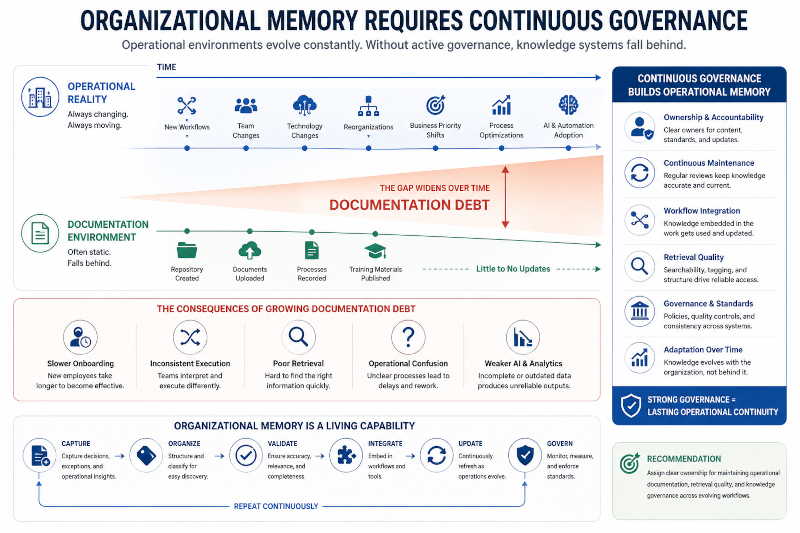
High-performing organizations increasingly treat organizational memory as a living operational capability requiring:
- governance,
- maintenance,
- workflow integration,
- ownership clarity,
- and continuous adaptation.
This is one reason many enterprises are now establishing dedicated knowledge operations functions responsible for retrieval quality, operational documentation standards, searchability, and institutional coordination across systems.
Increasingly, organizational memory is becoming part of enterprise infrastructure itself.
Recommendation: Assign clear ownership for maintaining operational documentation, retrieval quality, and knowledge governance across evolving workflows.
Organizational Memory Is Becoming Strategic Infrastructure
As organizations become more digital, interconnected, and AI-assisted, institutional knowledge is becoming increasingly strategic.
The companies operating most effectively at scale are often not the ones with the largest amount of information, but the ones that operationalize knowledge most effectively across workflows, systems, and teams. This increasingly shapes onboarding speed, execution consistency, operational resilience, AI reliability, decision quality, and organizational adaptability across the enterprise. In many organizations, competitive advantage no longer comes simply from possessing expertise itself, but from making that expertise structurally accessible across the organization rather than allowing it to remain isolated within individuals or disconnected teams.
“Organizations scale more effectively when institutional knowledge becomes infrastructure rather than tribal memory.”
Organizations that continue relying heavily on informal coordination and tribal knowledge may increasingly struggle as operational complexity expands.
Organizations that design strong institutional memory systems, however, often gain compounding advantages over time because operational learning becomes reusable rather than repeatedly reconstructed.
In the modern enterprise environment, organizational memory is no longer simply administrative documentation. It is increasingly an operational infrastructure for scalable execution, coordination, and organizational intelligence.
Recommendation: Treat organizational memory as a long-term operational capability that directly influences scalability, resilience, and execution quality across the enterprise.
6 thoughts on “Why Organizational Knowledge Disappears Faster Than Companies Realize”