As we move into 2026, the priority for IT has shifted from “trying out AI” to building a Hybrid Intelligence workforce. This means humans and AI “agents” working side-by-side as a unified team.
Here is a guide for the 2026 workforce, with immediate actions you can take to stay ahead.
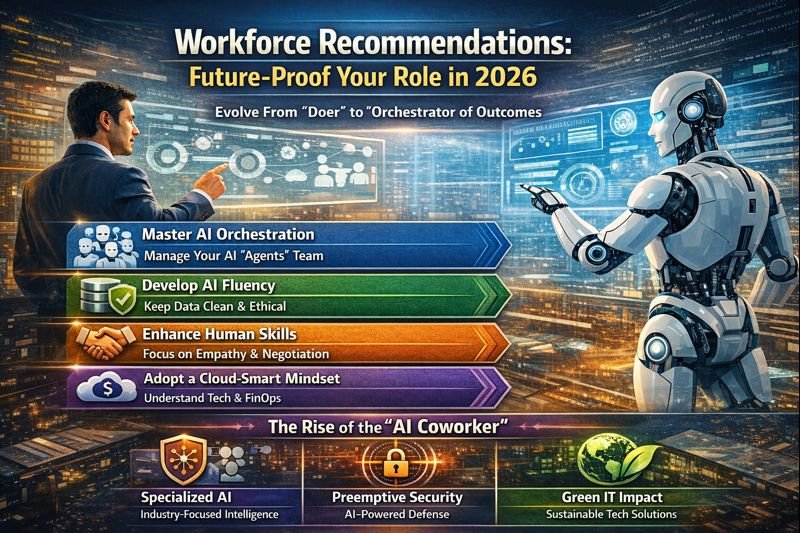
Workforce Recommendations: How to Future-Proof Your Role
If you want to be indispensable in 2026, you must evolve from a “doer” of tasks to an “orchestrator” of outcomes.
- Master AI “Orchestration” (AgenticOps): Don’t just learn to chat with AI; learn to manage “Agents.” In 2026, you will likely oversee a digital “pit crew” of agents that handle routine data, scheduling, and reporting. Your value is in setting their goals and checking their work.
- Develop “AI Fluency”: Employers are no longer looking for basic prompt engineering; they want people who understand data health. If you can help your department keep its data clean, secure, and ethical, you will be the most valuable person in the room.
- Double Down on “Human-Only” Skills: As machines take over technical “hard skills” like basic coding or data crunching, “soft skills” have become the new high-income skills. Focus on Empathy, Ethical Judgment, and Complex Negotiation. * Adopt a “Cloud-Smart” Mindset: Stop thinking that the “Cloud” is a magic fix. Learn the basics of FinOps (the financial side of IT). Being the person who knows how to save the company money by choosing the right tech environment is a major career booster.
The Big 2026 Trends: From Hype to Reality
1. The Rise of the “AI Coworker”
The most overarching trend is Connected Intelligence. We’ve moved beyond standalone apps. AI is now embedded into every workflow. By 2026, we aren’t just using AI; we are partnering with it. Digital workers (agents) now handle the “background noise” of work—like summarizing meetings or predicting supply chain gaps—so humans can focus on strategy.
2. Domain-Specific Intelligence
Generic AI is being replaced by specialized models. Companies in 2026 are using AI trained specifically for their industry (e.g., Legal, Healthcare, or Manufacturing). This means the “one-size-fits-all” approach is dead; deep industry knowledge is back in high demand.
3. Preemptive Cybersecurity
Hackers are using AI to craft perfect phishing emails and bypass old security. In response, IT has shifted to preemptive defense. Systems now use AI to “predict” an attack before it happens. For the workforce, this means Zero Trust—expecting to verify your identity every time you access data, regardless of where you are working.
4. The “Green IT” Mandate
Computing power isn’t free—it costs energy. In 2026, managers are being held accountable for the “carbon footprint” of their AI use. Choosing “Green Computing” and efficient code is no longer just a “nice-to-have”; it’s a business necessity to meet global energy regulations.
5. The “Middle Management” Evolution
With AI handling the routing of information and basic reporting, the role of the manager is changing. Managers in 2026 spend less time “checking in” and more time coaching, protecting the team’s culture, and making ethical calls that AI cannot.