Recommendations
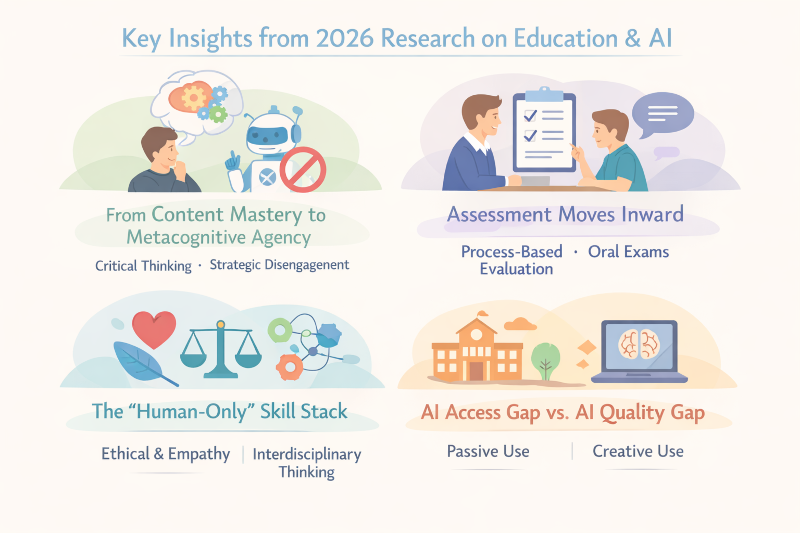
- Redesign learning environments around reasoning quality, critical evaluation, and metacognitive engagement rather than memorization alone.
- Introduce learning activities that require students to explain reasoning, defend conclusions, and evaluate AI-generated outputs rather than simply submitting final answers.
- Evaluate learning through reasoning demonstrations, iterative drafts, and verbal explanation rather than relying exclusively on static final submissions.
- Build educational programs around judgment quality, interdisciplinary reasoning, and critical evaluation rather than procedural repetition alone.
- Teach students to use AI as a collaborative reasoning tool rather than a shortcut for bypassing cognitive engagement entirely.
Education is undergoing a structural transformation that goes far beyond digital classrooms or AI-powered tutoring tools. As artificial intelligence becomes capable of generating essays, solving technical problems, summarizing research, and answering complex questions instantly, the purpose of education itself is beginning to shift.
For decades, most education systems focused heavily on information acquisition and content mastery. Students were evaluated based on how effectively they could memorize material, reproduce knowledge, and follow established procedures. That model developed during an era when information was relatively scarce and retrieval was slow.
Today, information is abundant. What has become scarce is sustained reasoning.
AI systems can now generate coherent explanations, draft assignments, solve coding problems, translate languages, and provide step-by-step guidance across subjects within seconds. This changes the role of both teachers and learners. The emerging challenge is no longer simply helping students access knowledge. It is helping them remain cognitively engaged while surrounded by systems capable of thinking alongside them.
Research from UNESCO’s AI and Education initiative similarly emphasizes that AI integration must remain human-centered and focused on preserving critical thinking, inclusion, and human agency rather than automating learning passively.
This creates a major transition in educational philosophy. The future of education may depend less on how much information students can retain independently and more on how effectively they can reason, evaluate, synthesize, and think critically while collaborating with intelligent systems.
This overlaps closely with themes explored previously in Mind vs. Machine: How AI Is Reshaping Human Thinking and Memory, where AI systems were discussed not simply as productivity tools, but as cognitive environments capable of reshaping attention, memory, reasoning, and decision-making patterns over time.
Recommendation: Redesign learning environments around reasoning quality, critical evaluation, and metacognitive engagement rather than memorization alone.
From Memorizing Information to Managing Thinking
One of the clearest educational shifts underway involves the growing importance of metacognition — the ability to understand, regulate, and evaluate one’s own thinking process.
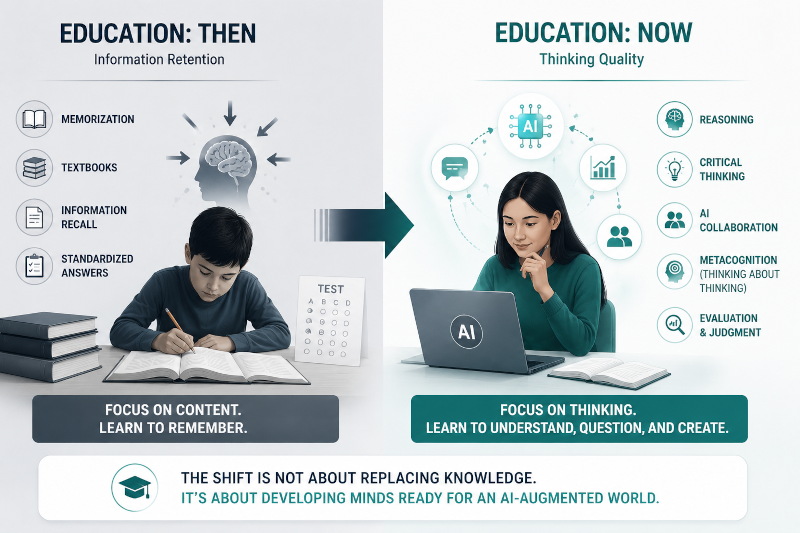
This matters because AI systems now reduce much of the cognitive friction historically associated with learning. Students can generate explanations, summarize material, solve equations, or produce structured essays almost instantly. While this can improve accessibility and efficiency, it also changes how learners engage with the thinking process itself.
Research published in Frontiers in Artificial Intelligence during 2024 argued that educators should use generative AI to strengthen critical thinking and human interaction rather than allowing AI systems to replace reasoning processes directly.
As a result, many educators are beginning to focus less on whether students can produce answers and more on whether they can explain:
- how they arrived at conclusions,
- how they evaluated information,
- what assumptions shaped their reasoning,
- and when AI-generated outputs should be questioned.
This introduces an increasingly important educational concept: intentional cognitive friction.
In traditional educational models, friction was often viewed negatively because it slowed learning speed. In AI-assisted environments, however, some degree of cognitive effort may become essential for maintaining reasoning capability itself.
A growing body of research examining AI-assisted learning environments suggests that excessive cognitive outsourcing can weaken critical engagement if students rely too heavily on AI-generated solutions without independent evaluation.
This does not mean AI should be removed from classrooms. More often, it means students must learn when to rely on AI systems and when deliberate reasoning remains necessary for deeper understanding.
Some universities are already adapting accordingly. Faculty across multiple institutions have begun redesigning assignments around iterative reasoning, reflection, and oral explanation rather than final written outputs alone. The goal is no longer simply producing correct answers. It is preserving active engagement with the reasoning process behind them.
Recommendation: Introduce learning activities that require students to explain reasoning, defend conclusions, and evaluate AI-generated outputs rather than simply submitting final answers.
The Shift in How Learning Is Assessed
AI is also transforming how educational systems measure understanding.
Traditional homework models assumed that students completed assignments independently and demonstrated their own reasoning through written outputs. Generative AI challenges those assumptions directly because systems can now produce highly polished essays, summaries, coding solutions, and research explanations almost instantly.
As a result, many schools and universities are reevaluating how assessment itself should function.
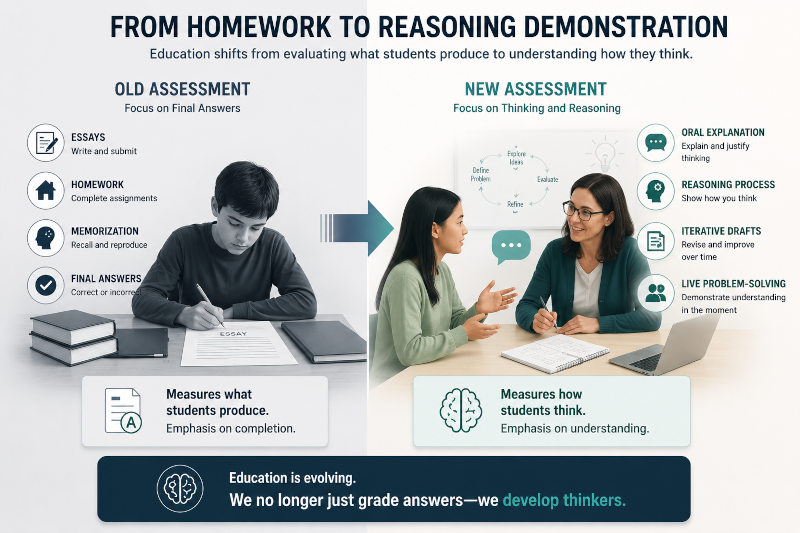
Rather than focusing exclusively on final outputs, educators are beginning to evaluate:
- revision processes,
- reasoning pathways,
- iterative drafts,
- oral explanations,
- collaborative problem-solving,
- and in-person demonstrations of understanding.
This shift is already visible in higher education. Some professors now require students to explain their reasoning verbally after submitting AI-assisted assignments. Others use live problem-solving exercises, in-class writing, or reflective analysis designed to reveal how students think rather than how effectively they can generate polished submissions.
Research examining AI-assisted critical thinking similarly suggests that educational systems may need to redesign Bloom’s Taxonomy and other traditional learning frameworks to account for AI-supported reasoning environments.
This creates a broader philosophical shift: education may become less focused on information reproduction and more focused on reasoning transparency.
The challenge is not simply detecting AI-generated work. It is ensuring students remain cognitively active participants in the learning process itself.
This also overlaps with operational concerns discussed previously in Why Employees Circumvent Security Policies, where workflow environments unintentionally encouraged passive behavior and shortcut-driven decision-making when systems prioritized speed over engagement.
Educational systems may now face a similar challenge at cognitive scale.
Recommendation: Evaluate learning through reasoning demonstrations, iterative drafts, and verbal explanation rather than relying exclusively on static final submissions.
The Emerging Human Skill Stack
As AI systems absorb larger portions of routine cognitive work, the value of distinctly human capabilities is becoming more visible across both education and workforce development.
The World Economic Forum’s Shaping the Future of Learning report emphasized that future-ready education systems must prioritize analytical thinking, creativity, collaboration, emotional intelligence, and complex problem-solving as AI becomes integrated into everyday work environments.
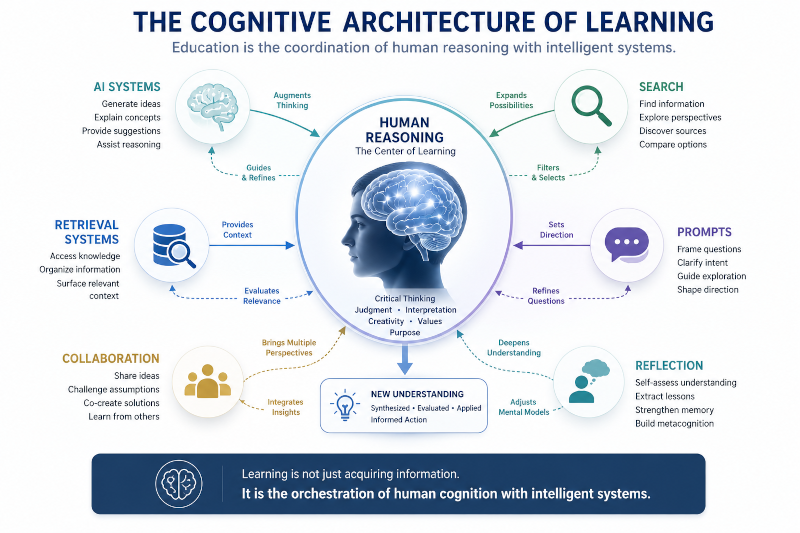
This is changing how educators think about “high-value skills.”
For years, educational systems rewarded procedural correctness and efficient information processing. AI now performs many of those tasks exceptionally well. Human value therefore shifts toward capabilities involving:
- interpretation,
- ambiguity management,
- ethical reasoning,
- contextual judgment,
- interdisciplinary synthesis,
- and independent evaluation.
This becomes especially important because AI systems still struggle in areas involving nuanced context, conflicting human priorities, ethical tradeoffs, and highly ambiguous real-world conditions.
Research from cognitive science and AI metacognition scholars similarly argues that future human-AI collaboration depends heavily on metacognitive skills such as recognizing uncertainty, evaluating limitations, considering multiple perspectives, and regulating reasoning processes intentionally.
In practical terms, this means education may evolve from:
- teaching students primarily how to produce answers,
toward: - teaching students how to evaluate, question, integrate, and refine machine-generated information critically.
Some education systems are already experimenting with AI literacy programs focused not merely on prompt engineering, but on judgment quality, source evaluation, verification, and reflective reasoning.
This shift may eventually reshape workforce development itself. The highest-value employees in AI-assisted environments may not necessarily be the individuals producing the largest quantity of outputs, but the individuals capable of navigating ambiguity while maintaining strong reasoning and interpretive judgment.
Recommendation: Build educational programs around judgment quality, interdisciplinary reasoning, and critical evaluation rather than procedural repetition alone.
The New Digital Divide Is Cognitive
One of the most important educational changes underway involves the emergence of a new form of inequality.
Historically, digital divides focused primarily on access:
- access to computers,
- internet infrastructure,
- software,
- or educational resources.
AI introduces a more complicated divide centered around cognitive behavior.
Some students now use AI systems as reasoning partners. They ask iterative questions, challenge outputs, refine ideas, compare perspectives, and deepen understanding collaboratively.
Others use AI primarily as answer-generation systems that reduce engagement with the learning process itself.
The difference between these approaches may become extremely significant over time.
Research examining AI-enhanced learning environments suggests that guided AI use supporting reflection and metacognitive engagement often produces stronger outcomes than passive dependency on machine-generated answers.
This creates a growing distinction between:
- passive AI consumption,
and: - active AI collaboration.
The implications extend far beyond classrooms.
Students who learn to use AI critically may strengthen reasoning, synthesis, and problem-solving capabilities. Students who rely on AI passively may gradually weaken independent evaluation skills over time.
This challenge mirrors themes explored previously in The Silent Productivity Killer: How Knowledge Managers Give You Your Time Back, where retrieval systems and operational environments shaped how individuals interacted with information itself.
“Students who use AI as a thinking partner may strengthen cognitive capability. Students who use it only for answers may gradually weaken independent reasoning over time.”
Educational systems now face a similar question: how do humans remain cognitively active inside environments optimized for convenience and automation?
The answer may shape the future of learning more than AI capability alone.
Recommendation: Teach students to use AI as a collaborative reasoning tool rather than a shortcut for bypassing cognitive engagement entirely.
Conclusion: Education Is Becoming a Cognitive Training System
The transformation of education is not simply about integrating artificial intelligence into classrooms.
It is about redefining what it means to learn in environments where information is abundant, automation is constant, and intelligent systems participate directly in reasoning processes themselves.
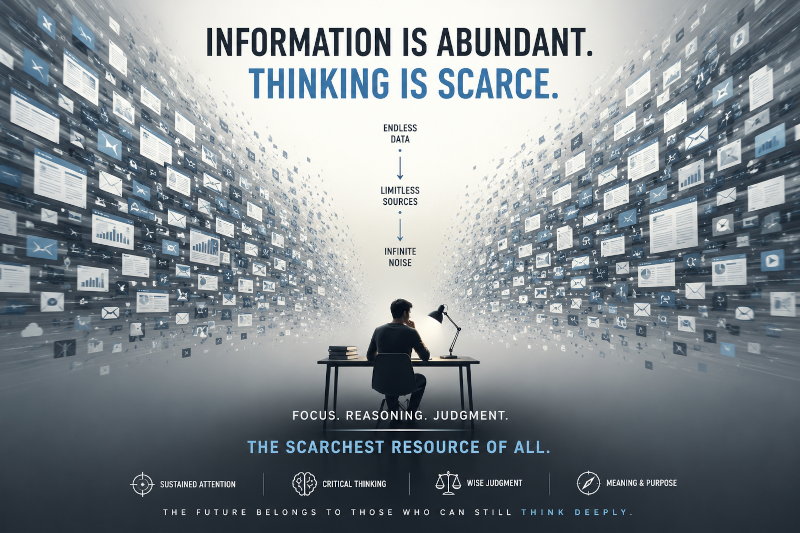
The future of education may depend less on how much information students can store independently and more on whether they preserve the ability to:
- reason deeply,
- evaluate critically,
- sustain attention,
- tolerate cognitive friction,
- and think independently while collaborating with AI systems.
Artificial intelligence will almost certainly become embedded across education systems, workplaces, research environments, and creative industries. The critical question is no longer whether students will rely on AI. They will.
The more important question is whether education systems continue developing humans capable of questioning machine-generated outputs rather than passively accepting them.
In many ways, the future of learning may ultimately become a balance between cognitive assistance and cognitive resilience.
The defining challenge of the AI era may not simply be teaching students how to use intelligent systems effectively. It may be preserving the human capacity for independent reasoning inside environments increasingly optimized to think on our behalf.