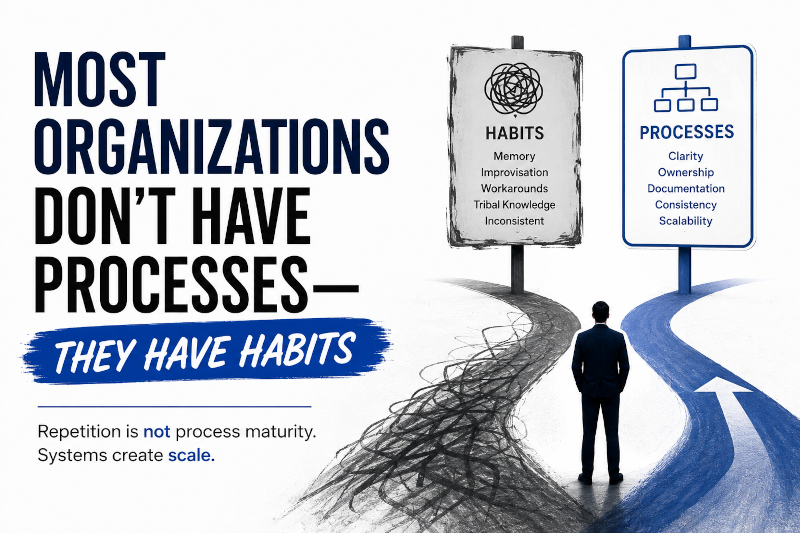
Most Organizations Don’t Have Processes — They Have Habits

Recommendations Many organizations believe they operate through structured processes. In reality, many operate through repeated habits that happen to work well enough under stable conditions. Work gets completed because certain employees remember what to do, experienced managers know who to contact, teams improvise around gaps quietly, and institutional memory compensates for missing operational clarity. This … Read more

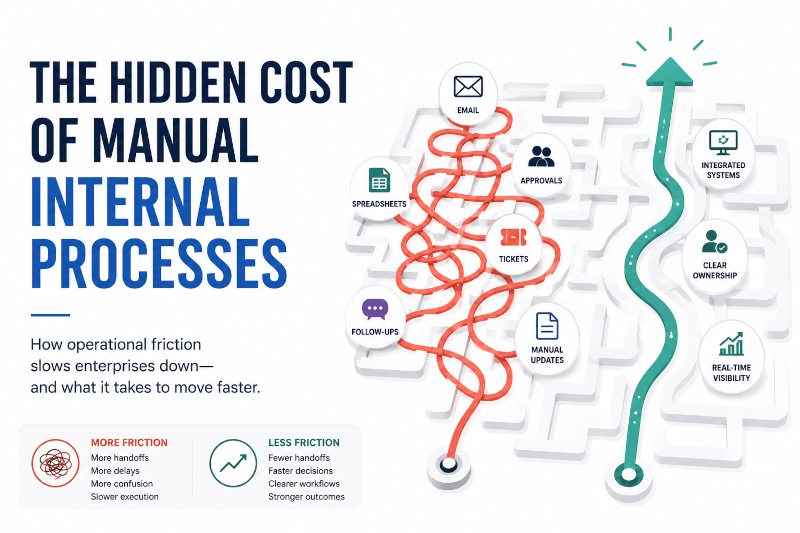
The Hidden Cost of Manual Internal Processes

Recommendations Manual Internal Processes Quietly Shape Enterprise Performance Most organizations still think about manual internal processes primarily as productivity inefficiencies. Employees spend time updating spreadsheets, chasing approvals, forwarding emails, reconciling systems, copying data between platforms, or coordinating work through fragmented communication channels. These tasks are often treated as operational inconveniences rather than structural business risks. … Read more

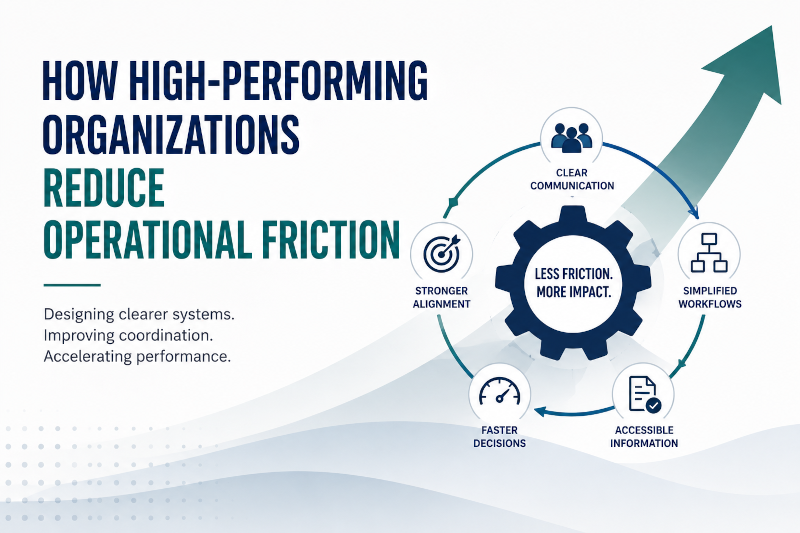
How High-Performing Organizations Reduce Operational Friction

Most organizations are not slowed by one catastrophic operational failure. They are slowed by accumulated friction. A delayed approval.An unclear workflow.A missing document.An unnecessary meeting.A decision waiting three days for validation.A process that requires employees to navigate six disconnected systems to complete one task. Individually, these inefficiencies may appear minor. Collectively, they create operational drag … Read more

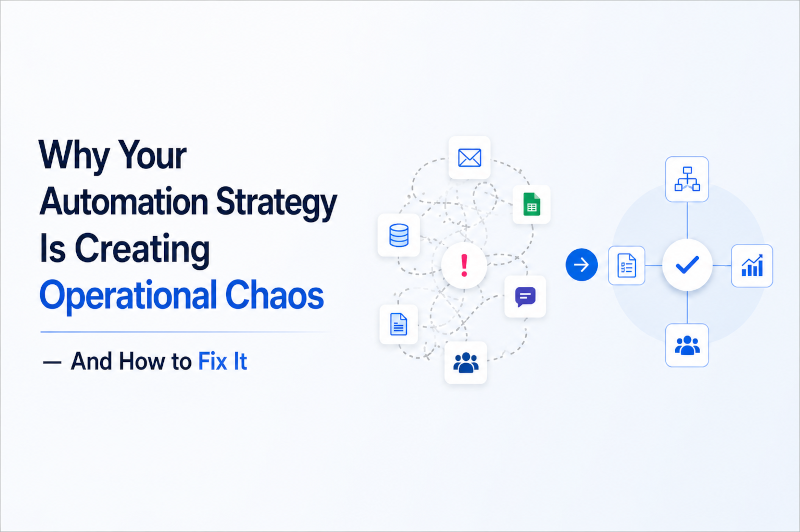
Why Your Automation Strategy Is Creating Operational Chaos — And How to Fix It

Most organizations are not suffering from a lack of automation. They are suffering from fragmented operational systems. Over the last decade, companies have aggressively invested in workflow automation technologies designed to improve productivity, reduce manual work, and accelerate business operations. From robotic process automation (RPA) and SaaS integrations to AI-powered assistants and workflow engines, automation … Read more

Nobody Knows How This Automation Works

Recommendations Automation is often sold as the cure for operational dependency. Build the workflow once, remove manual effort, and let the system run consistently at scale. In theory, automation reduces risk because work no longer depends on tribal knowledge or individual heroics. Yet in many organizations, the opposite has happened. Critical automations now run payroll … Read more

How to Fix Broken Automation: Aligning Workflows with Reality

Recommendations Automation promises something every organization wants: faster execution, lower costs, fewer errors, stronger controls, and greater operational consistency. Business cases often assume that once a workflow is automated, inefficiency disappears. Approvals become streamlined, handoffs become predictable, and manual effort declines. Yet many organizations discover a different reality after implementation. The workflow becomes automated, but … Read more

The Rise of the Autonomous IT Department

For years, IT departments have operated in reactive mode. Systems fail, tickets pile up, alerts fire, and teams scramble to restore service before the business feels the impact. Even with modern monitoring tools and automation platforms, much of enterprise IT still depends on human intervention to diagnose issues, execute fixes, approve workflows, and coordinate across … Read more

Why Onboarding Automation Fails: Fixing the New Hire Confusion Gap

Why poorly designed onboarding workflows are hurting employee experience, productivity, and retention Employee onboarding was supposed to become easier. Automation promised a smoother first day, faster account setup, digital paperwork, equipment requests, scheduled training, and a more scalable hiring process. HR teams could save time, IT teams could standardize provisioning, and managers could focus on … Read more

We Automated Ticketing… and Now Everything Is “High Priority”

Alert fatigue, broken prioritization, and why your ITSM tool may be making response times worse. Automation was supposed to fix service management. Faster ticket routing. Smarter categorization. Better SLAs. Less manual triage. Instead, many IT teams ended up with a new problem: every alert, incident, and request is now marked “high priority.” When everything is … Read more

Everyone Agreed to the Change—Then Nothing Actually Changed

Recommendations Why Stakeholder Alignment in Meetings Often Fails in Real Execution The meeting went perfectly. Leaders aligned. Stakeholders nodded. Concerns were addressed. The presentation was approved. Action items were assigned. Everyone left the room confident that the transformation initiative was moving forward. Then nothing happened. No meaningful adoption. No sustained behavior change. No measurable shift … Read more