- What Automation Actually Solves
- The Limits of Isolated Automation
- What Orchestration Means Operationally
- Workflow Fragmentation Creates Hidden Operational Complexity
- Human-in-the-Loop Systems Remain Critical
- Cross-Platform Coordination and Operational Visibility
- Building Scalable Operational Ecosystems
- The Future of Operational Orchestration
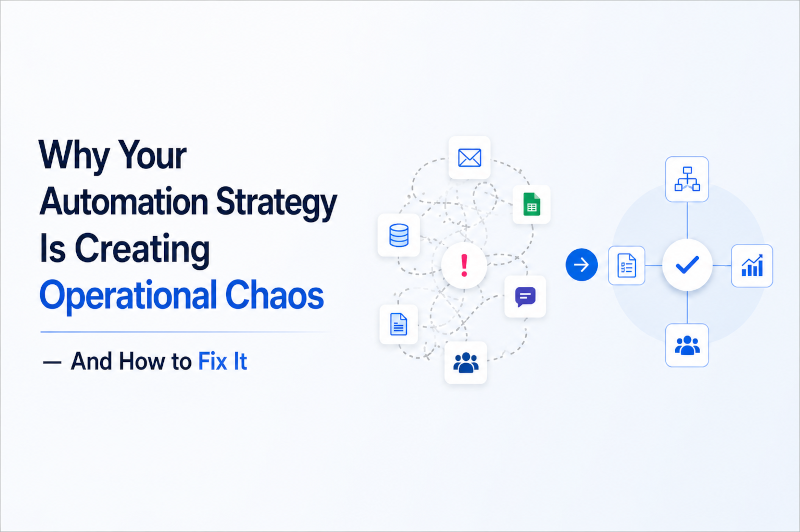
Most organizations are not suffering from a lack of automation.
They are suffering from fragmented operational systems.
Over the last decade, companies have aggressively invested in workflow automation technologies designed to improve productivity, reduce manual work, and accelerate business operations. From robotic process automation (RPA) and SaaS integrations to AI-powered assistants and workflow engines, automation has become one of the defining operational priorities of the modern enterprise.
According to research from the McKinsey Global Institute, approximately 60% of occupations contain at least 30% technically automatable activities using existing technologies, highlighting the growing operational impact of automation across modern enterprises.
Yet despite rapid automation adoption, many organizations continue struggling with operational bottlenecks, fragmented workflows, disconnected systems, poor visibility, duplicated processes, and increasing coordination complexity.
The reason is that many organizations mistake automation for operational transformation.
In reality, automating isolated tasks does not automatically create scalable operational systems. In many cases, companies simply accelerate fragmented workflows rather than improving organizational coordination itself.
This is the difference between automation and orchestration.
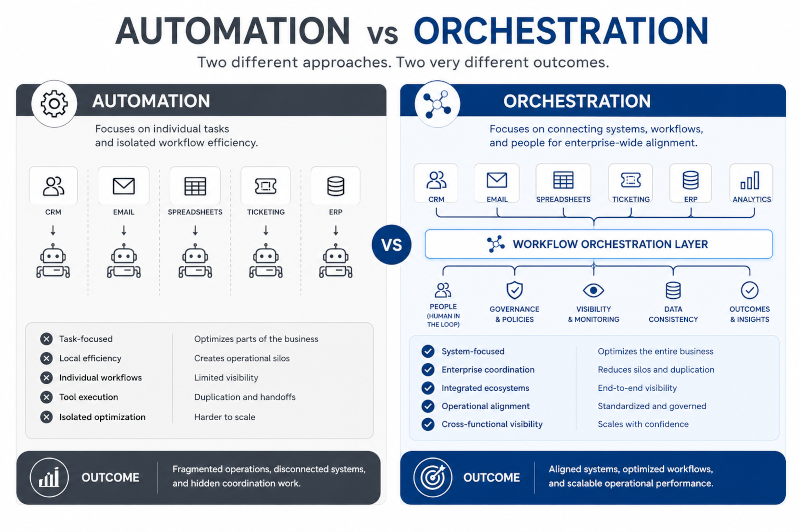
Automation focuses on individual tasks.
Orchestration focuses on coordinated systems.
Organizations that fail to understand this distinction often improve local efficiency while simultaneously increasing global operational complexity.
What Automation Actually Solves
Automation is extremely valuable when applied correctly.
At its core, automation reduces repetitive manual work by allowing systems to execute predefined actions automatically. These actions may include routing tickets, generating reports, synchronizing data, triggering notifications, processing approvals, or updating records between platforms.
Studies from the McKinsey Global Institute have consistently shown that automation technologies can significantly reduce repetitive administrative workload while improving operational consistency and execution speed across structured business processes.
This explains why automation has become foundational to modern operational strategy. Organizations implementing automation effectively often experience:
- faster execution speeds,
- reduced administrative overhead,
- lower error rates,
- and improved process consistency.
However, automation alone does not solve broader organizational coordination problems.
Many organizations successfully automate tasks while simultaneously creating disconnected operational ecosystems underneath.
The Limits of Isolated Automation
One of the most common operational mistakes organizations make is automating workflows without understanding how those workflows interact across the broader enterprise.
As departments independently adopt automation tools, organizations frequently accumulate:
- disconnected systems,
- fragmented approval structures,
- duplicated automation logic,
- inconsistent workflows,
- and siloed operational processes.
The result is often a patchwork of isolated automations rather than a coordinated operational environment.
Local efficiency does not necessarily create systemic efficiency.
A workflow may become faster inside one department while simultaneously increasing downstream operational friction for another team operating within a completely different system.
Organizational systems theory has long emphasized that optimizing individual components in isolation does not automatically improve the performance of the larger system itself. Daniel Katz and Robert Kahn’s foundational work on organizations as open systems argued that organizational effectiveness depends heavily on coordination, interdependence, and the continuous interaction between operational subsystems and the broader environment.
Operational complexity becomes especially dangerous when organizations underestimate how interconnected modern systems have become. In 2017, a routine maintenance operation inside Amazon Web Services triggered a major AWS S3 outage after an incorrect command unintentionally removed more server capacity than expected, disrupting large portions of the internet for several hours. Amazon later acknowledged that the incident exposed weaknesses in operational safeguards, visibility, and system coordination within highly automated environments.
This challenge has accelerated dramatically with the expansion of enterprise SaaS ecosystems. Organizations now operate across increasingly complex combinations of:
- project management platforms,
- ticketing systems,
- communication tools,
- ERP environments,
- analytics dashboards,
- CRM systems,
- and AI-enabled applications.
Without operational coordination, these systems often evolve independently rather than as part of a unified operational architecture.
An article published in Harvard Business Review on digital transformation maturity emphasizes that organizations frequently struggle not because of insufficient technology adoption, but because operational systems, workflows, and governance structures remain poorly coordinated across the enterprise. Disconnected automation efforts often improve isolated processes while simultaneously increasing organizational silos and operational fragmentation.
Organizations may appear technologically advanced while becoming operationally harder to govern.
What Orchestration Means Operationally
Automation focuses on executing tasks.
Orchestration focuses on coordinating systems.
Operational orchestration refers to the structured coordination of workflows, applications, approvals, data flows, governance controls, and decision-making processes across the organization.
“Automation focuses on executing tasks. Orchestration focuses on coordinating systems.”
Rather than simply automating individual actions, orchestration aligns interconnected operational systems into a coordinated operational ecosystem.
This includes cross-platform workflow coordination, integrated process visibility, governance oversight, standardized escalation paths, synchronized data flows, and structured decision-making frameworks.
Research in enterprise architecture and workflow management increasingly identifies orchestration as a critical component of operational maturity because modern organizations operate across highly distributed digital environments.
This distinction becomes especially important as organizations scale.
Small teams can often compensate for fragmented workflows manually. However, as operational complexity increases, disconnected automation environments become increasingly difficult to troubleshoot, govern, and optimize.
Organizations that orchestrate systems effectively gain stronger operational visibility, adaptability, and scalability than organizations that merely automate isolated workflows.
Workflow Fragmentation Creates Hidden Operational Complexity
Many organizations unknowingly create operational fragmentation while attempting to improve efficiency.
For example, one department may automate onboarding through a ticketing platform while another manages approvals through email-based workflows. Finance may operate through ERP automations while leadership relies on disconnected reporting dashboards pulling inconsistent data from multiple systems.
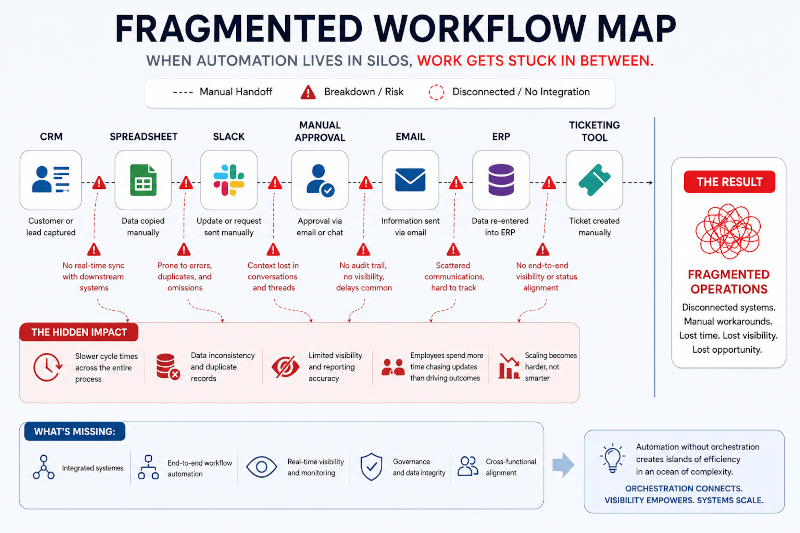
Individually, each automation may function correctly.
Collectively, however, the organization lacks operational cohesion.
The operational risks associated with fragmented systems become especially visible during periods of disruption. In late 2022, Southwest Airlines experienced a massive operational collapse that resulted in thousands of canceled flights across the United States. Federal investigations later identified major operational and scheduling failures that severely restricted the airline’s ability to recover efficiently during cascading disruptions. The incident ultimately contributed to a record $140 million penalty from the U.S. Department of Transportation and highlighted how fragmented operational systems and limited coordination visibility can rapidly amplify organizational complexity during high-stress events.
Over time, fragmented workflows create:
- duplicated work,
- inconsistent reporting,
- operational blind spots,
- governance challenges,
- and growing coordination overhead.
Employees increasingly compensate through manual interventions, spreadsheet tracking, excessive meetings, and informal workarounds that slowly increase operational complexity across the enterprise.
Research published in the International Journal of Information Management found that fragmented digital transformation initiatives often create organizational complexity when governance structures fail to align operational processes across systems.
This operational fragmentation closely resembles the same governance challenges organizations increasingly face with Shadow IT and uncontrolled SaaS expansion.
Automation without orchestration frequently creates fragmented efficiency rather than scalable operational performance.
Human-in-the-Loop Systems Remain Critical
One of the most common misconceptions surrounding automation is the belief that operational maturity means eliminating human involvement entirely.
In reality, high-performing operational systems strategically integrate human decision-making into orchestrated workflows.
Mature operational environments recognize that not every process should be fully automated. Complex systems still require:
- contextual judgment,
- escalation management,
- exception handling,
- compliance validation,
- and governance oversight.
Human-in-the-loop systems create structured checkpoints where employees review outputs, validate exceptions, approve decisions, or intervene during uncertain operational conditions.
The importance of human oversight within orchestrated operational systems is becoming increasingly visible in AI-enabled environments. In 2024, Air Canada was ordered to compensate a customer after its chatbot generated incorrect refund guidance related to bereavement fares. The case highlighted how automation and AI systems still require governance structures, validation workflows, and human accountability mechanisms to operate reliably at scale.
This becomes especially important in AI-enabled operational environments where automated systems may generate inaccurate recommendations or incomplete outputs.
Research from Stanford University’s Human-Centered AI Institute increasingly emphasizes that successful AI systems depend heavily on governance structures, human oversight, and operational accountability mechanisms.
Similarly, recent research from Anthropic examining AI integration into economic workflows found that augmentation models — where humans collaborate with AI systems rather than fully replacing them — remain significantly more effective across many complex operational environments.
Automation should reduce operational friction.
It should not eliminate organizational judgment.
Cross-Platform Coordination and Operational Visibility
Modern enterprises rarely operate within a single platform.
Instead, operational workflows now span:
- cloud applications,
- internal databases,
- analytics systems,
- AI platforms,
- customer management environments,
- and third-party vendor ecosystems.
This creates major coordination challenges.
Without orchestration, organizations struggle to maintain:
- operational visibility,
- process consistency,
- governance oversight,
- and reliable decision-making.
Data becomes fragmented across disconnected systems, making it increasingly difficult for leadership to maintain accurate operational awareness.
Article published in the Harvard Business Review on digital transformation maturity emphasizes that operational visibility and coordinated data ecosystems are among the defining characteristics separating mature digital organizations from fragmented operational environments.
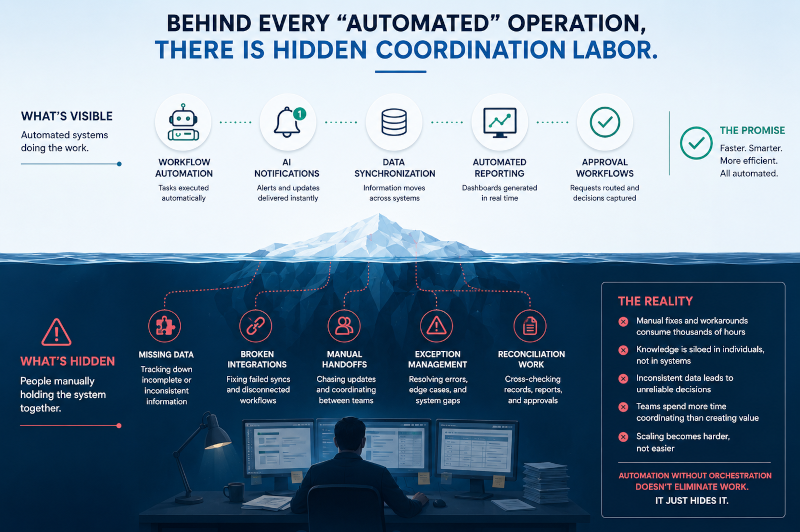
Organizations frequently believe they have automated operations when, in reality, employees are still manually reconciling disconnected workflows behind the scenes.
This hidden coordination labor often becomes one of the largest sources of operational inefficiency inside growing enterprises.
Building Scalable Operational Ecosystems
Operational scalability depends less on how many automation tools organizations deploy and more on how effectively systems operate together.
High-performing organizations increasingly approach automation as part of a broader operational ecosystem strategy rather than isolated workflow optimization.
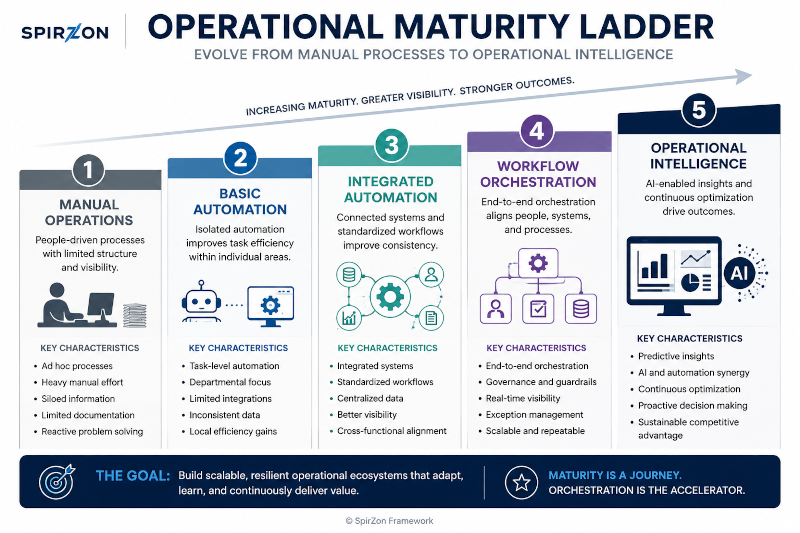
This requires:
- process standardization,
- governance structures,
- integrated visibility,
- workflow ownership,
- data consistency,
- and cross-functional coordination.
Organizations that successfully scale operational systems typically establish:
- centralized governance models,
- documented workflow architectures,
- integrated reporting environments,
- standardized automation frameworks,
- and clearly defined escalation paths.
Academic research in enterprise systems and organizational coordination consistently demonstrates that scalable operational performance depends heavily on alignment between workflows, information systems, governance structures, and institutional knowledge management practices.
This is one reason documentation quality becomes increasingly important as organizations scale automation and AI-enabled operations.
Undocumented operational complexity cannot be orchestrated effectively.
It can only be temporarily managed.
The Future of Operational Orchestration
As enterprise SaaS ecosystems, AI platforms, and automation technologies continue expanding, orchestration will likely become one of the defining operational capabilities separating scalable organizations from fragmented ones.
The future of operational maturity will depend less on how many tasks organizations automate and more on how effectively they coordinate:
- systems,
- workflows,
- governance,
- knowledge,
- and human decision-making across increasingly complex digital environments.
Organizations that continue pursuing isolated automation without orchestration may improve short-term efficiency while simultaneously increasing long-term operational complexity.
Organizations that invest in orchestration, however, build operational ecosystems capable of:
- scaling consistently,
- adapting more rapidly,
- reducing fragmentation,
- improving visibility,
- and maintaining operational resilience across evolving enterprise environments.
Automation accelerates tasks.
Orchestration aligns systems.
And in increasingly complex operational environments, alignment may become the more valuable capability.
3 thoughts on “Why Your Automation Strategy Is Creating Operational Chaos — And How to Fix It”