- Recommendations
- Documentation Debt: The Hidden Operational Liability
- Tribal Knowledge Creates Hidden Organizational Fragility
- Poor Documentation Slows Onboarding and Reduces Scalability
- Audit and Compliance Exposure
- Documentation Gaps Create Operational Bottlenecks
- Knowledge Loss During Employee Turnover
- AI Systems Amplify Documentation Problems
- Building Sustainable Documentation Systems
- Documentation Is Operational Infrastructure
Recommendations
- Move documentation ownership into operational processes by assigning accountable owners, establishing review cycles, and integrating knowledge maintenance into normal team workflows.
- Identify one critical business process that currently depends on undocumented knowledge and assign an owner to create or update the supporting documentation.
- Conduct a tribal knowledge assessment by identifying employees who are critical knowledge holders and documenting the workflows, decisions, and expertise that would be difficult to replace.
- Review your onboarding process and document the five most common questions new employees ask during their first 30 days to identify knowledge gaps.
Organizations rarely recognize documentation problems when operations are functioning normally.
The consequences usually emerge later — during onboarding failures, employee turnover, compliance audits, operational outages, or periods of rapid organizational growth. What initially appears to be a minor administrative issue gradually evolves into operational friction that affects nearly every layer of the business.
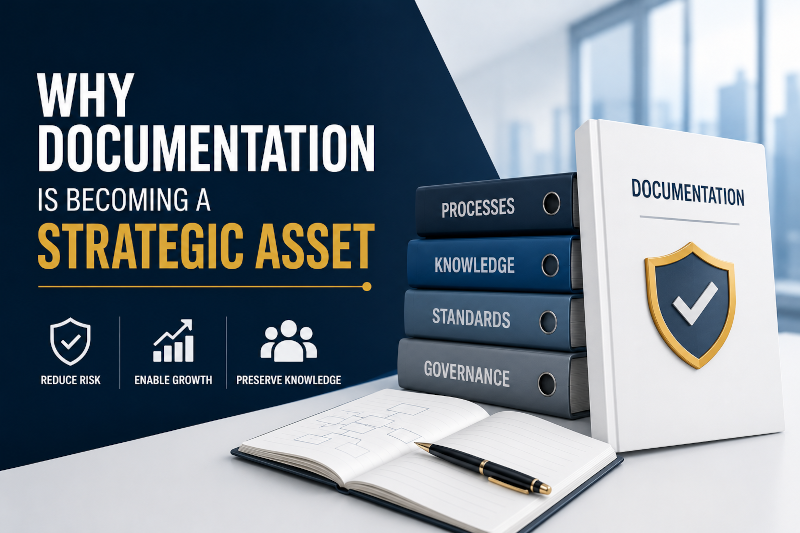
Documentation is often treated as secondary work: something useful when time permits, but ultimately less important than execution itself. In reality, documentation functions as operational infrastructure. It preserves institutional knowledge, supports continuity, reduces dependency bottlenecks, and enables organizations to scale processes consistently across teams and departments.
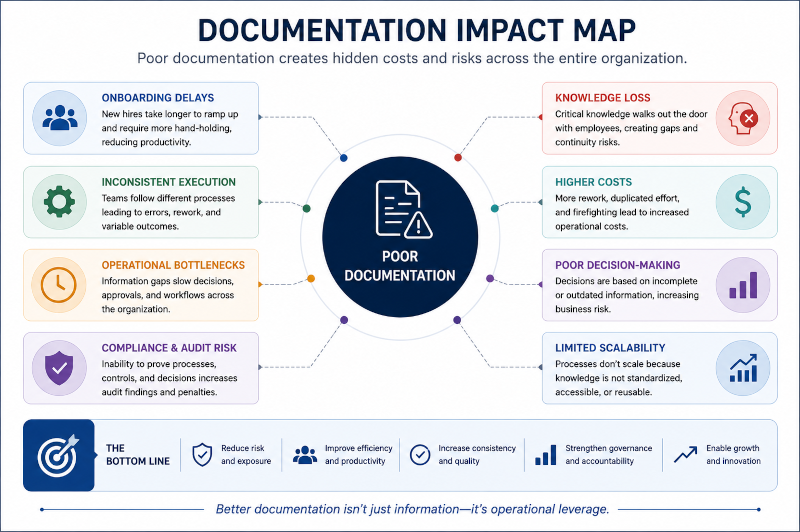
When documentation is poor, outdated, fragmented, or nonexistent, organizations accumulate hidden operational risk. Over time, those risks compound silently. Workflows become inconsistent, onboarding slows, institutional knowledge disappears, and decision-making quality declines.
The operational consequences are rarely immediate.
But eventually, every organization pays the price of documentation failure.
Documentation Debt: The Hidden Operational Liability
Organizations frequently discuss concepts such as technical debt or infrastructure debt, yet far fewer recognize the long-term operational risk created by what could be described as “documentation debt.”
Documentation debt accumulates when organizations delay documenting processes, fail to update procedures, or rely too heavily on informal knowledge transfer between employees. In many cases, operational information becomes scattered across disconnected systems, buried inside chat messages, or stored exclusively in the minds of experienced personnel.
Like technical debt, the short-term convenience of avoiding documentation often creates much larger operational costs over time.
Research on organizational knowledge management consistently demonstrates that knowledge preservation and structured documentation directly influence operational continuity and organizational performance.
The danger is that documentation debt often remains invisible until organizations experience operational stress. A workflow failure, a critical resignation, a compliance review, or a scaling initiative suddenly exposes how much operational knowledge was never properly preserved in the first place.
Poor documentation rarely creates a single catastrophic failure. More often, it creates persistent operational friction that gradually reduces efficiency across the organization.
Tribal Knowledge Creates Hidden Organizational Fragility
One of the most common operational risks associated with poor documentation is dependency on tribal knowledge.
Tribal knowledge refers to information that exists primarily in the minds of specific employees rather than within accessible organizational systems. This often includes undocumented workflows, approval processes, reporting logic, legacy system behaviors, or institutional historical context that employees learn informally over time.
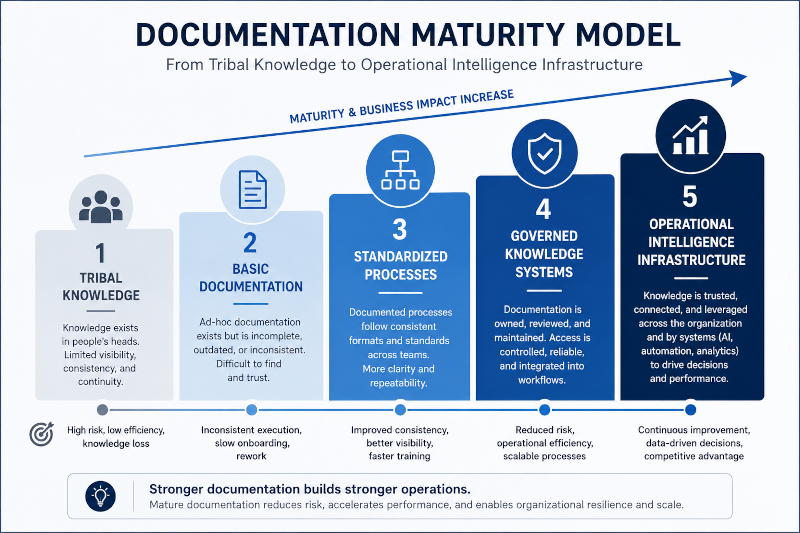
At first, this may appear efficient. Experienced employees become highly valuable operational “knowledge hubs” capable of solving problems quickly because they understand systems that nobody else fully understands.
However, this creates hidden organizational fragility.
If critical operations depend on knowledge that exists only in people’s heads, the organization is operating with invisible instability.
Research from Carnegie Mellon University’s Tepper School of Business highlights that successful knowledge transfer depends heavily on structured organizational systems rather than informal dependency on individuals alone.
Organizations heavily dependent on tribal knowledge often experience workflow inconsistencies, onboarding delays, operational bottlenecks, and reduced scalability. These same weaknesses increasingly affect AI-enabled systems and automation initiatives as organizations attempt to scale operations without first addressing fragmented organizational knowledge structures.
Poor Documentation Slows Onboarding and Reduces Scalability
Documentation quality directly affects how quickly organizations can onboard employees and scale operational systems.
When documentation is incomplete, outdated, or difficult to locate, employees rely heavily on informal guidance from coworkers to complete routine tasks. Over time, this creates dependency bottlenecks where experienced personnel spend increasing amounts of time answering repetitive operational questions rather than focusing on higher-value work.
Organizations frequently underestimate how much productivity is lost through repeated explanations, missing process information, inconsistent procedures, and employees searching for undocumented knowledge across disconnected systems.
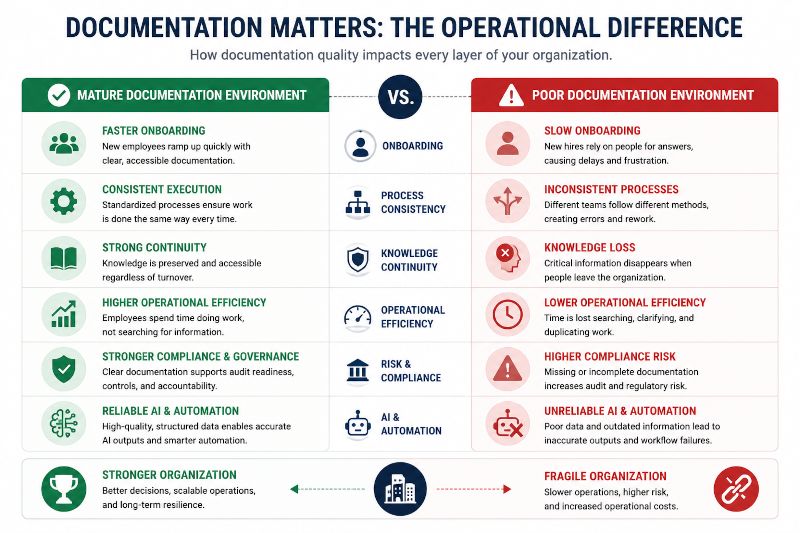
Research on organizational knowledge transfer consistently demonstrates that firms with effective knowledge-sharing systems improve coordination, efficiency, and long-term operational performance.
In many environments, knowledge managers and process owners effectively function as operational efficiency multipliers by reducing information retrieval friction and improving organizational visibility across teams and departments.
As organizations grow, these inefficiencies become increasingly difficult to absorb operationally. Processes that once functioned informally inside small teams begin breaking down under larger operational complexity.
Audit and Compliance Exposure
Poor documentation is not simply an efficiency problem. It is also a governance and compliance risk.
Regulated industries increasingly require organizations to demonstrate process consistency, operational accountability, traceability, and standardized controls. Without clear documentation, organizations struggle to validate procedures, prove policy adherence, or maintain audit readiness.
This becomes especially dangerous in environments involving cybersecurity, healthcare, finance, government contracting, and enterprise risk management.
Organizations may believe operational controls are functioning correctly until audits reveal undocumented exceptions, inconsistent procedures, outdated policies, or missing approval records. The resulting consequences can include delayed certifications, regulatory penalties, reputational damage, and increased oversight requirements.
As organizations become increasingly dependent on distributed digital systems and SaaS ecosystems, maintaining operational visibility becomes even more difficult when governance structures fail to keep pace with technology adoption.
Documentation Gaps Create Operational Bottlenecks
Operational bottlenecks rarely emerge from a single catastrophic issue. More often, they develop gradually through accumulated friction across workflows, approvals, communication systems, and undocumented operational processes.
When employees cannot quickly locate accurate information, operational speed declines. Teams duplicate work, workflows become inconsistent, and decision-making slows because employees spend increasing amounts of time validating information that should already exist within accessible systems.
The operational consequences of poor procedural controls and documentation are not theoretical. In 2023, the Federal Aviation Administration (FAA) temporarily grounded all domestic U.S. flights after contract personnel unintentionally deleted critical files while attempting to synchronize the agency’s live NOTAM database with a backup system. The outage disrupted thousands of flights nationwide and exposed how fragile critical operational systems can become when maintenance procedures, change controls, and system dependencies are not sufficiently safeguarded or documented.
The incident ultimately forced the FAA to review operational procedures and strengthen resilience controls across the system.
Studies in organizational knowledge management increasingly describe these challenges as knowledge flow failures — situations where information technically exists somewhere within the organization but cannot move efficiently to the people who need it.
Over time, organizations begin compensating for poor documentation through excessive meetings, redundant oversight layers, manual clarifications, and informal workarounds that slowly increase operational complexity.
Ironically, many organizations attempt to solve these inefficiencies through automation before addressing the underlying documentation and workflow problems responsible for the operational friction in the first place.
Automation cannot reliably scale undocumented operational chaos.
It often amplifies it.
Knowledge Loss During Employee Turnover
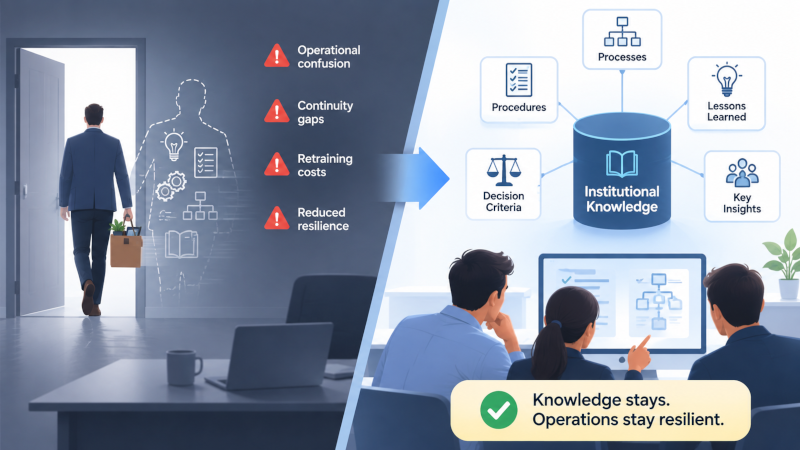
One of the most damaging operational consequences of poor documentation is institutional knowledge loss during employee turnover.
Employees leave organizations constantly through resignations, layoffs, promotions, retirements, and reorganizations. When operational knowledge is not documented effectively, organizations lose institutional memory every time experienced personnel leave.
The result is often operational confusion, continuity gaps, retraining costs, and reduced organizational resilience during periods of transition.
Research on operational knowledge preservation emphasizes that organizations capable of systematically documenting and transferring institutional knowledge maintain significantly stronger continuity and adaptability during workforce disruptions.
Organizations often assume knowledge transfer occurs naturally.
In reality, effective knowledge transfer requires structure, governance, maintenance, and operational discipline. Without those mechanisms, institutional expertise gradually disappears over time.
AI Systems Amplify Documentation Problems
As organizations increasingly integrate AI-enabled workflows into daily operations, documentation quality becomes even more important.
AI systems depend heavily on structured information, accessible documentation, standardized terminology, and reliable organizational knowledge. Poor documentation environments create major limitations for enterprise search systems, workflow automation, AI retrieval tools, and operational analytics platforms.
AI systems trained on fragmented or outdated organizational information frequently generate inaccurate outputs, misleading recommendations, inconsistent retrieval behavior, and operational confusion.
The operational risks associated with poor documentation and fragmented organizational knowledge are already becoming visible in AI-enabled systems. In 2024, Air Canada was ordered to honor incorrect refund guidance provided by its AI chatbot after the system generated inaccurate policy information for a customer. The airline initially argued that the chatbot was “responsible for its own actions,” but the tribunal ultimately ruled that Air Canada remained accountable for the information generated through its AI systems.
The case highlighted how AI systems can amplify inconsistencies in organizational knowledge and create operational, legal, and reputational risks when governance controls and information accuracy are insufficient.
Research on documentation debt within machine learning environments similarly highlights how insufficient documentation undermines reliability, governance, and long-term system usability.
Many organizations mistakenly assume AI can compensate for operational disorder.
In reality, AI often magnifies existing knowledge quality problems.
This is one reason many enterprise AI initiatives struggle during operational scaling phases .
Building Sustainable Documentation Systems
Effective documentation systems require significantly more than isolated SOPs or shared folders filled with outdated files.
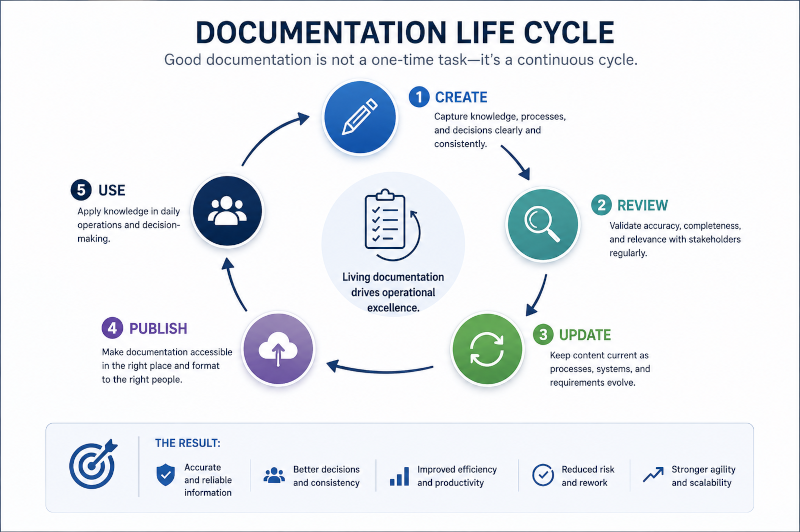
Sustainable documentation environments depend on governance, ownership, accessibility, standardization, and continuous maintenance. High-performing organizations increasingly integrate documentation directly into operational workflows rather than treating it as a separate administrative responsibility.
Studies on organizational knowledge systems consistently emphasize that documentation becomes most effective when embedded naturally into everyday operational processes.
Strong documentation environments typically include:
- standardized process structures,
- searchable knowledge repositories,
- version control systems,
- defined ownership responsibilities,
- periodic review cycles,
- and clear governance policies.
Most importantly, organizations must build cultures where documentation is viewed as operational enablement rather than unnecessary bureaucracy.
Documentation Is Operational Infrastructure
Documentation is often invisible when it functions properly.
But nearly every operational system depends on it.
Documentation supports continuity, scalability, governance, onboarding, compliance, operational visibility, and organizational resilience. Organizations that neglect documentation frequently compensate through additional oversight layers, repeated meetings, redundant approvals, reactive troubleshooting, and informal workarounds that slowly increase operational complexity over time.
High-performing organizations increasingly recognize that documentation is not administrative overhead.
It is operational infrastructure.
“Documentation is not administrative overhead. It is operational infrustructure.”
And in an environment increasingly shaped by automation, AI systems, distributed workforces, and complex digital ecosystems, organizations that manage operational knowledge effectively will likely hold significant long-term advantages.
7 thoughts on “Why Documentation Is Becoming a Strategic Asset”