
Recommendations
- Assess whether your organization is measuring AI adoption through usage statistics or through operational and financial outcomes.
- Require every AI initiative to identify a measurable business problem, baseline metric, and expected financial outcome before funding is approved.
- Conduct a data readiness assessment before approving any enterprise AI program and identify systems that cannot be trusted as authoritative sources.
- Treat AI adoption as a change management initiative with dedicated ownership, communication plans, and workforce enablement strategies.
Artificial intelligence has moved from innovation labs to boardroom agendas with remarkable speed. Nearly every enterprise strategy presentation now includes references to copilots, intelligent agents, automation, or generative AI. Technology vendors are racing to position their offerings as indispensable, while executives face growing pressure to demonstrate that their organizations are not falling behind.
Yet beneath the enthusiasm lies a more complicated reality.
Many organizations have accumulated AI pilots without creating meaningful business value. Teams experiment with tools daily, but operating metrics remain unchanged. Annual AI budgets continue to grow while executives struggle to answer a deceptively simple question:
What measurable value has AI created for the business? The answer is often less clear than anticipated.
According to Boston Consulting Group’s 2024 global survey, 74% of companies report struggling to achieve and scale value from AI investments, while only 26% have developed the capabilities required to move beyond experimentation. Similarly, McKinsey’s latest research shows that while AI adoption has become widespread, enterprise-scale impact remains relatively uncommon.
This should not be interpreted as a failure of the technology. Quite the opposite. AI has already demonstrated its ability to improve productivity, accelerate knowledge work, and create entirely new business models. The problem is that organizations frequently approach AI as a technology initiative when it is fundamentally a business transformation initiative.
Companies rarely fail because they selected the wrong large language model. They fail because they skipped strategy, underestimated operational complexity, and never established a path from experimentation to enterprise value.
The Growing Gap Between AI Adoption and AI Value
A pattern is emerging across nearly every major AI survey conducted over the past two years. Adoption is accelerating faster than organizational maturity.
Boston Consulting Group’s 2025 research found that only 5% of organizations are generating substantial value at scale from AI, while approximately 60% continue to produce little or no meaningful return. The firms that have succeeded are not necessarily using better models. They are simply better at operationalizing them.
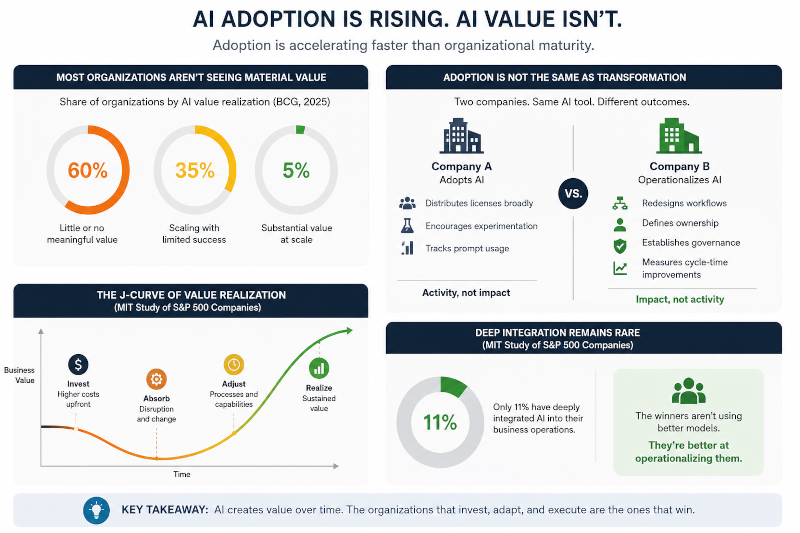
There is an important distinction between using AI and becoming an AI-enabled organization.
Consider two companies that both deploy an enterprise copilot platform. The first distributes licenses broadly, encourages experimentation, and celebrates prompt usage metrics. The second redesigns workflows, defines ownership, establishes governance, and measures cycle-time reductions against baseline performance.
Both organizations can claim AI adoption. Only one can demonstrate transformation.
Research from MIT examining S&P 500 companies found that only about 11% had deeply integrated AI into their business operations despite years of investment and growing public commitments. The study also noted a “J-curve” effect: organizations often experience higher costs and organizational disruption before realizing significant benefits.
That finding is particularly relevant for executives expecting immediate returns. AI, much like ERP implementations or digital transformation programs before it, requires organizations to endure a period of adjustment before value becomes visible.
Recommendation: Assess whether your organization is measuring AI adoption through usage statistics or through operational and financial outcomes.
The First Failure: Solving for Technology Instead of Business Problems
Many AI initiatives begin with a demonstration rather than a diagnosis. Leadership teams attend conferences, observe competitors implementing copilots, and decide they need an AI strategy. Procurement discussions begin almost immediately, followed by pilot programs designed to showcase capability.
The underlying business problem often receives less attention.
Organizations routinely deploy AI to:
- Build customer chatbots without reducing call volume.
- Generate reports that decision-makers never read.
- Automate processes that were not operational bottlenecks.
- Conduct pilots with no intention or capability to scale.
The result is predictable. Costs rise while business performance remains largely unchanged.
The strongest AI programs begin by asking questions that have nothing to do with AI:
- Which processes create the greatest friction?
- Where are employees spending the most time?
- Which decisions suffer from poor information?
- What activities directly affect revenue, cost, or customer experience?
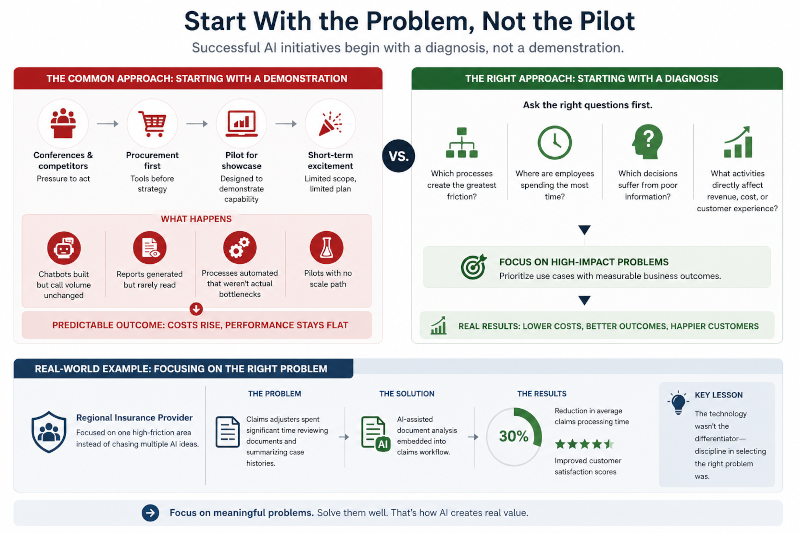
A regional insurance provider offers a useful example. Rather than launching multiple AI initiatives simultaneously, the company focused exclusively on claims processing. Claims adjusters spent significant time reviewing documentation and summarizing case histories. By introducing AI-assisted document analysis, the organization reduced average processing time by nearly 30% while improving customer satisfaction scores.
The technology itself was not particularly novel. The discipline in selecting the problem made the difference.
This builds on ideas explored in The Hidden Cost of Manual Internal Processes, where operational friction often proves to be a better starting point than technological capability.
Recommendation: Require every AI initiative to identify a measurable business problem, baseline metric, and expected financial outcome before funding is approved.
Poor Data Remains AI’s Greatest Limitation
Organizations often speak about AI readiness while overlooking the condition of the data ecosystem supporting it. Artificial intelligence is exceptionally effective at identifying patterns and generating outputs. It is considerably less effective at compensating for fragmented, inaccurate, or poorly governed information.
Many enterprises continue to operate with:
- Duplicate records across systems.
- Conflicting definitions of key business terms.
- Outdated documentation.
- Incomplete metadata.
- Siloed repositories.
- Limited confidence in source information.
McKinsey’s research found that relatively few organizations have established enterprise-wide data sourcing strategies capable of supporting scaled AI deployments. This issue becomes particularly problematic with generative AI. Organizations assume the model will produce better answers than the information it receives. In practice, the opposite is often true.
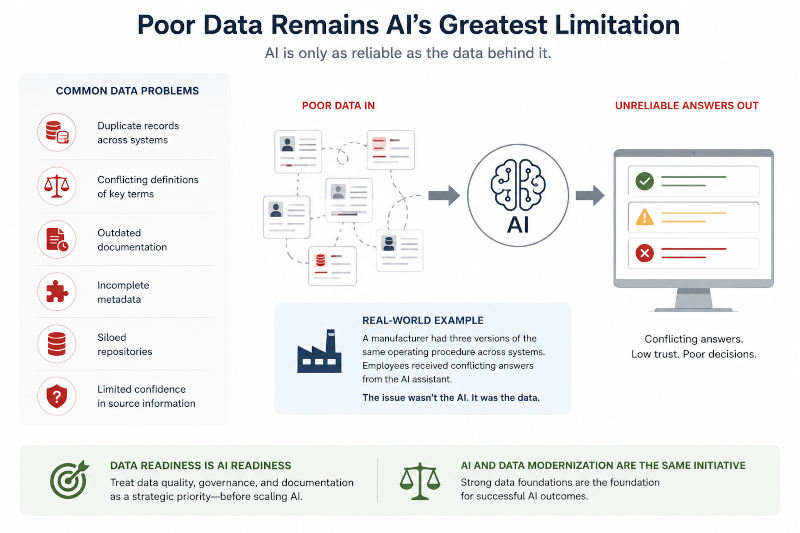
A manufacturing company implementing an internal knowledge assistant discovered that employees received conflicting answers depending on which legacy repository contained the relevant documentation. The issue was not the AI platform. It was the fact that three versions of the same operating procedure existed simultaneously.
Executives sometimes ask whether they should prioritize AI or data modernization. Increasingly, the evidence suggests these are the same initiative.
As discussed in Why Documentation Is Becoming a Strategic Asset, knowledge quality is rapidly becoming a competitive differentiator in AI-enabled organizations.
Recommendation: Conduct a data readiness assessment before approving any enterprise AI program and identify systems that cannot be trusted as authoritative sources.
Pilot Purgatory: Why Promising Ideas Never Scale
Perhaps the most common AI failure pattern is what many consultants have begun referring to as “pilot purgatory.” Organizations become exceptionally good at experimentation and remarkably poor at institutionalization.
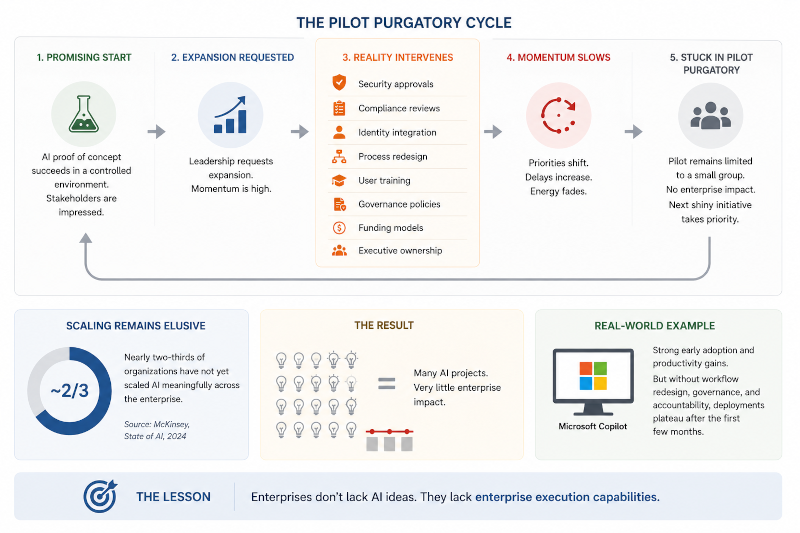
An AI proof of concept succeeds in a controlled environment. Stakeholders are impressed. Leadership requests expansion. Then reality intervenes.
Suddenly, the initiative requires:
- Security approvals.
- Compliance reviews.
- Identity integration.
- Process redesign.
- User training.
- Governance policies.
- Funding models.
- Executive ownership.
Momentum slows. Priorities shift. The pilot remains operational for a small group of users while the broader organization moves on to the next innovation initiative.
McKinsey’s latest survey suggests that nearly two-thirds of organizations have yet to scale AI meaningfully across the enterprise despite reporting isolated use-case successes.
This helps explain an increasingly common phenomenon: companies with dozens of AI projects and virtually no enterprise impact.
Consider the experience of many organizations deploying Microsoft Copilot. Initial adoption often produces enthusiasm and localized productivity gains. However, without workflow redesign, governance, and leadership accountability, many deployments plateau after the first few months.
The lesson is straightforward. Enterprises do not suffer from a shortage of AI ideas. They suffer from a shortage of enterprise execution capabilities.
Recommendation: Establish an explicit scaling plan during the pilot phase, including governance, ownership, funding, and integration requirements.
ROI Is Still the Missing Conversation
For all the discussion surrounding artificial intelligence, ROI remains surprisingly underdeveloped.
Many organizations continue to rely on vanity metrics:
- Licenses issued.
- Prompts submitted.
- Employees trained.
- Pilot satisfaction scores.
- Estimated hours saved.
These metrics may indicate activity, but they do not demonstrate value.
Operator Collective’s 2026 survey found that approximately 40% of organizations lack defined AI ROI metrics entirely.
From a finance perspective, AI should be evaluated no differently than any other investment portfolio. Leaders should be able to answer four questions:
- What did we spend?
- What did we expect to gain?
- What did we actually gain?
- Should we continue investing?
Organizations that successfully scale AI tend to measure:
- Revenue growth.
- Margin improvement.
- Error reduction.
- Customer retention.
- Cycle-time reduction.
- Cost-to-serve improvements.
- Productivity tied to measurable output.
A financial services organization, for example, implemented AI-assisted underwriting support. Rather than reporting prompt usage, leadership tracked application throughput, approval times, and underwriting accuracy. Within twelve months, executives could quantify improvements in both operational efficiency and customer responsiveness.
That level of measurement creates credibility. It also creates accountability.
Recommendation: Require quarterly AI portfolio reviews that evaluate initiatives using operational and financial KPIs rather than adoption metrics.
AI Adoption Is Primarily a Change Management Challenge
One of the most overlooked findings in enterprise AI research comes from Boston Consulting Group.
According to BCG, approximately 70% of AI implementation challenges are people- and process-related, while only 10% are primarily algorithm-related. That statistic should fundamentally change how organizations think about AI adoption.
Many executives continue to focus discussions on model selection, vendors, and technical capabilities. Meanwhile, employees struggle to understand:
- Which tasks AI should perform.
- Who remains accountable for outputs.
- How workflows will change.
- Which tools are approved.
- What success looks like.
Without clear answers, employees develop workarounds.
Some continue operating manually. Others adopt unapproved tools. Many duplicate effort by performing work themselves while validating AI-generated outputs. Complexity increases instead of decreases.
“AI implementation is not primarily a technology problem—it is a people, process, and organizational design problem.”
History provides useful context here. ERP systems, cloud migrations, and digital transformation programs encountered similar resistance. Technology changed quickly. Organizations changed slowly.
AI appears to be following the same pattern.
The companies creating meaningful value are redesigning work itself. They are asking how decisions should be made, where humans add the greatest value, and how organizational structures must evolve to support new operating models.
This builds on themes explored in The New Skill Companies Actually Need: Systems Thinking, where organizational performance is often determined less by individual tools and more by how systems interact.
Recommendation: Treat AI adoption as a change management initiative with dedicated ownership, communication plans, and workforce enablement strategies.
The Organizations Winning With AI
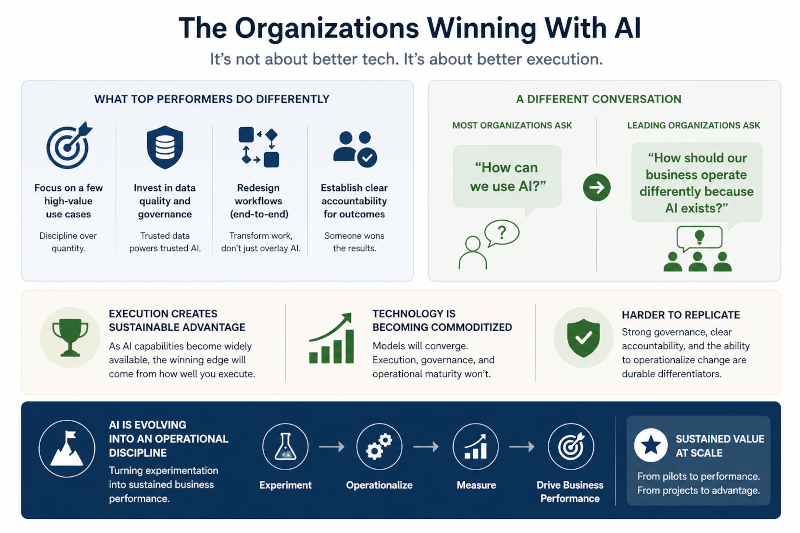
Despite the challenges, a growing number of organizations are beginning to separate themselves from the pack by demonstrating measurable and repeatable value from AI investments. Interestingly, their success is rarely attributed to having access to better technology. Instead, they tend to share a common set of organizational capabilities: a disciplined focus on a handful of high-value use cases, a commitment to strong data governance, and a willingness to redesign workflows rather than simply overlay AI onto existing inefficiencies.
Perhaps most importantly, these organizations establish clear accountability. Someone owns the outcome—not just the implementation.
This changes the nature of the conversation. Rather than asking, “How can we use AI?” leading organizations are asking a much more consequential question: “How should our business operate differently because AI exists?”
The distinction may seem subtle, but it has significant implications. Over time, competitive advantage is likely to accrue less to organizations with access to the most sophisticated models and more to those that consistently execute better than their peers. As AI capabilities become more widely available, the technology itself will become increasingly commoditized. Execution, governance, and operational maturity, on the other hand, are considerably harder to replicate.
In many respects, AI is evolving from a technology initiative into an operational discipline—one that rewards organizations capable of turning experimentation into sustained business performance.
Final Thoughts
Artificial intelligence is neither a passing trend nor an automatic source of competitive advantage. It is a business capability, and like any capability, its value is determined by how effectively an organization develops, governs, and integrates it into the way work gets done.
This helps explain why so many AI initiatives fall short of expectations. In most cases, the technology is performing exactly as designed. The breakdown occurs elsewhere—when organizations confuse experimentation with transformation, or when adoption metrics are mistaken for evidence of business value.
The companies creating meaningful impact are not necessarily those with the largest budgets or the most ambitious AI roadmaps. More often, they are the organizations that approach AI with discipline. They focus on solving meaningful business problems, establish clear measures of success before implementation begins, redesign workflows where necessary, and maintain accountability for outcomes long after the initial excitement has faded.
At this point, the debate over whether AI will influence the future of business is largely settled. The technology has arrived, and its capabilities will continue to improve. The more pressing question for executives is whether their organizations are prepared to evolve alongside it.
Recommendation: Schedule an executive-level AI portfolio review within the next 30 days and identify which initiatives can demonstrate measurable business value today.