
- Recommendations
- Security Produces Information. Governance Produces Decisions
- Case Study: The Vulnerability Everyone Owned
- The Alert Fatigue Problem May Actually Be a Governance Problem
- Governance Is How Organizations Express Risk Appetite
- Why CISO Reporting Lines Matter Less Than Decision Rights
- Case Study: The Board That Received Metrics but Not Decisions
- The Future Security Leader Is a Governance Leader
- Conclusion
Recommendations
- For every major cyber risk, identify a single accountable decision-maker rather than relying solely on shared ownership models.
- Assign a single accountable owner for high-risk findings and document escalation paths before vulnerabilities become business issues.
- Establish documented risk thresholds and escalation criteria so security teams can distinguish between issues that require action and issues that require monitoring.
- Document formal risk acceptance thresholds and approval authorities so similar risks receive consistent treatment across the organization.
- Ensure every executive cyber-risk presentation includes a clear decision, action, or ownership request rather than relying solely on metrics and status reporting.
- Incorporate governance, decision-making, and executive communication skills into cybersecurity leadership development programs alongside technical training.
Organizations have never had more cybersecurity information at their disposal.
Security teams monitor thousands of alerts each day. Vulnerability scanners continuously identify weaknesses across environments. Threat intelligence feeds provide real-time information about emerging threats. Risk assessments generate findings, recommendations, and action plans. Executive dashboards provide visibility into security metrics that would have been impossible to collect just a decade ago.
Despite all of this information, many organizations continue to struggle with the same fundamental challenge.
They know more about risk than ever before, yet they often find it difficult to decide what matters most, who owns the response, and how competing priorities should be balanced.
This is where governance enters the picture.
Cybersecurity discussions frequently focus on tools, controls, frameworks, and technical capabilities. Those elements are important, but they represent only part of the equation. A mature cybersecurity program is not defined solely by its ability to identify risk. It is defined by its ability to make decisions about risk.
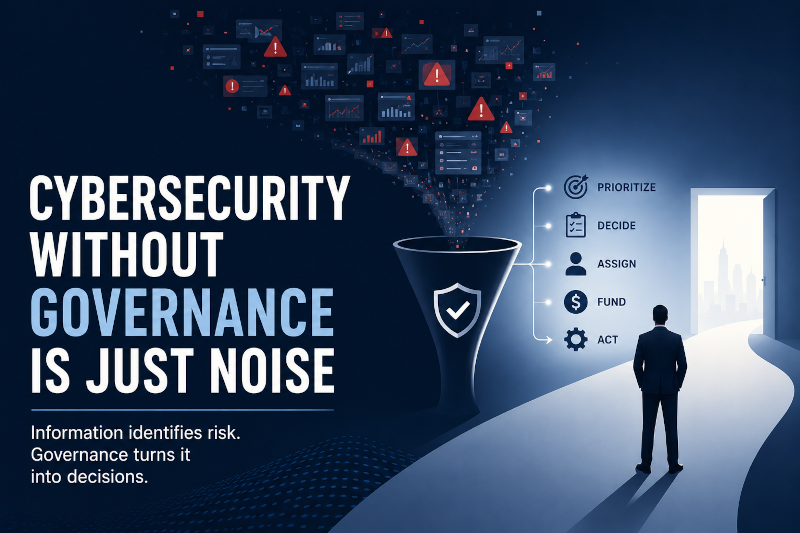
Without governance, cybersecurity can become a constant stream of alerts, findings, reports, and recommendations. Activity increases. Visibility improves. Information accumulates.
The challenge is that information alone does not reduce risk. Someone still needs to decide what gets funded, what gets fixed, what gets accepted, and what gets escalated.
That distinction has become significant enough that NIST elevated governance to a standalone function in the Cybersecurity Framework 2.0, placing it alongside Identify, Protect, Detect, Respond, and Recover. The message is clear: cybersecurity is not only a technical discipline. It is also a governance discipline.
The organizations that manage cyber risk effectively are rarely the ones generating the most information. More often, they are the ones making the clearest decisions.
Security Produces Information. Governance Produces Decisions
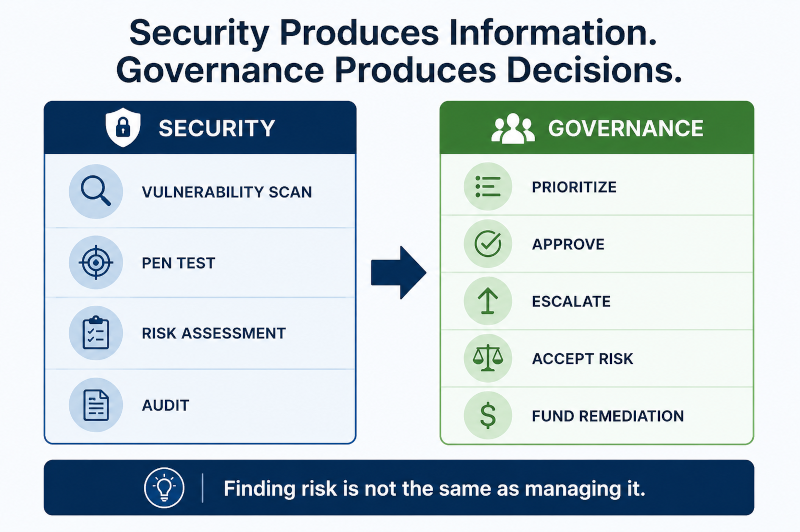
One of the most common misconceptions in cybersecurity is the belief that identifying risk is the same as managing it.
A vulnerability scan identifies weaknesses. A penetration test identifies exposure. A risk assessment identifies concerns. An audit identifies gaps. None of these activities reduce risk on their own—they simply provide information.
The real challenge begins after the findings are delivered. Who decides whether a critical vulnerability must be remediated immediately? Who determines whether a compensating control is sufficient? Who has the authority to accept residual risk when security recommendations conflict with business priorities?
These are not technical questions. They are governance questions. Yet many organizations invest far more in identifying risks than in establishing clear processes for making decisions about them.
The World Economic Forum’s Global Cybersecurity Outlook 2025 highlights growing complexity across cyber ecosystems, noting that leaders must navigate interconnected technology, business, regulatory, and geopolitical risks simultaneously. In that environment, collecting more information is rarely the hardest part. Determining what actions should follow often proves more challenging.
Organizations that mature their cybersecurity programs eventually discover that security and governance serve different purposes.
Security identifies and analyzes risk. Governance determines what happens next.
When governance is weak, security teams often become trapped in a cycle of generating findings that never fully translate into action. Reports are produced. Risks are documented. Recommendations are issued. Yet many issues remain unresolved because accountability, ownership, or decision authority is unclear.
The result is not a lack of visibility, but a lack of remediation.
Recommendation: For every major cyber risk, identify a single accountable decision-maker rather than relying solely on shared ownership models.
Case Study: The Vulnerability Everyone Owned
Consider a common scenario found across many organizations.
A security team identifies a critical vulnerability affecting a business-critical application. The issue is serious enough to warrant immediate attention. Technical analysis confirms the exposure. The vulnerability is documented, prioritized, and distributed to relevant stakeholders.
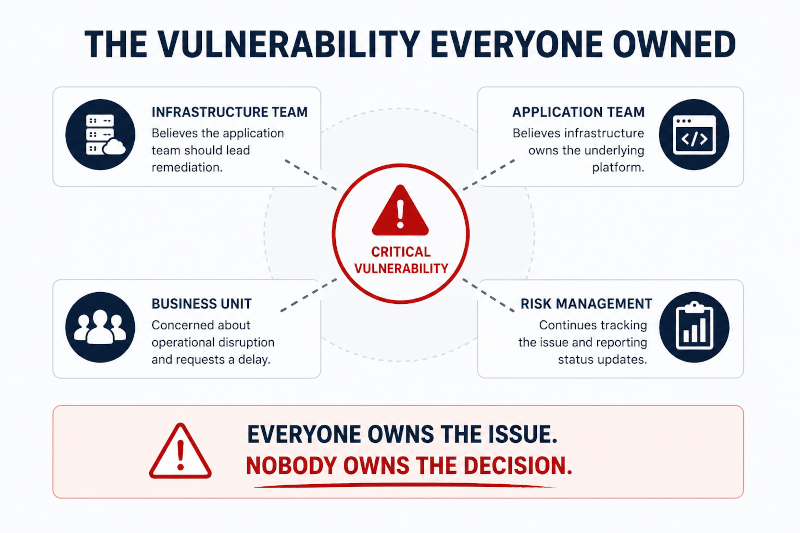
Everyone agrees it should be fixed. Yet three months later, the issue remains unresolved.
The infrastructure team believes the application team should lead remediation because the vulnerability affects software. The application team points to the underlying platform and argues that infrastructure owns the issue. Meanwhile, the business unit is concerned about operational disruption and requests a delay, while risk management continues tracking the finding and reporting status updates.
From a governance perspective, the problem is straightforward: everyone owns part of the issue, but nobody owns the decision.
This situation is surprisingly common because organizations often mistake participation for accountability. Multiple teams may contribute to remediation efforts, yet effective governance requires clear authority over who makes the final decision, who can approve exceptions, and who accepts the risk if remediation is postponed.
The challenge is rarely technical. More often, it is organizational.
Many cybersecurity failures do not occur because organizations failed to identify risk. They occur because responsibility becomes fragmented across multiple stakeholders, creating uncertainty around who should act and when.
Strong governance reduces that ambiguity. It establishes ownership, escalation pathways, decision authority, and timelines before a critical issue emerges rather than after.
As discussed in our article, “Cybersecurity is No Longer Just a Technical Problem,” organizations often struggle not because they lack solutions, but because accountability becomes disconnected from execution. Cybersecurity is no different.
Recommendation: Assign a single accountable owner for high-risk findings and document escalation paths before vulnerabilities become business issues.
The Alert Fatigue Problem May Actually Be a Governance Problem
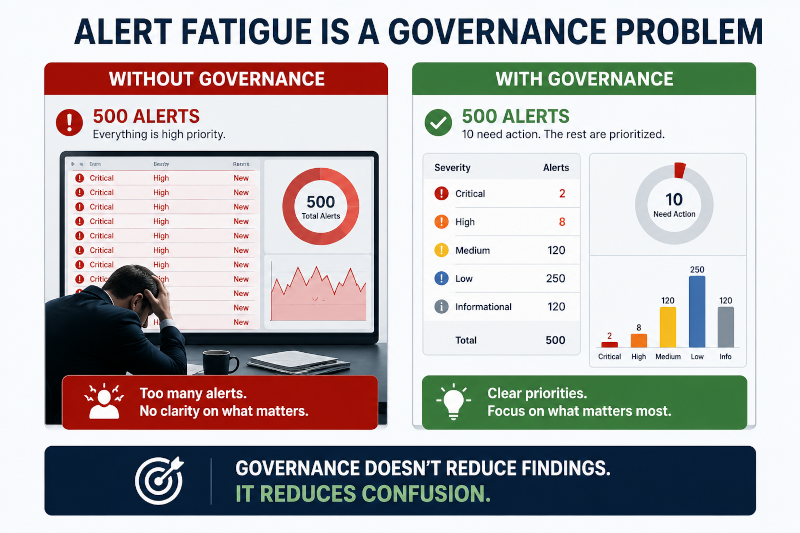
Security leaders often describe alert fatigue as a technology problem. There are simply too many alerts, too many findings, and too many competing priorities for teams to address effectively.
Technology and staffing certainly play a role, but governance is often the overlooked factor. In organizations with weak governance, everything feels urgent. Security teams identify hundreds of vulnerabilities with similar severity ratings. Business units compete for resources. Technology teams juggle conflicting priorities. Executives receive different recommendations from different stakeholders.
The result is that prioritization becomes subjective. Which issues require immediate action? Which risks are acceptable? When should leadership become involved? What can safely wait?
These questions become difficult to answer when risk thresholds, escalation criteria, and ownership are poorly defined.
Strong governance does not reduce the number of security findings. What it does provide is a framework for determining which findings matter most.
That distinction becomes increasingly important as organizations expand into cloud environments, adopt AI, and rely on growing networks of third-party providers. Security programs generate more signals every year. Governance determines which of those signals deserve attention.
Without that filter, cybersecurity becomes a constant stream of competing alarms—in other words, noise.
Recommendation: Establish documented risk thresholds and escalation criteria so security teams can distinguish between issues that require action and issues that require monitoring.
Governance Is How Organizations Express Risk Appetite
Most organizations claim that cybersecurity is important. But the more revealing question is how important.
Governance provides the answer.
Risk appetite is often discussed as an abstract concept, but governance is how organizations translate that concept into operational reality. It determines which risks require executive approval, which issues can be accepted at the business-unit level, which findings warrant board visibility, and which threats require immediate action regardless of cost or disruption.
Without governance, risk appetite becomes difficult to distinguish from risk tolerance by default. Decisions are made inconsistently. Similar risks receive different treatment depending on who happens to be involved. Security teams struggle to understand when escalation is appropriate, while business leaders struggle to understand when exceptions are acceptable.
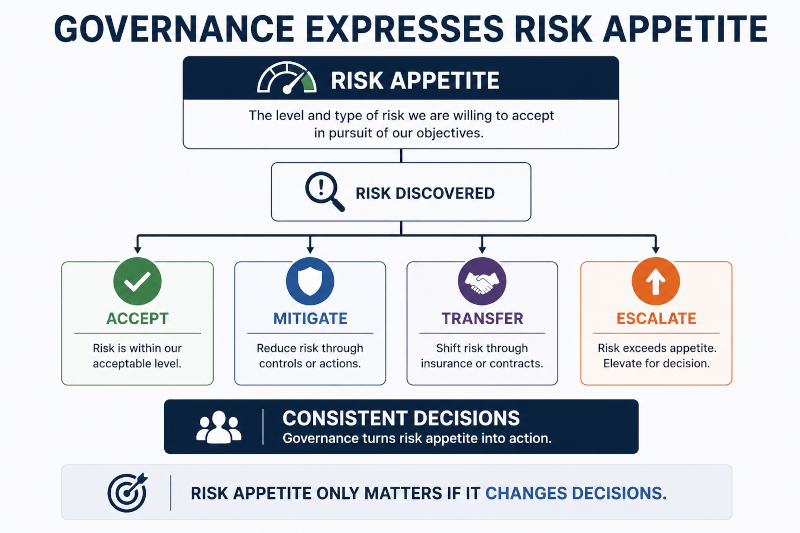
This inconsistency creates challenges far beyond cybersecurity.
Executives need a way to balance security, operational performance, customer experience, regulatory obligations, and financial objectives. Those tradeoffs cannot be solved through technical controls alone. They require governance structures that define who makes decisions, how decisions are made, and what level of risk the organization is willing to accept.
In many respects, governance is where cybersecurity becomes a business discipline rather than a technical discipline.
Organizations often spend significant time discussing threats and vulnerabilities. The more mature conversation focuses on accountability, ownership, decision rights, and acceptable levels of risk. Security teams may identify the problem, but governance determines how the organization responds.
As explored in our article, “Middle Management Will Change More Than Most Executives Expect,” information becomes less valuable when organizations lack the structures necessary to translate information into action. The same principle applies to cybersecurity.
Recommendation: Document formal risk acceptance thresholds and approval authorities so similar risks receive consistent treatment across the organization.
Why CISO Reporting Lines Matter Less Than Decision Rights
Few cybersecurity topics generate more debate than where the CISO should sit within the organization. Should the role report to the CIO, CFO, General Counsel, or directly to the CEO?
Each reporting structure has advantages and tradeoffs. Yet organizations often focus so heavily on reporting lines that they overlook a more important question: Can the CISO influence decisions?
A direct reporting relationship to the CEO may increase visibility, but visibility alone does not create influence. Conversely, a CISO reporting through another executive can still be highly effective if governance structures provide clear escalation paths, meaningful involvement in strategic decisions, and the authority to raise concerns when risks exceed acceptable thresholds.
The reporting structure sends a signal. Governance determines whether that signal translates into action.
“The reporting structure sends a signal. Governance determines whether that signal translates into action.”
This distinction matters because cybersecurity is increasingly intertwined with business transformation, cloud adoption, AI initiatives, mergers and acquisitions, and digital product development. When security leaders are excluded from these discussions, they often find themselves evaluating risk after key decisions have already been made.
Organizations with mature governance take a different approach. They bring cybersecurity into the conversation early, making security part of planning rather than a review step at the end.
The difference may seem subtle, but it has significant consequences. One model treats cybersecurity as a function that evaluates decisions. The other treats cybersecurity as a participant in decision-making.
That is where governance creates the greatest value.
Recommendation: Evaluate whether cybersecurity is represented during major business and technology decisions rather than focusing exclusively on reporting structures.
Case Study: The Board That Received Metrics but Not Decisions
A large organization invested heavily in cybersecurity reporting. Every quarter, executives and board members received detailed presentations filled with vulnerability metrics, incident statistics, compliance updates, and risk dashboards.
The reporting process was thorough. The governance process was not.
Board members received plenty of information, but little clarity about which risks required intervention, which decisions required approval, or which issues represented meaningful business exposure. Security teams focused on presenting data, assuming leadership would determine the appropriate response. Leadership assumed security teams would handle the issues operationally.
Both groups fulfilled their responsibilities. Yet important decisions remained unresolved.
The problem was not visibility. It was decision-making.
Over time, the organization changed its approach. Instead of leading with metrics, security leaders framed discussions around decisions, tradeoffs, and risk ownership. Rather than simply presenting findings, they clarified what actions were needed, who was responsible for making those decisions, and what was at stake.
Board engagement improved almost immediately.
The lesson is simple: governance is not about creating more reporting. It is about creating more clarity.
Executives rarely struggle because they lack data. More often, they struggle because the path from information to action is unclear.
Recommendation: Ensure every executive cyber-risk presentation includes a clear decision, action, or ownership request rather than relying solely on metrics and status reporting.
The Future Security Leader Is a Governance Leader
The cybersecurity profession has traditionally rewarded technical expertise. Organizations needed leaders who understood networks, infrastructure, vulnerabilities, security operations, and emerging threats. Those capabilities remain essential, but the role of the security leader continues to evolve.
Today’s CISOs are increasingly expected to engage with executives, advise boards, support business transformation, influence investment decisions, and help organizations navigate complex risk environments.
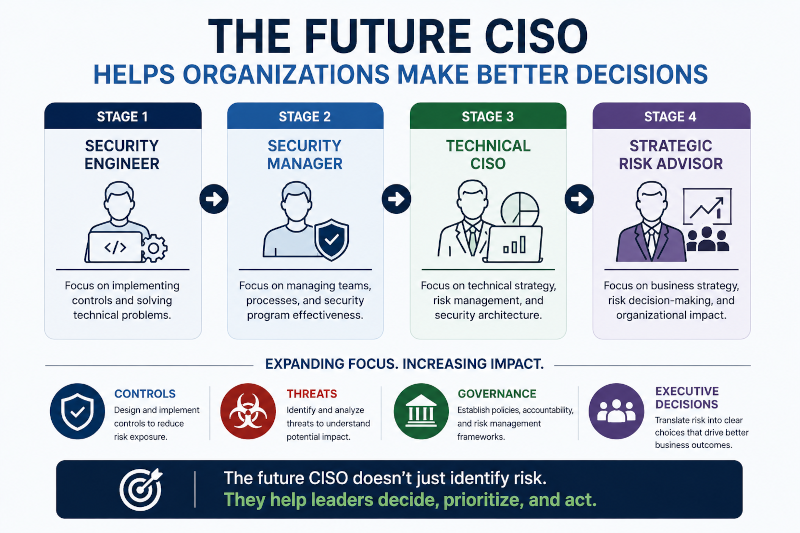
As a result, one of the most valuable cybersecurity skills is no longer identifying a vulnerability. It is helping the organization decide what to do about it.
This reflects a broader shift taking place across many disciplines. Information has become easier to generate, while the ability to interpret, prioritize, and act on that information has become more valuable. Security programs already produce enormous amounts of data. The real challenge is turning that information into better decisions.
The future CISO may spend less time discussing controls and more time discussing accountability. Less time producing reports and more time improving decision quality. Less time acting as a technical specialist and more time serving as a strategic advisor.
None of this diminishes the importance of technical expertise. It simply acknowledges a reality: cybersecurity outcomes depend as much on governance and decision-making as they do on technology.
Organizations that recognize this distinction are often better positioned to manage risk, allocate resources effectively, and adapt to an increasingly complex threat landscape.
Recommendation: Incorporate governance, decision-making, and executive communication skills into cybersecurity leadership development programs alongside technical training.
Conclusion
Organizations do not become secure because they collect more information about risk.
They become secure because they consistently make better decisions about risk.
Security tools identify vulnerabilities. Threat intelligence highlights emerging threats. Assessments reveal gaps. Dashboards provide visibility. All of these activities are valuable, but none of them reduce risk until someone decides what actions should follow.
That is the role of governance.
Without governance, cybersecurity can become a continuous stream of alerts, findings, reports, and recommendations. Activity increases. Visibility improves. Yet accountability remains unclear and important decisions stall.
The result is more noise, not stronger security.
The organizations that manage cyber risk most effectively understand that cybersecurity is not only about detecting threats or implementing controls. It is also about creating the structures, decision rights, and accountability mechanisms that allow information to become action.
Because security identifies risk. Governance determines what happens next.
Recommendation: Assess your cybersecurity program not only by the risks it identifies, but by how effectively it turns those risks into timely, accountable decisions.
1 thought on “Cybersecurity Governance: Turning Risk Into Decisions”