- Recommendations
- Human Systems Quietly Create Security Exposure
- SaaS Sprawl and Vendor Complexity Are Expanding the Attack Surface
- AI Is Expanding the Attack Surface Again
- Governance Failures Often Matter More Than Technical Failures
- Operational Resilience Is Becoming More Important Than Prevention Alone
- Building Security-Aware Organizations
Recommendations
- Organizations should begin treating cybersecurity as an enterprise operational design challenge rather than solely a technical control function.
- Review identity verification and approval workflows for gaps attackers could exploit.
- Track vendor access, inactive integrations, and privileged accounts continuously.
- Establish centralized governance policies for AI usage, sensitive data handling, approved tools, and human review responsibilities before AI adoption scales broadly.
- Clearly define executive accountability for cyber resilience, third-party dependency oversight, and cross-functional incident response coordination.
- Regularly test operational continuity plans, vendor failure scenarios, escalation paths, and recovery workflows under simulated disruption conditions.
- Prioritize operational simplicity, ownership clarity, and cross-functional visibility as foundational components of long-term cybersecurity resilience.
For decades, organizations primarily treated cybersecurity as a technical discipline.
Security teams focused on firewalls, endpoint protection, malware detection, network segmentation, and vulnerability management. Most cyber incidents were framed as technical failures requiring technical solutions. That model no longer reflects how modern organizations actually operate.
Today’s enterprise environments are deeply interconnected systems involving cloud platforms, SaaS ecosystems, vendors, contractors, APIs, remote employees, AI tools, identity platforms, collaboration systems, and operational workflows spread across hundreds of applications.
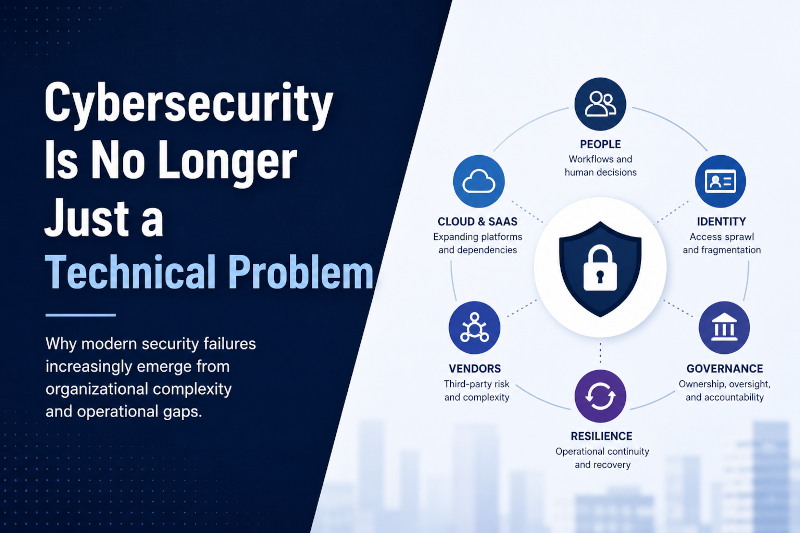
As organizations became more digitally interconnected, cybersecurity evolved into an organizational coordination problem rather than simply a technical one.
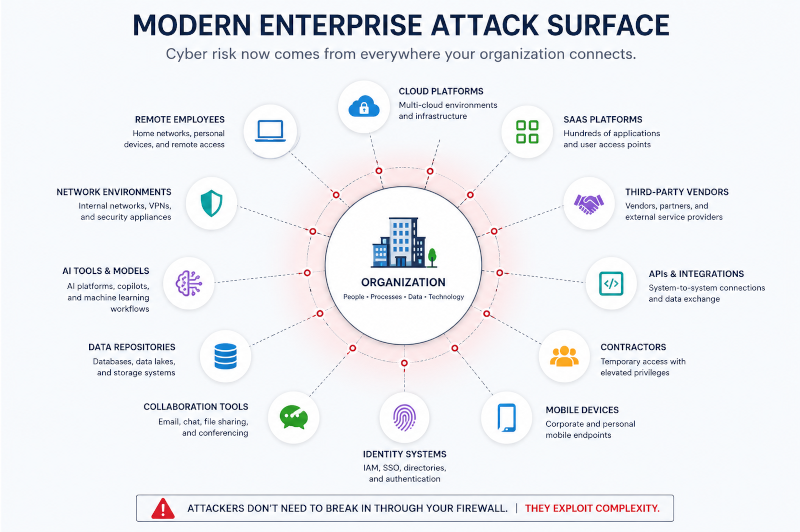
Modern security failures now frequently emerge from:
- fragmented workflows,
- unclear ownership structures,
- operational complexity,
- vendor sprawl,
- weak governance,
- and human communication gaps.
In many cases, attackers no longer need sophisticated technical exploits to cause major disruption. They simply exploit organizational complexity itself.
This shift is becoming increasingly visible across enterprise cybersecurity research. The World Economic Forum’s 2025 Global Cybersecurity Outlook noted that organizational complexity, supply-chain dependencies, and fragmented digital ecosystems are significantly increasing systemic cyber risk across industries.
Cybersecurity is no longer confined to IT departments. It increasingly reflects how organizations design workflows, govern access, coordinate decisions, manage vendors, and operate at scale.
Recommendation: Organizations should begin treating cybersecurity as an enterprise operational design challenge rather than solely a technical control function.
Human Systems Quietly Create Security Exposure
Many modern cyber incidents begin not with software vulnerabilities, but with human workflow vulnerabilities.
Employees operate inside increasingly complex environments involving password resets, vendor requests, access approvals, identity verification processes, remote communication systems, and escalating volumes of digital coordination. As these workflows become more fragmented, attackers increasingly target operational confusion rather than technical infrastructure directly.
The 2023 cyberattack against MGM Resorts International demonstrated this clearly. Attackers reportedly gained access through a social engineering attack targeting the company’s IT help desk. By impersonating an employee and manipulating identity verification processes, the attackers successfully obtained credentials that allowed broader access into MGM’s systems. The resulting disruption affected hotel operations, digital room keys, reservation systems, slot machines, and payment systems across multiple properties, with MGM later estimating roughly $100 million in related losses.
The incident highlighted a growing reality inside enterprise security environments: organizational workflows increasingly function as part of the attack surface itself.
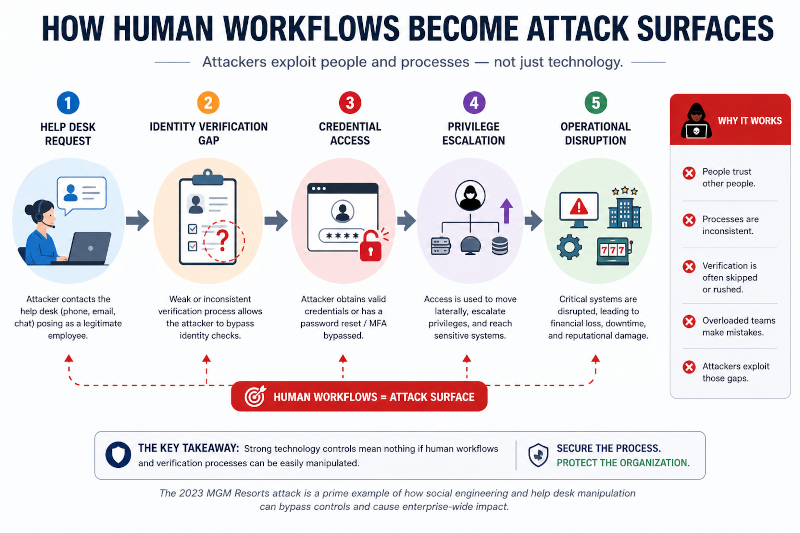
The problem was not simply a failed authentication mechanism. It was an operational process that allowed social engineering to bypass governance controls through human coordination systems.
Research from Verizon’s 2024 Data Breach Investigations Report similarly found that human involvement continues to play a major role in breaches, particularly through credential abuse, phishing, social engineering, and workflow exploitation.
As organizations scale, operational friction can unintentionally increase security exposure as well. Employees navigating excessive approvals, fragmented systems, and unclear workflows often develop informal workarounds that bypass governance controls entirely.
This is one reason cybersecurity increasingly overlaps with organizational design and workflow management rather than existing purely as a technical specialty.
Recommendation: Review identity verification and approval workflows for gaps attackers could exploit.
SaaS Sprawl and Vendor Complexity Are Expanding the Attack Surface
Modern enterprises increasingly operate across hundreds of SaaS platforms, cloud environments, integrations, contractors, and third-party providers. This flexibility accelerated organizational speed. It also dramatically expanded operational exposure.
In many organizations, employees now access sensitive data through interconnected systems that evolved faster than governance structures could adapt. Identity access often becomes fragmented across vendors, contractors, business units, and inherited systems over time.
The result is growing identity sprawl.
The 2024 Snowflake-related breaches demonstrated how dangerous this environment can become. Threat actors gained access to customer environments primarily through stolen credentials, weak identity controls, and the absence of multi-factor authentication across affected accounts. Importantly, public investigations suggested the issue was not a compromise of Snowflake’s platform itself, but rather weaknesses in how organizations governed customer-side identity management and credential hygiene.
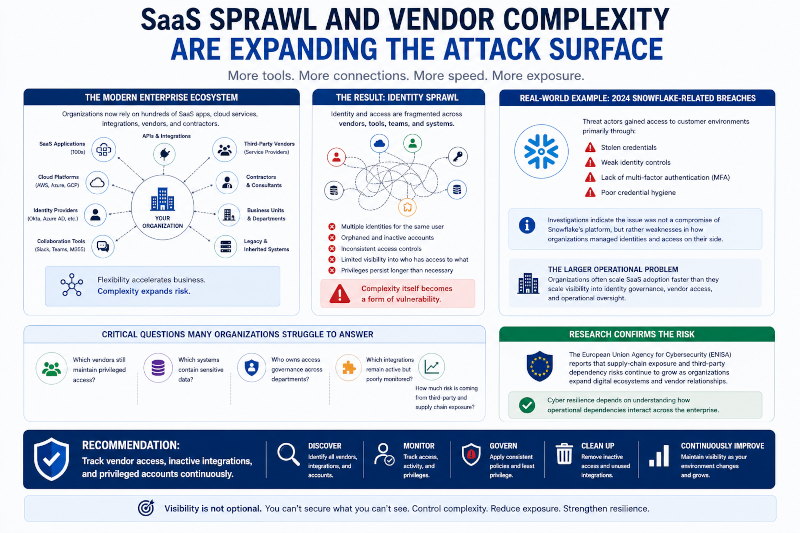
The incident exposed a larger operational problem affecting many enterprises: organizations often scale SaaS adoption faster than they scale visibility into identity governance, vendor access, and operational oversight.
As cloud ecosystems expand, many organizations struggle to answer relatively basic operational questions:
- Which vendors still maintain privileged access?
- Which systems contain sensitive data?
- Who owns access governance across departments?
- Which integrations remain active but poorly monitored?
This creates security environments where complexity itself becomes a form of vulnerability.
Research from the European Union Agency for Cybersecurity similarly emphasized that supply-chain exposure and third-party dependency risks continue growing as organizations expand digital ecosystems and interconnected vendor relationships.
Increasingly, organizations are discovering that cybersecurity resilience depends not only on preventing intrusion, but also on understanding how operational dependencies interact across the enterprise.
Recommendation: Track vendor access, inactive integrations, and privileged accounts continuously.
AI Is Expanding the Attack Surface Again
Artificial intelligence is already reshaping cybersecurity on both sides of the threat landscape.
Defenders increasingly use AI for threat detection, anomaly monitoring, incident response, and behavioral analysis.
Attackers are adapting just as quickly.
Generative AI systems are already being used to create more convincing phishing campaigns, automate reconnaissance, imitate writing styles, generate malicious code variants, and enhance social engineering operations at scale.
This changes the economics of cyberattacks significantly. Previously, many attacks required substantial manual effort or technical expertise. AI increasingly lowers those barriers.
The Federal Bureau of Investigation and multiple cybersecurity agencies have warned that AI-enhanced phishing and impersonation techniques are becoming more sophisticated, particularly in business email compromise and identity-targeted attacks.
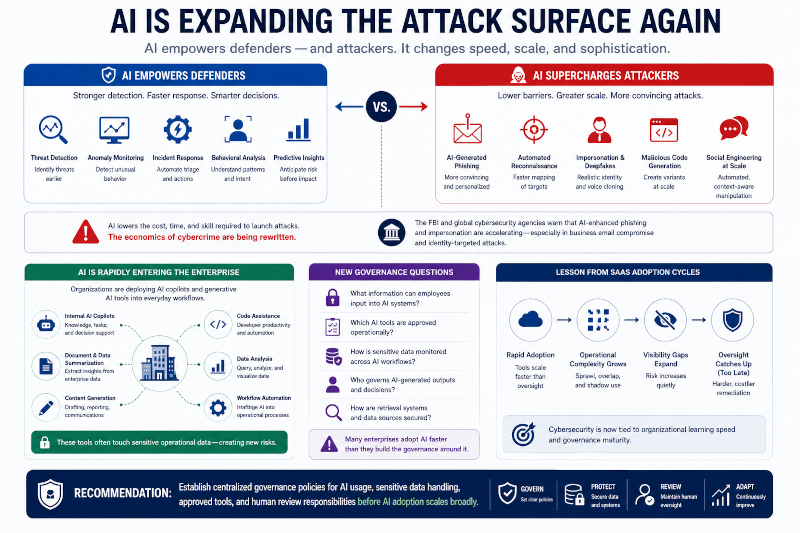
At the same time, organizations are rapidly deploying internal AI copilots and generative AI tools into workflows that often interact with sensitive operational data.
This introduces entirely new governance questions:
- What information can employees input into AI systems?
- Which AI tools are approved operationally?
- How is sensitive data monitored across AI workflows?
- Who governs AI-generated outputs?
- How are retrieval systems secured?
Many enterprises are currently deploying AI faster than they are redesigning governance structures around it. That pattern increasingly resembles earlier SaaS adoption cycles where operational complexity quietly expanded faster than oversight capability. Cybersecurity is therefore becoming deeply connected to organizational learning speed and governance maturity.
The challenge is no longer simply protecting infrastructure. It is governing rapidly evolving digital behavior across increasingly intelligent systems.
Recommendation: Organizations should establish centralized governance policies for AI usage, sensitive data handling, approved tools, and human review responsibilities before AI adoption scales broadly across departments.
Governance Failures Often Matter More Than Technical Failures
Many major cyber incidents ultimately reveal leadership and governance problems rather than purely technical weaknesses.
Organizations frequently invest heavily in security technologies while underinvesting in:
- ownership clarity,
- escalation structures,
- decision accountability,
- resilience planning,
- and cross-functional coordination.
This often creates fragmented security ownership across departments, where IT assumes legal manages governance, legal assumes security owns risk, and business leadership continues treating cybersecurity as primarily a technical issue. Over time, these assumptions create operational blind spots between teams that weaken coordination and delay effective response.
“Cyber resilience is no longer just an IT responsibility. It is an organizational leadership capability.”
The 2024 cyberattack against Change Healthcare illustrated how deeply interconnected operational systems can amplify disruption when governance and resilience planning lag behind organizational dependency. The ransomware attack disrupted healthcare payments, insurance processing, prescriptions, and clinical operations across the United States. The American Hospital Association later described the incident as one of the most consequential cyberattacks in U.S. healthcare history because of how heavily the broader healthcare system depended on a centralized operational intermediary.
The event exposed a broader reality: cybersecurity failures increasingly create operational consequences far beyond the breached organization itself. Modern enterprises operate inside interconnected ecosystems where disruption cascades across vendors, customers, suppliers, and operational partners. This is one reason cyber resilience is increasingly becoming a board-level governance issue rather than simply an IT concern.
Research from IBM’s 2024 Cost of a Data Breach Report similarly noted that organizations with stronger incident response coordination, governance maturity, and cross-functional preparation often reduced breach-related costs and recovery timelines significantly.
The strongest cybersecurity programs increasingly depend on organizational coordination quality as much as technical controls.
Recommendation: Organizations should clearly define executive accountability for cyber resilience, third-party dependency oversight, and cross-functional incident response coordination.
Operational Resilience Is Becoming More Important Than Prevention Alone
For many years, cybersecurity strategy focused heavily on prevention.
The assumption was that strong enough defenses could stop attackers entirely.
Modern enterprise environments are too interconnected and dynamic for that assumption to remain realistic indefinitely.
Today, many security leaders increasingly recognize that resilience may matter just as much as prevention.
The 2024 CrowdStrike outage demonstrated this dramatically. Although the incident was not a cyberattack, a flawed software update triggered operational disruptions across airlines, hospitals, financial institutions, logistics providers, and enterprises worldwide. The event exposed how deeply dependent modern organizations have become on interconnected technology providers and centralized operational infrastructure.
The lesson was broader than software reliability. It revealed how quickly operational disruption can cascade across globally connected systems.
Organizations with stronger contingency planning, redundancy structures, operational visibility, and recovery coordination often restored operations significantly faster than those operating with tighter dependency concentration.
Cyber resilience increasingly means:
- maintaining operational continuity,
- containing disruption,
- recovering quickly,
- and adapting under pressure.
That requires far more than technical defenses alone. It requires organizational preparedness.
Increasingly, cybersecurity resilience overlaps with:
- operational governance,
- crisis management,
- vendor diversification,
- communication coordination,
- and workflow adaptability.
Organizations that treat cybersecurity solely as perimeter defense may struggle in environments where disruption itself becomes unavoidable.
Recommendation: Organizations should regularly test operational continuity plans, vendor failure scenarios, communication escalation paths, and recovery workflows under simulated disruption conditions.
Building Security-Aware Organizations
The organizations adapting most effectively to modern cyber risk increasingly approach cybersecurity differently.
Rather than isolating security entirely inside technical departments, they integrate security awareness into operational behavior, workflow design, governance structures, and leadership decision-making.
Importantly, this does not mean turning every employee into a cybersecurity specialist. It means designing operational systems that reduce unnecessary exposure while improving organizational clarity.
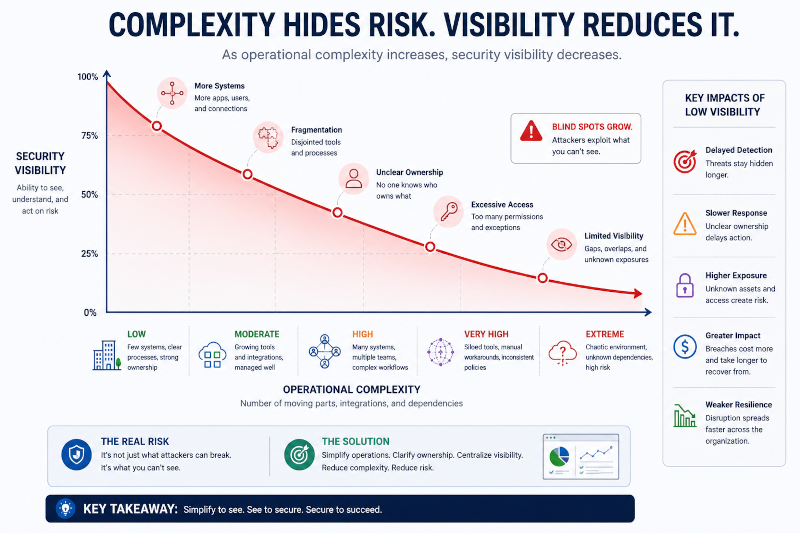
High-performing organizations increasingly focus on:
- simplifying access governance,
- reducing unnecessary privileges,
- clarifying ownership structures,
- standardizing workflows,
- improving vendor visibility,
- and strengthening coordination between technical and operational teams.
Security-aware organizations also recognize that excessive operational complexity quietly increases risk exposure over time. Fragmented systems create blind spots, disconnected tools weaken visibility, unclear ownership delays response, and overloaded employees become more vulnerable to manipulation and workflow mistakes. As a result, cybersecurity increasingly overlaps with operational simplification itself.
Organizations that scale securely often reduce complexity intentionally rather than continuously layering additional controls onto already fragmented systems.
Cybersecurity is no longer just about protecting infrastructure. It is increasingly about designing organizations that remain resilient, coordinated, and operationally visible in environments where digital complexity continues expanding rapidly.
In many ways, modern cybersecurity has become a reflection of organizational architecture itself.
Recommendation: Organizations should prioritize operational simplicity, ownership clarity, and cross-functional visibility as foundational components of long-term cybersecurity resilience.
4 thoughts on “Cybersecurity Is No Longer Just a Technical Problem”