
Recommendations
- Conduct a 30-day SaaS inventory exercise and require every department to identify all software subscriptions, owners, and renewal dates.
- Ask every department leader to identify one application they believe could be eliminated without materially affecting business outcomes.
- Generate a report of all applications connected to your identity provider and identify those without assigned business owners.
- Schedule an executive-level SaaS portfolio review within the next quarter and challenge every application to justify its continued existence.
Walk through the average enterprise technology environment and a familiar pattern emerges. Sales teams live in Salesforce. Marketing prefers HubSpot. Finance has its own budgeting platform. Human Resources operates Workday. IT manages Jira and ServiceNow. Somewhere along the way, Slack was introduced, followed by Teams, then an AI assistant, then another AI assistant because one department preferred a different interface.
No one planned for this to happen.
Most organizations arrived here through hundreds of reasonable decisions made over many years. A business unit needed a capability, found a cloud solution, secured a budget, and moved forward. Individually, these decisions improved agility. Collectively, they created a technology portfolio that few organizations fully understand.
The irony is difficult to ignore. Software-as-a-Service (SaaS) was supposed to simplify technology management. Instead, many organizations have merely traded infrastructure complexity for application complexity.
Recent industry data illustrates the scale of the problem. Zylo’s 2025 SaaS Management Index found that organizations manage an average of 275 SaaS applications, while larger enterprises often exceed several hundred applications across their environments. BetterCloud similarly reports that SaaS adoption remains nearly universal, with organizations continuing to expand their software portfolios despite ongoing consolidation initiatives.
Executives are beginning to recognize that this is not simply an IT issue. It is an operational issue.
Every additional application introduces new costs, new vendors, new integrations, new identities, and new risks. Eventually, organizations reach a point where they are no longer managing technology. Technology is managing them.
The Silent Growth of SaaS Sprawl
Technology environments rarely become unmanageable overnight. SaaS sprawl is the result of gradual accumulation.
Consider a hypothetical organization of 2,500 employees. Five years ago, it may have operated with fewer than 50 enterprise applications. Since then, departments have independently adopted collaboration tools, survey platforms, analytics applications, workflow automation software, AI assistants, project management solutions, and knowledge repositories.
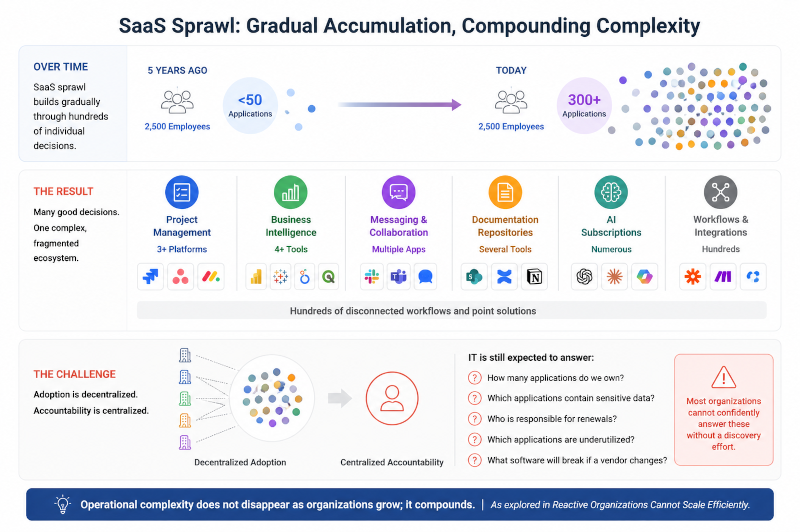
The result is an environment that looks something like this:
- Three project management platforms.
- Four business intelligence tools.
- Multiple messaging applications.
- Several documentation repositories.
- Numerous AI subscriptions.
- Hundreds of disconnected workflows.
By itself, none of these decisions appears problematic. Together, they create an ecosystem that becomes increasingly difficult to govern.
Industry data suggests this pattern is widespread. Productiv’s State of SaaS report found enterprises continue to struggle with visibility, utilization, and software redundancy across their portfolios.
The underlying issue is not that organizations have too much software. The issue is that software adoption has historically been decentralized while accountability remains centralized.
IT is still expected to answer questions such as:
- How many applications do we own?
- Which applications contain sensitive data?
- Who is responsible for renewals?
- Which applications are underutilized?
- What software will break if a vendor relationship changes?
Many organizations cannot confidently answer these questions without launching a discovery effort.
This observation builds on ideas explored in Reactive Organizations Cannot Scale Efficiently. Operational complexity does not disappear as organizations grow; it compounds.
Recommendation: Conduct a 30-day SaaS inventory exercise and require every department to identify all software subscriptions, owners, and renewal dates.
When Software Becomes an Operational Liability
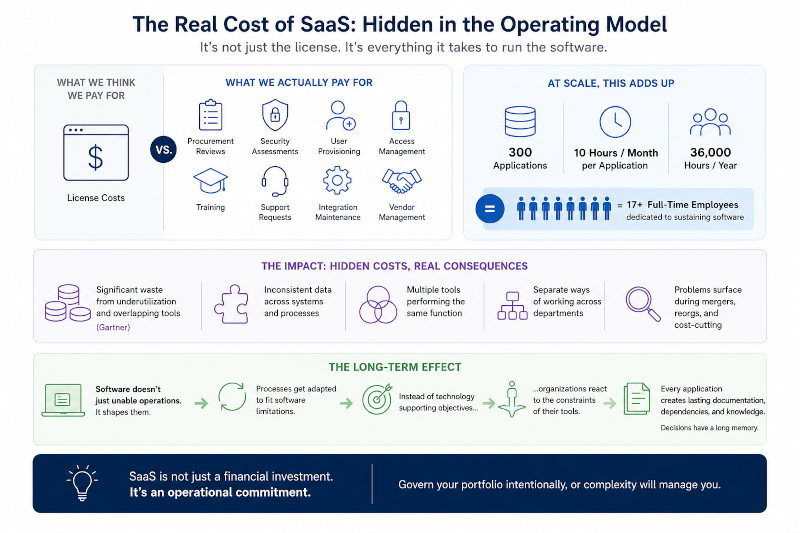
The conversation around SaaS often focuses on licensing costs. While software expenditures are substantial, the greater expense is frequently hidden within the organization’s operating model.
Every application introduces additional work:
- Procurement reviews
- Security assessments
- User provisioning
- Access management
- Training
- Support requests
- Integration maintenance
- Vendor management
At scale, these activities consume thousands of hours annually.
Imagine an organization operating 300 applications. Even if each application requires only ten hours of administrative effort per month across IT, procurement, and business stakeholders, that represents 36,000 hours annually. That is the equivalent of more than seventeen full-time employees dedicated solely to sustaining software operations.
This hidden labor rarely appears on financial statements.
Research from Gartner estimates that organizations waste significant portions of their software spend due to underutilization and overlapping capabilities, particularly as software purchasing becomes more decentralized.
The challenge becomes particularly visible during mergers, reorganizations, or cost reduction initiatives. Leaders discover multiple tools performing identical functions, inconsistent data across systems, and departments that have developed entirely separate ways of working.
Software does not simply enable operations. It shapes them.
Organizations that fail to intentionally govern their SaaS portfolios often find themselves adapting business processes to fit software limitations rather than selecting software to support business objectives.
As discussed in Why Documentation Is Becoming a Strategic Asset, technology decisions have a long memory. Every application leaves behind documentation requirements, process dependencies, and institutional knowledge that must be maintained long after the initial purchase decision.
Recommendation: Ask every department leader to identify one application they believe could be eliminated without materially affecting business outcomes.
Security’s Expanding Attack Surface
For years, cybersecurity strategies were built around protecting endpoints, networks, and data centers. That approach made sense when most work occurred within clearly defined environments. Today, however, the enterprise lives in the browser.
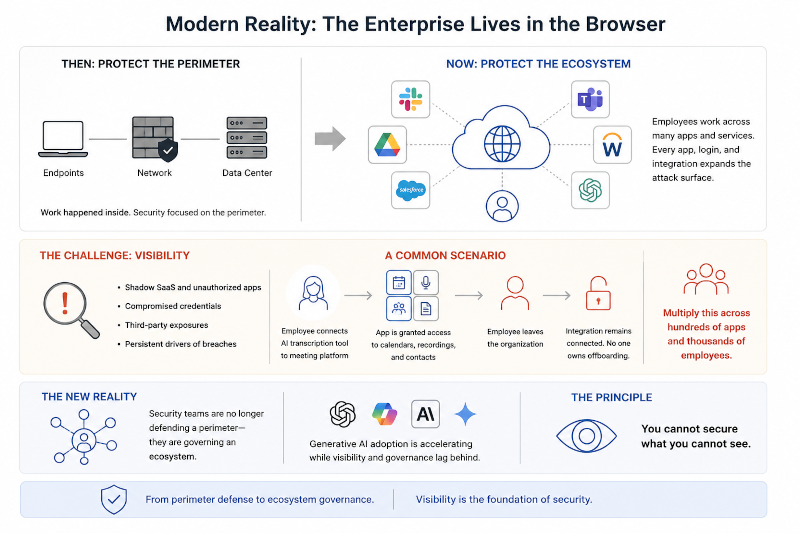
Employees move continuously between collaboration platforms, cloud storage, HR systems, CRM applications, AI tools, and countless third-party integrations. Every application, login, and connected service expands the organization’s attack surface.
The challenge is visibility. Reports from Wing Security continue to highlight the prevalence of shadow SaaS and unauthorized application adoption, while Verizon’s 2025 Data Breach Investigations Report points to compromised credentials and third-party exposures as persistent contributors to security incidents.
Consider a common scenario: a marketing employee connects an AI transcription tool to the company’s meeting platform. The integration is granted access to calendars, recordings, and contacts. Months later, the employee leaves, but the application remains connected because no one owns the offboarding process.
Now multiply that situation across hundreds of applications and thousands of employees.
Security teams are no longer defending a perimeter—they are governing an ecosystem. Generative AI has only accelerated this challenge as organizations race to adopt tools like ChatGPT, Copilot, Claude, and Gemini while still struggling to understand their existing software environments.
The principle remains unchanged: you cannot secure what you cannot see.
Recommendation: Generate a report of all applications connected to your identity provider and identify those without assigned business owners.
The Productivity Myth
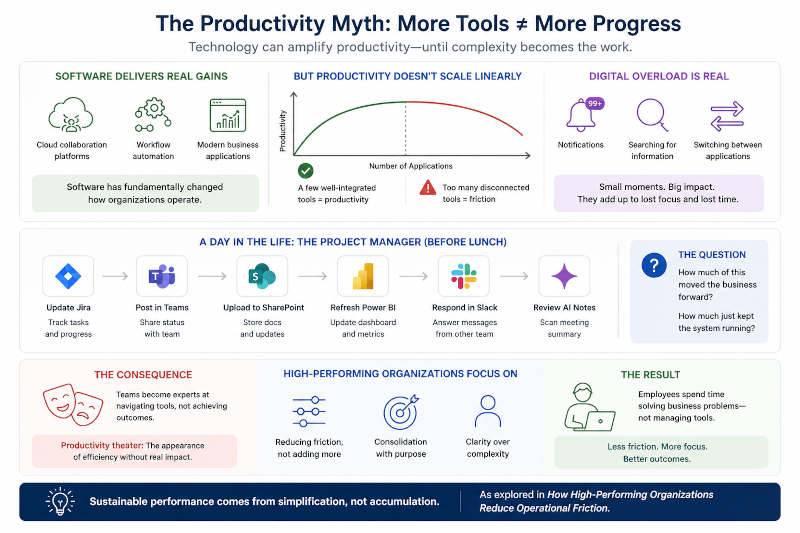
Software vendors have spent decades promising productivity gains, and to be fair, many of those promises have been realized. Cloud collaboration platforms, workflow automation tools, and modern business applications have fundamentally changed how organizations operate. The problem is not that software fails to improve productivity; it is that organizations often assume those gains continue indefinitely as additional tools are introduced.
In practice, productivity does not scale linearly with application count. There is a meaningful difference between an employee working effectively across a handful of well-integrated systems and one attempting to navigate dozens of disconnected platforms throughout the day. At a certain point, the burden shifts from performing work to managing the environment in which work occurs.
Microsoft’s Work Trend Index continues to highlight concerns around digital overload, interruptions, and fragmented work experience. Employees spend substantial portions of their day responding to notifications, searching for information, and transitioning between applications. Those moments may seem insignificant in isolation, but collectively they introduce a considerable amount of friction into the workday.
Consider the experience of a typical project manager. Before lunch, they may have updated Jira, posted status updates in Teams, uploaded documentation to SharePoint, refreshed a Power BI dashboard, responded to Slack messages from another workstream, and reviewed notes generated by an AI meeting assistant. By most measures, it would appear to have been a productive morning.
Yet that observation raises an uncomfortable question: how much of that effort moved the business forward, and how much was spent maintaining the machinery of modern work?
This is the subtle consequence of SaaS sprawl. Teams become exceptionally skilled at navigating tools, while organizations struggle to determine whether those tools are producing better outcomes. The result is what might be described as productivity theater—the appearance of operational efficiency without a corresponding increase in effectiveness.
High-performing organizations recognize that technology should reduce friction rather than redistribute it across additional platforms. That is why many leaders have shifted their focus toward consolidation efforts in recent years. The goal is not technological minimalism for its own sake; it is clarity. Employees should spend their time solving business problems, not acting as human middleware between disconnected systems.
This builds on ideas explored in How High-Performing Organizations Reduce Operational Friction, where sustainable performance is achieved not through the continual addition of new capabilities, but through the deliberate simplification of existing ones.
Recommendation: Survey employees to identify the five applications they use most frequently and the five they believe create the most friction.
The Next Wave: AI Sprawl
If the past decade taught organizations anything, it is that convenience almost always outpaces governance.
Most enterprises did not intend to build SaaS portfolios containing hundreds of applications. They simply allowed departments to solve problems independently over time. Generative AI is following a remarkably similar trajectory. In less than two years, organizations have gone from experimenting with a single AI platform to supporting multiple tools across business units, each with its own use cases, costs, and risk considerations.
A typical environment may include Microsoft Copilot for enterprise users, ChatGPT Team subscriptions for business functions, Claude for technical teams, Gemini for organizations operating within Google Workspace, and an expanding number of specialized AI applications supporting sales, marketing, customer service, and software development.
Unlike traditional SaaS applications, however, AI platforms introduce additional questions around data handling, intellectual property, and decision transparency. Recent reporting suggests that many organizations still lack comprehensive visibility into AI spending and adoption patterns, even as usage continues to grow.
There is a familiar feeling to all of this. The same organizations that spent years attempting to understand their SaaS environments are now preparing to manage an entirely new category of software layered on top of existing portfolios. Without clear governance, today’s handful of AI tools can quickly become tomorrow’s AI ecosystem.
Technology leaders should resist the temptation to treat AI as a separate initiative. It is simply the next evolution of software adoption. And if managing 300 applications proved difficult, adding another 50 AI services without a strategy is unlikely to improve the situation.
Recommendation: Establish a centralized AI approval process before AI adoption patterns become embedded across the organization.
From SaaS Management to Technology Portfolio Management
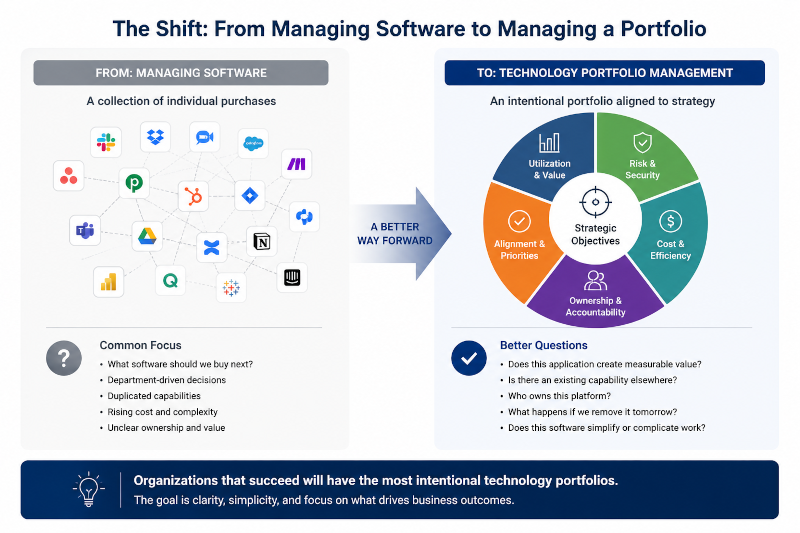
Mature organizations eventually reach the same conclusion: software should be managed with the same discipline applied to financial assets. The question is no longer, “What software should we buy next?” Instead, leaders are asking, “What is the minimum technology footprint required to achieve our strategic objectives?”
This shift requires organizations to think about software as a portfolio rather than a collection of individual purchases. Every application should have a clear owner, a defined business purpose, and measurable value. If those questions cannot be answered, organizations should consider whether the software deserves a place in their environment.
Portfolio thinking also forces leaders to ask difficult questions. Is this capability already available elsewhere in the organization? Does this application simplify work or introduce additional complexity? What would happen if we removed it tomorrow? The answers are often more revealing than expected.
The organizations that navigate the next decade most effectively will not necessarily have the largest or most sophisticated technology stacks. They will have the most intentional ones. Technology strategy has always been a series of tradeoffs, and the challenge for modern leaders is determining which applications genuinely contribute to business outcomes.
Conclusion
SaaS transformed enterprise technology by making software easier to acquire. In many organizations, it also made software easier to forget.
Over time, hundreds of reasonable decisions have produced environments defined by complexity, fragmented ownership, and limited visibility. What began as a strategy for agility has evolved into an operational challenge that touches finance, security, procurement, and employee productivity.
“The future belongs not to the organizations with the most software, but to those that can explain why every application exists.”
Organizations do not suffer from a lack of software. They suffer from an inability to distinguish essential software from merely available software.
The companies that thrive over the next decade will not be those with the largest technology portfolios. They will be the ones that understand precisely why every application exists, who owns it, and what value it delivers.
Because at some point, every executive must confront the same question:
If your SaaS stack disappeared tomorrow, how much of it would you actually miss?
Recommendation: Schedule an executive-level SaaS portfolio review within the next quarter and challenge every application to justify its continued existence.
5 thoughts on “Your SaaS Stack Is Out of Control”