Recommendations
- Audit critical workflows to determine whether execution depends on documented operational systems or informal employee behavior.
- Identify workflows that depend heavily on specific employees, informal approvals, or undocumented coordination patterns.
- Convert recurring tribal knowledge into searchable operational guidance before critical expertise leaves the organization.
- Standardize workflow logic, ownership structures, and operational decision paths before scaling AI-driven automation initiatives.
- Reduce coordination ambiguity by centralizing workflow ownership, retrieval paths, and operational guidance across teams and systems.
- Build operational systems that reduce dependency on memory, improvisation, and individual heroics over time.
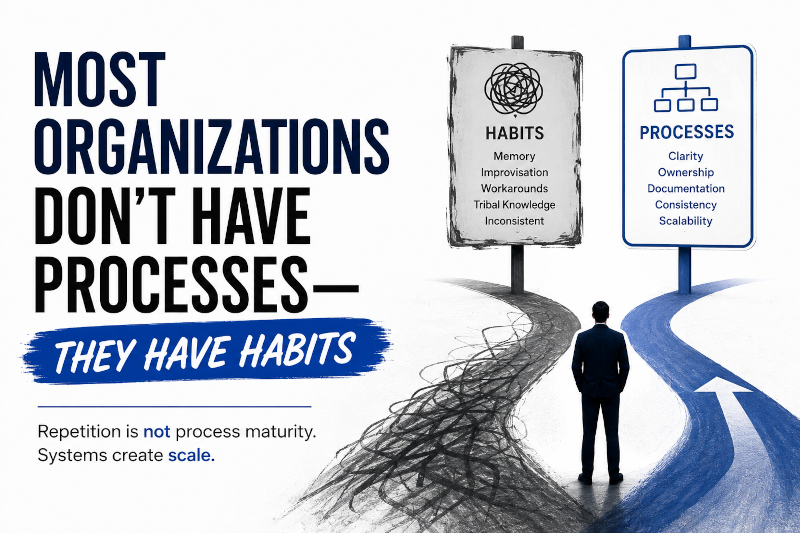
Many organizations believe they operate through structured processes.
In reality, many operate through repeated habits that happen to work well enough under stable conditions. Work gets completed because certain employees remember what to do, experienced managers know who to contact, teams improvise around gaps quietly, and institutional memory compensates for missing operational clarity.
This distinction matters far more than many leaders realize.
A process is something the organization can execute consistently, visibly, and reliably regardless of who happens to be available on a given day. A habit, by contrast, depends heavily on memory, informal coordination, workarounds, and social reinforcement accumulated over time.
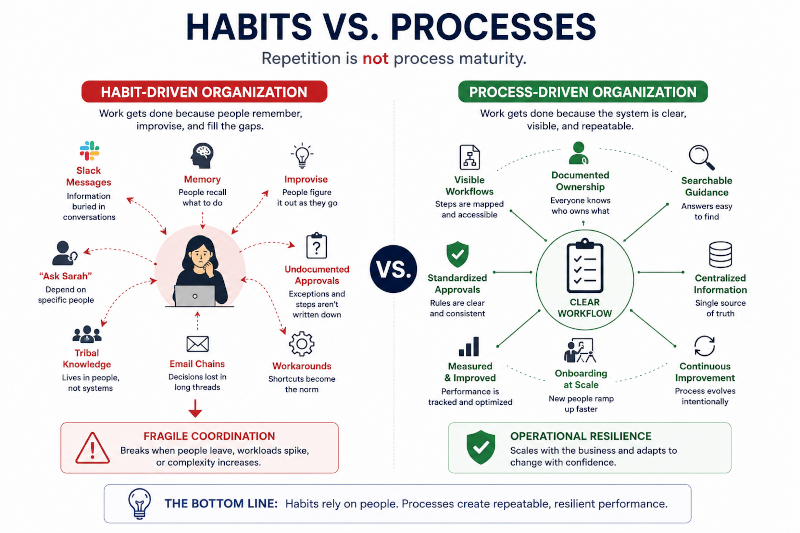
The problem is that habits often look like processes until complexity exposes the gaps.
APQC’s process maturity research notes that mature organizations rely on governance, documentation, measurement, and standardized operational management rather than informal execution patterns alone. Organizations with weak process maturity frequently struggle with scalability, consistency, and operational resilience.
This challenge is becoming more visible as organizations scale hybrid work, AI systems, cloud operations, and distributed workflows simultaneously. Environments that once functioned through informal coordination begin breaking down when operational complexity expands faster than organizational clarity.
As explored previously in The Strategic Case for Knowledge Management in 2026, operational execution increasingly depends on how effectively organizations preserve, retrieve, and operationalize institutional knowledge across systems and teams.
The uncomfortable reality for many enterprises is that their “processes” are often simply habits repeated by experienced employees long enough to appear stable.
Recommendation: Audit critical workflows to determine whether execution depends on documented operational systems or informal employee behavior.
Habits Scale Poorly
Habits can function surprisingly well inside small teams and relatively stable environments. Early-stage companies often move quickly precisely because people communicate informally, improvise continuously, and solve problems through direct relationships rather than structured systems.
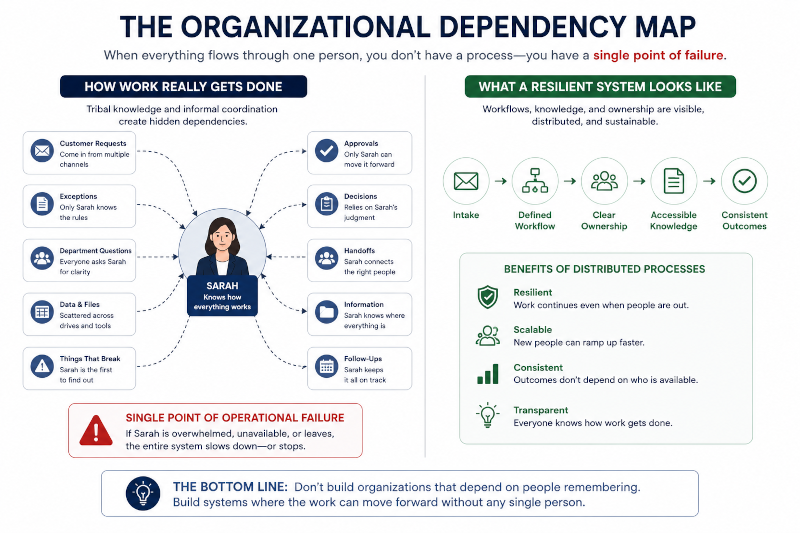
But scale changes the equation.
As organizations grow, coordination complexity expands dramatically. New employees arrive without historical context. Departments develop their own interpretations of workflows. Approval paths become inconsistent. Knowledge fragments across communication tools, spreadsheets, emails, and tribal memory.
What once felt agile gradually becomes operationally fragile.
This pattern appears repeatedly inside rapidly growing companies. A startup operating effectively with fifteen employees may struggle heavily after expanding to several hundred people because many “processes” existed only inside employee habits and informal coordination structures. Suddenly teams begin asking:
- Who owns this?
- Which version is correct?
- Who approves exceptions?
- Where is this documented?
The organization assumed it had operational maturity because work continued getting completed. In reality, it had accumulated coordination habits dependent on proximity, memory, and improvisation.
Research from McKinsey examining operational resilience emphasizes that modern organizations require scalable operating models capable of functioning consistently across changing conditions, workforce shifts, and digital complexity. Resilience depends heavily on operational visibility, standardization, and cross-functional coordination rather than isolated employee adaptability alone.
Southwest Airlines’ 2022 operational collapse offers a powerful real-world example of this challenge. Investigations following the disruption found that procedural complexity, outdated scheduling systems, and operational coordination failures contributed heavily to the airline’s inability to recover effectively during severe weather disruptions. Thousands of employees ultimately had to coordinate recovery manually under extreme operational stress.
The issue was not that employees lacked dedication or experience. The issue was that organizational complexity had outgrown the operational systems supporting coordination.
Habits depend on people remembering how work happens. Processes create visibility around how work should happen consistently.
That distinction becomes critical under pressure.
Recommendation: Identify workflows that depend heavily on specific employees, informal approvals, or undocumented coordination patterns.
Institutional Knowledge Quietly Becomes Operational Infrastructure
Many organizations underestimate how much operational continuity depends on invisible institutional memory.
Experienced employees often compensate for weak systems without leadership fully realizing it. They know which spreadsheet matters, which workflow exceptions exist, which system contains accurate information, and which approvals are unofficially required even if not documented anywhere formally.
Organizations frequently mistake this employee adaptability for process maturity. In reality, the organization is relying on human memory as operational infrastructure.
Healthcare environments provide strong examples of this dynamic. Hospitals and clinical systems often depend heavily on experienced nurses, coordinators, and administrators who understand how workflows actually function across departments despite fragmented systems and procedural inconsistencies. Much of this operational coordination exists through tacit knowledge rather than formal documentation.
The same pattern appears across legal firms, manufacturing environments, consulting organizations, and enterprise operations teams. Senior employees become institutional translators who quietly bridge operational gaps every day.
APQC’s recent process maturity research highlighted that many organizations struggle because process work becomes disconnected from how the business actually operates operationally. Documentation alone does not create process maturity. Governance, visibility, measurement, and operational integration matter equally.
“Documentation alone does not create process maturity.”
This becomes especially dangerous during turnover.
When highly experienced employees leave organizations operating primarily through habits, institutional knowledge disappears with them. New employees inherit fragmented systems, unclear workflows, undocumented exceptions, and incomplete operational context.
Suddenly leadership discovers that what appeared to be a scalable process was actually accumulated historical memory distributed unevenly across individuals.
This overlaps directly with themes explored previously in The Silent Productivity Killer: How Knowledge Managers Give You Your Time Back, where retrieval friction and fragmented knowledge environments quietly reduced execution quality across organizations.
Operational continuity often depends less on systems themselves and more on whether organizations have successfully externalized institutional knowledge into visible operational structures.
Mature organizations reduce dependency on memory over time. Immature organizations normalize it.
Recommendation: Convert recurring tribal knowledge into searchable operational guidance before critical expertise leaves the organization.
AI Exposes Weak Process Design
Artificial intelligence is accelerating another important shift: it is exposing operational ambiguity that organizations previously managed through human adaptability.
AI systems function best inside environments where workflows, ownership structures, retrieval systems, and operational logic remain relatively consistent. They struggle in environments dominated by undocumented exceptions, inconsistent coordination behavior, fragmented approvals, and habit-based execution patterns.
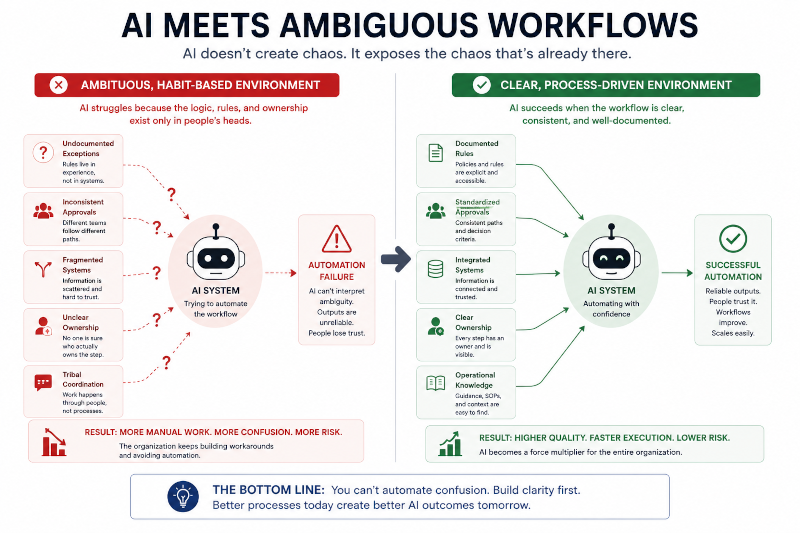
This is why many automation initiatives underperform.
Organizations often assume AI will eliminate inefficiency automatically. In practice, AI frequently magnifies existing operational confusion because the organization itself lacks standardized workflow logic.
An AI system cannot reliably automate a process that employees themselves interpret differently across departments.
For example, many companies attempting to automate approval workflows discover that approval logic exists primarily inside employee experience rather than documented governance structures. Employees “just know” who needs to approve specific exceptions based on historical precedent and informal organizational behavior.
Humans compensate for ambiguity naturally. AI systems generally cannot.
This is one reason organizations with mature knowledge environments and clearer process governance tend to scale AI more effectively. AI does not create operational discipline independently. It depends heavily on operational clarity already existing within the organization.
As explored previously in Why Employees Circumvent Security Policies, employees routinely create workarounds when systems fail to align with operational reality. AI systems expose similar tensions. They reveal where organizations rely on informal adaptation rather than consistent operational design.
The strategic implication is significant.
Organizations preparing for AI transformation often focus heavily on technology acquisition while underestimating the operational maturity required to support intelligent automation effectively.
AI does not create operational chaos. It exposes operational ambiguity that already existed quietly inside the organization.
Recommendation: Standardize workflow logic, ownership structures, and operational decision paths before scaling AI-driven automation initiatives.
Coordination Ambiguity Quietly Creates Cognitive Overload
Many organizations believe employees are overwhelmed primarily because workloads are too large.
Often, the larger issue is coordination ambiguity.
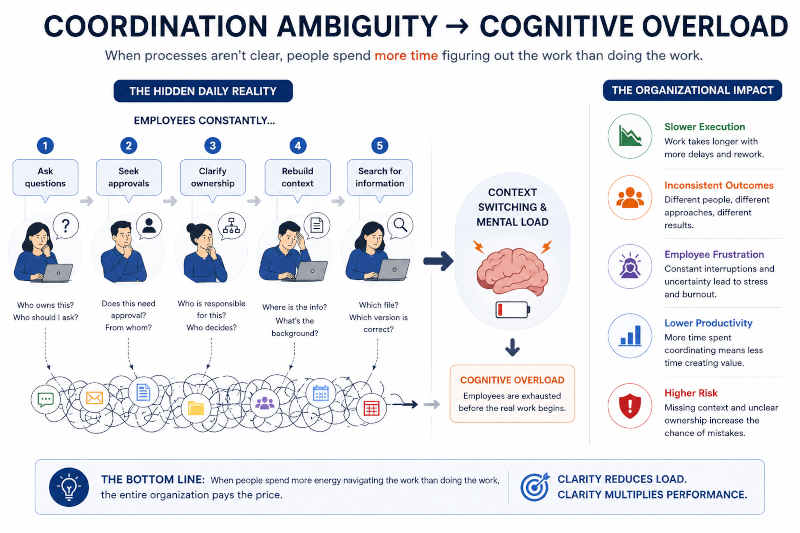
Employees spend enormous amounts of time rebuilding context, clarifying ownership, searching for information, validating decisions, and navigating fragmented workflows. Much of this effort exists because organizations rely on habits rather than operationally visible systems.
Workers constantly interrupt coworkers to ask:
- Where is this stored?
- Which version is current?
- Who handles this request?
- Has this already been approved?
- What is the actual process?
These interruptions accumulate into significant organizational cognitive load.
McKinsey’s operational resilience research similarly emphasizes that organizations operating effectively under complexity require strong coordination structures and integrated operational visibility rather than fragmented siloed processes.
The problem becomes especially severe in hybrid and distributed work environments where informal hallway coordination disappears. Teams that once relied on proximity and tribal communication suddenly discover that many workflows were never actually designed to function visibly or independently.
This creates operational drag that leadership often misinterprets as:
- low productivity,
- employee disengagement,
- or communication problems.
In reality, employees are frequently exhausting cognitive capacity navigating ambiguity.
The strongest organizations reduce unnecessary coordination work through:
- clearer ownership,
- retrieval visibility,
- operational standardization,
- and accessible workflow guidance.
This does not eliminate human flexibility. It reduces dependency on constant improvisation.
The future of operational maturity may depend less on how efficiently employees adapt to broken systems and more on how effectively organizations reduce ambiguity itself.
Recommendation: Reduce coordination ambiguity by centralizing workflow ownership, retrieval paths, and operational guidance across teams and systems.
Conclusion: Mature Organizations Design Systems, Not Heroics
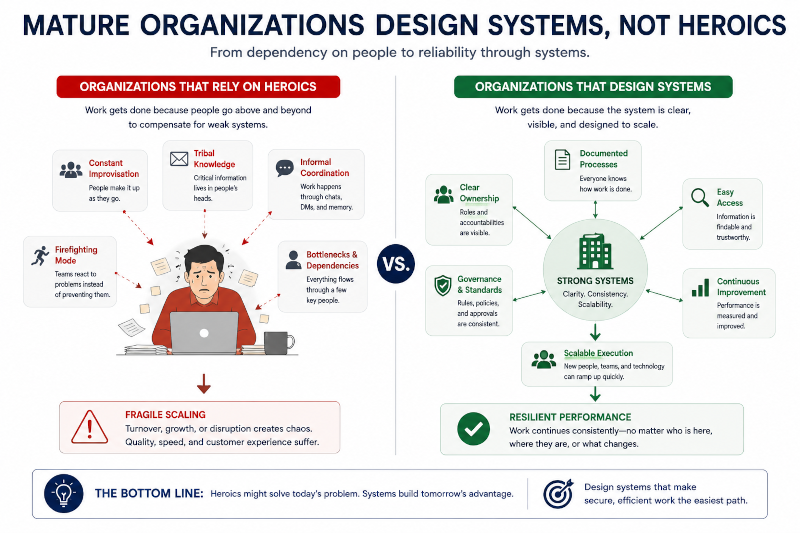
Most organizations do not fail because employees lack effort.
In many cases, employees work extraordinarily hard compensating for operational systems that were never designed to scale clearly in the first place.
Weak operational environments often survive because experienced employees continuously bridge gaps through memory, improvisation, relationships, and historical context. Over time, organizations mistake this adaptability for process maturity.
But habits eventually break under pressure.
Growth, turnover, AI adoption, operational complexity, remote coordination, and system fragmentation all expose the limits of informal operational behavior.
The organizations operating most effectively at scale are rarely the organizations relying on constant heroics.
More often, they are the organizations building:
- visible workflows,
- standardized coordination structures,
- operational retrieval systems,
- governance clarity,
- and scalable process intelligence.
APQC’s process maturity research emphasizes that process management succeeds when institutionalized operationally rather than treated as isolated documentation exercises.
This is the critical distinction many organizations miss:
a process is not simply something people repeat.
It is something the organization can execute consistently, visibly, and reliably even as complexity grows.
The future of operational resilience may depend less on employee improvisation and more on how effectively organizations transform habits into scalable systems.
Recommendation: Build operational systems that reduce dependency on memory, improvisation, and individual heroics over time.
6 thoughts on “Most Organizations Don’t Have Processes — They Have Habits”