- Recommendations
- Security Policies Often Fail Operationally
- Security Friction Quietly Competes With Productivity
- Shadow IT Is Often an Operational Symptom
- Security Policies Often Ignore Real Workflow Conditions
- AI Will Amplify Both Security and Circumvention
- Human-Centered Security Is Becoming Operationally Necessary
Recommendations
- Identify where security controls create workflow bottlenecks that encourage employees to prioritize speed and execution continuity over formal compliance procedures.
- Measure how security controls affect workflow speed, approval latency, and employee coordination burden rather than evaluating controls solely through compliance metrics.
- Investigate why employees adopt unauthorized tools before focusing solely on enforcement and restriction policies.
- Test security policies under realistic operational conditions involving interruptions, urgency, and coordination pressure rather than relying solely on theoretical compliance models.
- Build governance, verification, and retrieval visibility into AI-assisted workflows before scaling automation across sensitive operational environments.
- Design security controls that support execution speed, workflow continuity, and usability while preserving governance and operational visibility across enterprise systems.
Security Policies Often Fail Operationally
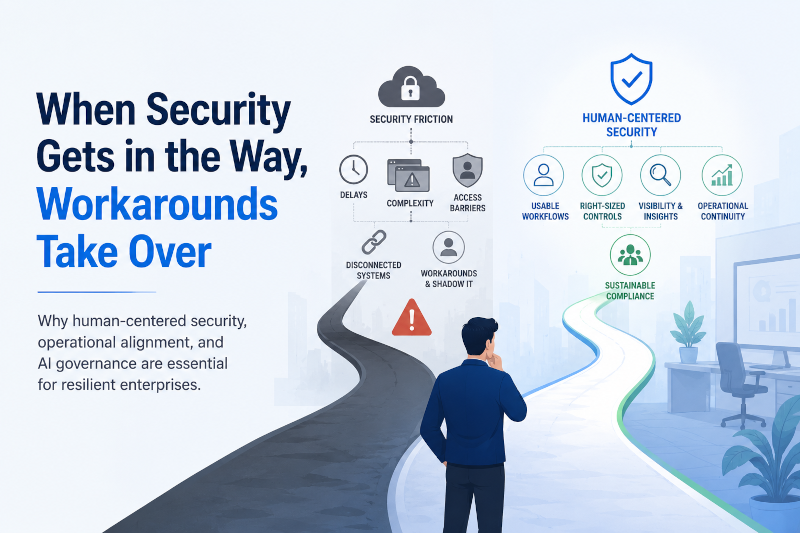
Most organizations assume employees bypass security policies because they are careless, resistant to compliance, or insufficiently trained. In reality, the issue is often far more operational than behavioral.
Modern employees work inside environments defined by constant notifications, fragmented workflows, meeting overload, remote coordination, and continuous pressure to maintain execution speed. At the same time, security teams continue adding authentication steps, approval workflows, device restrictions, monitoring requirements, password policies, and compliance controls intended to reduce organizational risk. Individually, many of these controls make sense. Collectively, however, they can create operational friction that quietly competes with productivity itself.
This tension is becoming more visible across enterprise environments. Research from the 2025 Verizon Data Breach Investigations Report noted that identity abuse, credential compromise, and human interaction remain central components of modern breaches, while operational complexity and inconsistent security adoption continue creating exploitable gaps across organizations.
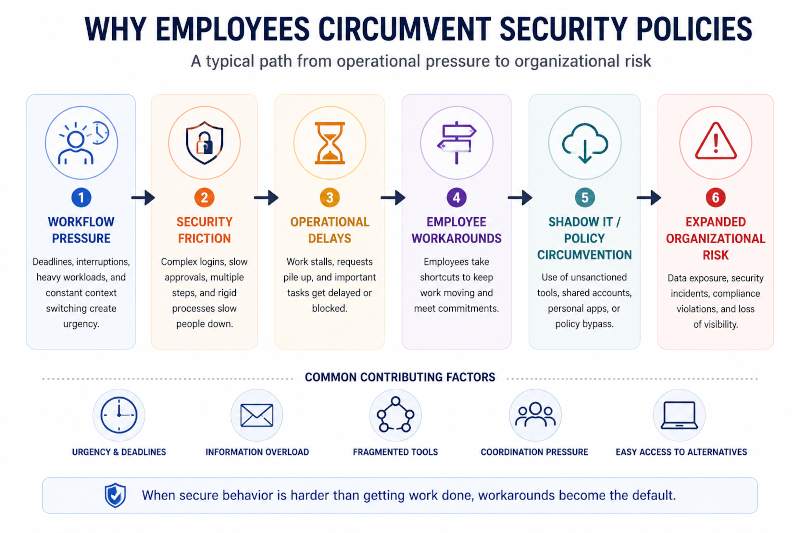
Employees rarely wake up intending to violate security policy. More often, they encounter systems that make secure behavior harder than completing the work itself.
A finance employee bypasses approval workflows because vendor payments are delayed. An engineer stores files locally because VPN performance slows development work. A project manager uses unsanctioned collaboration software because official tools create coordination bottlenecks across teams. Over time, these workarounds evolve into normalized operational behavior.
This overlaps closely with themes explored previously in The Hidden Cost of Manual Internal Processes, where fragmented workflows and excessive coordination overhead quietly reduced execution quality long before failures became visible organizationally.
The challenge for leadership is therefore not simply enforcing stricter policy adherence. It is understanding why employees feel operationally pressured to bypass controls in the first place.
Recommendation: Identify where security controls create workflow bottlenecks that encourage employees to prioritize speed and execution continuity over formal compliance procedures.
Security Friction Quietly Competes With Productivity
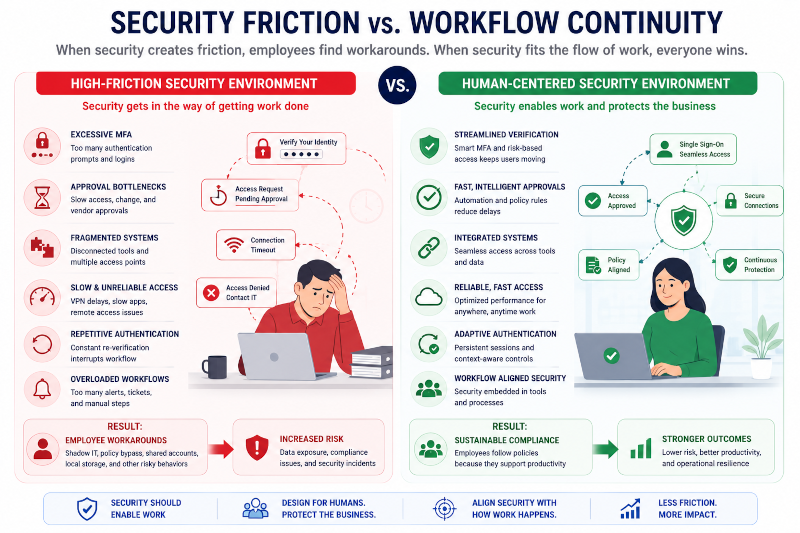
One of the most underestimated cybersecurity risks inside modern enterprises is security-induced workflow friction.
Employees now operate inside machine-speed coordination environments where messages, approvals, tickets, meetings, dashboards, and operational requests move continuously throughout the day. Under those conditions, even well-designed security procedures can begin competing directly with execution speed.
Research from Microsoft and LinkedIn’s 2024 Work Trend Index found that employees already feel overwhelmed by the pace and volume of work, with many workers turning to AI and automation tools specifically to reduce operational pressure and reclaim time. The report also found that 75% of knowledge workers now use AI at work, often because existing workflows feel unsustainable operationally.
This matters because security policies rarely exist in isolation. They operate inside already overloaded systems.
When employees repeatedly encounter:
- excessive authentication requests,
- slow approval chains,
- fragmented access systems,
- repetitive verification steps,
- or delayed support processes,
many begin optimizing for workflow continuity rather than strict compliance.
This is not necessarily malicious behavior. It is frequently adaptive behavior.
Uber’s 2022 breach demonstrated how workflow fatigue can intersect with security vulnerability. Attackers reportedly bombarded an employee with repeated MFA requests until the user eventually approved access, illustrating how security mechanisms themselves can become operational stressors under persistent pressure.
Research from Gartner’s cybersecurity friction analysis similarly emphasized that excessive cybersecurity-induced friction often leads employees toward less secure practices as they attempt to maintain productivity and reduce operational interruption.
This is one reason human-centered security design is becoming strategically important. Organizations that align security controls with real workflow behavior often experience stronger adoption and fewer informal workarounds than organizations relying primarily on restrictive enforcement alone.
The strongest security environments therefore do not simply block unsafe behavior. They make secure behavior operationally sustainable.
Recommendation: Measure how security controls affect workflow speed, approval latency, and employee coordination burden rather than evaluating controls solely through compliance metrics.
Shadow IT Is Often an Operational Symptom
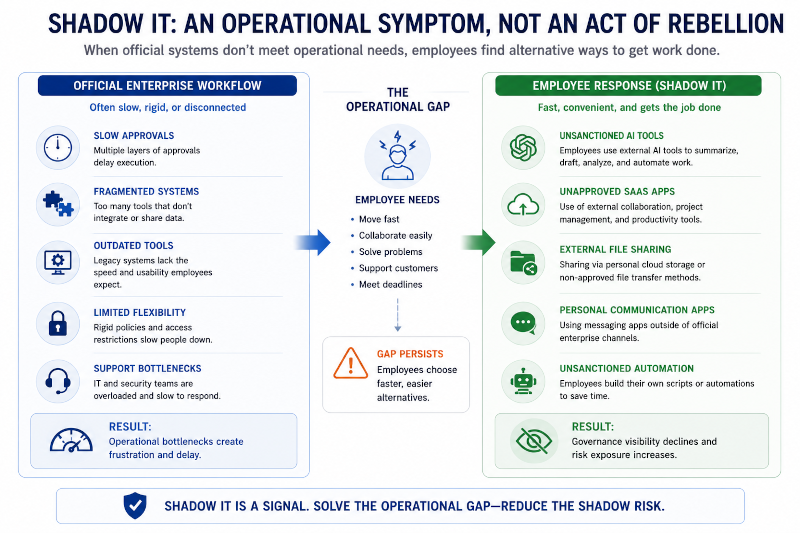
Many organizations still treat shadow IT primarily as a governance failure. In practice, it is often a signal that official systems are failing operationally.
Employees adopt unauthorized software, collaboration platforms, AI tools, and automation systems because those tools solve problems that formal enterprise systems often handle poorly. When approved workflows move too slowly or create excessive coordination overhead, employees naturally seek alternatives capable of helping them execute work faster.
This dynamic has accelerated sharply with generative AI adoption.
Research from Microsoft’s 2024 Work Trend Index found that 78% of AI users are bringing their own AI tools into the workplace, a trend now widely referred to as “Bring Your Own AI” or shadow AI.
This creates a major governance challenge.
Employees increasingly upload documents, summarize meetings, analyze spreadsheets, generate reports, and automate tasks using tools that enterprise security teams may not fully monitor or govern. The issue is not simply policy violation. It is operational demand moving faster than enterprise governance structures.
Samsung encountered a highly publicized example of this problem when employees reportedly uploaded sensitive source code and internal data into public AI systems during early experimentation with generative AI tools. Similar concerns have since emerged across finance, healthcare, legal, and technology sectors as employees adopt external AI systems faster than organizations can establish governance frameworks.
Research examining shadow AI adoption also suggests that employees frequently turn to unauthorized tools because approved alternatives either do not exist or fail to support operational execution effectively.
This mirrors broader operational coordination themes explored previously in The Future of Operational Intelligence in AI-Driven Organizations, where governance maturity struggled to keep pace with the rapid integration of AI systems into enterprise workflows.
The organizations managing shadow IT most effectively are often not the organizations imposing the strictest restrictions. More often, they are the organizations building secure systems employees genuinely want to use operationally.
Recommendation: Investigate why employees adopt unauthorized tools before focusing solely on enforcement and restriction policies.
Security Policies Often Ignore Real Workflow Conditions
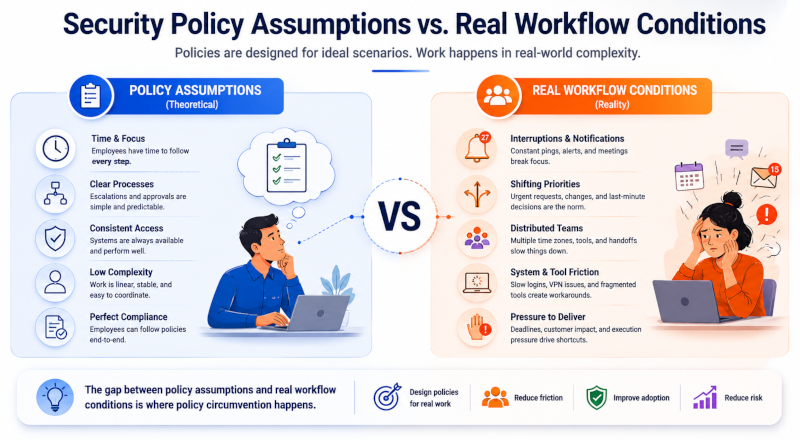
One of the largest weaknesses in many enterprise security programs is that policies are frequently designed around idealized compliance environments rather than actual operational conditions.
Policies often assume employees have:
- sufficient time,
- uninterrupted focus,
- clear escalation pathways,
- consistent system access,
- and low coordination complexity.
Modern enterprises rarely operate that way.
Employees instead work inside environments filled with interruptions, shifting priorities, distributed communications, cross-functional coordination, vendor dependencies, and constant context switching. Under those conditions, security procedures that appear reasonable on paper can become difficult to execute consistently in practice.
The MGM Resorts breach illustrated this challenge clearly. Attackers reportedly used social engineering techniques against internal support personnel to gain system access, exploiting operational processes designed for speed and customer responsiveness. The issue was not simply technical weakness. It was a workflow vulnerability under real-world pressure.
Research cited by Gartner’s human-centric cybersecurity guidance emphasized that employees frequently perceive security guidance as unrealistic, overly complex, or poorly aligned with how work actually occurs operationally. Gartner also noted that organizations adopting human-centric security design practices often improve security control adoption while reducing unsafe behavior.
This is an important shift because many organizations still frame policy circumvention primarily as an employee discipline problem rather than an operational systems problem.
In reality, secure behavior becomes difficult to sustain when workflows themselves are overloaded.
The organizations adapting most effectively are beginning to redesign security around actual employee behavior patterns rather than theoretical compliance assumptions. That includes simplifying verification, reducing repetitive approval structures, streamlining authentication experiences, and embedding security directly into workflows rather than layering it on top afterward.
Recommendation: Test security policies under realistic operational conditions involving interruptions, urgency, and coordination pressure rather than relying solely on theoretical compliance models.
AI Will Amplify Both Security and Circumvention
AI adoption is accelerating across enterprise environments because employees and organizations both recognize its productivity potential. But AI will also amplify many existing governance and security weaknesses already embedded inside operational systems.
Employees now use AI systems to summarize meetings, generate reports, draft communications, analyze data, automate repetitive tasks, and accelerate workflow coordination. When official enterprise AI tools lag behind operational demand, employees often adopt external systems independently.
Research from Microsoft’s Work Trend Index found that employees are often moving faster on AI adoption than leadership teams themselves, creating governance gaps around security, visibility, and operational oversight.
This creates a major enterprise challenge because AI amplifies both:
- efficient systems,
- and broken systems.
Inside well-governed environments, AI can improve retrieval, automate repetitive coordination work, reduce operational friction, and strengthen execution consistency. Inside fragmented environments, however, AI can accelerate insecure workarounds, amplify policy bypass behavior, and increase dependency on poorly governed systems.
Research from the Stanford AI Index Report 2024 emphasized that organizations continue scaling AI faster than governance, accountability, and operational oversight frameworks mature around those systems.
“Inside well-governed environments, AI accelerates productivity. Inside fragmented environments, it accelerates chaos.”
This means organizations can no longer approach security governance separately from workflow design, knowledge systems, operational coordination, and AI deployment strategy.
The future of enterprise security may depend less on restricting employee behavior and more on designing operational environments where secure behavior becomes naturally aligned with execution efficiency itself.
Recommendation: Build governance, verification, and retrieval visibility into AI-assisted workflows before scaling automation across sensitive operational environments.
Human-Centered Security Is Becoming Operationally Necessary
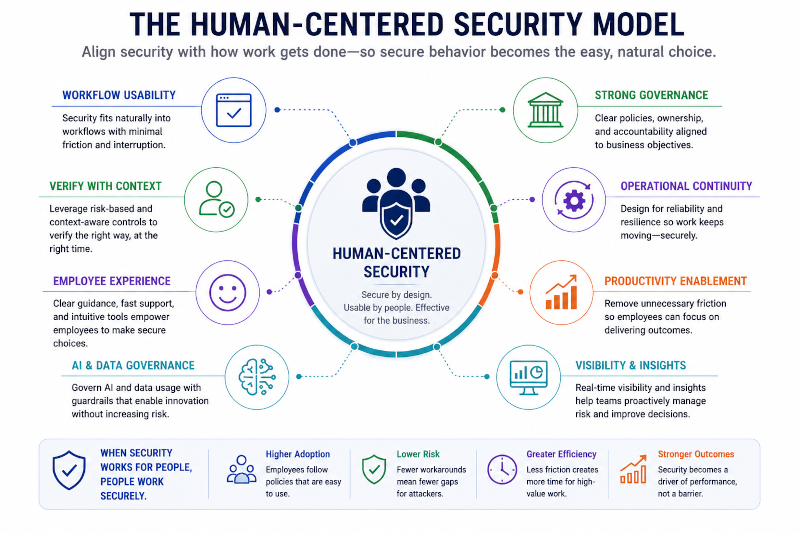
The organizations managing cybersecurity most effectively are beginning to recognize a difficult reality: security systems fail when they consistently conflict with how work actually happens.
Employees do not operate inside static compliance environments. They operate inside dynamic coordination systems shaped by deadlines, interruptions, competing priorities, fragmented tools, and continuous operational pressure.
This changes how organizations must think about cybersecurity governance itself.
Research from Gartner’s cybersecurity trends research found that organizations adopting human-centric security practices often improve agility, strengthen control adoption, and reduce unsafe behavior across enterprise environments.
The strongest security environments therefore do not simply enforce rules. They reduce unnecessary friction while preserving governance, visibility, accountability, and operational resilience.
This does not mean weakening security standards. It means recognizing that security succeeds when employees can sustain secure behavior consistently under real operational conditions.
The organizations adapting most effectively to machine-speed enterprise environments may not necessarily be the organizations deploying the largest number of controls. More often, they may be the organizations building security systems aligned closely enough with workflow reality that employees no longer feel operationally pressured to circumvent them.
Recommendation: Design security controls that support execution speed, workflow continuity, and usability while preserving governance and operational visibility across enterprise systems.
2 thoughts on “Why Employees Circumvent Security Policies”