- Recommendations
- Manual Internal Processes Quietly Shape Enterprise Performance
- Operational Friction Creates Hidden Organizational Drag
- Cognitive Overload Quietly Reduces Execution Quality
- Manual Processes Often Create Governance and Security Gaps
- AI Will Amplify Broken Processes Before It Fixes Them
- Operational Simplicity Is Becoming Competitive Advantage
Recommendations
- Identify workflows where employees spend more time coordinating work than executing work.
- Reduce repetitive approvals, duplicate data entry, and manual reconciliation across systems.
- Standardize operational workflows before layering AI or automation on top of fragmented processes.
- Centralize operational visibility instead of distributing work across disconnected tools and email chains.
- Treat workflow simplification as a governance and resilience initiative, not just a productivity project.
- Measure operational friction using coordination delays, context switching, and execution inconsistency rather than labor hours alone.
Manual Internal Processes Quietly Shape Enterprise Performance
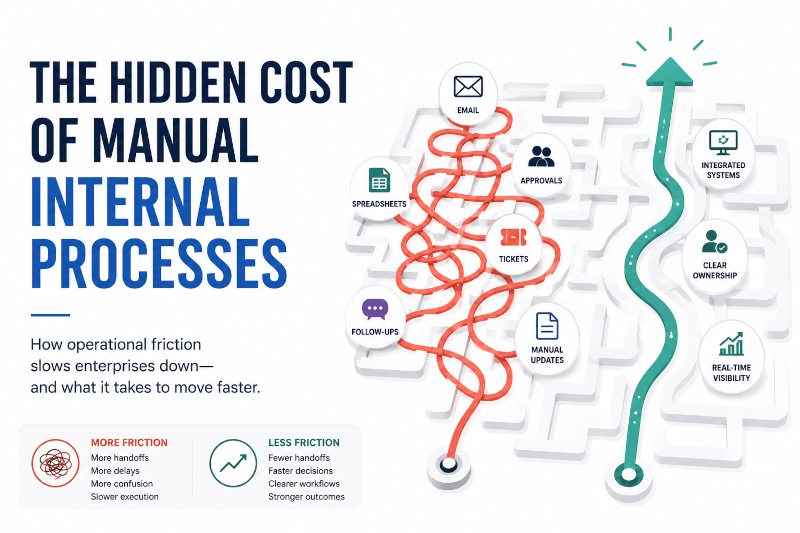
Most organizations still think about manual internal processes primarily as productivity inefficiencies. Employees spend time updating spreadsheets, chasing approvals, forwarding emails, reconciling systems, copying data between platforms, or coordinating work through fragmented communication channels. These tasks are often treated as operational inconveniences rather than structural business risks.
But the larger issue is not the task itself. It is the hidden operational friction created when organizations depend heavily on human coordination to move work across more complex environments.
In practice, manual internal processes quietly create:
- execution delays,
- fragmented visibility,
- duplicated effort,
- and coordination bottlenecks that compound over time.
A delayed approval chain may seem minor in isolation, just like duplicate data entry or inconsistent escalation handling. Yet across large enterprises, these inefficiencies accumulate into operational drag that weakens scalability, slows decision-making, and reduces organizational adaptability.
Research from the Microsoft 2024 Work Trend Index found that employees across modern enterprise feel overwhelmed by the pace and fragmentation of modern work environments. Microsoft reported that workers now spend much of their time navigating communication systems rather than focusing on creation-oriented work, while constant interruptions, meeting overload, and rising coordination complexity continue expanding across enterprise environments.
This challenge becomes even more significant as organizations scale AI adoption, SaaS ecosystems, remote coordination, and cross-functional workflows simultaneously. Enterprises increasingly operate inside environments where operational complexity expands faster than governance and coordination systems can adapt.
This overlaps closely with themes explored previously in The Future of Operational Intelligence in AI-Driven Organizations, where operational performance depended on real-time coordination, workflow integration, and organizational visibility rather than static reporting structures alone.
The organizations struggling most operationally are often not the ones lacking talent or technology. More often, they are the organizations where work moves too slowly across fragmented internal systems.
Recommendation: Identify workflows where employees spend more time coordinating work than executing work.
Operational Friction Creates Hidden Organizational Drag
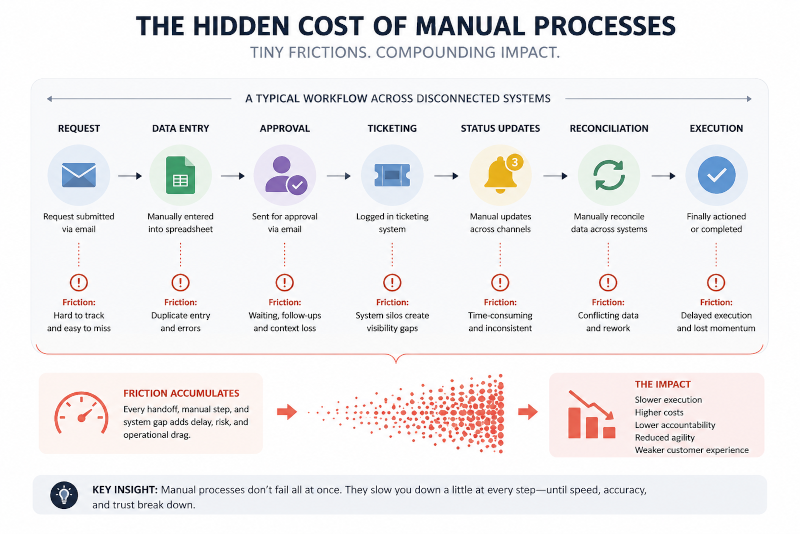
One of the most overlooked consequences of manual internal processes is the accumulation of operational friction across the enterprise. Modern organizations often rely on email approvals, spreadsheet tracking, disconnected ticketing systems, manual status updates, repetitive reporting, and fragmented communication workflows that force employees to continuously coordinate work across systems and departments.
These coordination layers rarely appear directly on financial statements, yet they shape execution quality constantly. Employees spend large amounts of time searching for updates, clarifying ownership, validating information, and manually synchronizing workflows across environments that were never fully designed to operate together cohesively.
Research from Asana’s Anatomy of Work research hub similarly found that employees spend significant portions of their workweek managing coordination overhead rather than performing high-value work directly. Many organizations continue relying heavily on meetings, follow-ups, and fragmented collaboration systems that quietly reduce execution efficiency over time.
The issue becomes especially visible inside large enterprises where workflows span multiple teams, vendors, systems, and business units simultaneously. A relatively simple procurement request, for example, may pass through email chains, spreadsheets, ticketing systems, compliance review, legal validation, budget approval, and operational signoff across multiple departments before completion. Each additional coordination layer introduces delay, ambiguity, ownership confusion, and opportunities for workflow breakdown.
The result is not simply slower approvals. It is reduced organizational responsiveness.
Research from Gartner’s research on work friction and organization design increasingly emphasizes that fragmented workflows and inefficient operational structures quietly reduce organizational adaptability and execution effectiveness across modern enterprises.
“Operational responsiveness increasingly depends less on activity volume and more on how smoothly work moves across systems, teams, and decisions.”
This is one reason operationally mature organizations focus heavily on reducing coordination complexity itself rather than merely increasing activity volume. High-performing organizations often move faster not because employees work harder, but because work encounters less friction while moving through systems.
Recommendation: Reduce repetitive approvals, duplicate data entry, and manual reconciliation across operational workflows.
Cognitive Overload Quietly Reduces Execution Quality
Manual coordination systems create another hidden cost that many organizations underestimate: cognitive fragmentation.
Employees operating inside highly manual environments often spend substantial portions of their day:
- searching for information,
- switching between systems,
- validating outdated data,
- and reconstructing workflow context repeatedly.
Over time, the issue becomes far larger than simple time loss. Sustained cognitive focus gradually erodes across the organization.
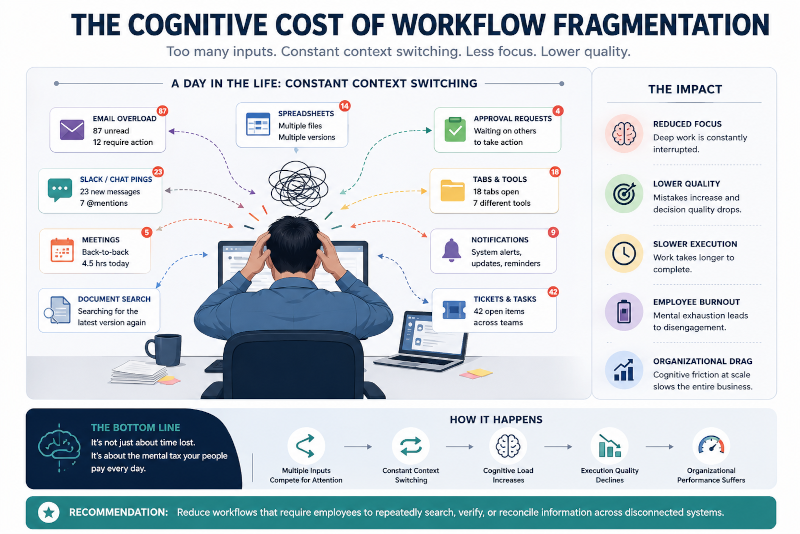
Research from Microsoft’s Work Trend Index described this growing challenge as “digital debt,” where excessive meetings, messaging traffic, email overload, and constant interruptions reduce deep work capacity across enterprise environments. Employees increasingly operate inside fragmented operational systems that continuously compete for attention and force rapid context switching throughout the workday.
This creates downstream consequences for decision quality, strategic thinking, operational accuracy, execution consistency, and employee burnout. Asana’s workplace research similarly found that many employees now spend growing portions of their workweek inside coordination-heavy environments dominated by busywork, fragmented communication, and excessive workflow management rather than execution-focused activity.
This challenge overlaps directly with themes explored previously in How AI Is Reshaping Human Cognitive Work, where workflow fragmentation and operational overload increasingly shifted employee attention toward coordination management rather than analytical depth, strategic reasoning, or creative problem-solving.
Many organizations still evaluate operational efficiency primarily through activity metrics such as response times, ticket closures, meeting participation, or task throughput. But operational effectiveness increasingly depends on whether employees can maintain clarity, focus, and execution quality inside highly interconnected work environments.
The organizations reducing cognitive friction most effectively may gain substantial long-term advantages because operational coordination remains sustainable as complexity expands.
Recommendation: Reduce workflows that require employees to repeatedly search, verify, or reconcile information across disconnected systems.
Manual Processes Often Create Governance and Security Gaps
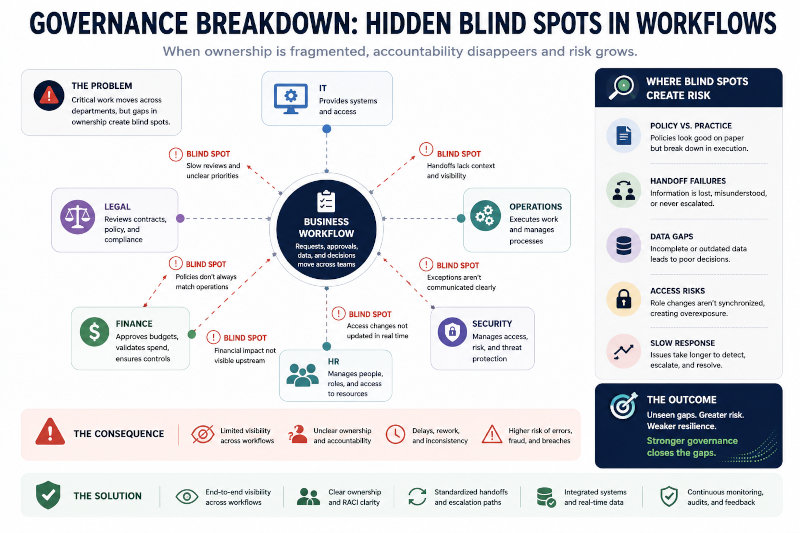
Manual internal processes also create governance vulnerabilities that many organizations fail to recognize until operational failures emerge visibly. Spreadsheet-based approvals, undocumented workflows, inconsistent escalation procedures, and fragmented access management often produce environments where accountability becomes unclear across departments.
This creates operational blind spots that quietly expand over time.
Cybersecurity incidents increasingly demonstrate how fragmented coordination systems amplify organizational risk. The MGM Resorts cyberattack and broader Scattered Spider social engineering campaigns exposed how human verification failures and inconsistent operational workflows could lead to major enterprise disruption despite significant investment in cybersecurity technology.
Similarly, the 2024 CrowdStrike outage demonstrated how centralized operational dependencies can trigger cascading disruption across airlines, hospitals, banks, retailers, and enterprise environments globally when coordination systems fail unexpectedly.
The larger issue is not simply technical vulnerability. It’s operational dependency on poorly governed processes.
Research from Cloud Security Alliance increasingly emphasizes that operational resilience now depends heavily on governance maturity, dependency visibility, and coordinated response capability across interconnected systems rather than isolated technical controls alone.
Manual internal processes often weaken governance because:
- ownership becomes fragmented,
- documentation drifts over time,
- approvals lose consistency,
- and accountability becomes increasingly difficult to trace clearly.
This challenge becomes even more dangerous as enterprises scale AI-assisted workflows and automation environments. Organizations frequently automate tasks without redesigning governance structures around them first.
As explored previously in Cybersecurity Is No Longer Just a Technical Problem, operational resilience increasingly depends on coordination quality, governance clarity, and visibility across workflows rather than technical controls alone.
The organizations most resilient operationally are often the ones where workflows remain understandable, auditable, and structurally coordinated even under disruption.
Recommendation: Standardize workflows that control approvals, access management, and operational escalation paths.
AI Will Amplify Broken Processes Before It Fixes Them
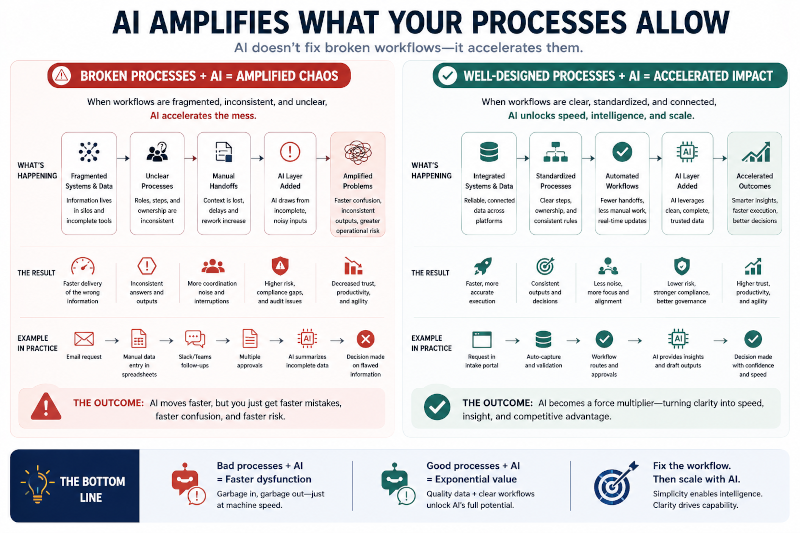
Many organizations now view AI as the solution to operational inefficiency. In some cases, that may prove true. But AI does not automatically eliminate fragmentation. In poorly coordinated environments, AI often accelerates fragmentation faster.
This is becoming one of the defining operational risks of enterprise AI adoption.
Organizations increasingly deploy AI copilots, workflow automation systems, retrieval tools, and operational assistants into environments where:
- documentation remains fragmented,
- workflows lack standardization,
- governance standards remain inconsistent,
- and institutional knowledge is poorly structured.
As a result, AI systems frequently inherit the same operational inconsistencies already embedded inside enterprise environments.
Research from the Microsoft Work Trend Index noted that many employees are already bringing AI tools into workflows independently while organizations continue struggling to redesign operational structures, governance systems, and coordination models around AI adoption effectively.
This creates a dangerous pattern where organizations scale AI faster than they simplify workflows. The result is often faster coordination noise, inconsistent outputs, fragmented retrieval, governance ambiguity, and expanding operational complexity hidden beneath automation layers.
This mirrors broader themes explored in Why Organizational Knowledge Disappears Faster Than Companies Realize, where fragmented knowledge environments quietly weakened execution consistency and operational continuity long before organizations recognized the structural problem itself.
The organizations benefiting most from AI may not necessarily be the ones deploying the largest number of AI tools. Increasingly, they may be the organizations simplifying operational systems enough for AI-assisted workflows to remain coherent, governable, and operationally reliable.
Recommendation: Simplify and standardize workflows before embedding AI deeply into operational systems.
Operational Simplicity Is Becoming Competitive Advantage
As enterprises become more interconnected, AI-assisted, and operationally complex, workflow simplicity increasingly becomes a strategic organizational capability rather than merely an efficiency initiative.
The organizations operating most effectively at scale are often not the ones with the most software, the highest volume of automation, or the largest number of dashboards. More often, they are the organizations that reduce operational friction enough for people, systems, workflows, and decision environments to coordinate effectively under real-world conditions.
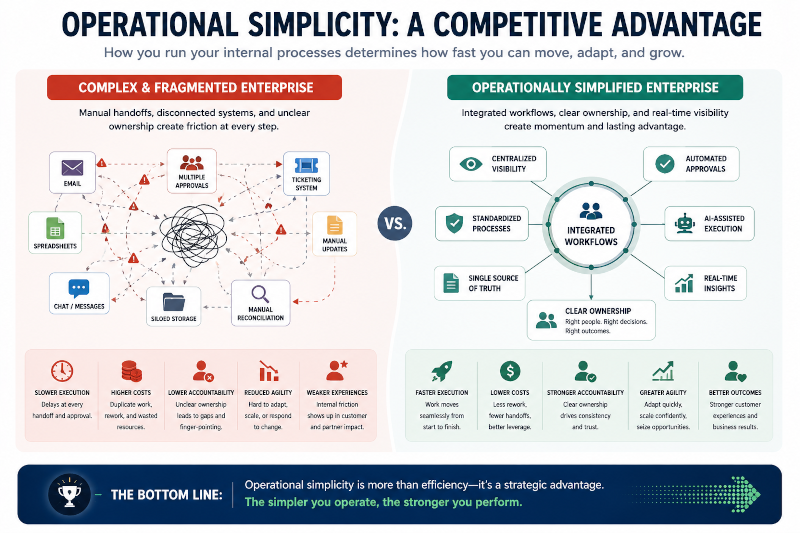
Operational simplicity influences execution speed, governance quality, resilience, employee cognitive load, AI reliability, and organizational adaptability itself. Organizations that continue relying heavily on fragmented manual coordination may increasingly struggle as operational complexity expands.
Organizations that simplify workflows structurally, however, often gain compounding advantages over time because operational clarity, governance consistency, and institutional coordination become easier to scale across the enterprise.
In modern enterprises, the hidden cost of manual internal processes is rarely the task itself. Increasingly, the larger cost is the operational friction that accumulates silently across interconnected systems over time.
Recommendation: Measure operational friction using coordination delays, context switching, and execution inconsistency rather than labor hours alone.
4 thoughts on “The Hidden Cost of Manual Internal Processes”