- Recommendations
- Operational Intelligence Is Becoming Enterprise Infrastructure
- Operational Visibility Is Replacing Static Reporting
- AI Systems Are Becoming Operational Decision Layers
- Predictive Workflows Are Replacing Reactive Operations
- Knowledge Retrieval Is Becoming Part of Operational Intelligence
- Governance Will Determine Which Organizations Scale Successfully
- Operational Intelligence Is Becoming a Competitive Capability
Recommendations
- Consolidate operational data into shared, real-time visibility systems across departments.
- Standardize workflows and terminology before scaling AI-assisted decision systems.
- Build retrieval systems that connect operational data, documentation, and historical context.
- Introduce human verification layers into AI-assisted operational workflows.
- Establish governance standards for AI-driven recommendations, escalation paths, and decision accountability.
- Measure operational intelligence maturity based on coordination quality, visibility, and execution consistency rather than automation volume alone.
Operational Intelligence Is Becoming Enterprise Infrastructure
Most organizations still think about operational intelligence primarily as a reporting function where dashboards are created, KPIs are tracked, business intelligence systems generate analytics, and executives review summaries during scheduled meetings. But operational intelligence is gradually evolving into something much larger.
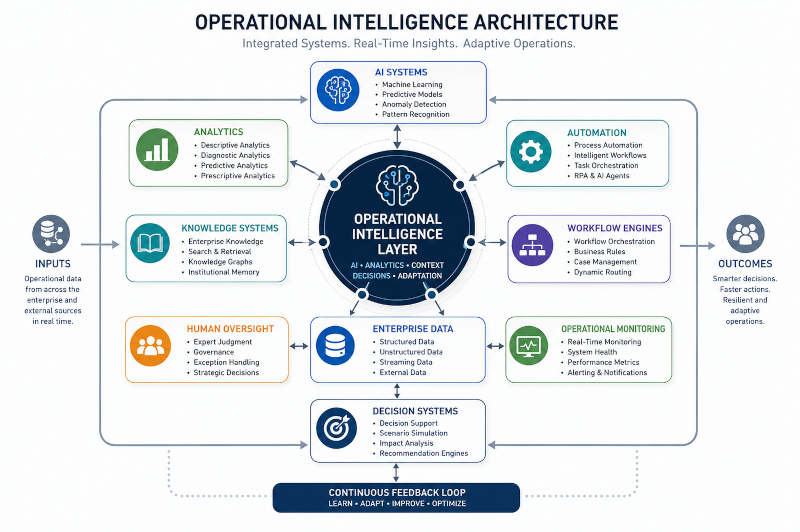
In modern enterprises, operational intelligence increasingly refers to interconnected systems that combine data visibility, AI-assisted analysis, workflow coordination, automation, knowledge retrieval, and real-time decision support into continuously adaptive operational environments.
The shift matters because organizations now operate inside increasingly dynamic systems where decisions often need to occur faster than traditional reporting structures can support effectively.
- Supply chains shift rapidly.
- Cybersecurity threats evolve continuously.
- Customer behavior changes in real time.
- Operational bottlenecks emerge unpredictably.
- AI systems increasingly influence workflows directly rather than simply generating passive insights.
As a result, many organizations are moving away from static reporting environments toward operational ecosystems capable of continuous sensing, interpretation, coordination, and adaptation.
Research from Deloitte’s 2025 Global Human Capital Trends report similarly noted that organizations are increasingly redesigning work around integrated human-machine systems rather than treating automation, analytics, and decision-making as isolated functions.
The long-term implication is significant: operational intelligence is gradually becoming part of enterprise infrastructure itself rather than a secondary analytical capability.
This overlaps closely with themes previously explored in SpirZon’s analysis of Why Organizational Memory Matters More Than Ever in the AI Era, where institutional knowledge increasingly functioned as infrastructure supporting scalable AI-enabled coordination and decision environments.
Recommendation: Consolidate fragmented operational data into shared visibility systems before expanding AI-assisted decision workflows broadly.
Operational Visibility Is Replacing Static Reporting
For decades, enterprise analytics primarily focused on historical reporting.
Organizations gathered data from multiple systems, generated summaries, and reviewed trends after operational activity had already occurred. That model increasingly struggles inside environments where conditions evolve continuously.
Operational intelligence environments are moving toward real-time visibility instead.
Modern enterprises increasingly attempt to monitor:
- workflow execution,
- system health,
- customer behavior,
- operational bottlenecks,
- supply chain disruptions,
- cybersecurity anomalies,
- and performance deviations continuously rather than periodically.
This transition is accelerating as organizations deploy AI-assisted monitoring systems capable of identifying patterns, correlations, and operational risks faster than traditional reporting structures alone.
The logistics industry has already demonstrated how transformative this shift can become. UPS has invested heavily in AI-assisted route optimization and operational analytics systems designed to reduce delivery inefficiencies, fuel usage, and workflow delays across massive transportation networks. These systems increasingly function as operational coordination infrastructure rather than traditional reporting tools alone.
The larger trend extends far beyond logistics. For example, healthcare systems monitor patient flow in real time, manufacturing facilities track predictive maintenance continuously, financial institutions monitor transactional anomalies dynamically, and retail operations increasingly optimize inventory and customer demand through live analytics environments.
Research from McKinsey’s Technology Trends Outlook 2025 similarly emphasized that real-time operational visibility, AI-enhanced analytics, autonomous systems, and adaptive enterprise technologies are becoming foundational capabilities across modern organizations.
The organizations benefiting most are often not the ones collecting the largest amount of data. They are the organizations that reduce the delay between operational activity, insight generation, and coordinated response.
Recommendation: Reduce reporting latency by integrating operational monitoring directly into live workflows rather than relying primarily on retrospective dashboards.
AI Systems Are Becoming Operational Decision Layers
One of the most important enterprise shifts underway is the transition from AI as an analytical tool toward AI as an operational decision layer.
Historically, analytics systems primarily supported human interpretation, but AI systems are increasingly participating directly inside operational workflows themselves. Customer service platforms now route requests dynamically, cybersecurity systems prioritize threats automatically, supply chains continuously adjust forecasting models, and AI copilots increasingly support operational decision-making across finance, engineering, legal, and enterprise support environments. The result is not fully autonomous organizations, but rather hybrid operational systems where machine-assisted analysis and human coordination increasingly function together in real time.
Instead, enterprises are gradually building hybrid operational systems where AI continuously assists human coordination, prioritization, retrieval, and workflow execution. This distinction matters enormously because operational intelligence increasingly depends on how effectively organizations integrate human judgment alongside machine-assisted analysis.
“Organizations increasingly compete on how effectively they integrate human judgment with machine-assisted operational intelligence.”
Research from Microsoft and LinkedIn’s 2024 Work Trend Index found that employees increasingly rely on AI systems during knowledge work, but organizations still struggle to redesign workflows, governance structures, and decision accountability systems around that reality.
The banking sector has already begun confronting this transition directly. JPMorgan Chase has publicly expanded AI deployment across fraud detection, operational analytics, risk monitoring, and internal workflow systems while simultaneously increasing governance oversight around model usage, explainability, and operational accountability.
The challenge is no longer simply deploying AI models.
It is designing operational systems where AI recommendations remain interpretable, governable, and operationally trustworthy under real-world conditions.
This connects naturally with SpirZon’s earlier discussion in How AI Is Reshaping Human Cognitive Work, where AI increasingly shifted human work toward verification, contextual interpretation, and strategic reasoning rather than repetitive information production alone.
Recommendation: Introduce structured human verification and escalation layers into AI-assisted operational workflows before expanding automation depth.
Predictive Workflows Are Replacing Reactive Operations
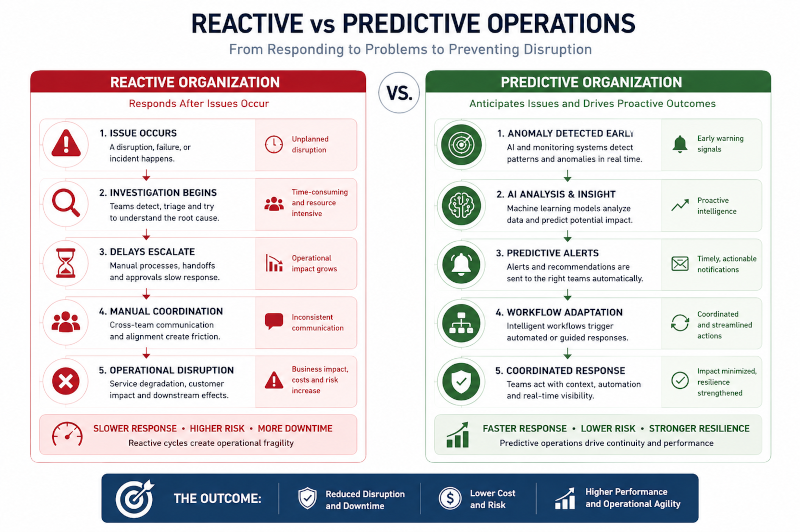
Operational intelligence systems increasingly aim not only to describe operational activity, but to anticipate it. This shift toward predictive operations is transforming how organizations approach planning, coordination, and execution.
Rather than waiting for disruptions to emerge visibly, enterprises increasingly attempt to predict:
- equipment failures,
- workflow bottlenecks,
- cybersecurity incidents,
- staffing shortages,
- customer demand changes,
- and operational risk patterns before they escalate operationally.
Manufacturing environments have aggressively pursued predictive maintenance systems capable of identifying equipment degradation before failures occur. Airlines increasingly monitor engine telemetry continuously. Retailers forecast inventory demand dynamically based on live customer behavior. Cybersecurity teams increasingly use AI-assisted anomaly detection to identify unusual patterns before major incidents fully develop.
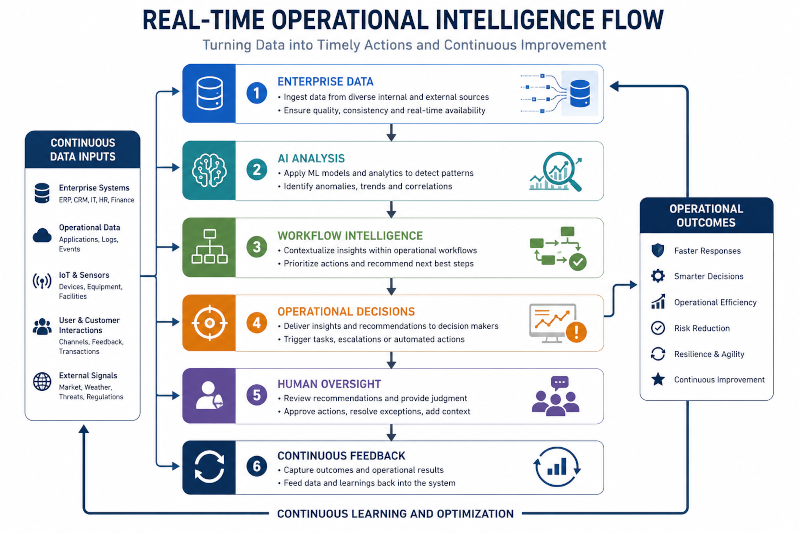
The energy sector provides one of the clearest examples. Shell has publicly discussed expanding predictive analytics systems across industrial operations, maintenance planning, and infrastructure monitoring environments to reduce operational disruption and improve long-term system reliability.
This transformation changes the role of operational intelligence itself.
The goal increasingly becomes: reducing operational reaction time.
Organizations that scale predictive operational systems effectively often reduce:
- downtime,
- coordination delays,
- execution friction,
- and cascading operational disruption significantly over time.
Research from IBM’s Global AI Adoption Index Enterprise Report similarly noted that AI systems are becoming increasingly embedded across operational environments beyond traditional analytics use cases, particularly in automation, security monitoring, business intelligence, workflow optimization, fraud detection, and supply chain intelligence.
Recommendation: Prioritize predictive monitoring in operational areas where delays, bottlenecks, or disruptions create disproportionate organizational impact.
Knowledge Retrieval Is Becoming Part of Operational Intelligence
One of the most overlooked aspects of operational intelligence is knowledge retrieval. Many organizations already possess valuable operational knowledge. The larger challenge is accessibility.
Operational intelligence increasingly depends on whether employees, AI systems, and workflows can retrieve reliable information quickly enough to support execution consistently.
This includes:
- operational procedures,
- historical decisions,
- troubleshooting guidance,
- customer context,
- governance standards,
- and institutional memory distributed across systems.
As enterprises deploy AI copilots and retrieval-augmented systems more broadly, knowledge retrieval increasingly overlaps directly with operational intelligence architecture itself.
Organizations with fragmented knowledge environments often struggle because operational context remains disconnected across repositories, departments, communication systems, and undocumented workflows.
“Organizations scale more effectively when operational knowledge becomes searchable infrastructure rather than disconnected documentation.”
This challenge mirrors operational coordination problems explored previously in Why Organizational Knowledge Disappears Faster Than Companies Realize, where fragmented institutional memory systems quietly weakened execution consistency and organizational continuity.
Research from Microsoft’s 2024 Work Trend Index increasingly suggests that enterprise AI effectiveness depends heavily on knowledge accessibility, workflow integration, retrieval quality, and governance consistency rather than model capability alone, particularly as organizations embed AI systems directly into operational environments.
Operational intelligence therefore increasingly requires convergence between:
- analytics,
- workflow systems,
- AI infrastructure,
- and institutional knowledge architecture.
Organizations that scale effectively increasingly operationalize knowledge rather than treating documentation as passive storage.
Recommendation: Integrate searchable operational knowledge directly into workflows instead of isolating institutional memory inside disconnected repositories.
Governance Will Determine Which Organizations Scale Successfully
As operational intelligence systems become more autonomous, governance becomes significantly more important. Many organizations are currently deploying AI-assisted systems faster than they are redesigning accountability structures around them.
This creates growing operational risks.
- Who validates AI-generated operational recommendations?
- How are escalation pathways managed?
- Which systems retain final authority?
- How are model decisions audited?
- Who owns operational accountability when machine-assisted decisions influence real-world outcomes?
These questions increasingly shape enterprise resilience itself.
The 2024 CrowdStrike outage demonstrated how deeply interconnected operational systems can create cascading disruption when centralized digital infrastructure fails unexpectedly. Although the incident originated from a software update issue rather than malicious activity, the operational consequences spread rapidly across airlines, hospitals, financial systems, and enterprise environments globally.
The incident reinforced a broader operational reality: highly interconnected digital systems increasingly require governance structures capable of managing systemic dependency risk.
Research from the World Economic Forum’s Global Risks Report 2025 similarly emphasized that technological interconnectedness is amplifying systemic operational vulnerabilities across industries.
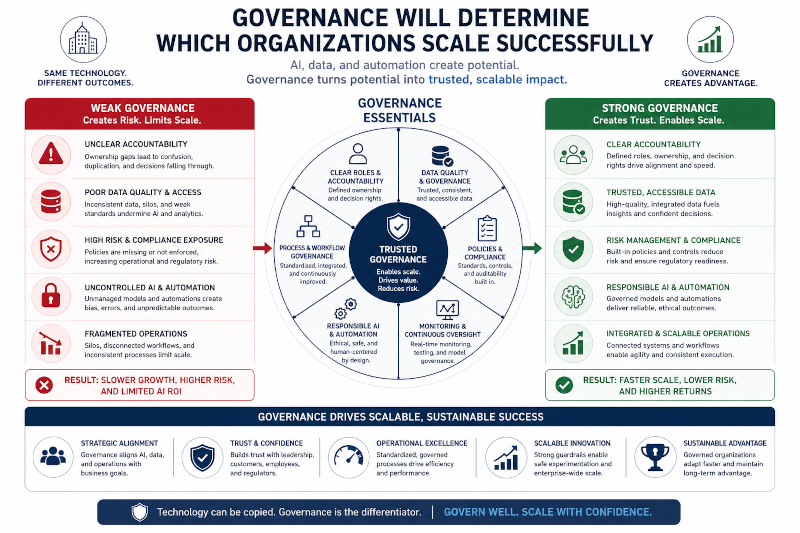
The organizations that scale operational intelligence successfully may not necessarily be the ones deploying the most automation. More often, they may be the organizations building the clearest governance structures around visibility, accountability, escalation, and operational coordination.
Recommendation: Establish clear governance standards for AI-assisted decisions, escalation authority, and operational accountability before scaling interconnected automation systems broadly.
Operational Intelligence Is Becoming a Competitive Capability
As enterprises become increasingly AI-assisted, operational intelligence is gradually transforming into a strategic organizational capability rather than a specialized analytics function.
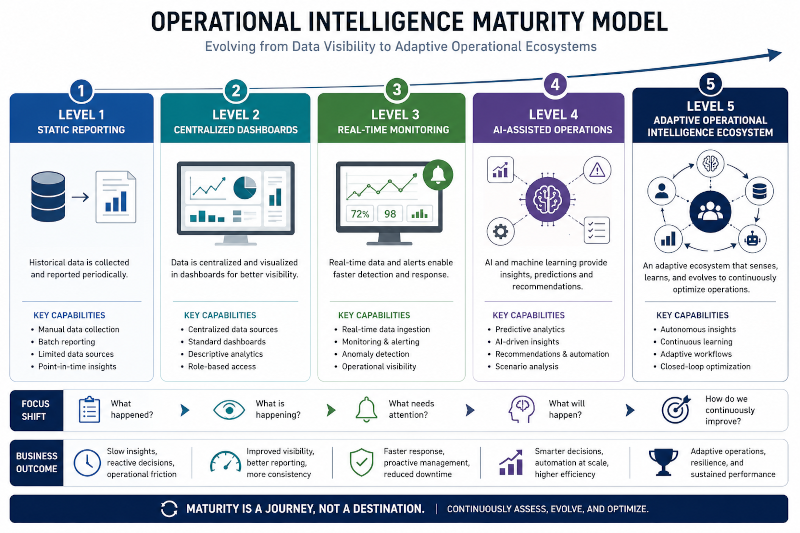
The organizations operating most effectively in the coming decade will likely not simply possess more data, more dashboards, or more automation tools.
They will be the organizations capable of:
- sensing operational change quickly,
- coordinating across systems efficiently,
- integrating human and machine intelligence effectively,
- and adapting workflows continuously under dynamic conditions.
Operational intelligence increasingly influences:
- execution speed,
- resilience,
- decision quality,
- AI reliability,
- customer responsiveness,
- and enterprise adaptability itself.
Organizations that continue treating analytics, AI, automation, and knowledge systems as isolated technology initiatives may increasingly struggle with fragmentation as operational complexity expands.
Organizations that integrate those systems into coordinated operational ecosystems, however, may gain compounding advantages over time because operational learning, visibility, and adaptation become continuously embedded into execution itself.
In the emerging enterprise environment, operational intelligence is no longer simply about understanding what happened.
It is increasingly becoming infrastructure for anticipating, coordinating, and shaping what happens next.
Recommendation: Measure operational intelligence maturity based on coordination quality, adaptability, and execution consistency rather than automation volume alone.
5 thoughts on “The Future of Operational Intelligence in AI-Driven Organizations”