Recommendations
- Review recurring management reports and identify which activities can be automated so managers can spend more time on decision-making, coaching, and organizational leadership.
- Train managers to oversee AI-enabled workflows while strengthening skills related to decision-making, coaching, and change leadership.
- Measure managers on adoption outcomes and behavioral change indicators, not solely on operational performance metrics.
- Redesign management development programs to emphasize coaching, decision facilitation, organizational design, and change leadership rather than administrative supervision.
For years, conversations about artificial intelligence and workforce transformation have focused on frontline employees. Organizations debate whether customer service representatives will become more productive, whether analysts will automate portions of their work, and whether administrative roles will shrink as AI tools become more capable. Those discussions dominate conference agendas, executive briefings, and media coverage.
Yet one of the most significant organizational shifts may be occurring somewhere else entirely.
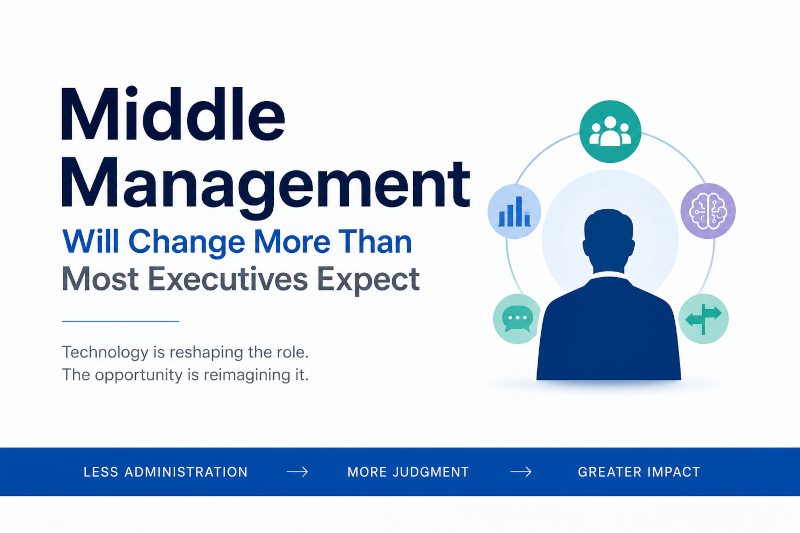
The layer of the organization most likely to experience fundamental change over the next decade is middle management.
This may seem counterintuitive. After all, managers have historically been viewed as the people responsible for coordinating work, aligning teams, communicating priorities, and translating strategy into execution. Those responsibilities remain essential. What is changing is the amount of time managers spend performing administrative coordination versus the amount of time they spend exercising judgment, coaching employees, and helping organizations navigate complexity.
Many management structures were designed for a world where information moved slowly. Reports were assembled manually. Performance data often arrived days or weeks after events occurred. Status updates required meetings, spreadsheets, email chains, and significant human effort. Managers served an essential function because they acted as information hubs, collecting data from one part of the organization and transmitting it to another.
Technology is steadily reducing the need for that type of work.
Modern enterprise platforms provide real-time visibility into operations. Workflow systems route tasks automatically. AI-powered tools can summarize meetings, generate reports, identify anomalies, monitor performance indicators, and surface emerging risks in seconds. The cost of coordination is falling dramatically.
What remains expensive is judgment.
This distinction matters because many executives are looking at the same trend and reaching very different conclusions. Some see automation reducing administrative overhead and conclude that organizations will simply need fewer managers. Others argue that managers will become more important because someone must still make sense of information, resolve competing priorities, build trust, drive adoption, and help employees navigate change.
The research suggests both views may be partially correct.
Gartner predicts that by 2026, 20% of organizations will use AI to flatten organizational structures, potentially eliminating more than half of current middle management positions. At the same time, Microsoft’s 2025 Work Trend Index argues that organizations are entering an era of “Frontier Firms,” where managers are expected to orchestrate teams consisting of both human employees and AI agents.
Those predictions are not contradictory.
Organizations may need fewer managers whose primary responsibility is administrative coordination while simultaneously needing more leaders capable of coaching, decision-making, stakeholder alignment, and organizational adaptation.
The future of middle management is therefore not primarily a headcount discussion. It is a purpose discussion.
Recommendation: Conduct a management activity assessment to determine how much managerial time is spent on reporting, coordination, and administration versus coaching, decision-making, and leadership.
Why The Traditional Middle Management Model Is Under Pressure
For decades, managers served as the primary connection between frontline operations and executive leadership. A significant portion of their time was spent gathering updates, consolidating information, preparing reports, and communicating status across the organization. Without those activities, leaders lacked visibility into what was happening.
Technology has changed that equation.
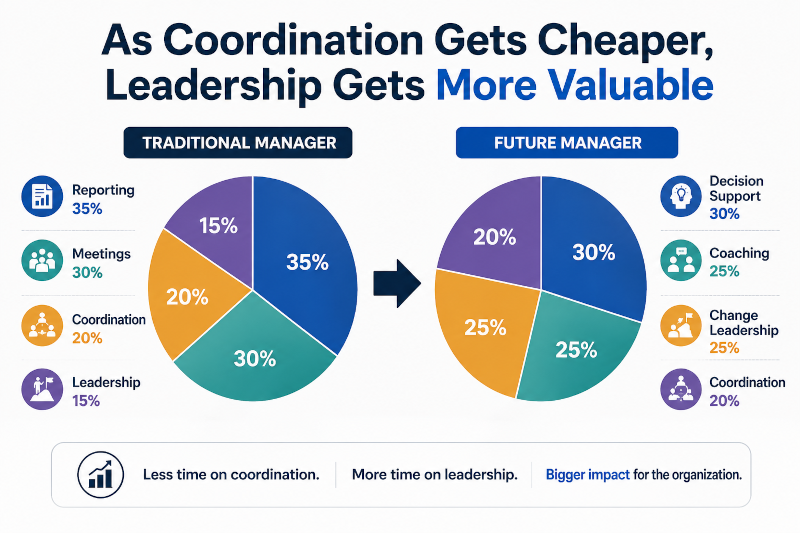
Today, project dashboards update automatically, operational metrics are available in real time, and AI can generate summaries, reports, and performance insights in minutes. Information that once required hours of coordination is now readily available.
What has not changed is the need for judgment.
A dashboard can show that customer satisfaction is declining or that a project is falling behind schedule. It cannot determine which tradeoffs should be prioritized, how competing business objectives should be balanced, or whether a problem is temporary or systemic. Organizations may have more visibility than ever before, yet still struggle to make effective decisions.
This shift is already reflected in leadership research. Deloitte’s 2024 Human Capital Trends report found that as AI becomes more embedded in the workplace, leaders place greater value on capabilities such as judgment, adaptability, collaboration, and decision-making.
The pressure on traditional middle management is not that managers are becoming unnecessary. It is that the administrative side of management is becoming less valuable while the human side is becoming more important.
Recommendation: Review recurring management reports and identify which activities can be automated so managers can spend more time on decision-making, coaching, and organizational leadership.
Case Study: Microsoft’s Vision of the “Agent Boss”
One of the clearest signals about the future of management comes from Microsoft’s 2025 Work Trend Index, which describes a workplace where employees work alongside AI agents that can research information, generate content, analyze data, and complete portions of business processes.
Microsoft calls this emerging role the “agent boss.” While the term sounds futuristic, the idea is surprisingly familiar. Managers have always been responsible for assigning work, monitoring performance, and ensuring objectives are achieved. The difference is that some of the work may now be performed by AI instead of people.
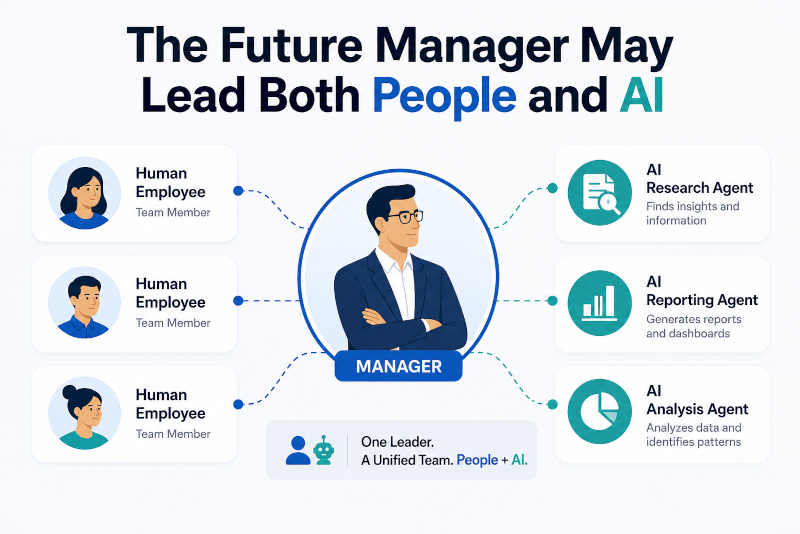
Imagine a manager leading a team of analysts. Activities that once required days of research and reporting can now be completed in minutes using AI tools. That doesn’t eliminate the need for management. It shifts the manager’s focus toward validating outputs, making decisions, identifying risks, and helping employees focus on work that creates the most value.
This is why many organizations may discover that management is not disappearing—it is evolving. As routine coordination becomes easier, managers spend less time gathering information and more time helping teams understand what information actually means and what actions should follow.
As discussed in our article, Automation Doesn’t Eliminate Friction. It Relocates It, technology rarely removes complexity entirely. More often, it changes where that complexity exists. The future manager may spend less time managing tasks and more time managing judgment.
Recommendation: Train managers to oversee AI-enabled workflows while strengthening skills related to decision-making, coaching, and change leadership.
The Real Battleground Is Adoption
One reason the future of middle management is often misunderstood is that executives tend to focus on implementation while managers live in the world of adoption.
A leadership team can approve a new AI strategy, invest in technology, and launch a transformation program. On paper, the initiative may appear successful within weeks. Systems are deployed, employees are trained, and dashboards show utilization metrics moving in the right direction.
Yet anyone who has spent time inside a major transformation knows that implementation and adoption are rarely the same thing.
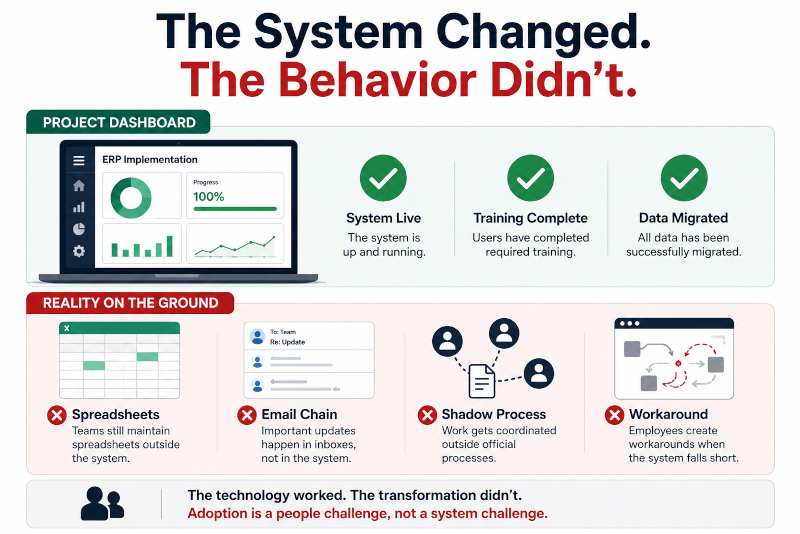
Employees continue using familiar processes. Teams create workarounds. Managers modify workflows to accommodate operational realities. New tools are technically available but not fully embedded into daily work. The organization appears transformed from a governance perspective while behaving much as it did before.
This is precisely where middle managers become critical.
Research from McKinsey has repeatedly shown that managers play a disproportionate role in shaping employee experiences during periods of organizational change. Employees often place greater trust in their immediate managers than they do in senior leadership, making middle managers the primary translators of strategy into behavior.
The challenge is that many organizations still evaluate managers based on operational metrics while simultaneously expecting them to serve as change leaders, coaches, and culture builders.
Those expectations are becoming harder to separate.
As AI becomes embedded into more business processes, adoption challenges will likely become more complex rather than less. Employees will need guidance on how to use new tools, when to trust automated outputs, when to challenge recommendations, and how their roles fit within redesigned workflows.
Technology may automate portions of the work. It cannot automate trust.
As discussed in our article, Everyone Agreed to the Change—Then Nothing Actually Changed, most transformation efforts fail not because organizations lack solutions, but because adoption never fully materializes. The manager often becomes the deciding factor between implementation success and organizational success.
Recommendation: Measure managers on adoption outcomes and behavioral change indicators, not solely on operational performance metrics.
Case Study: The ERP Implementation That Didn’t Fail
When organizations think about transformation failures, they often imagine projects that go badly wrong. Budgets are exceeded, timelines slip, or systems fail to launch.
In reality, some of the most expensive failures look successful on paper.
Consider a typical ERP implementation. A company invests millions of dollars to standardize processes, improve visibility, and eliminate manual work. The system launches successfully, data is migrated correctly, employees complete training, and project milestones are achieved.
Six months later, however, teams are still maintaining spreadsheets, managers rely on informal reporting methods, and employees have created workarounds for situations the new system does not handle well. The technology works exactly as intended. The behavior does not change.
This is where middle managers often make the difference. The most effective managers do more than monitor project status. They identify workflow gaps, address concerns, reinforce new behaviors, and help employees navigate the transition from old ways of working to new ones.
As discussed in The Spreadsheet That Still Runs the Business, employees rarely hold onto spreadsheets because they dislike change. More often, they are solving a problem the official system has not solved well enough. Managers who recognize that distinction can help improve the process rather than simply demanding compliance.
The future manager may spend less time collecting updates and more time understanding why people continue working around the system. That insight often reveals more about the success of a transformation than any dashboard ever could.
Recommendation: Require managers to identify and review recurring workarounds during major transformation efforts to uncover process gaps before they become permanent habits.
Some Management Layers Will Shrink
Not every management role will survive this transition.
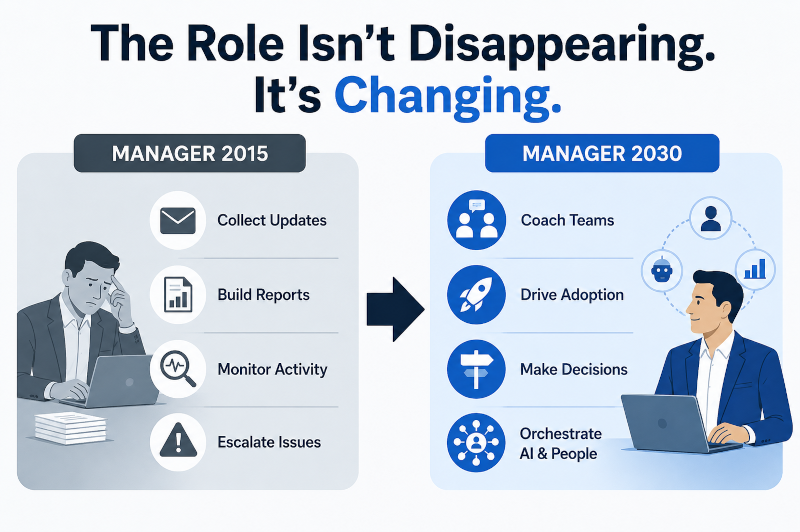
Many organizations still have layers of management dedicated primarily to coordinating information, preparing reports, monitoring performance, and escalating issues. As AI, dashboards, and workflow platforms become more capable, much of that work can be automated or significantly reduced.
That does not mean management is disappearing. It means organizations will need to distinguish between administrative management and leadership.
Administrative management focuses on reporting, coordination, and oversight. Leadership focuses on judgment, coaching, conflict resolution, stakeholder alignment, and helping teams navigate change. One is becoming easier to automate. The other remains fundamentally human.
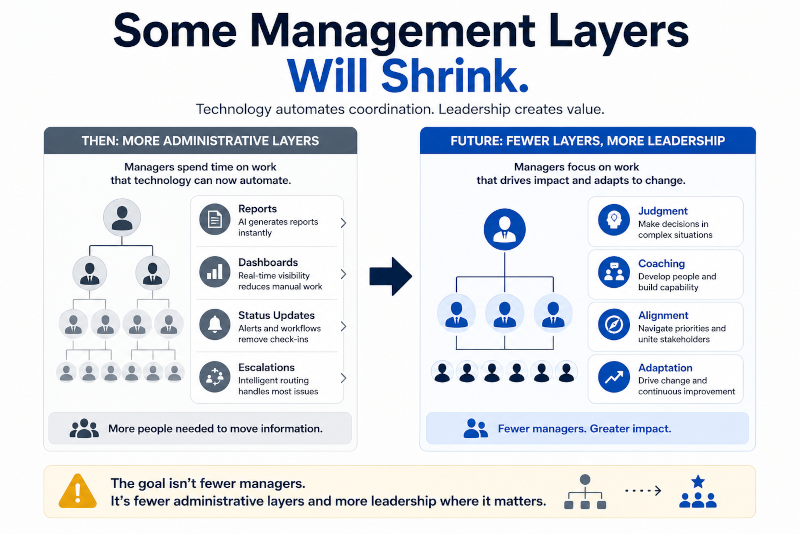
This helps explain why some organizations are flattening structures while simultaneously investing more heavily in leadership development. They are not eliminating management altogether. They are redefining where managers create value.
The risk for executives is assuming that reducing management layers and reducing management capability are the same thing. Reporting structures can be removed relatively quickly. Trust, experience, and institutional knowledge are much harder to replace once they are gone.
Recommendation: Before eliminating management layers, separate administrative responsibilities from leadership responsibilities and evaluate the business value of each independently.
The New Manager Profile
As technology makes information easier to access, the manager’s role is shifting from information management to decision support.
Future managers will likely spend less time collecting updates and monitoring routine activities and more time helping teams navigate uncertainty, balance competing priorities, and make effective decisions. While they will need to understand how AI-enabled workflows operate, technical expertise alone will not define success.
“The future manager may spend less time managing information and more time managing decisions.”
The strongest managers will combine operational knowledge with coaching, change leadership, and organizational awareness. They will help employees adapt to new ways of working, identify unintended consequences, and translate information into action.
In many ways, the future manager may look less like a supervisor and more like a facilitator of organizational effectiveness. As technology handles more administrative work, managers may find themselves returning to some of the most fundamentally human aspects of leadership—building trust, creating alignment, and helping people navigate change.
Recommendation: Redesign management development programs to emphasize coaching, decision facilitation, organizational design, and change leadership rather than administrative supervision.
Final Thought
The debate surrounding AI and middle management often focuses on a simple question:
Will organizations need fewer managers?
That question may ultimately prove less important than another.
What should managers actually do?
Organizations that continue treating managers primarily as information routers, report generators, and administrative coordinators may discover that many of those responsibilities can be automated or eliminated.
Organizations that develop managers as coaches, adoption leaders, decision facilitators, and organizational connectors may reach a very different conclusion.
The future of middle management is not merely a story about workforce reduction. It is a story about organizational redesign.
“Some of the most expensive transformation failures look successful on paper.”
As technology lowers the cost of coordination, the value of judgment, trust, and leadership becomes easier to see. The organizations that recognize this shift early will not simply redesign their org charts. They will redefine the role managers play in helping people, processes, and technology work together.
And that transformation may prove far more significant than most executives currently expect.
Recommendation: Create a three-year management capability roadmap that identifies which responsibilities should be automated, which should be redesigned, and which should become core leadership expectations.
2 thoughts on “Middle Management Will Change More Than Most Executives Expect”