
Recommendations
- Before deploying AI, assess the maturity of your processes, data, documentation, and governance structures to identify operational weaknesses that AI is likely to expose.
- Conduct a structured review of critical documentation before deploying AI knowledge tools, focusing on outdated procedures, conflicting guidance, and undocumented business rules.
- Observe how work is actually performed before applying AI to a workflow rather than relying solely on documented procedures.
- Establish ownership, governance, and consistent definitions for critical business data before relying on AI-generated insights.
- Establish clear AI governance structures, including ownership, risk categories, approval pathways, and usage guidelines before adoption scales across the organization.
- Measure AI success through operational outcomes such as cycle-time reduction, decision quality, employee productivity, and business performance rather than tool adoption metrics alone.
Artificial intelligence is often described as a transformational technology that will fundamentally reshape how businesses operate. While that statement is accurate, it overlooks a more immediate and arguably more important reality. Before AI changes organizations, it reveals them.
Over the past two years, businesses have rapidly adopted AI assistants, copilots, workflow automation platforms, knowledge management tools, and decision-support systems. According to McKinsey’s 2024 State of AI survey, 65% of organizations now report regular use of generative AI in at least one business function, nearly double the adoption rate reported the previous year. Microsoft’s 2024 Work Trend Index found that 75% of knowledge workers already use AI at work in some capacity, whether through approved enterprise tools or their own initiatives.
Much of the conversation surrounding AI focuses on efficiency, productivity, and automation. Organizations want employees spending less time on repetitive administrative work and more time solving problems, making decisions, and creating value. Those benefits are real. However, many organizations are discovering that AI acts less like a new technology platform and more like a diagnostic tool. It exposes weaknesses that have existed for years beneath layers of manual workarounds, undocumented processes, fragmented knowledge, inconsistent data, and unclear ownership.
This is why some AI initiatives deliver immediate value while others stall despite substantial investment. The difference is often not the technology itself. It is the operational environment into which that technology is introduced.
Organizations that view AI as a software deployment tend to focus on tools. Organizations that view AI as an operational transformation effort tend to focus on processes, information flows, governance, and organizational readiness. The latter group is typically far better positioned to realize sustainable value.
Recommendation: Before deploying AI, assess the maturity of your processes, data, documentation, and governance structures to identify operational weaknesses that AI is likely to expose.
AI Reveals the Knowledge Problem
One of the most popular enterprise AI use cases is internal knowledge retrieval. The concept is appealing because nearly every organization struggles with information fragmentation. Policies live on shared drives, procedures reside in knowledge bases, project information is buried in chat platforms, and critical operational knowledge often exists only in the minds of experienced employees.
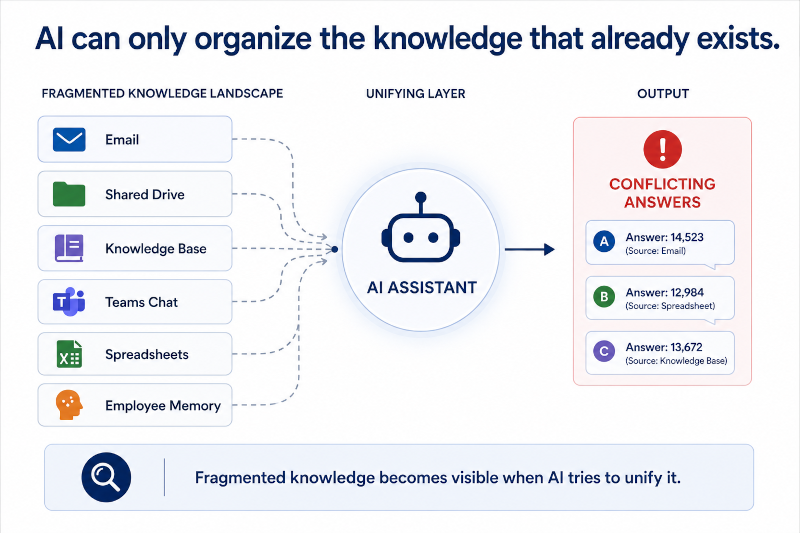
AI promises to simplify that experience. Instead of searching across multiple systems, employees can ask questions conversationally and receive immediate answers. Yet many organizations quickly discover that AI cannot create clarity where clarity does not already exist.
Consider a manufacturing company that implemented an AI-powered assistant to support maintenance technicians. Leadership expected the tool to reduce the time technicians spent searching for repair procedures and increase operational efficiency. During testing, however, the organization discovered multiple versions of maintenance procedures for the same equipment. Some documents reflected current practices. Others had not been updated in years. The AI system was functioning correctly and retrieving relevant content, but the underlying information was inconsistent.
The challenge was not technical. It was organizational.
This scenario is becoming increasingly common. Many businesses have accumulated years of operational knowledge without a consistent strategy for managing it. Procedures evolve, systems change, employees develop workarounds, and documentation often lags behind reality. Human workers compensate for these shortcomings through experience and institutional knowledge. AI cannot.
When AI systems surface conflicting information, they expose a problem that already existed. Organizations sometimes interpret this as an AI failure when it is actually a knowledge management failure. The technology simply makes the inconsistency visible.
This challenge closely mirrors the issues discussed in our article on how organizations often rely on habits rather than documented processes. In both cases, operational reality has drifted away from formal documentation. AI shines a light on that gap.
Recommendation: Conduct a structured review of critical documentation before deploying AI knowledge tools, focusing on outdated procedures, conflicting guidance, and undocumented business rules.
AI Reveals the Process Problem
Organizations frequently assume AI will improve inefficient workflows. In practice, AI often reveals why those workflows were inefficient in the first place.
Many business processes appear clean and straightforward when represented in flowcharts or standard operating procedures. The actual execution of those processes is usually far more complicated. Employees bypass systems to meet deadlines. Managers approve requests through informal channels. Exception paths become routine. Spreadsheets emerge to compensate for system limitations. Over time, the documented process and the real process become two different things.
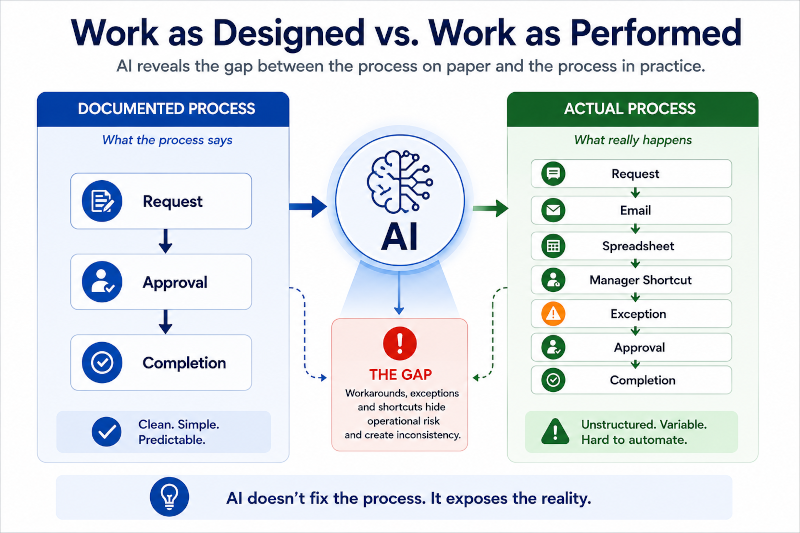
AI struggles when confronted with this reality because it depends on consistency. When organizations attempt to automate or augment workflows using AI, they frequently discover that the process they planned to automate is not the process employees actually follow.
A financial services organization learned this lesson during an initiative to deploy AI-assisted workflow automation. On paper, approvals followed a clearly defined sequence involving multiple stakeholders and review stages. During implementation, analysts discovered dozens of unofficial exception paths that employees had developed over time. These workarounds allowed work to move more quickly but had never been formally documented.
The AI solution was designed around the official process. The organization operated through a collection of exceptions.
Rather than accelerating the project, AI forced the organization to confront process complexity that had accumulated over years of operational adaptation. The initiative ultimately succeeded, but only after leaders redesigned the workflow itself.
This pattern appears repeatedly across industries. AI does not eliminate the need for process design. It makes process design impossible to ignore.
Recommendation: Observe how work is actually performed before applying AI to a workflow rather than relying solely on documented procedures.
AI Reveals the Data Problem
Data quality has always mattered. AI simply increases the consequences of poor data governance.
Organizations often view AI as a decision-support capability capable of identifying patterns, generating forecasts, and accelerating analysis. These capabilities depend entirely on the quality of the information being analyzed. When data is inconsistent, incomplete, or poorly governed, AI can produce answers with remarkable confidence that are fundamentally flawed.
Many businesses continue to struggle with multiple versions of the truth. Customer information may differ between CRM systems and financial platforms. Operational metrics may use different definitions across departments. Reports frequently produce conflicting numbers depending on who generated them and which data source they used.
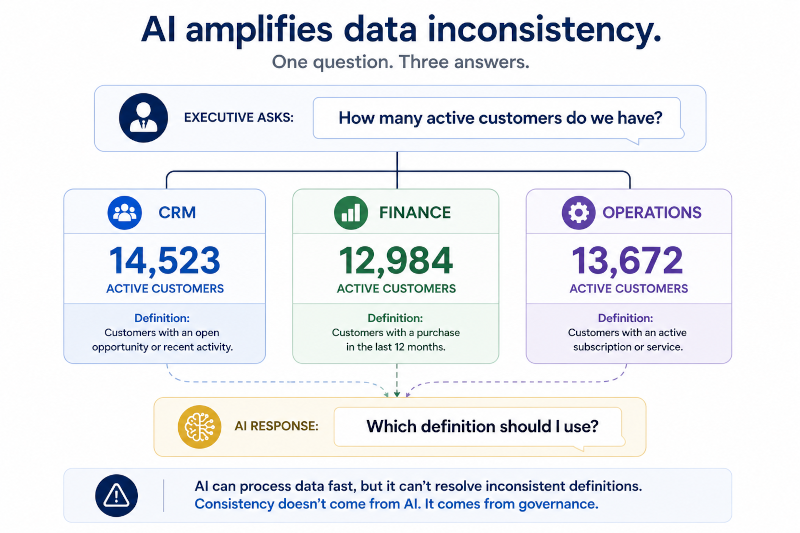
Imagine an executive asking an AI assistant a seemingly simple question:
“How many active customers do we currently have?”
The answer depends entirely on how the organization defines an active customer.
Sales may define active customers based on pipeline activity. Finance may define them based on recent transactions. Operations may define them based on service utilization. If those definitions are not aligned, AI cannot resolve the discrepancy. It can only process the information provided.
This challenge aligns closely with themes explored in our article on multiple versions of the truth. Organizations often discover that their AI strategy is actually a data governance strategy disguised as a technology initiative.
McKinsey’s research consistently shows that organizations generating the strongest returns from AI investments are also investing heavily in foundational data management, governance, and operational controls.
The lesson is straightforward. AI does not solve data problems. It amplifies them.
Recommendation: Establish ownership, governance, and consistent definitions for critical business data before relying on AI-generated insights.
AI Reveals the Governance Problem
One of the most persistent misconceptions about AI governance is that it slows innovation. In many organizations, the opposite is true.
Weak governance creates uncertainty. Business teams are unsure what is permitted. Technology teams do not know which controls are required. Privacy, legal, cybersecurity, and compliance teams become involved late in the process. As a result, every AI use case becomes a negotiation rather than a decision.
A healthcare organization provides a useful example. Several departments independently began experimenting with generative AI tools to summarize documents, draft communications, and support administrative tasks. None of these efforts violated policy because no policy existed. Different teams made different assumptions about acceptable use, data handling, and risk management.
Eventually, leadership discovered multiple AI initiatives operating simultaneously without consistent oversight.
The organization did not have an AI problem. It had a governance problem.
“Without governance, every AI use case becomes a negotiation instead of a decision.”
Strong governance creates clarity. It establishes ownership, defines acceptable use, identifies escalation pathways, and ensures risk is addressed proportionately. Low-risk use cases can move forward quickly. Higher-risk use cases receive additional scrutiny. Teams understand expectations before work begins rather than after concerns emerge.
Without governance, organizations often create the exact operational friction they hoped AI would eliminate.
Recommendation: Establish clear AI governance structures, including ownership, risk categories, approval pathways, and usage guidelines before adoption scales across the organization.
The Organizations Seeing the Most Value
The organizations reporting the strongest AI outcomes are not necessarily deploying the most advanced models or purchasing the most expensive platforms. They are aligning technology with operational reality.
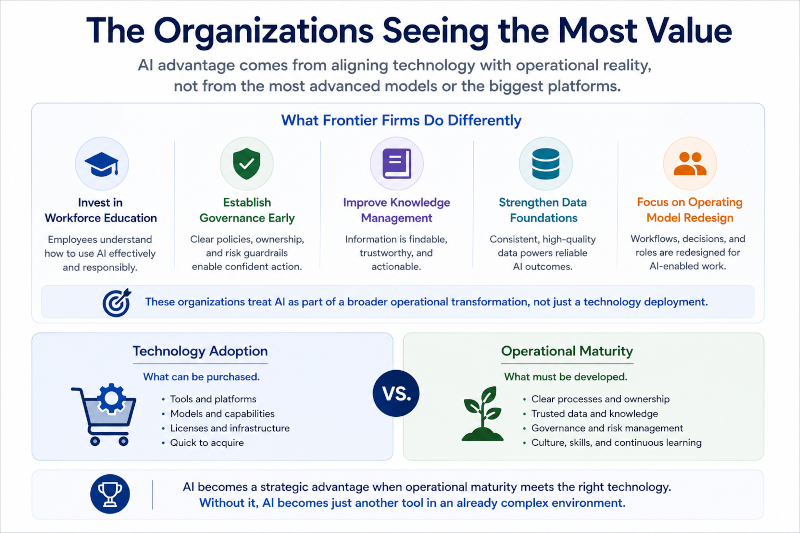
Microsoft’s research on emerging “Frontier Firms” highlights organizations redesigning workflows, decision-making processes, and operating models around AI-enabled work rather than simply deploying new software.
These organizations share several common characteristics. They invest in workforce education. They establish governance early. They improve knowledge management. They strengthen data foundations. Most importantly, they recognize that technology adoption and organizational transformation are not the same thing.
Technology can be purchased. Operational maturity must be developed.
This distinction often determines whether AI becomes a strategic advantage or simply another tool added to an already complex environment.
Recommendation: Measure AI success through operational outcomes such as cycle-time reduction, decision quality, employee productivity, and business performance rather than tool adoption metrics alone.
Final Thought
Much of the public discussion surrounding AI focuses on what the technology can do. While those capabilities matter, they are not the most important question organizations should be asking.
A better question is this: What is AI revealing about how your organization actually operates?
Because AI has a remarkable ability to expose realities that organizations have tolerated for years. It reveals fragmented knowledge that employees quietly compensate for. It exposes undocumented processes that rely on tribal knowledge. It highlights inconsistent data definitions that undermine decision-making. It uncovers ownership gaps and governance weaknesses that were previously hidden behind manual workarounds.
The organizations that derive the greatest value from AI will not necessarily be those with the most sophisticated models. They will be the organizations willing to confront the operational realities those models expose.
AI is certainly changing business operations. Before it transforms them, however, it is helping organizations see themselves more clearly than ever before.
1 thought on “AI Is Not Changing Business Operations. It’s Exposing How They Really Work.”