Recommendations
- Evaluate AI initiatives based on workflow integration and operational impact rather than standalone productivity gains alone.
- Design AI deployments around workflow coordination and human oversight rather than isolated employee productivity enhancement alone.
- Prioritize workflow standardization, governance visibility, and retrieval quality before scaling enterprise-wide AI initiatives.
- Train employees not only to use AI tools, but also to supervise, validate, and govern AI-assisted workflows effectively.
- Measure AI transformation success through workflow integration, operational resilience, and governance maturity rather than adoption metrics alone.
For decades, enterprise technology primarily functioned as a support layer for human work. Spreadsheets accelerated calculations, collaboration platforms improved communication, and automation systems handled repetitive tasks through predefined logic.
Artificial intelligence is beginning to change that model.
Organizations are no longer deploying AI solely as a tool employees interact with occasionally. Increasingly, AI systems are being integrated directly into operational workflows across customer support, software development, research, compliance, logistics, and knowledge management environments.
This shift matters because it changes how organizations think about work itself.
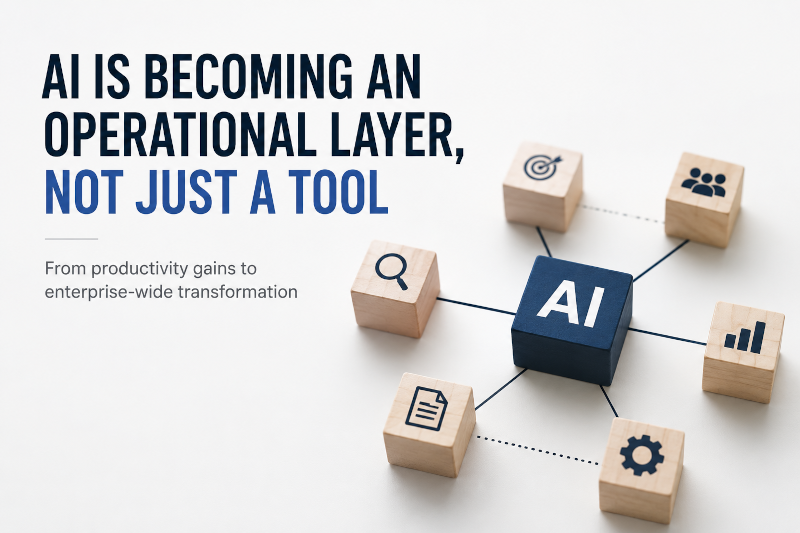
The conversation around AI often focuses on productivity enhancement at the individual level: faster writing, quicker coding, improved search, or automated summarization. But the larger transformation underway is operational. AI is gradually becoming embedded inside the systems that coordinate, route, validate, prioritize, and execute work across the enterprise.
McKinsey’s 2025 State of AI research found that while AI adoption is now widespread, relatively few organizations report enterprise-wide financial impact at scale because many deployments remain fragmented, experimental, or disconnected from operational workflows.
The gap between AI experimentation and measurable business transformation increasingly appears to depend less on model capability and more on workflow integration, governance maturity, and operational redesign.
As explored previously in Most Organizations Don’t Have Processes — They Have Habits, many enterprises still rely heavily on informal coordination patterns, tribal knowledge, and fragmented operational logic. AI systems tend to expose those weaknesses quickly because automation requires far more organizational clarity than humans typically do.
The future of enterprise AI may therefore depend less on the intelligence of the models themselves and more on how effectively organizations redesign workflows around human-AI coordination.
Recommendation: Evaluate AI initiatives based on workflow integration and operational impact rather than standalone productivity gains alone.
From Software Assistance to Operational Participation
Many organizations still approach AI as an isolated productivity layer.
Employees receive chatbot interfaces, writing assistants, coding copilots, or standalone automation tools designed to improve individual tasks without fundamentally changing how work flows across the organization. In these environments, AI often creates localized efficiency improvements while leaving the surrounding operational structure largely unchanged.
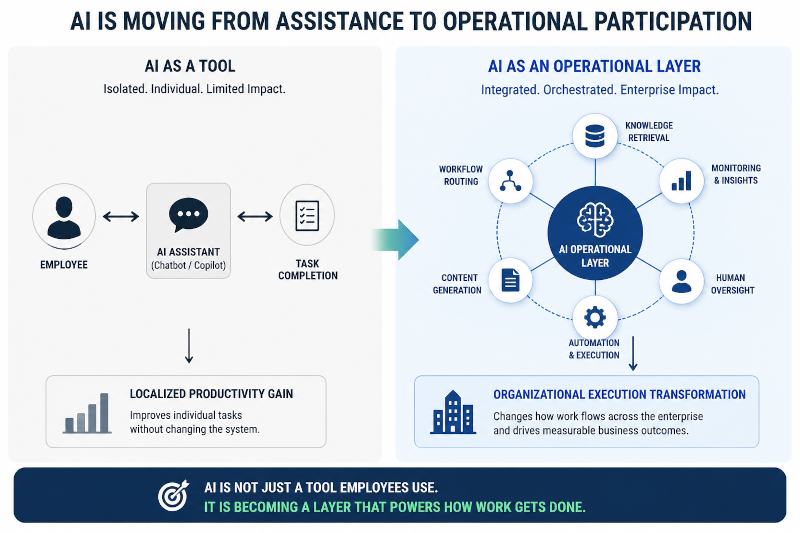
Higher-performing organizations tend to approach implementation differently.
Rather than treating AI as a supplemental feature, they redesign workflows around automation, orchestration, retrieval systems, and human oversight simultaneously.
This shift is becoming especially visible inside customer support operations. In many enterprises, AI systems now classify tickets, retrieve documentation, summarize conversations, prioritize escalation paths, translate communications, and draft responses before human agents become involved. The operational value comes not only from faster responses, but from reducing coordination friction across the entire workflow.
Software development environments are undergoing similar changes. AI tools initially adopted for code generation are increasingly integrated into testing, debugging, documentation, deployment pipelines, and code review processes. Developers often spend less time producing repetitive boilerplate work and more time validating outputs, reviewing architectural decisions, handling edge cases, and supervising automated workflows.
Research examining generative AI adoption in software engineering environments found that practitioners reported measurable reductions in cycle time and workflow friction, while also emphasizing growing concerns around validation overhead, governance, reliability, and overreliance on automated outputs.
Financial institutions provide another important example. Many banks are now integrating AI into fraud analysis, compliance review, reporting workflows, and document analysis environments. However, these deployments remain heavily governed because organizations recognize that AI systems still struggle with ambiguity, contextual interpretation, and high-risk edge cases.
This illustrates the broader transition underway:
AI is moving from:
- software assistance,
toward: - operational participation.
Employees are no longer simply using tools. They are increasingly supervising workflows where portions of execution are handled autonomously by interconnected systems.
Recommendation: Design AI deployments around workflow coordination and human oversight rather than isolated employee productivity enhancement alone.
Why Many AI Initiatives Fail to Scale
Despite rapid adoption, many organizations continue struggling to generate meaningful returns from AI investments.
One major reason is that companies often layer AI onto existing workflows without redesigning the surrounding operational environment. This creates fragmented systems where AI accelerates individual tasks while bottlenecks, approval delays, governance gaps, and coordination inefficiencies remain unresolved.
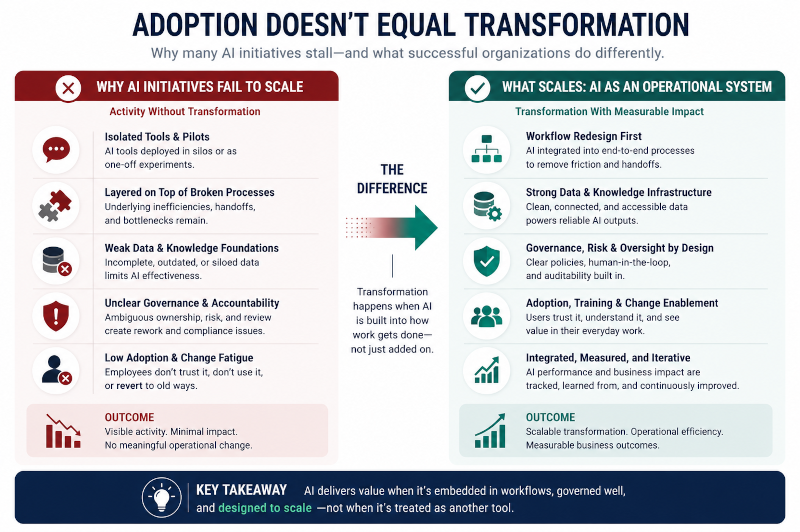
A chatbot embedded inside a poorly structured customer support system may reduce response times for simple inquiries while leaving escalation paths, exception handling, and issue resolution dependent on the same fragmented manual processes.
Similarly, AI-generated reports may save time initially while creating additional review overhead if accountability standards and verification processes remain unclear.
Industry analysts increasingly describe this pattern as “AI theater” — visible experimentation without meaningful operational transformation.
The issue is rarely the model itself.
Organizations achieving stronger AI outcomes tend to invest heavily in:
- workflow redesign,
- knowledge infrastructure,
- retrieval quality,
- governance frameworks,
- employee adoption,
- and operational integration.
These factors often determine whether AI deployments remain isolated pilots or evolve into scalable operational systems.
Research from MIT examining workplace automation similarly found that the pace of transformation depends heavily on economic practicality, integration complexity, and organizational adaptation rather than technical capability alone.
This is one reason many organizations underestimate the importance of process maturity during AI adoption.
AI systems perform best inside environments with:
- structured workflows,
- visible ownership,
- standardized processes,
- and reliable retrieval systems.
Organizations operating primarily through habits, undocumented exceptions, and fragmented coordination often struggle because AI cannot compensate for operational ambiguity the way experienced employees can.
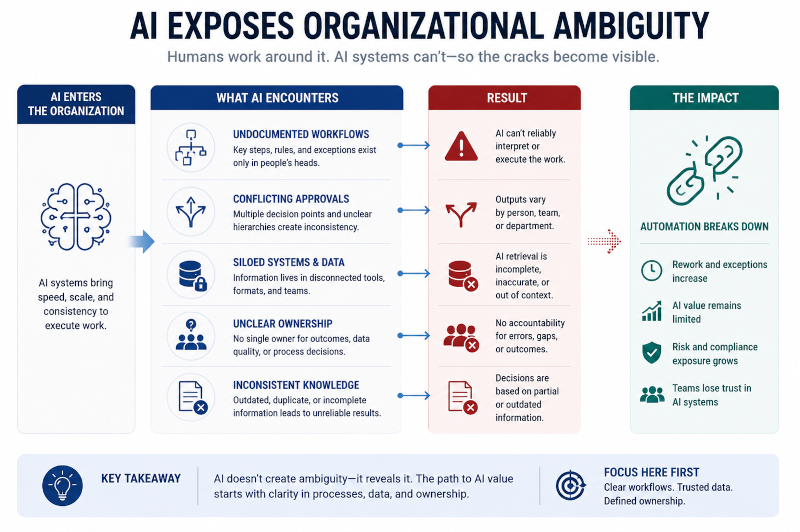
As explored previously in The Strategic Case for Knowledge Management in 2026, AI effectiveness depends heavily on the quality, accessibility, and consistency of organizational knowledge environments.
AI does not automatically create operational discipline. It exposes where discipline already exists — and where it does not.
Recommendation: Prioritize workflow standardization, governance visibility, and retrieval quality before scaling enterprise-wide AI initiatives.
Human Work Is Shifting Toward Supervision and Coordination
One of the most important workforce shifts underway involves where human effort is now being applied.
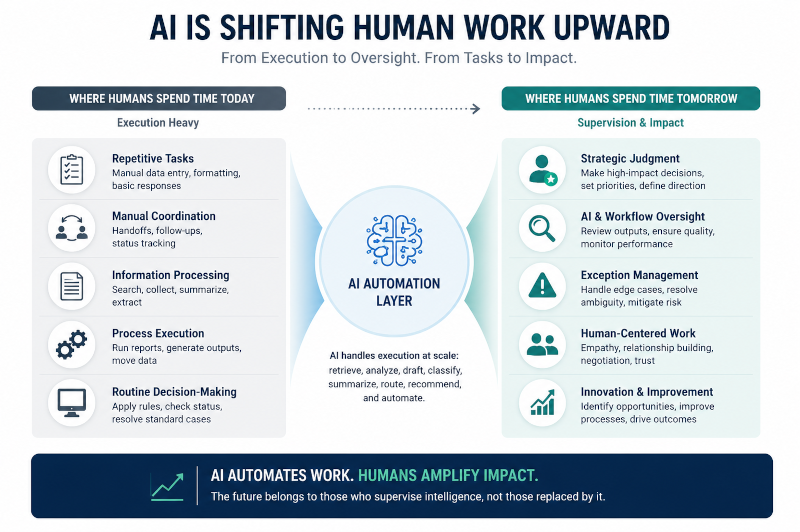
In most enterprise environments, AI is not functioning as a full replacement for employees. Instead, it is redistributing human work upward into areas requiring judgment, interpretation, accountability, communication, and exception management.
Employees increasingly spend time:
- reviewing AI-generated outputs,
- validating decisions,
- monitoring workflow quality,
- handling ambiguous situations,
- and coordinating automated systems.
In many environments, this resembles operational supervision more than traditional software usage.
Anthropic’s 2025 Economic Index found that users were gradually delegating more autonomous work to AI systems over time, particularly in API-driven enterprise environments where task automation could be integrated directly into workflows.
At the same time, organizations are discovering that human oversight remains essential.
AI systems can still:
- hallucinate information,
- misinterpret context,
- mishandle exceptions,
- or generate unreliable outputs in ways that require experienced human judgment to detect.
This creates a new operational challenge: supervising AI systems at scale introduces its own cognitive demands.
Employees must now balance:
- trust,
- verification,
- speed,
- governance,
- and accountability simultaneously.
Research examining enterprise AI decision-making environments found that organizations often face larger challenges from change management, employee adaptation, and workflow integration than from technical limitations themselves.
The future workforce may therefore depend less on humans performing every operational task manually and more on humans effectively supervising increasingly automated coordination systems.
This transition changes the nature of knowledge work itself.
Employees become:
- validators,
- orchestrators,
- reviewers,
- exception handlers,
- and systems coordinators
inside hybrid human-AI environments.
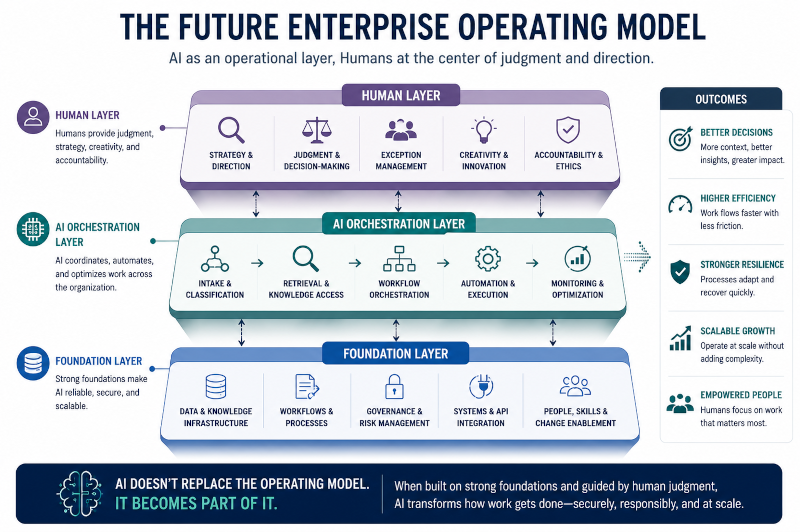
The strategic challenge for leadership is no longer simply adopting AI tools. It is designing operational systems where automation, governance, accountability, and human judgment function together coherently.
Recommendation: Train employees not only to use AI tools, but also to supervise, validate, and govern AI-assisted workflows effectively.
Operational Maturity Will Determine AI Success
The organizations benefiting most from AI adoption are often not the organizations deploying the largest number of tools.
More often, they are the organizations redesigning workflows, governance structures, retrieval systems, and operational coordination models around AI-enabled execution environments.
This is a critical distinction because many enterprises still approach AI primarily as a technology initiative rather than an operational transformation initiative.
The strongest implementations typically emerge where organizations already possess:
- mature knowledge systems,
- scalable workflows,
- governance visibility,
- operational clarity,
- and cross-functional coordination.
AI amplifies those strengths.
Conversely, organizations with fragmented processes, weak retrieval systems, inconsistent governance, and poor operational visibility often struggle to scale AI effectively even when using advanced models.
Recent enterprise research continues showing that adoption alone does not guarantee meaningful transformation. McKinsey’s 2025 survey found that only a relatively small percentage of organizations describe their AI deployments as mature or enterprise-scaled.
The issue is no longer whether organizations are experimenting with AI. Most already are.
The larger challenge is whether organizations can redesign operational systems around intelligent automation in ways that remain scalable, governed, measurable, and sustainable over time.
As AI systems become embedded deeper into enterprise workflows, the defining competitive advantage may shift away from tool adoption itself and toward operational coordination quality.
The organizations adapting most successfully may not necessarily be those using the most advanced models. More likely, they will be the organizations capable of integrating AI into workflows in ways that improve execution without sacrificing governance, visibility, or human judgment.
AI is not simply changing productivity. It is changing how organizations coordinate work itself.
Recommendation: Measure AI transformation success through workflow integration, operational resilience, and governance maturity rather than adoption metrics alone.
3 thoughts on “AI Is Becoming an Operational Layer, Not Just a Productivity Tool”