
Recommendations
- Evaluate IT leadership performance using operational impact, workflow transformation, and business outcome metrics rather than infrastructure uptime alone.
- Align major technology investments directly with measurable customer experience, operational efficiency, and revenue-impact objectives.
- Position IT leadership inside enterprise planning and operational redesign discussions rather than limiting involvement to technical implementation phases.
- Shift IT operating models from project delivery structures toward cross-functional orchestration models aligned around workflows and business outcomes.
- Measure digital transformation success through operational performance, workflow efficiency, and strategic business impact rather than deployment milestones alone.
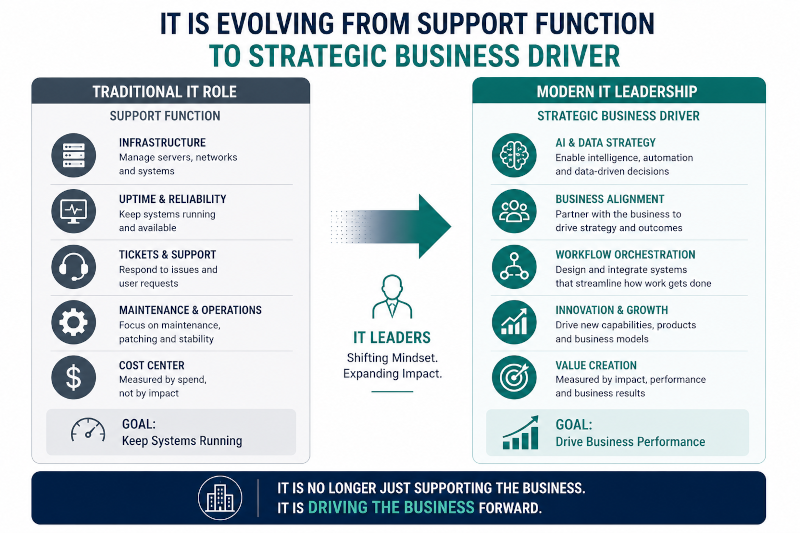
For most of the modern business era, IT leadership was measured primarily by stability. If systems stayed online, security incidents remained limited, and employees could access the tools they needed, technology teams were considered successful. IT functioned largely as an operational support layer behind the business itself.
That definition no longer reflects reality.
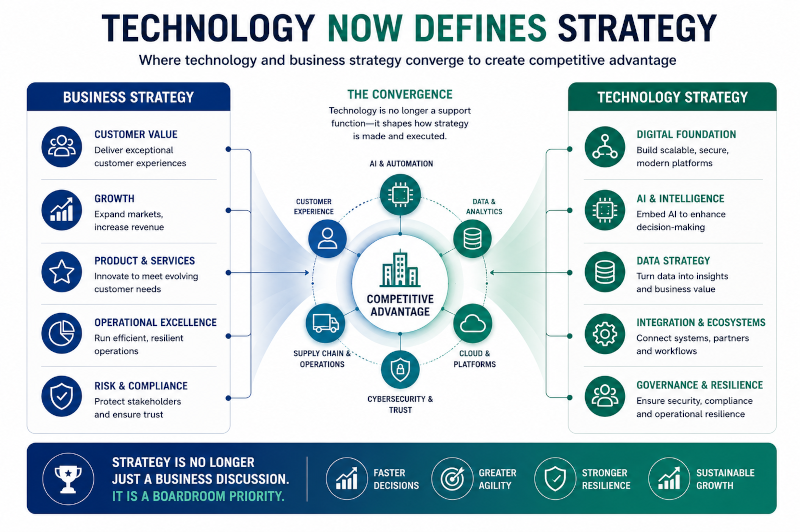
Today, technology shapes how organizations compete, coordinate workflows, deliver customer experiences, scale AI systems, manage data, and execute strategy across the enterprise. In many industries, the distinction between “business strategy” and “technology strategy” is beginning to disappear.
This transformation is measurable. Gartner’s CIO research shows that technology leaders are now prioritizing AI, business intelligence, integration, cybersecurity, and digital operating models at unprecedented levels. At the same time, McKinsey’s 2025 State of AI report found that organizations seeing the strongest AI-related financial impact were not simply deploying more tools — they were redesigning workflows and operational systems around intelligent technologies.
This creates a fundamental shift in how IT leadership is evaluated.
The modern CIO is no longer responsible only for:
- infrastructure,
- uptime,
- and system delivery.
Increasingly, IT leaders are expected to influence:
- growth,
- operational resilience,
- workflow coordination,
- AI strategy,
- and enterprise-wide transformation outcomes.
As explored previously in AI Is Becoming an Operational Layer, Not Just a Productivity Tool, AI is changing how organizations coordinate work itself. That shift places technology leadership much closer to the center of enterprise strategy than many organizations historically anticipated.
The larger implication is becoming difficult to ignore: technology is no longer simply supporting the business from the sidelines. In many organizations, it is becoming part of the business operating model itself.
Recommendation: Evaluate IT leadership performance using operational impact, workflow transformation, and business outcome metrics rather than infrastructure uptime alone.
Technology Now Shapes Competitive Advantage
One of the clearest signs of this shift is that technology decisions now directly influence market performance.
For years, organizations treated IT investments primarily as efficiency initiatives. The goal was often cost reduction, infrastructure modernization, or process automation. Today, technology systems increasingly shape customer retention, personalization, operational agility, and competitive differentiation itself.
Netflix provides one of the clearest examples.
The company’s recommendation systems and personalization infrastructure are no longer peripheral technical features. They are central to how Netflix drives engagement, retention, and customer experience. Research examining Netflix’s recommendation ecosystem found that personalized content recommendations materially improve engagement and viewing behavior across the platform. Additional industry analysis estimates that Netflix’s personalization systems contribute substantially to customer retention and revenue performance by reducing churn and improving user engagement.
In this environment, technology does not merely support the product. Technology becomes the product experience itself.
Retail environments are undergoing similar transformations. Modern supply chain operations increasingly rely on real-time analytics, predictive forecasting, automated inventory management, and AI-assisted logistics coordination. Walmart has invested heavily in AI-driven supply chain analytics and operational visibility systems designed to improve forecasting, inventory optimization, and fulfillment coordination across massive distribution networks. The strategic advantage comes not simply from owning infrastructure, but from how effectively technology systems coordinate execution at scale.
This changes the role of IT leadership fundamentally.
Technology leaders are no longer only managing systems. They are helping shape:
- customer experience,
- operational efficiency,
- organizational adaptability,
- and strategic growth simultaneously.
McKinsey similarly notes that leading CIOs are evolving into “strategy architects,” embedding technology directly into enterprise operating models rather than functioning as isolated technical managers.
The important insight is that organizations no longer compete solely through products, pricing, or scale. Increasingly, they compete through operational intelligence.
Recommendation: Align major technology investments directly with measurable customer experience, operational efficiency, and revenue-impact objectives.
The CIO Role Is Expanding Beyond Technology
The expanding influence of technology is forcing a broader transformation in leadership itself.
Historically, CIOs often focused primarily on:
- infrastructure delivery,
- system maintenance,
- vendor management,
- and project execution.
Those responsibilities still matter, but they are no longer sufficient.
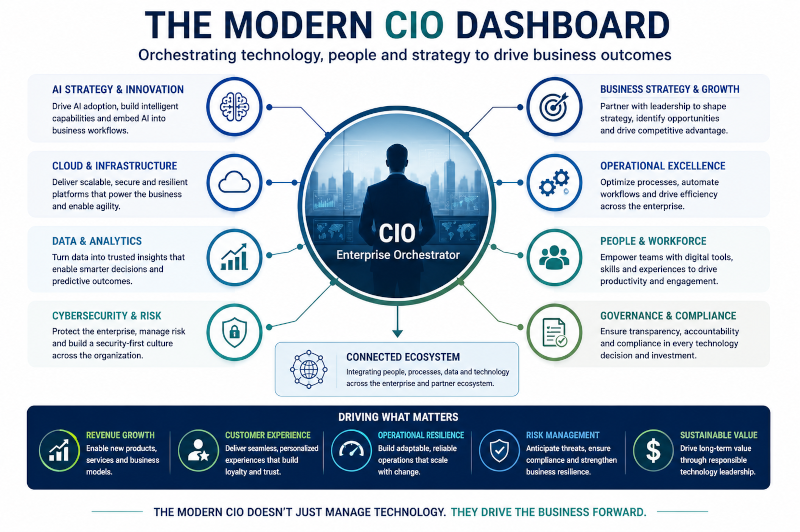
Modern IT leaders now operate at the intersection of:
- strategy,
- AI governance,
- cybersecurity,
- operational coordination,
- workforce enablement,
- and business transformation.
This evolution is partly being driven by AI adoption itself. Organizations are investing aggressively in AI systems while simultaneously struggling to translate experimentation into measurable business value. Gartner warns that many AI initiatives fail because organizations focus on hype and deployment activity without sufficient operational integration or governance maturity.
This creates a more complicated leadership environment for CIOs.
Technology leaders must now balance:
- innovation pressure,
- governance requirements,
- workflow redesign,
- cybersecurity exposure,
- vendor complexity,
- and business expectations simultaneously.
The challenge is not simply technical implementation. It is organizational orchestration.
This shift is especially visible in enterprises attempting large-scale AI integration. Many organizations discover that deploying AI exposes deeper operational problems involving fragmented workflows, poor data quality, unclear ownership structures, and inconsistent governance. AI often magnifies organizational ambiguity that employees previously compensated for manually.
As explored previously in Most Organizations Don’t Have Processes — They Have Habits, many organizations still operate through informal coordination patterns rather than fully scalable operational systems. AI adoption exposes those weaknesses quickly because automation depends on clarity far more than human adaptability does.
This creates a more contrarian reality than many technology narratives acknowledge: the biggest challenge facing CIOs may no longer be technological complexity itself. It may be organizational misalignment between technology systems and how the business actually operates.
The organizations struggling most with digital transformation are often not the organizations lacking technology investments. More often, they are the organizations attempting to modernize technology without modernizing operational coordination simultaneously.
Recommendation: Position IT leadership inside enterprise planning and operational redesign discussions rather than limiting involvement to technical implementation phases.
AI Is Accelerating the Shift From Execution to Orchestration
Artificial intelligence is accelerating another major change: the nature of IT work itself.
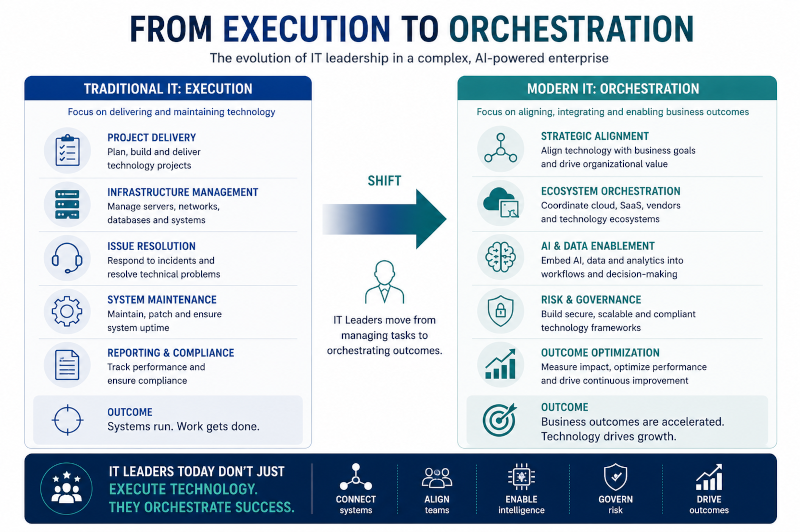
Traditional IT leadership focused heavily on execution:
- infrastructure deployment,
- application management,
- issue resolution,
- and project delivery.
Modern technology environments require something different.
Today’s CIOs increasingly function as orchestrators managing interconnected systems involving:
- cloud infrastructure,
- AI platforms,
- SaaS ecosystems,
- cybersecurity operations,
- data governance,
- APIs,
- vendors,
- and cross-functional workflows simultaneously.
This orchestration challenge is becoming more complex as AI systems become embedded deeper into enterprise operations.
McKinsey’s workplace AI research found that organizations reporting stronger AI adoption outcomes typically integrated AI directly into workflows and organizational systems rather than treating it as a standalone tool layer.
That distinction matters.
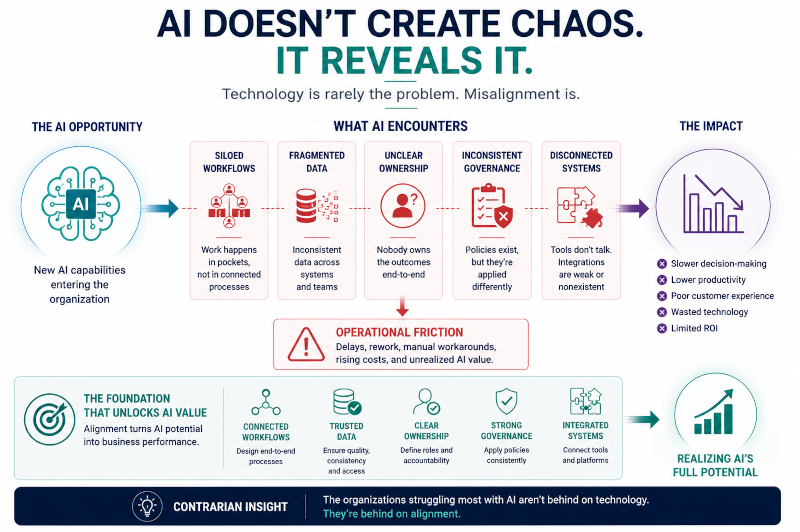
Deploying isolated AI tools may improve local productivity. But enterprise-scale value typically emerges only when organizations redesign coordination systems around automation, retrieval, analytics, and intelligent workflows simultaneously.
Walmart’s supply chain modernization efforts help illustrate this transition clearly. AI-assisted analytics and forecasting systems now support inventory optimization, logistics coordination, and operational decision-making across highly distributed retail environments. The value does not come merely from deploying AI software. It comes from integrating intelligent systems into the operational architecture governing how inventory, fulfillment, forecasting, and execution interact continuously.
This is why many CIOs are spending less time managing infrastructure directly and more time coordinating ecosystems.
Technology leadership increasingly involves:
- aligning systems with business goals,
- reducing workflow fragmentation,
- improving operational visibility,
- and ensuring intelligent systems produce measurable outcomes.
The future CIO may resemble less of a traditional technology manager and more of an enterprise systems architect coordinating human, digital, and AI-enabled execution environments simultaneously.
Recommendation: Shift IT operating models from project delivery structures toward cross-functional orchestration models aligned around workflows and business outcomes.
The Real Challenge Is Business Impact, Not Technology Deployment
Despite enormous investment in digital transformation, many organizations still struggle to produce meaningful operational results. AI pilots often fail to scale beyond experimentation, cloud migrations deliver less improvement than expected, workflow fragmentation persists despite modernization efforts, and large technology initiatives frequently generate activity without fundamentally improving coordination, execution, or business performance. In many cases, the problem is not the technology itself, but the organization’s inability to align systems, workflows, governance, and operational behavior around measurable outcomes.
McKinsey’s research consistently shows that organizations generating the strongest returns from AI and digital transformation are those redesigning workflows, governance structures, and operating models rather than simply deploying new tools.
This exposes one of the most important misconceptions surrounding modern IT leadership: technology deployment is not the same thing as business transformation.
Many organizations still evaluate success through:
- deployment activity,
- platform adoption,
- project completion,
- or infrastructure modernization.
But mature organizations increasingly focus on:
- execution quality,
- operational coordination,
- measurable business outcomes,
- and organizational adaptability instead.
Gartner similarly emphasizes that AI systems must be treated as evolving operational products requiring ongoing refinement, governance, and alignment rather than one-time implementations.
This creates a more difficult but more important leadership mandate.
The CIO role is no longer simply about ensuring technology works.
It is about ensuring technology produces enterprise-wide value under growing operational complexity.
That shift requires:
- stronger governance,
- clearer alignment with business KPIs,
- better cross-functional coordination,
- and deeper integration between technology and operational strategy.
The future of IT leadership may therefore depend less on technical expertise alone and more on the ability to coordinate transformation across interconnected systems, teams, and workflows at enterprise scale.
Technology no longer operates adjacent to the business.
Increasingly, it defines how the business functions altogether.
Recommendation: Measure digital transformation success through operational performance, workflow efficiency, and strategic business impact rather than deployment milestones alone.