

Recommendations
- Evaluate automation initiatives based on how work is actually performed rather than how the process is documented.
- Map exceptions, escalations, and informal handoffs before automating any process.
- Treat recurring workarounds as diagnostic signals rather than compliance failures.
- Measure the volume of off-system work alongside traditional workflow performance metrics.
- Evaluate automation success through user outcomes, not system utilization statistics.
- Design exception pathways intentionally rather than forcing users to create them informally.
- Investigate every commonly accepted workaround as if it were a process improvement opportunity.
Automation promises something every organization wants: faster execution, lower costs, fewer errors, stronger controls, and greater operational consistency. Business cases often assume that once a workflow is automated, inefficiency disappears. Approvals become streamlined, handoffs become predictable, and manual effort declines.
Yet many organizations discover a different reality after implementation. The workflow becomes automated, but employees continue relying on spreadsheets, side conversations, email chains, shared drives, and informal escalation paths to get work done.
The technology functions exactly as designed. Adoption remains high on paper. Process metrics appear healthy. At the same time, critical work continues to occur outside the system.
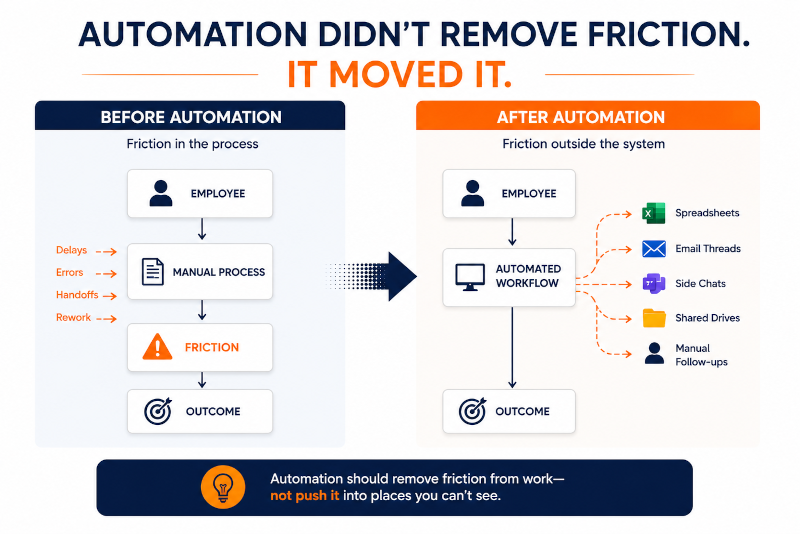
This pattern appears across finance, procurement, HR, IT service management, customer support, and operations. The official process lives inside the platform. The real process often lives somewhere else.
The issue is rarely employee resistance. More often, automation has been designed around policy logic rather than operational reality.
As organizations invest heavily in automation, workflow orchestration, AI-powered process tools, and digital transformation initiatives, understanding this distinction becomes increasingly important. Gartner predicts that by 2026, 30% of enterprises will automate more than half of their network activities, up from less than 10% in 2023, highlighting how central automation has become to modern operating models.
Recommendation: Evaluate automation initiatives based on how work is actually performed rather than how the process is documented.
The Official Process vs. The Real Process
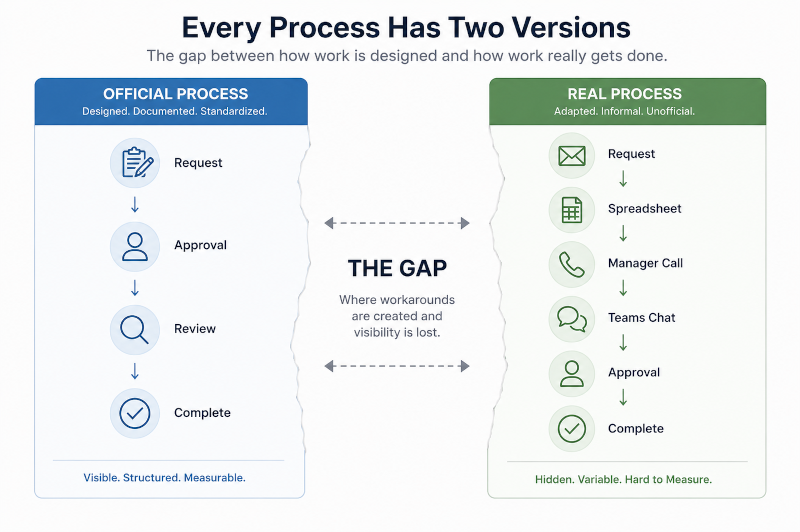
Most business processes have two versions.
The first is the documented process. This version appears in process maps, standard operating procedures, governance documentation, and transformation presentations. It contains approval chains, workflow rules, service-level agreements, and clearly defined responsibilities.
The second version exists in everyday operations. It includes judgment calls, exceptions, relationship-based escalations, missing information, competing priorities, and practical adaptations that help employees meet business objectives when reality does not align with the designed workflow.
Automation projects frequently focus on the first version because it is visible and easier to model. Unfortunately, that is not always where the most important work occurs.
Researchers studying sociotechnical systems continue to find that technology adoption succeeds when technical workflows and human work structures are designed together rather than independently. When formal systems fail to accommodate operational complexity, employees naturally develop alternative practices to bridge the gap between process design and operational necessity.
This is one of the reasons many digital transformation efforts struggle to achieve their expected return on investment. The workflow may be automated successfully while the underlying behavior remains largely unchanged.
The same dynamic appears in organizations that believe they have standardized processes when employees are actually relying on informal routines and tribal knowledge. As explored in Spirzon’s article Most Organizations Don’t Have Processes—They Have Habits, documented workflows often describe how leaders believe work happens rather than how it actually happens.
Recommendation: Map exceptions, escalations, and informal handoffs before automating any process.
Why Employees Build Workarounds
Workarounds are often misunderstood.
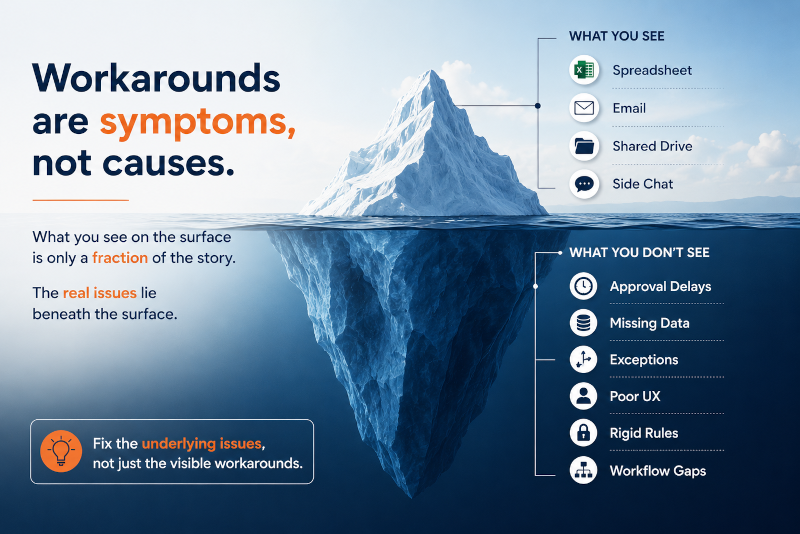
Leaders may interpret them as evidence that employees are unwilling to follow procedures or embrace change. In reality, workarounds are frequently rational responses to operational constraints.
Consider a procurement workflow that requires five approvals regardless of purchase value. The process may satisfy governance requirements, but when a business-critical laptop fails and replacement equipment is needed immediately, employees often bypass the official workflow through email requests, phone calls, or personal relationships. The workaround emerges because the operational need cannot wait for the designed process.
A similar pattern appears in IT service management. A ticketing platform may require complete categorization before routing a request. If employees do not know which category applies, requests stall. Service desk staff then create unofficial guidance documents or maintain side channels to keep work moving.
Healthcare provides another example. Recent research examining digital health implementations found that clinicians routinely develop workarounds to compensate for workflow mismatches, usability challenges, and system limitations. These adaptations often allow work to continue while simultaneously masking underlying process weaknesses.
Employees rarely wake up intending to violate process standards. They are usually trying to accomplish their work. When systems create friction that prevents outcomes, people optimize for outcomes.
Recommendation: Treat recurring workarounds as diagnostic signals rather than compliance failures.
The Hidden Cost of Helpful Shortcuts
Many workarounds initially appear beneficial.
A manager maintains a spreadsheet because reporting data arrives too slowly. A team uses a shared mailbox because access requests take too long. Employees coordinate approvals through chat messages because workflow notifications are unreliable.
Business operations continue functioning. In some cases, performance even appears to improve.
The costs emerge later.
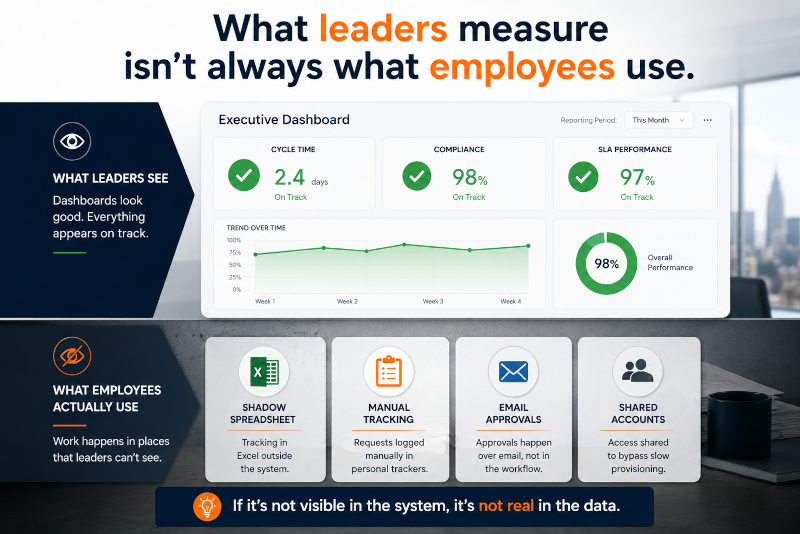
Visibility declines because significant work occurs outside governed systems. Audit trails become incomplete. Data quality deteriorates as information exists in multiple locations. Leadership dashboards no longer reflect operational reality. Security controls weaken when approvals and access decisions move into unmanaged channels.
The same pattern can be observed in organizations that continue relying on spreadsheets despite significant investments in enterprise platforms. As discussed in Spirzon’s article The Spreadsheet That Still Runs the Business, spreadsheets often persist because they solve workflow problems that official systems fail to address.
Studies on workflow automation continues to demonstrate that automation introduces its own maintenance burden. Research examining automated workflow environments have found that automated processes require ongoing refinement, monitoring, exception handling, and governance to remain effective over time.
Automation can reduce manual effort. It does not eliminate operational complexity.
Recommendation: Measure the volume of off-system work alongside traditional workflow performance metrics.
Bad Automation Optimizes the Wrong Thing
Many automation programs are designed around organizational priorities such as compliance, standardization, consistency, and cost reduction.
These objectives matter. Problems arise when they become the only objectives.
Employees experience automation differently. They evaluate systems based on speed, usability, flexibility, and their ability to handle unusual situations. A workflow that satisfies governance requirements but prevents work from being completed efficiently will eventually lose user trust.
Once that trust disappears, adoption often becomes performative.
Employees complete the required system steps while simultaneously relying on unofficial processes to accomplish meaningful work.
Consider employee onboarding. An automated onboarding workflow may successfully provision accounts, distribute forms, and track completion milestones. Yet new hires may still depend on managers, coworkers, and informal conversations to obtain the practical knowledge necessary to perform their jobs effectively.
Technically, the workflow succeeded.
Operationally, the process remained incomplete.
Research examining technology adoption in workplace environments consistently shows that successful implementation requires alignment between technical systems and the realities of human work rather than simply expanding automation capabilities.
Recommendation: Evaluate automation success through user outcomes, not system utilization statistics.
What Better Automation Looks Like
Organizations that achieve meaningful automation benefits take a different approach.
Rather than asking how to automate the documented process, they begin by understanding how work actually happens. This requires observing frontline operations, reviewing exceptions, interviewing users, and analyzing informal workflows. The goal is not to eliminate flexibility but to understand why flexibility exists.
Effective automation distinguishes between routine work and judgment-based work. Routine activities can often be standardized and automated successfully. Complex situations frequently require guided decision-making, exception pathways, and human discretion.
“Effective automation distinguishes between routine work and judgment-based work.”
The strongest automation programs also create transparency. Employees are more likely to trust workflows when they understand request status, ownership, expected timelines, and escalation options.
Recent research on enterprise workflow automation suggests that the most successful implementations balance mechanization of routine tasks with orchestration that supports more complex collaborative work, rather than treating every activity as a candidate for rigid standardization.
Automation performs best when it supports operational reality rather than attempting to replace it.
Recommendation: Design exception pathways intentionally rather than forcing users to create them informally.
The Signal Leaders Should Never Ignore
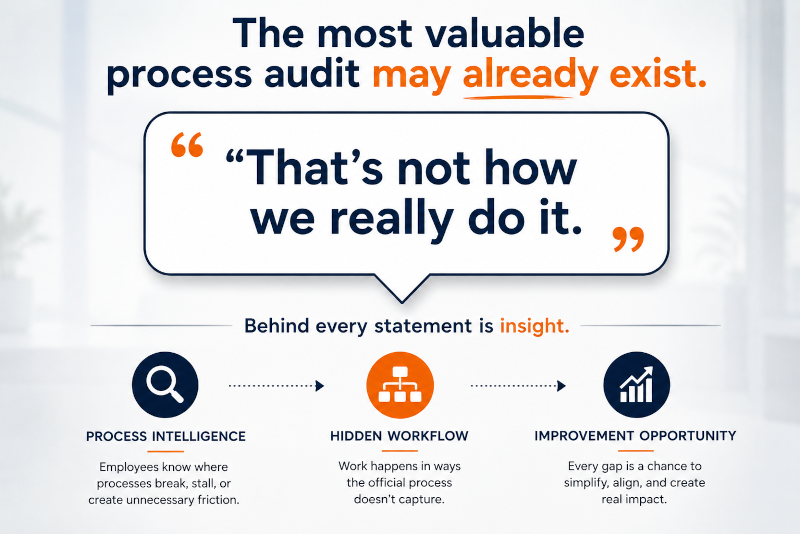
One of the most valuable pieces of process intelligence in any organization is a simple statement:
“That’s not how we really do it.”
When employees say this, they are identifying a gap between process design and operational reality.
They know where approvals stall.
They know where information is missing.
They know which steps add value and which create delay.
Most importantly, they know what actually happens when the documented process breaks down.
Organizations often invest heavily in process mining, workflow analytics, and operational dashboards while overlooking this source of information. Yet hidden inside every workaround is evidence about how the workflow could be improved.
The workaround itself is rarely the problem. The conditions that created it usually are.
Recommendation: Investigate every commonly accepted workaround as if it were a process improvement opportunity.
Final Thought
Automation should remove friction, not relocate it.
When employees consistently build side processes around official workflows, they are not necessarily rejecting automation. More often, they are compensating for gaps between process design and operational reality.
The organizations that generate lasting value from automation are not those with the most sophisticated workflow engines, approval rules, or AI-powered tools. They are the organizations that understand how work actually gets done and design systems that support those realities.
Because when the real process lives outside the platform, the platform is not the process.
2 thoughts on “How to Fix Broken Automation: Aligning Workflows with Reality”