- The Managerial Shift Is Already Underway
- Managers Are Becoming Workflow Architects
- The Entry-Level Talent Pipeline Is Quietly Changing
- Data Readiness Determines Whether AI Works Operationally
- Shadow AI Is Becoming a Management Problem
- The Best Managers Will Reduce Organizational Anxiety During Transition
The Managerial Shift Is Already Underway
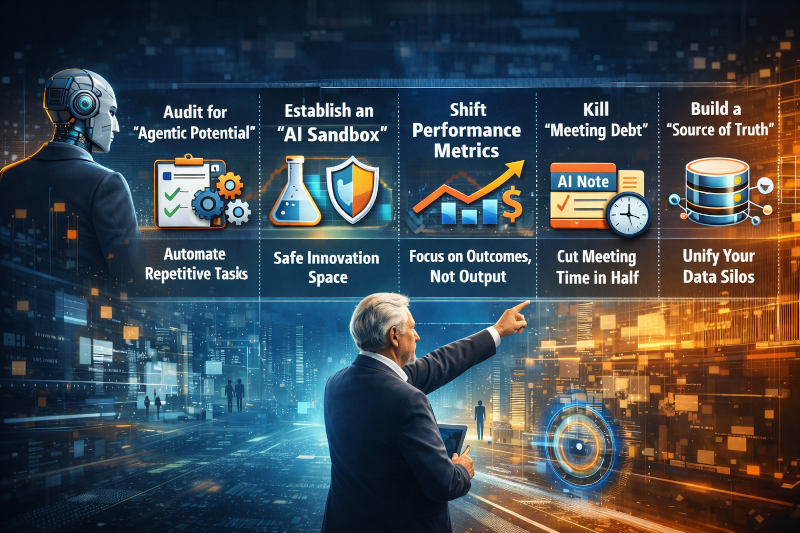
Most organizations are no longer asking whether AI will influence work. That transition has already happened. The more immediate challenge facing managers in 2026 is operational: how to lead teams where human employees and AI systems work together across the same workflows.
In many enterprise environments, AI agents already participate in ticket triage, reporting automation, onboarding support, workflow routing, meeting summarization, document retrieval, customer support escalation, and operational analytics. Research from the Microsoft 2024 Work Trend Index found that 75% of knowledge workers already use AI at work, while many organizations continue struggling to redesign workflows, governance structures, and management models around that reality.
This creates a structural shift in management itself.
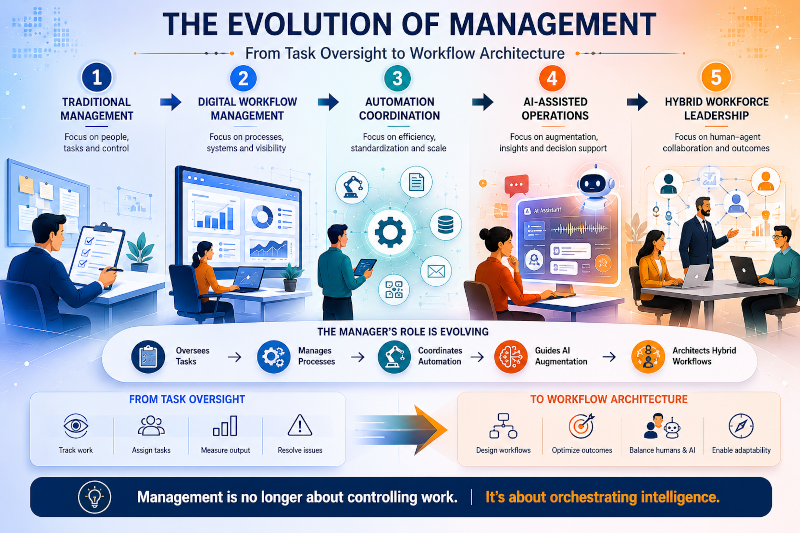
For decades, managers primarily coordinated human labor. Today, many managers are beginning to oversee hybrid execution environments where work moves continuously between employees, automation systems, copilots, retrieval systems, and AI agents. The operational challenge is no longer simply task assignment. Increasingly, it involves workflow architecture, governance oversight, coordination quality, and organizational adaptability.
This transition overlaps closely with themes explored previously in From AI Hype to Operational Execution, where AI adoption often resembled enterprise operational redesign rather than standalone software deployment.
The organizations adapting most effectively are often not the ones automating the largest number of tasks. More often, they are the organizations redesigning management structures around hybrid intelligence environments thoughtfully and deliberately.
Recommendation: Identify workflows where employees already rely on AI informally and formalize governance, accountability, and operational standards around those environments first.
Managers Are Becoming Workflow Architects
One of the largest managerial changes underway involves the shift from supervising tasks toward designing workflows.
Historically, many managers focused heavily on tracking deliverables, assigning responsibilities, escalating blockers, and monitoring execution progress manually. But as AI systems automate portions of reporting, routing, scheduling, retrieval, and repetitive operational work, managerial value now shifts toward optimizing how work moves across systems and teams.
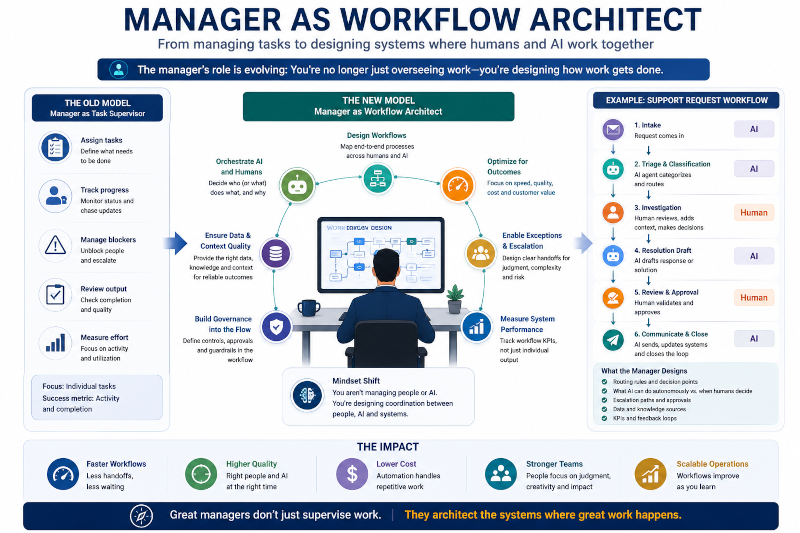
This transition becomes particularly visible inside organizations deploying AI-assisted operational workflows. ServiceNow, for example, has expanded AI integration across enterprise workflow environments to automate repetitive service operations, knowledge retrieval, incident classification, and operational coordination functions while still relying heavily on human oversight for escalation, governance, and judgment-based decisions.
The managerial question therefore changes fundamentally.
Instead of asking:
“Did the employee complete the task?”
Managers today ask:
“Is the workflow structured correctly across human and AI execution layers?”
This includes:
- determining which decisions require human review,
- identifying where AI improves speed or consistency,
- defining escalation pathways,
- and ensuring workflows remain understandable and governable as automation expands.
Research from McKinsey’s Technology Trends Outlook 2025 emphasized that agentic AI systems are rapidly evolving from isolated experimentation into operational tools capable of participating directly inside multistep enterprise workflows. McKinsey also noted that governance, workforce adaptation, and operational alignment increasingly determine whether organizations scale these systems successfully.
This shift resembles the evolution of managers from supervisors into operational system designers.
The organizations struggling most with AI adoption are often not facing technical limitations. More often, workflows themselves remain fragmented, poorly governed, or structurally unclear.
Recommendation: Map workflows end-to-end before automating them and identify where human judgment, escalation, and oversight must remain embedded operationally.
The Entry-Level Talent Pipeline Is Quietly Changing
One of the least discussed consequences of AI-assisted work is its impact on workforce development itself.
In many organizations, junior employees historically developed operational judgment through repetitive foundational work:
- ticket handling,
- documentation,
- reporting,
- data cleanup,
- customer intake,
- and process coordination.
But many of these tasks are now partially automated.
This creates a subtle organizational risk. Employees may gain efficiency faster than they gain operational understanding.
Research from Microsoft’s workplace analysis found that many employees depend on AI systems for drafting, summarization, retrieval, and information processing tasks. While this improves productivity, it also changes how employees build foundational expertise.
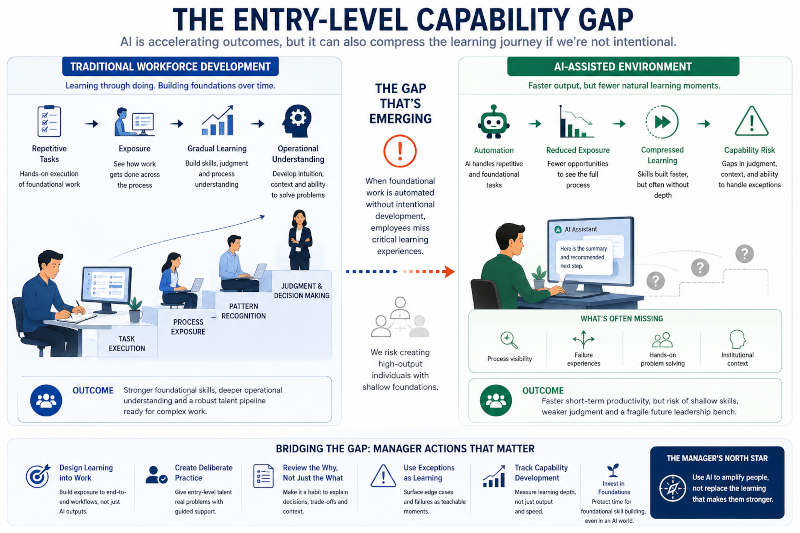
McKinsey executives have publicly discussed this issue as well. Despite rapid AI expansion, the firm continues increasing entry-level hiring because organizations still require employees capable of critical thinking, contextual reasoning, and adaptive problem-solving rather than narrow tool operation alone.
This creates a new managerial responsibility: capability development can no longer depend entirely on passive “learning by doing.”
Managers need to design intentional development pathways around AI-assisted environments. This often means exposing employees to:
- workflow reasoning,
- decision tradeoffs,
- exception handling,
- governance thinking,
- and operational coordination earlier in their careers.
The challenge is not simply preserving jobs. It is preserving organizational capability development itself.
This mirrors themes explored previously in How AI Is Reshaping Human Cognitive Work, where AI increasingly shifted human work toward validation, contextual interpretation, and strategic reasoning rather than repetitive information production alone.
The managers who succeed in hybrid intelligence environments may not necessarily be the ones maximizing automation fastest. More often, they may be the ones developing adaptable human judgment alongside automation simultaneously.
Recommendation: Build structured learning environments where junior employees regularly review AI-generated outputs, workflow exceptions, and operational decision reasoning rather than only consuming final answers.
Data Readiness Determines Whether AI Works Operationally
Many organizations still approach AI implementation primarily as a model or tooling challenge. In practice, managers often discover that the real bottleneck is operational data quality.
Across enterprise environments, AI systems frequently struggle because:
- workflows remain poorly documented,
- systems lack standardization,
- ownership structures remain fragmented,
- and institutional knowledge exists across disconnected repositories.
As a result, AI systems often inherit the same operational inconsistencies already embedded inside organizations.
Research from Deloitte’s State of Generative AI in the Enterprise 2024 found that governance maturity, data quality, operational readiness, and organizational alignment remain among the largest barriers preventing enterprises from scaling AI successfully.
This becomes especially visible inside reporting and analytics environments. Many organizations attempt to deploy AI copilots on top of fragmented operational systems without first addressing:
- inconsistent definitions,
- duplicate data,
- undocumented workflows,
- and unclear system-of-record ownership.
The result is often faster confusion rather than operational clarity.
JPMorgan Chase provides an important counterexample. The company has expanded AI deployment across fraud detection, operational analytics, and internal workflow systems while simultaneously strengthening governance, retrieval integrity, explainability standards, and oversight structures around those systems. The emphasis is not simply on deploying AI broadly. It is on ensuring operational trustworthiness at scale.
“AI inherits the strengths and weaknesses of the operational environments it is built on.”
This overlaps directly with themes explored in Why Organizational Knowledge Disappears Faster Than Companies Realize, where fragmented institutional knowledge environments quietly weakened operational continuity and execution consistency long before failures became visible organizationally.
Managers increasingly need to think less like software users and more like operational coordinators responsible for maintaining workflow clarity across interconnected systems.
Recommendation: Standardize operational definitions, ownership structures, and workflow documentation before scaling AI-assisted workflows across teams.
Shadow AI Is Becoming a Management Problem
As AI tools become more accessible, many organizations are confronting a rapidly expanding operational issue: unmanaged AI adoption inside teams.
Employees today use external AI systems for:
- drafting communications,
- analyzing documents,
- summarizing meetings,
- generating reports,
- and supporting operational tasks independently.
In many cases, this occurs outside formal governance structures.
This creates what many enterprises now describe as “Shadow AI,” where AI usage expands faster than organizational oversight.
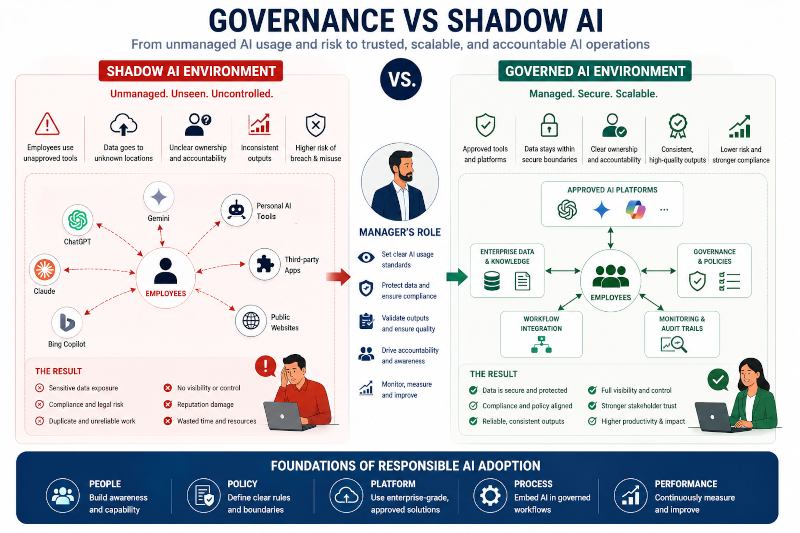
The problem is not necessarily employee misuse. Often, employees adopt AI tools simply because existing workflows are inefficient. But unmanaged adoption creates growing operational risk involving:
- data leakage,
- inconsistent outputs,
- compliance exposure,
- retrieval integrity,
- and unclear accountability.
Research from Deloitte similarly found that governance uncertainty and operational risk management remain major enterprise concerns as AI adoption accelerates.
Managers therefore face a new operational responsibility: they often become governance leaders inside AI-assisted environments.
This does not mean managers must become AI engineers. But they increasingly need to understand:
- which tools are approved,
- where sensitive data flows,
- how outputs are validated,
- and where human oversight remains mandatory.
The organizations scaling AI most effectively are often not the organizations with the least governance. More often, they are the organizations building governance structures aggressively enough to sustain trust as automation expands.
This mirrors operational resilience themes explored previously in Cybersecurity Is No Longer Just a Technical Problem, where governance, coordination visibility, and operational accountability increasingly determined enterprise resilience under complex digital environments.
Recommendation: Establish team-level AI usage standards covering approved tools, validation procedures, sensitive data handling, and escalation requirements before Shadow AI expands informally.
The Best Managers Will Reduce Organizational Anxiety During Transition
One of the most underestimated aspects of AI transformation is the psychological instability it creates across organizations.
Employees with greater frequency operate inside environments where:
- workflows change continuously,
- automation expands gradually,
- responsibilities evolve rapidly,
- and long-term role expectations remain unclear.
This creates uncertainty even inside organizations where AI adoption improves productivity significantly.
Research from Microsoft’s workplace studies found that many employees already feel overwhelmed by digital overload, workflow fragmentation, and accelerating operational complexity. AI adoption can improve efficiency, but poorly managed transitions often increase organizational anxiety simultaneously.
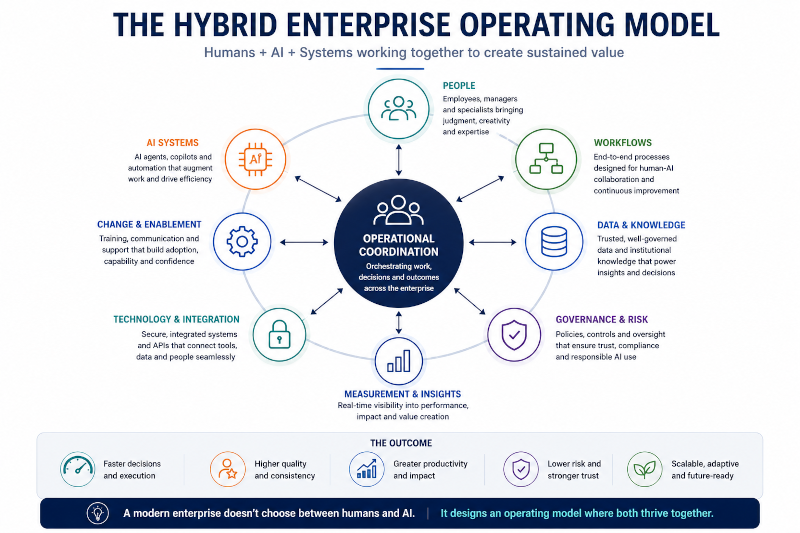
The strongest managers in hybrid intelligence environments increasingly function as operational stabilizers. This includes reducing ambiguity, clarifying role evolution, creating structured adaptation pathways, and communicating operational changes consistently. Research published by MIT Sloan Management Review suggests that organizations frequently struggle with AI transformation not because the technology lacks capability, but because management structures, workforce adaptation, governance models, and operational coordination evolve more slowly than the technology itself.
Managers who focus exclusively on productivity targets often create resistance, burnout, and fragmentation during AI transitions. Managers who balance operational modernization with workforce clarity, however, often sustain adoption far more effectively over time.
The managerial challenge in 2026 is therefore not simply implementing AI tools. Increasingly, it involves maintaining organizational coherence while workflows, decision systems, and operational structures evolve simultaneously.
The organizations adapting most successfully may not necessarily be the ones automating work the fastest. More often, they may be the organizations redesigning management itself around human-machine coordination thoughtfully enough to preserve trust, governance, and operational stability at scale.
Recommendation: Communicate operational role changes explicitly and continuously so employees understand how AI affects workflows, expectations, escalation paths, and long-term capability development.
1 thought on “Managing the Human–Agent Hybrid Workforce: A Practical Guide for Managers in 2026”