
- Recommendations
- The Promise of Onboarding Automation
- Understanding the New Hire Confusion Gap
- Onboarding Is Organizational Socialization
- The First 90 Days Matter More Than Most Leaders Realize
- Managers Remain the Most Important Variable
- AI Will Improve Onboarding—But Not in the Way Leaders Expect
- Conclusion
Recommendations
- Review your onboarding metrics and determine whether they measure administrative completion or employee readiness.
- Add a 30-, 60-, and 90-day survey that asks employees whether they feel confident navigating the organization—not just performing their job.
- Review your onboarding materials and identify whether they explain organizational culture and decision-making in addition to administrative requirements.
- Extend onboarding programs to 90 days and include structured manager check-ins throughout the process.
- Use AI to support onboarding logistics and knowledge retrieval, but continue investing in mentorship and manager engagement.
Most organizations can tell you exactly when a new employee’s laptop was delivered.
They know when accounts were provisioned, when mandatory training was completed, and whether benefits enrollment was submitted before the deadline. Modern onboarding platforms have become exceptionally good at managing administrative activities, providing HR and operations teams with dashboards that track progress across dozens of tasks.
Ask a different question, however, and the answers become less certain.
- When did the employee become comfortable asking questions?
- When did they understand how decisions are made?
- When did they feel confident enough to work independently?
- And perhaps most importantly, when did they stop feeling like the newest person in the room?
These questions are considerably more difficult to answer because they sit outside the boundaries of most onboarding programs.
Over the past several years, organizations have invested heavily in onboarding automation. Workflows have been streamlined, manual effort has been reduced, and administrative processes that once took days now happen in a matter of minutes. Those are meaningful improvements.
Yet many organizations continue to experience familiar challenges. New hires remain uncertain about expectations, managers report longer-than-expected ramp-up periods, and employees often spend their first few months navigating an environment that feels far more ambiguous than leadership intended.
The issue is not that onboarding automation has failed. It is that many organizations have automated onboarding activities while leaving the onboarding experience largely unchanged.
The Promise of Onboarding Automation
The business case for onboarding automation is compelling.
Organizations use automation to provision accounts, initiate equipment requests, assign training, coordinate background checks, and manage policy acknowledgments. These efforts produce measurable results. Several organizations have publicly reported significant reductions in onboarding time through workflow automation initiatives.
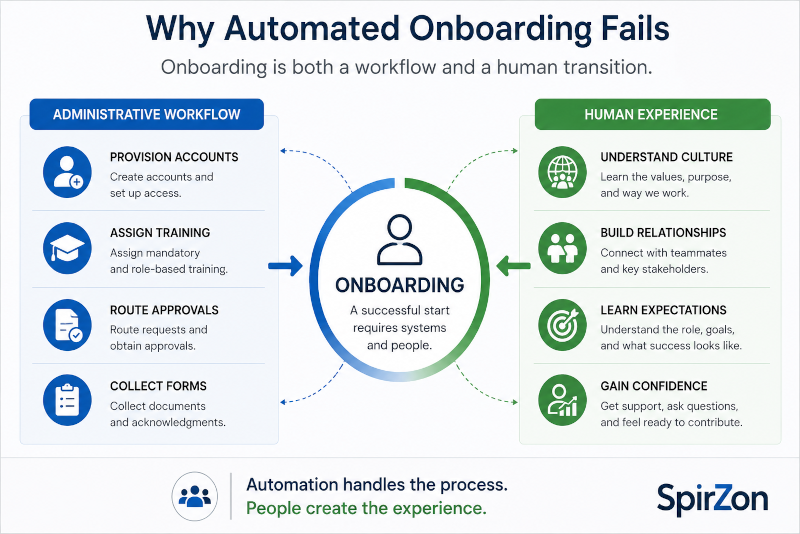
For HR and operations teams, the benefits are substantial. Processes become more consistent, administrative burden decreases, and leaders gain greater visibility into onboarding progress across the enterprise.
There is also an important employee benefit. Few people would argue that spending their first day waiting for system access or completing paper forms contributes positively to the onboarding experience.
However, administrative efficiency and organizational integration are not the same thing.
An employee may have access to every system they need by 9:00 a.m. on their first day and still have little understanding of how work actually gets done within the organization. They may know where to submit a request but remain uncertain about who approves it. They may complete required training while still struggling to understand what success looks like in their role.
Experience suggests that organizations are generally good at onboarding employees into systems. They are considerably less effective at onboarding them into the organization itself.
Recommendation: Review your onboarding metrics and determine whether they measure administrative completion or employee readiness.
Understanding the New Hire Confusion Gap
Every organization has an onboarding period. Less frequently discussed is what might be described as the “New Hire Confusion Gap”—the period between when an employee becomes operationally active and when they become organizationally effective.
The distinction is subtle but important.
An employee may receive their laptop on Monday, complete mandatory training by Wednesday, and gain access to all required systems before the end of the week. From a process perspective, onboarding appears complete.
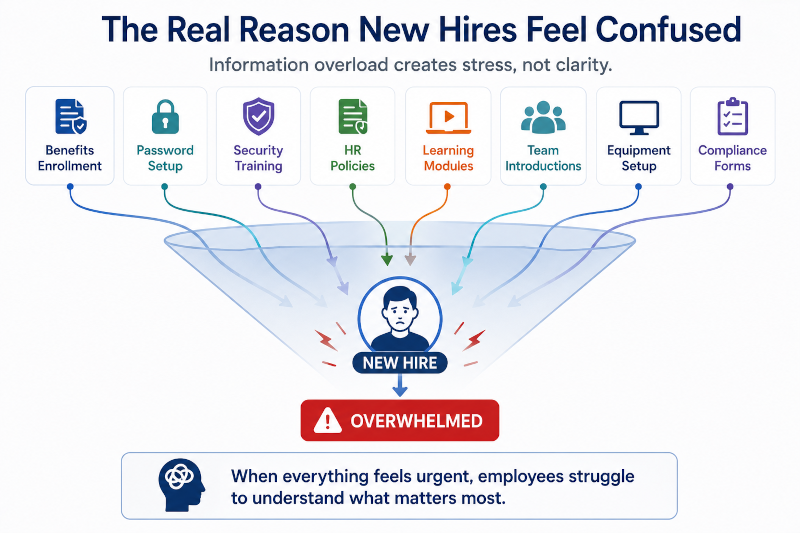
From the employee’s perspective, however, the experience may be just beginning.
Questions tend to emerge gradually:
- Who should I ask when I need help?
- Which meetings are genuinely important?
- How are priorities established?
- What is expected during my first 90 days?
- How are decisions made here?
Research from BambooHR found that 39% of employees experience second thoughts about their new employer during onboarding, while nearly one-third report disappointment with the onboarding experience.
Those findings suggest many organizations may be measuring the wrong outcomes.
Administrative completion rates are relatively easy to track. Confidence, belonging, and organizational understanding are not.
The result is a gap that often goes unnoticed by leadership. New hires become productive enough to perform their responsibilities while still operating with incomplete context. In many cases, they spend their first several months relying heavily on colleagues to fill in information that no onboarding checklist captured.
As discussed in Why Documentation Is Becoming a Strategic Asset, organizations often underestimate the importance of context. Information matters, but understanding how that information is applied within the organization matters just as much.
Recommendation: Add a 30-, 60-, and 90-day survey that asks employees whether they feel confident navigating the organization—not just performing their job.
Onboarding Is Organizational Socialization
Onboarding has been described as a form of organizational socialization—the process through which individuals acquire the knowledge, behaviors, and relationships needed to become effective members of an organization.
This perspective changes how onboarding should be viewed.
Organizations often approach onboarding as a sequence of tasks to be completed. Employees tend to experience it as a process of learning how the organization functions.
Those experiences are not always aligned.
For example, a new employee may complete every required onboarding activity during their first week and still have no understanding of unwritten norms. They may not know whether meetings typically begin on time, how quickly leadership expects responses to emails, or whether decisions are made collaboratively or escalated through management chains.
These details rarely appear in employee handbooks, yet they play a significant role in shaping how employees experience an organization.
A hypothetical example illustrates the point. Two employees join different organizations on the same day. Both receive equipment, complete training, and meet their managers during their first week. Three months later, one employee feels integrated into the organization and operates independently. The other continues relying heavily on colleagues for guidance.
The difference is unlikely to be explained by onboarding technology. More often, it reflects how effectively the organization introduced employees to its culture, expectations, and ways of working.
Technology can streamline tasks. It has historically been less successful at creating understanding.
Recommendation: Review your onboarding materials and identify whether they explain organizational culture and decision-making in addition to administrative requirements.
The First 90 Days Matter More Than Most Leaders Realize
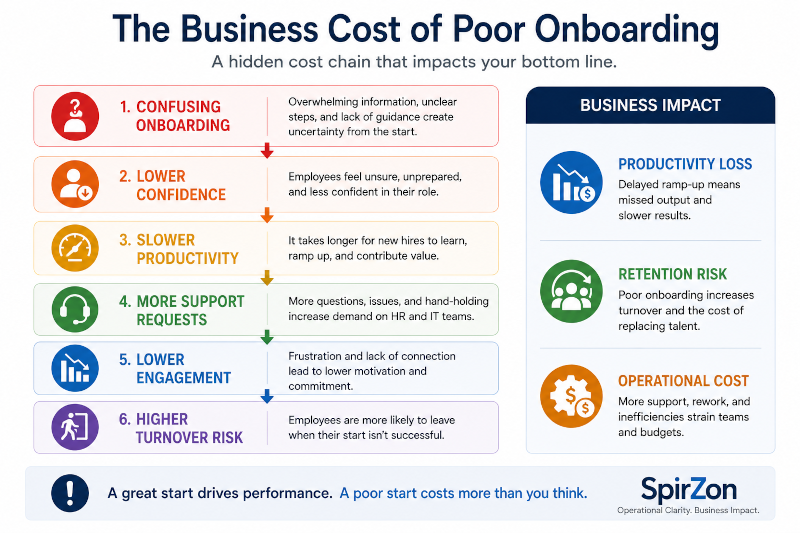
Organizations frequently measure onboarding in days, while employees experience it in months.
Research continues to demonstrate the relationship between onboarding quality, employee retention, and productivity. Studies indicate that effective onboarding can improve retention rates significantly while contributing to higher levels of engagement and job satisfaction.
These findings are not particularly surprising.
Employees form opinions about their organization relatively quickly. Their early experiences influence how they perceive leadership, whether they feel supported, and how confident they become in their ability to succeed.
Studies examining nearly a decade of HR data found that employees onboarded remotely during the pandemic were more likely to leave within their first three years, suggesting that weaker organizational attachment may have long-term consequences.
This presents an interesting challenge for leadership teams.
Most onboarding dashboards focus on the first week. Employees often continue evaluating their onboarding experience for the first several months.
High-performing organizations recognize this distinction. They treat onboarding as an extended process rather than a one-time event and continue investing in employee integration well beyond the completion of mandatory tasks.
As discussed in How High-Performing Organizations Reduce Operational Friction, the handoff between processes and people is often where organizations experience the greatest challenges.
Recommendation: Extend onboarding programs to 90 days and include structured manager check-ins throughout the process.
Managers Remain the Most Important Variable
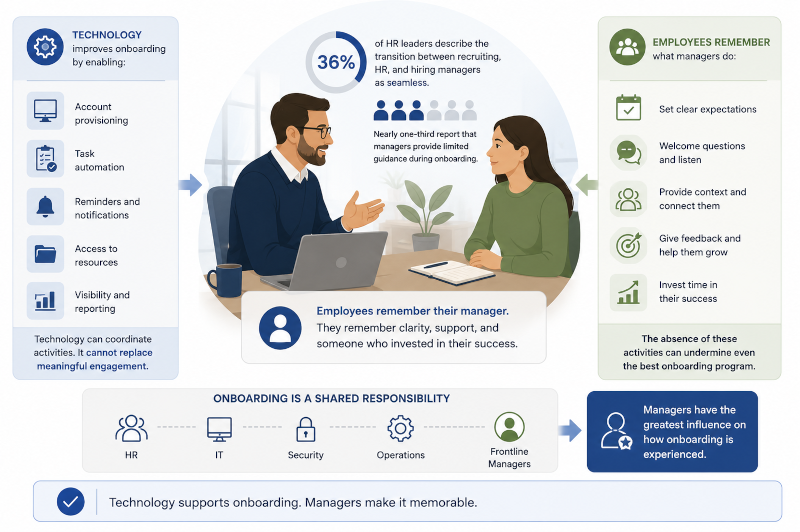
Technology has improved many aspects of onboarding.
It has not replaced the role of managers.
Enboarder found that only 36% of HR leaders describe the transition between recruiting, HR, and hiring managers as seamless. Nearly one-third report that managers provide limited guidance during onboarding.
This observation helps explain why onboarding initiatives sometimes underperform despite significant investments in technology.
Employees rarely remember the workflow that provisioned their accounts. They remember their manager.
They remember whether expectations were clear, whether questions were welcomed, and whether someone invested time helping them understand how to succeed.
Organizations occasionally treat onboarding as an HR process when, in practice, it is a shared responsibility involving HR, IT, Security, Operations, and frontline managers. Among those groups, managers tend to have the greatest influence on how onboarding is ultimately experienced.
A manager who schedules regular check-ins, provides context, and creates opportunities for connection can significantly improve the onboarding experience. Conversely, the absence of those activities can undermine even the most sophisticated onboarding program.
Technology can coordinate activities across departments. It cannot replace meaningful engagement.
Recommendation: Require managers to conduct structured 30-, 60-, and 90-day conversations focused on employee confidence, expectations, and organizational integration.
AI Will Improve Onboarding—But Not in the Way Leaders Expect
Artificial intelligence will undoubtedly play a larger role in onboarding over the next several years.
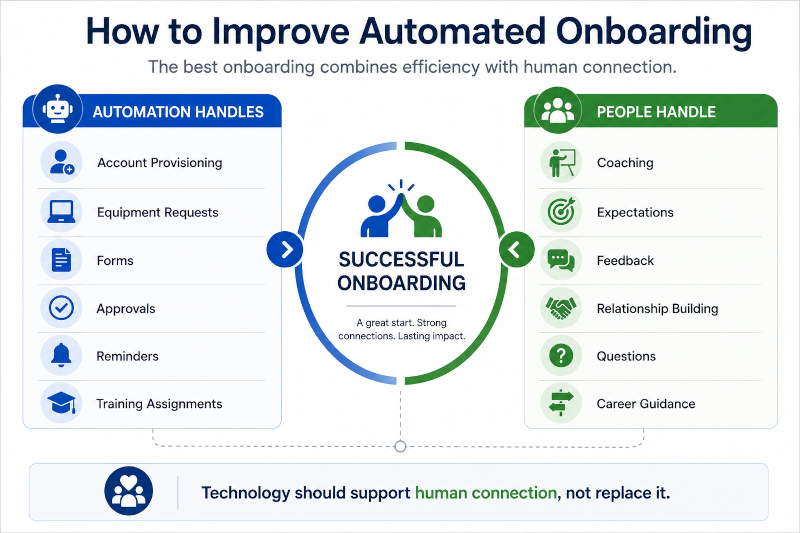
Organizations are already experimenting with onboarding assistants capable of answering policy questions, recommending learning paths, and helping employees locate information across enterprise systems.
These capabilities are valuable.
At the same time, AI has limitations that are worth acknowledging. It cannot establish trust, provide mentorship, or help employees navigate the informal aspects of organizational life.
Washington University found that users frequently experience confusion despite the existence of documentation and supporting resources, reinforcing the idea that access to information does not automatically create understanding.
This observation aligns with a broader trend across organizations.
Most onboarding challenges are not caused by a lack of information. They emerge when employees struggle to connect information with context.
AI may eventually become exceptionally good at answering questions such as, “Where can I find the travel policy?” It is less likely to answer questions such as, “How do successful people on this team build credibility?”
Those conversations remain distinctly human.
This builds on ideas explored in Why Most AI Implementations Fail Inside Organizations. Technology can improve processes, but it rarely substitutes for leadership, culture, or organizational clarity.
Recommendation: Use AI to support onboarding logistics and knowledge retrieval, but continue investing in mentorship and manager engagement.
Conclusion
Organizations have made substantial progress automating onboarding over the past decade. Administrative processes are faster, onboarding experiences are more consistent, and employees are generally better equipped on their first day than they were only a few years ago.
At the same time, many organizations continue to encounter the same questions from new hires: Who should I ask for help? What does success look like? How are decisions made here?
Those questions persist because onboarding has always been about more than completing tasks. It is the process through which employees learn how to operate within an organization, build relationships, and develop confidence in their ability to contribute.
“Organizations do not succeed because employees complete onboarding. They succeed when employees feel confident enough to contribute.”
Technology will continue to improve this experience. AI will help employees locate information more quickly, workflows will become more efficient, and organizations will gain better visibility into onboarding activities. Those developments are worth pursuing.
However, organizations that consistently onboard employees well tend to recognize that onboarding is ultimately a human experience supported by technology—not the other way around.
For leaders, that distinction presents a useful question: Are we measuring how quickly employees complete onboarding, or how long it takes them to feel successful once they arrive?
Recommendation: Ask your last five hires the same question: “At what point did you feel like you truly understood how to succeed here?” Their answers will likely provide valuable insight into your onboarding experience.