
- Recommendations
- The Network Is No Longer the Enterprise
- Why Attackers Target Identities Instead of Networks
- From Trusting Networks to Verifying Every Request
- Identity Is the New Security Perimeter
- Real-World Lessons: When Identity Becomes the Target
- Identity Governance Is Becoming a Business Capability
- Identity-First Security Requires Organizational Change, Not Just Better Technology
- Conclusion
Recommendations
- Review your highest-privilege user accounts and service accounts first—these identities present the greatest business risk if compromised.
- Begin evaluating access policies based on identity and context rather than network location to align security controls with how your organization actually operates.
- Review access policies with business leaders—not just IT—to ensure privileges reflect current responsibilities rather than historical job changes.
- Conduct tabletop exercises that simulate identity compromise rather than network breaches to better prepare security and business teams for modern attack scenarios.
The IT perimeter didn’t disappear overnight. It dissolved gradually, almost unnoticed.
For years, organizations expanded their technology footprint beyond the walls of the corporate office. Applications moved to the cloud. Employees began working from home, airports, and customer sites. Software-as-a-Service (SaaS) platforms replaced on-premises applications, and business partners started accessing internal systems through APIs rather than private networks. By the time hybrid work became commonplace, the idea of a clearly defined “inside” and “outside” network had already become obsolete.
Yet many organizations continue to operate as though the perimeter still exists.
Firewalls remain essential. Network segmentation still matters. Secure gateways continue to block malicious traffic. But these technologies are no longer the primary line of defense because modern attackers rarely need to breach a network when they can simply log in. Stolen credentials, compromised authentication tokens, and abused identities have become some of the most effective tools in an attacker’s arsenal. Rather than exploiting technical vulnerabilities, adversaries increasingly exploit trust itself.
This shift has profound implications that extend beyond cybersecurity teams. Identity has become the new control plane for the enterprise, influencing how organizations manage employees, contractors, applications, cloud workloads, APIs, and even autonomous AI agents. Security is no longer defined by where someone connects from, but by who—or what—is requesting access, under what circumstances, and with what level of trust.
For business leaders, this represents more than a technical evolution. It reflects a broader transformation in how organizations operate. Just as digital transformation forced companies to rethink business processes, identity-first security requires organizations to rethink governance, access management, and operational resilience. The companies adapting most successfully are not simply deploying new security technologies—they are redesigning how trust is established across the enterprise.
The Network Is No Longer the Enterprise
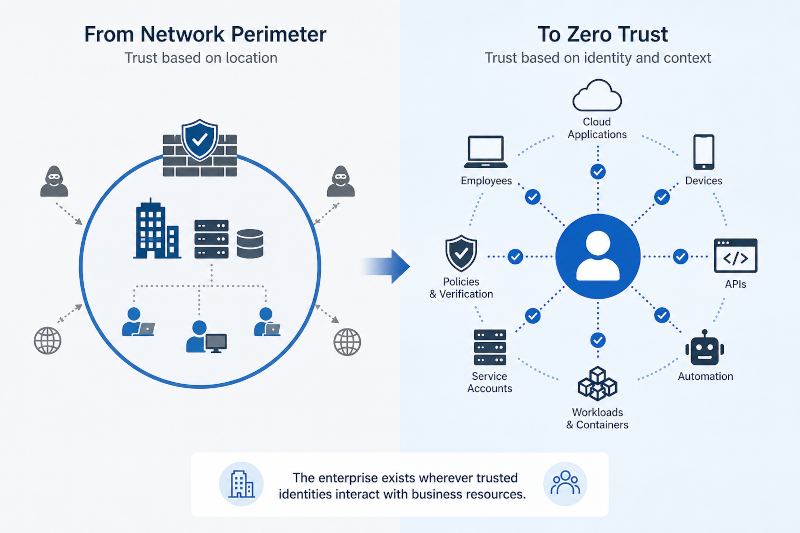
For decades, enterprise security relied on a relatively simple assumption: protect the network, and you protect the organization.
This model made sense when employees worked almost exclusively from corporate offices, business applications resided in company-owned data centers, and network traffic flowed through a limited number of gateways. Firewalls established a trusted boundary, intrusion detection systems monitored traffic entering the network, and virtual private networks (VPNs) extended that trusted environment to remote employees. Once authenticated through the VPN, users generally operated with broad access to internal resources.
The network itself became a proxy for trust.
That assumption began to erode long before the pandemic accelerated remote work. Cloud computing fundamentally changed where applications lived. Instead of hosting software within corporate data centers, organizations increasingly adopted services from providers such as Microsoft Azure, Amazon Web Services, and Google Cloud. At the same time, SaaS platforms such as Microsoft 365, Salesforce, ServiceNow, Workday, and GitHub enabled employees to access critical business applications directly over the internet without traversing the corporate network.
According to the Cloud Security Alliance, enterprise workloads continue to migrate toward distributed cloud environments, making traditional network-centric security architectures progressively less effective for protecting modern business operations.
Remote and hybrid work accelerated this trend even further. Employees now access enterprise resources from home offices, client locations, airports, hotels, and personal devices. Their physical location reveals very little about the legitimacy of an access request.
Perhaps more importantly, many systems accessing enterprise resources are no longer operated by humans at all.
Modern organizations depend on thousands of machine identities—service accounts, cloud workloads, Kubernetes containers, APIs, robotic process automation platforms, and AI-driven services—that continuously communicate without human intervention. In many enterprises, non-human identities already outnumber employee accounts by a substantial margin. Research published in IEEE Access highlights that securing these dynamic, distributed identities has become one of the defining challenges of Zero Trust architectures as organizations embrace cloud-native computing.
The enterprise no longer resides inside a single network. It exists wherever trusted identities interact with business resources.
That distinction changes everything.
Recommendation: Map where your critical applications and identities actually reside today—you may discover that your business operates far beyond your corporate network.
Why Attackers Target Identities Instead of Networks
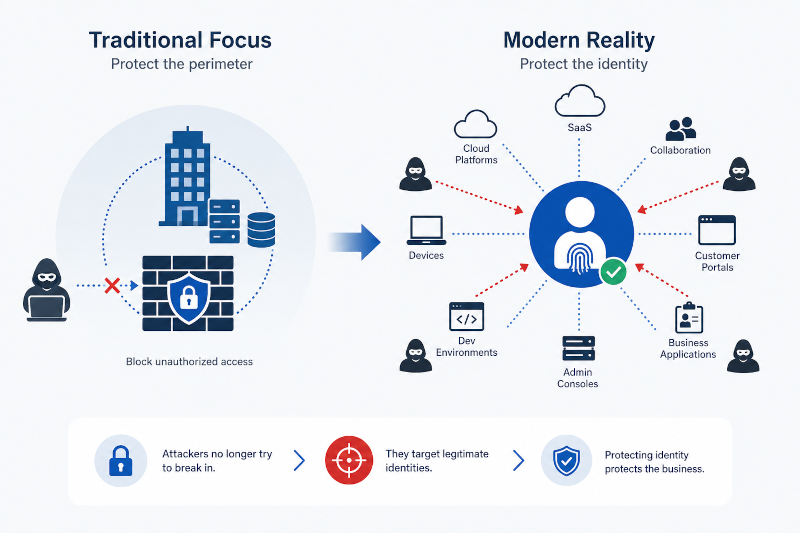
Attackers adapt to the environments they encounter. As organizations invested heavily in perimeter defenses over the past two decades, adversaries shifted their focus toward a target that offered a higher probability of success: legitimate identities.
Compromising an employee’s credentials is often more effective than exploiting a firewall vulnerability. Once authenticated, attackers inherit the permissions, access paths, and trust relationships associated with that identity. To many security systems, malicious activity conducted through a legitimate account appears indistinguishable from normal business operations.
The cybersecurity community has observed this trend for years, but recent incident data demonstrates just how dominant identity-based attacks have become.
The Verizon 2025 Data Breach Investigations Report (DBIR) found that credential abuse and exploitation of stolen authentication information remain among the most common initial access vectors observed across thousands of investigated breaches. Rather than relying solely on sophisticated malware, attackers frequently gain entry using compromised passwords, stolen session cookies, phishing campaigns, and social engineering techniques designed to defeat multi-factor authentication.
This evolution explains why phishing continues to generate outsized business risk despite decades of employee awareness training. Modern phishing campaigns are rarely about convincing someone to download malicious software. Instead, they seek to harvest authentication tokens, capture session cookies, or manipulate users into approving fraudulent authentication requests.
The goal is no longer to break into the network, instead, the goal is to become a trusted user.
The rise of cloud applications has amplified this challenge. Authentication no longer occurs once per day through a corporate VPN. Employees authenticate dozens—sometimes hundreds—of times across SaaS platforms, collaboration tools, cloud management consoles, customer portals, and development environments. Each authentication event represents a potential opportunity for compromise.
Identity-based attacks have also become remarkably efficient. Criminal groups now purchase stolen credentials through underground marketplaces, automate password-spraying campaigns against cloud services, and exploit weaknesses in identity federation protocols. Rather than developing sophisticated exploits, they often succeed by abusing legitimate authentication mechanisms.
This shift is one reason the Cybersecurity and Infrastructure Security Agency (CISA) continues to emphasize phishing-resistant multi-factor authentication and identity protection as foundational cybersecurity practices. CISA’s Secure by Design initiative argues that organizations must reduce reliance on passwords and strengthen identity verification because credential theft remains one of the most persistent attack methods.
Business leaders should recognize that identity attacks are fundamentally different from traditional network attacks. A firewall can block unauthorized traffic entering the network. It cannot distinguish between a legitimate employee and an attacker who has successfully stolen that employee’s authentication token.
The implications extend well beyond cybersecurity. Identity has become intertwined with business continuity, regulatory compliance, third-party risk management, and operational resilience. Every digital business process ultimately depends on accurately determining who—or what—is requesting access.
As discussed in Why Organizational Memory Matters More Than Ever, organizations often underestimate invisible dependencies until they fail. Identity systems have become one of those invisible dependencies. When trust in identity breaks down, business operations quickly follow.
Recommendation: Review your highest-privilege user accounts and service accounts first—these identities present the greatest business risk if compromised.
From Trusting Networks to Verifying Every Request
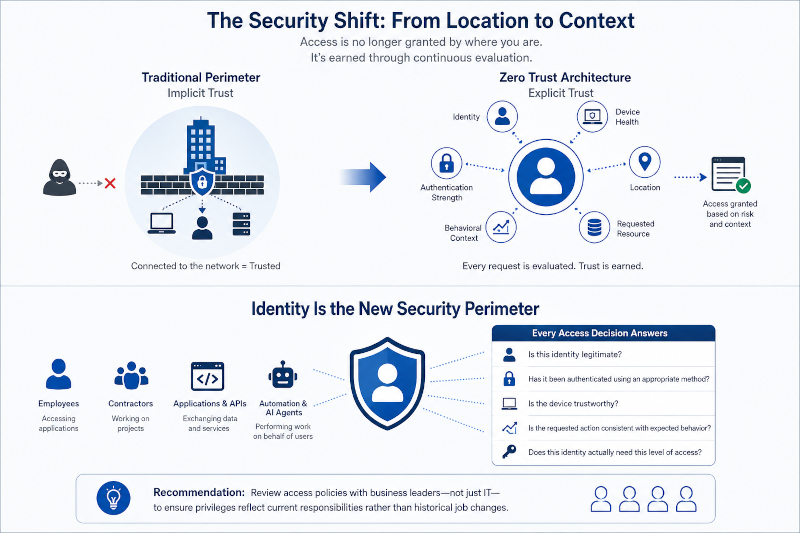
The collapse of the traditional perimeter did not eliminate the need for trust. It changed how trust is established.
Instead of granting access because a user is connected to the corporate network, modern security architectures evaluate each request independently. Identity, device health, authentication strength, location, behavioral context, and requested resource all contribute to a dynamic assessment of risk.
This philosophy underpins Zero Trust Architecture (ZTA), a security model that rejects implicit trust based on network location. Rather than assuming users inside the network are trustworthy, Zero Trust requires continuous verification throughout every interaction.
The concept is often summarized by the phrase “Never trust, always verify,” but that slogan oversimplifies what has become a comprehensive operating model. Zero Trust is not a product organizations purchase. It is an architectural approach that recognizes trust should be earned continuously rather than granted indefinitely.
The National Institute of Standards and Technology (NIST) formalized this approach in Special Publication 800-207, defining Zero Trust as an architecture in which access decisions are based on continuously evaluated policies and contextual information instead of network boundaries.
This subtle shift—from trusting locations to evaluating identities—represents one of the most significant changes in enterprise security over the past two decades. It also lays the foundation for understanding why identity has become the new perimeter, a topic explored in the next section.
Recommendation: Begin evaluating access policies based on identity and context rather than network location to align security controls with how your organization actually operates.
Identity Is the New Security Perimeter
If the traditional perimeter has disappeared, what replaces it?
The answer is not another technology. It is identity.
Every significant interaction within a modern enterprise begins with an identity asserting who—or what—it claims to be. Sometimes that identity belongs to an employee logging into Microsoft 365. Other times it is a contractor accessing a project workspace, an API exchanging customer information between applications, or an automated workflow provisioning cloud infrastructure. Increasingly, it may even be an AI agent performing work on behalf of a human.
This is why identity has evolved from an authentication function into the enterprise’s primary control plane. Every access decision now depends on answering a series of questions:
- Is this identity legitimate?
- Has it been authenticated using an appropriate method?
- Is the device trustworthy?
- Is the requested action consistent with expected behavior?
- Does this identity actually need this level of access?
Those questions extend well beyond cybersecurity. They influence regulatory compliance, data governance, operational continuity, and customer trust.
Microsoft’s Zero Trust guidance reflects this reality by placing identity at the center of its security architecture. Rather than treating authentication as a single event at login, Microsoft recommends continuously validating identities throughout a session and adjusting permissions dynamically as risk changes.
For many organizations, this requires a significant mindset shift. Identity is no longer an IT service managed by Active Directory administrators. It has become an enterprise capability that intersects with Human Resources, procurement, legal, operations, cybersecurity, and business leadership.
This evolution also changes how organizations think about privilege. Historically, employees accumulated access over time. A promotion, departmental transfer, or new project often resulted in additional permissions while existing access remained untouched. Over several years, individuals accumulated broad privileges that far exceeded what they actually required.
Identity-first security reverses that logic. Access becomes temporary, contextual, and continuously evaluated. Rather than asking, “What systems should this employee always have access to?” organizations begin asking, “What access does this person need right now to perform this specific task?”
The distinction appears subtle, but it dramatically reduces organizational risk.
Recommendation: Review access policies with business leaders—not just IT—to ensure privileges reflect current responsibilities rather than historical job changes.
Real-World Lessons: When Identity Becomes the Target
Several high-profile incidents demonstrate why identity has become the preferred attack surface.
MGM Resorts: Social Engineering Defeats Technology
In 2023, attackers associated with the Scattered Spider cybercrime group reportedly gained access to MGM Resorts by impersonating an employee during a help desk call. Rather than exploiting sophisticated software vulnerabilities, the attackers convinced support personnel to reset authentication credentials, allowing them to compromise internal systems.
The resulting disruption affected hotel operations, reservation systems, digital room keys, gaming platforms, and customer-facing services across multiple properties.
The lesson is striking. The attackers did not defeat the network perimeter. They defeated the organization’s trust in identity verification.
Snowflake Customer Breaches: Credentials Without MFA
In 2024, multiple organizations experienced data theft involving cloud data platform accounts protected only by usernames and passwords. According to public investigations, many compromised accounts lacked multi-factor authentication and relied on credentials previously exposed through information-stealing malware.
Again, attackers did not exploit vulnerabilities in Snowflake’s infrastructure. They authenticated using valid credentials.
The platform functioned exactly as designed. The identity did not.
Google’s BeyondCorp: Eliminating the Trusted Network
Not every example involves failure.
Google’s BeyondCorp initiative represents one of the earliest large-scale demonstrations that organizations could eliminate traditional VPN-centric security without sacrificing protection. Instead of assuming trust based on network location, BeyondCorp evaluates user identity, device posture, and contextual signals before granting access to internal applications.
The model has since influenced Zero Trust architectures across both government and industry.
Its significance extends beyond technology. BeyondCorp demonstrated that secure access can be built around verified identities rather than trusted networks—a concept that has fundamentally reshaped enterprise security strategies.
These examples reveal a common pattern. Successful attacks are becoming less dependent on breaking technology and more dependent on exploiting trust relationships.
Recommendation: Conduct tabletop exercises that simulate identity compromise rather than network breaches to better prepare security and business teams for modern attack scenarios.
Identity Governance Is Becoming a Business Capability
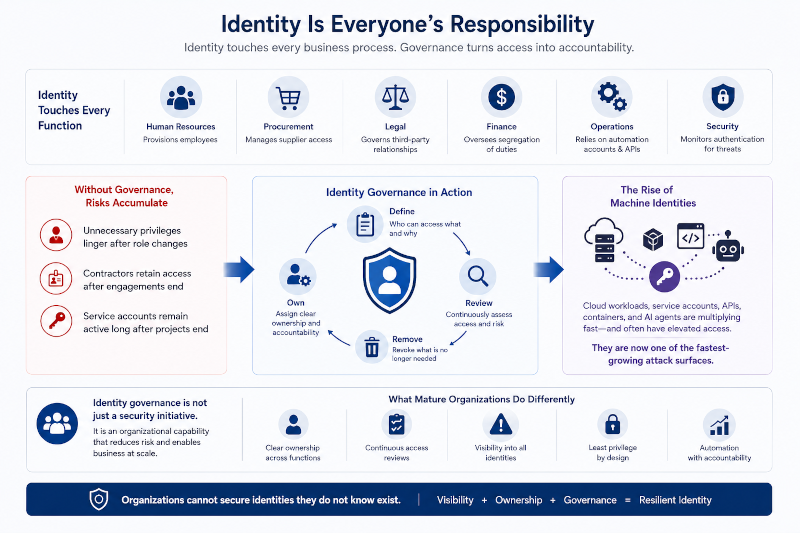
Many organizations still treat Identity and Access Management (IAM) as an infrastructure project.
That perspective is becoming outdated.
Identity now touches nearly every business process. Human Resources provisions employee accounts. Procurement manages supplier access. Legal governs third-party relationships. Finance oversees segregation of duties. Operations depends on automation accounts and APIs to execute critical workflows. Security teams monitor authentication events for indicators of compromise.
Without coordinated governance, these activities become fragmented.
A new employee may receive access promptly but retain unnecessary privileges years after changing roles. Contractors may continue accessing sensitive systems after engagements end. Service accounts created for temporary projects often remain active indefinitely because no business owner remembers they exist.
The problem is rarely technical.
It is organizational.
Identity governance requires organizations to establish clear ownership over who can access what, why that access exists, and when it should be removed. Mature organizations treat access reviews as ongoing operational processes rather than annual compliance exercises.
Machine identities make this challenge even more complex.
Cloud-native environments automatically create thousands of service accounts, containers, APIs, and workloads. AI-powered automation platforms are introducing another layer of non-human identities capable of interacting with enterprise systems independently.
Research published by IEEE and other academic institutions suggests that machine identities now represent one of the fastest-growing attack surfaces in enterprise computing because they often possess elevated privileges while receiving less governance than human accounts.
Organizations cannot secure identities they do not know exist.
This builds on ideas explored in Our “Single Source of Truth” Has Four Versions. Just as fragmented information creates operational friction, fragmented identity ownership creates security blind spots that no technology alone can eliminate.
Recommendation: Assign a business owner—not just a technical owner—for every privileged human and machine identity.
Identity-First Security Requires Organizational Change, Not Just Better Technology
Technology vendors often present identity-first security as a deployment challenge.
- Deploy stronger authentication.
- Implement single sign-on.
- Purchase an identity governance platform.
- Enable adaptive access policies.
Those investments matter, but they represent only part of the transformation.
Identity-first security changes how organizations think about trust, authority, and accountability. Every new employee onboarding process, vendor relationship, cloud migration, AI initiative, acquisition, and digital transformation project creates new identities that must be governed throughout their lifecycle.
The organizations making the greatest progress recognize that identity is no longer confined to cybersecurity teams. It is becoming a core business capability, much like financial controls or quality management.
This perspective also aligns with broader operational trends. Modern enterprises are becoming distributed ecosystems rather than centralized organizations. Employees collaborate across geographic boundaries. Applications span multiple cloud providers. Business processes depend on APIs connecting dozens of external platforms. AI agents will soon perform routine operational tasks with limited human intervention.
In that environment, network boundaries become almost irrelevant.
Identity becomes the mechanism through which organizations establish trust across an increasingly decentralized enterprise.
The question is no longer whether the perimeter has disappeared.
The question is whether organizations are prepared to operate without one.
Recommendation: Include identity governance as a workstream in every major digital transformation initiative rather than treating it as a separate cybersecurity project.
Conclusion
For decades, cybersecurity strategies centered on protecting networks. Firewalls, VPNs, and perimeter defenses were designed for an era when applications, employees, and data largely resided within clearly defined organizational boundaries.
That era has passed.
Cloud computing, hybrid work, SaaS applications, APIs, automation, and AI have fundamentally reshaped how organizations operate. The enterprise now exists wherever trusted identities interact with business resources, regardless of physical location or network connection.
“The enterprise is no longer defined by its network. It is defined by the identities it trusts.”
This evolution explains why modern attackers increasingly target identities instead of infrastructure. It also explains why Zero Trust has become more than a security framework—it reflects a broader recognition that trust must be continuously established rather than implicitly granted.
Organizations that view identity as merely another IT function risk falling behind. Those that recognize identity as a foundational business capability will be better positioned to secure digital operations, govern AI, manage third-party relationships, and adapt to whatever technologies emerge next.
The perimeter has not disappeared because security failed.
It disappeared because the enterprise itself changed.
The organizations that thrive in this new environment will not be those with the tallest walls. They will be the ones that know exactly who—and what—they can trust.