
Recommendations
- Select one business-critical document and map every location where employees currently access or store it.
- Conduct a quarterly review of your ten most frequently used documents and identify how many active versions currently exist.
- Ask employees which systems they trust most for obtaining accurate information and compare the responses across departments.
- Document the systems of record for your five most important business domains and confirm whether employees know where they are.
- Assign a documented owner to every critical enterprise policy, procedure, and operational playbook.
Most organizations can quickly identify where their critical information is supposed to live.
Employee data belongs in Workday. Customer records are maintained in Salesforce. Financial information resides in the ERP system. Policies, procedures, and project documentation are stored in SharePoint or Confluence.
At least, that is how the architecture diagrams are typically presented.
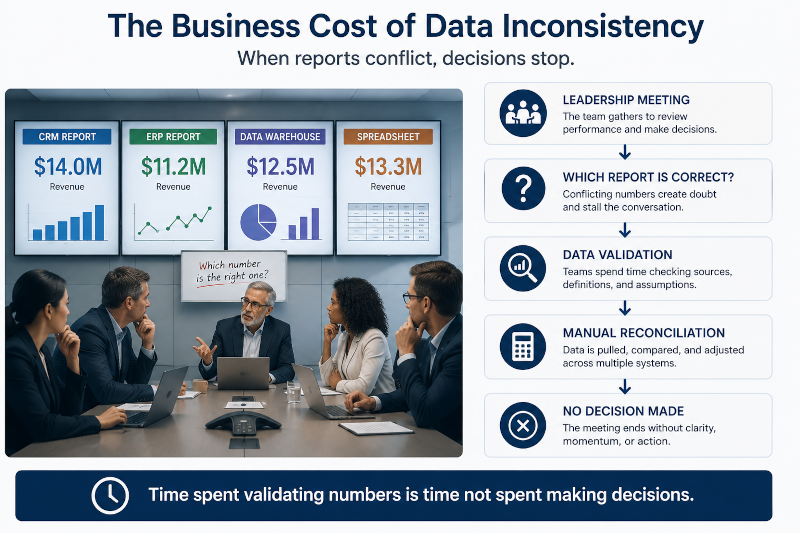
Spend time with employees, however, and a more nuanced picture often emerges. Important documents are shared through Teams chats. Project trackers exist as local spreadsheets. Teams maintain copies of procedures “just in case” the official version is out of date. Before long, it becomes apparent that information is moving through the organization in ways that were never formally designed.
This is not necessarily a sign of poor intent or organizational dysfunction. In many cases, it is simply the result of people adapting to the realities of getting work done.
The challenge is that over time, these adaptations accumulate. Organizations that believe they have established a single source of truth often discover they have several sources that coexist with varying degrees of accuracy, ownership, and trust.
That distinction matters more than ever. As organizations introduce AI-enabled search, enterprise assistants, and knowledge management tools, questions about document ownership and version control are no longer administrative concerns. They have become operational considerations with implications for decision-making, compliance, and organizational effectiveness.
The Myth of the Single Source of Truth
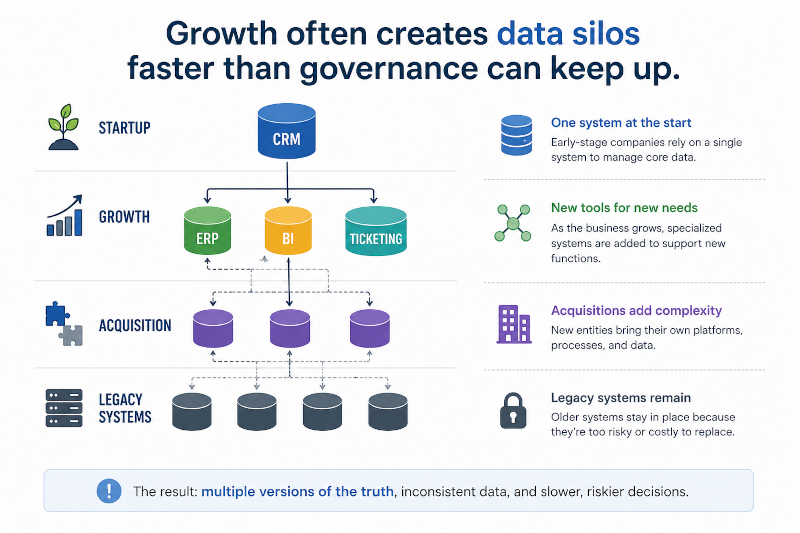
The concept of a Single Source of Truth (SSOT) remains an important objective in data and knowledge management. The underlying principle is sound: maintain authoritative information in one place and ensure employees know where to find it.
In practice, however, maintaining a single source of truth is considerably more difficult than implementing the technology intended to support it.
Consider a standard operating procedure updated by an operations team. The official version is published to SharePoint on Monday morning. By the end of the week, a manager has downloaded a local copy for reference, another team has embedded portions of it into a PowerPoint presentation, and someone has saved a PDF to a shared drive to make it easier to access during meetings.
Several months later, employees may be referencing different versions of the same document without realizing it.
This pattern is common across organizations of all sizes. Information tends to move toward convenience, particularly when employees are operating under tight deadlines or attempting to avoid delays. Over time, the gap between where information is intended to reside and where it is actually consumed begins to widen.
As discussed in Why Documentation Is Becoming a Strategic Asset, documentation is no longer simply a repository of organizational knowledge. It plays an increasingly important role in enabling consistency across teams, supporting onboarding efforts, and maintaining continuity as organizations grow.
Recommendation: Select one business-critical document and map every location where employees currently access or store it.
Version Drift Happens Gradually
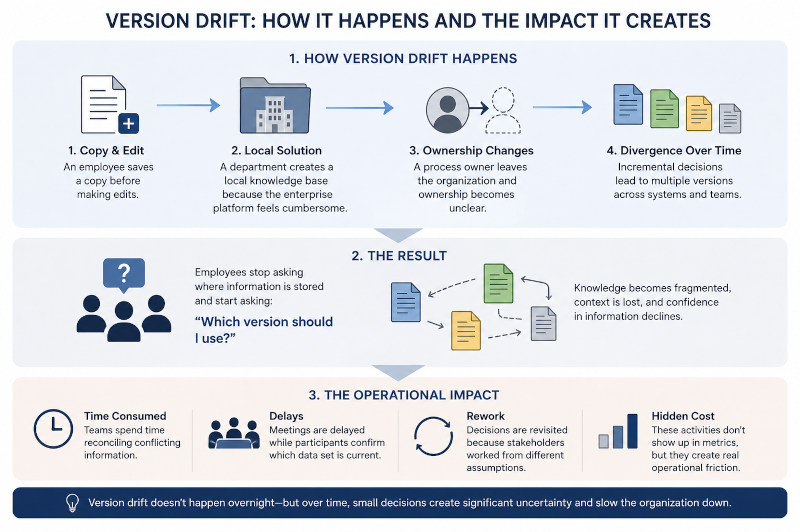
One of the more useful terms to emerge from recent discussions around AI and knowledge management is “version drift”—the gradual divergence of information across documents, repositories, and systems over time.
The term is useful because it accurately reflects how these issues tend to develop.
Organizations rarely wake up one morning to discover that they have four competing versions of a document. More often, those versions emerge incrementally as teams make practical decisions in response to immediate needs.
An employee saves a copy before making edits. A department creates a local knowledge base because the enterprise platform feels cumbersome. A process owner leaves the organization, and responsibility for maintaining documentation becomes unclear.
Individually, these decisions are understandable. Collectively, they introduce uncertainty into the organization. Eventually, employees begin asking a different set of questions. Rather than asking where information is stored, they ask which version they should use.
Knowledge management research has consistently highlighted the difficulty organizations face in maintaining context and relevance over time, particularly as information moves across systems and teams.
The operational impact is often subtle. Teams spend time reconciling conflicting information. Meetings are delayed while participants confirm which data set is current. Decisions are revisited because stakeholders were working from different assumptions.
None of these activities appear in traditional performance metrics, but they represent a meaningful source of operational friction.
Recommendation: Conduct a quarterly review of your ten most frequently used documents and identify how many active versions currently exist.
Employees Follow Trust, Not Governance
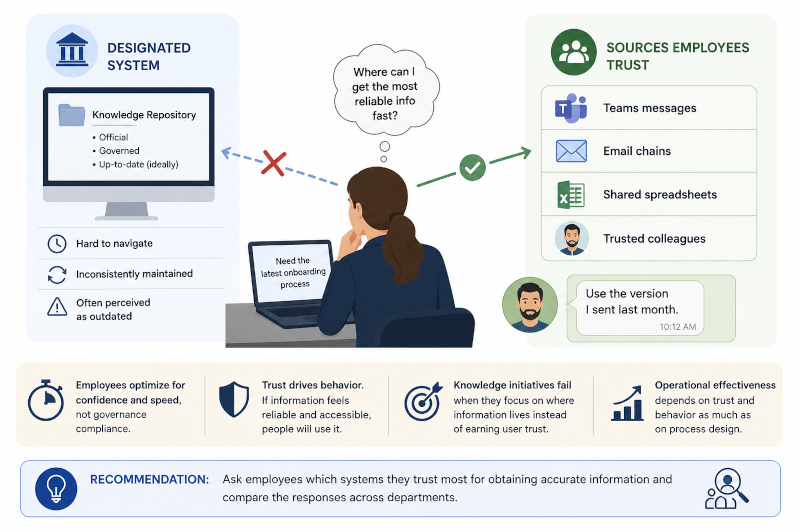
Organizations often assume that employees will naturally use the systems designated by leadership. Experience suggests that people tend to rely on the sources that have consistently helped them do their jobs effectively.
This distinction is worth considering.
A knowledge repository may contain the most up-to-date information available. However, if employees believe it is difficult to navigate, inconsistently maintained, or frequently outdated, they will look elsewhere.
That “elsewhere” often takes familiar forms: Teams messages, email chains, shared spreadsheets, or trusted colleagues who have become informal sources of institutional knowledge.
Imagine a project manager preparing for a meeting who needs the latest onboarding process. Rather than searching the organization’s document repository, she messages a colleague and receives an immediate response: “Use the version I sent last month.”
The interaction takes only a few seconds, but it illustrates an important point. Employees are often optimizing for confidence and speed rather than strict adherence to governance standards.
This helps explain why many knowledge management initiatives fail to achieve their intended outcomes. Organizations spend considerable time deciding where information should live and comparatively less time ensuring employees trust what they find when they get there.
This observation aligns with themes explored in How High-Performing Organizations Reduce Operational Friction. Operational effectiveness is influenced as much by trust and behavior as it is by process design.
Recommendation: Ask employees which systems they trust most for obtaining accurate information and compare the responses across departments.
System of Record and Source of Truth Are Different Things
The terms “system of record” and “source of truth” are frequently used interchangeably, despite describing different concepts.
A system of record refers to where information originates. A source of truth reflects where the organization has agreed to consume and reference that information.
For example, Workday may serve as the authoritative system for employee information, while Salesforce maintains customer records and an ERP platform manages financial data.
Modern organizations rarely operate from a single application. Instead, they depend upon an interconnected ecosystem of systems that support different business functions.
Recognizing this distinction helps reframe an important question. Rather than asking, “Which platform will become our single source of truth?” organizations may find it more useful to ask, “How do we establish trust and consistency across multiple systems?”
High-performing organizations tend to approach this as a governance challenge rather than a technology initiative. They establish ownership, define accountability, and communicate clearly about where authoritative information resides.
Recommendation: Document the systems of record for your five most important business domains and confirm whether employees know where they are.
AI Will Expose Existing Knowledge Challenges
Artificial intelligence adds another dimension to this discussion.
Enterprise AI tools can search across repositories, summarize documents, and retrieve information almost instantaneously. This creates the impression that organizational knowledge has become unified.
However, retrieval and validation are not the same thing.
If an AI assistant encounters several versions of a policy document, it has limited ability to determine which version leadership intended employees to follow. Its objective is to identify relevant information, not necessarily authoritative information.
Consider an illustrative scenario. An organization deploys an internal AI assistant connected to its document repositories. An employee asks about the company’s travel reimbursement policy, and the assistant retrieves multiple versions that appear equally credible.
Without clear metadata, ownership, and document governance practices, outdated guidance can easily find its way into operational decisions.
In situations like this, the underlying challenge is rarely the technology itself. More often, it reflects longstanding issues involving version control and document management that existed well before AI entered the conversation.
As discussed in Why Most AI Implementations Fail Inside Organizations, technology often amplifies existing organizational conditions rather than replacing them.
Recommendation: Establish clear ownership and metadata standards for authoritative documents before integrating them with enterprise AI tools.
Maintaining Alignment Over Time
Organizations are dynamic systems. People join and leave. Processes evolve. Technologies change. Under those conditions, some degree of version drift is inevitable.
The more important consideration is how quickly organizations identify and address it.
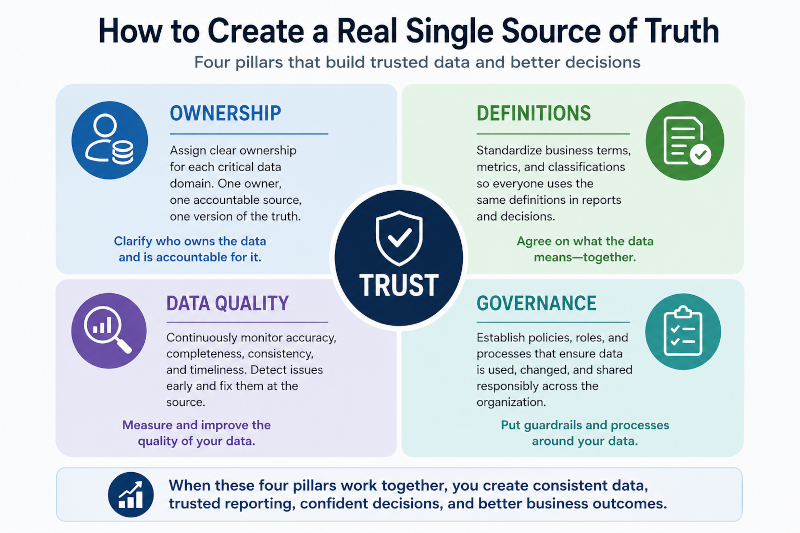
Competing versions of information are usually symptoms of broader organizational dynamics involving governance, accountability, and communication across teams. Addressing them requires more than consolidating documents into a single repository.
It requires maintaining alignment over time.
Organizations that manage this effectively tend to approach information as a strategic asset. They assign ownership, conduct periodic reviews, and recognize that consistency is something that must be actively maintained rather than assumed.
The objective is not perfection. Large organizations will always experience some level of duplication and inconsistency. The goal is to ensure that employees can reliably determine which information is current when it matters most.
Recommendation: Assign a documented owner to every critical enterprise policy, procedure, and operational playbook.
Conclusion
Many organizations would acknowledge, if asked candidly, that their information ecosystem is more distributed than their architecture diagrams suggest.
For years, that reality was manageable. Teams developed workarounds, relied on institutional knowledge, and found practical ways to navigate ambiguity. The introduction of AI, however, has increased the importance of maintaining authoritative information and ensuring that employees—and systems—can distinguish current guidance from historical artifacts.
Ultimately, a single source of truth is less about selecting the right platform and more about establishing shared confidence in the information the organization relies upon. Technology can support that objective, but it cannot create it on its own.
Organizations that invest in governance, ownership, and trust are generally better positioned to adapt as their information environments become more complex. And in many cases, a simple exercise—tracing how a single document moves through the enterprise—can provide valuable insight into where those opportunities exist.
2 thoughts on “Our “Single Source of Truth” Has 4 Versions”