- The Paradox of Cognitive Offloading
- Memory, External Systems, and the “Extended Mind”
- Creativity: Expansion at the Individual Level, Compression at the System Level
- Attention Fragmentation and Decision Load
- The Core Tension: Resilience vs. Reliance
- Conclusion: AI Is Reshaping the Architecture of Human Thinking
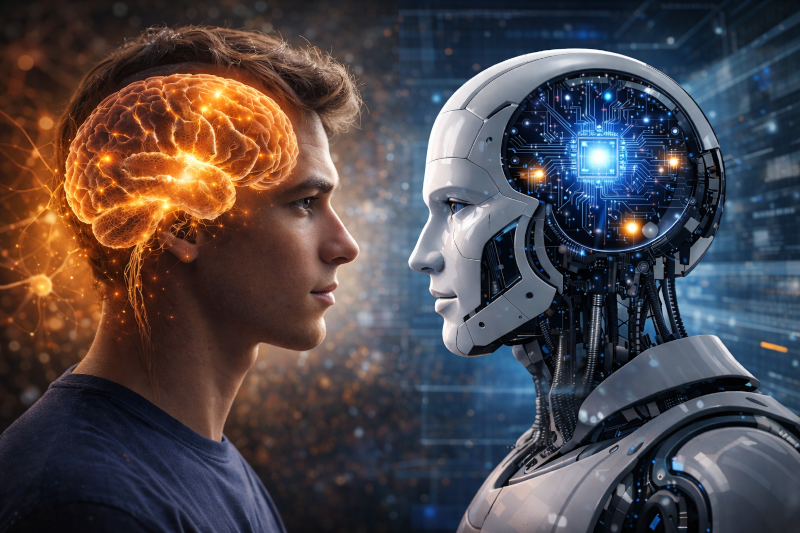
The integration of artificial intelligence into everyday work and life is creating a subtle but important shift in how humans think, remember, create, and process information. While AI tools clearly improve productivity, researchers are now examining a deeper question: how does continuous reliance on these systems influence the way the human brain engages with reasoning, memory, creativity, and decision-making over time?
The answer is not simple.
Artificial intelligence is no longer just changing what humans do. It is gradually influencing how humans think.
This matters because AI systems are rapidly becoming embedded across education, enterprise operations, knowledge work, software development, research, communication, and creative environments. Employees now use AI to summarize meetings, generate reports, draft emails, organize information, write code, analyze documents, and accelerate workflow coordination across everyday tasks.
These systems reduce cognitive friction significantly. But reducing friction also changes behavior.
The long-term challenge may not be whether AI improves productivity. It almost certainly will. The larger question is how continuous cognitive outsourcing reshapes human attention, memory, reasoning habits, and creative processes over time.
The Paradox of Cognitive Offloading
One of the most immediate effects of AI adoption is the reduction of deliberate mental effort across routine cognitive tasks.
Activities that once required sustained engagement — writing, organizing ideas, researching information, coding, summarizing material, or structuring analysis — can now be partially delegated to AI systems within seconds. This creates obvious productivity gains, particularly inside fast-moving operational environments where employees already face significant coordination overload and time pressure.
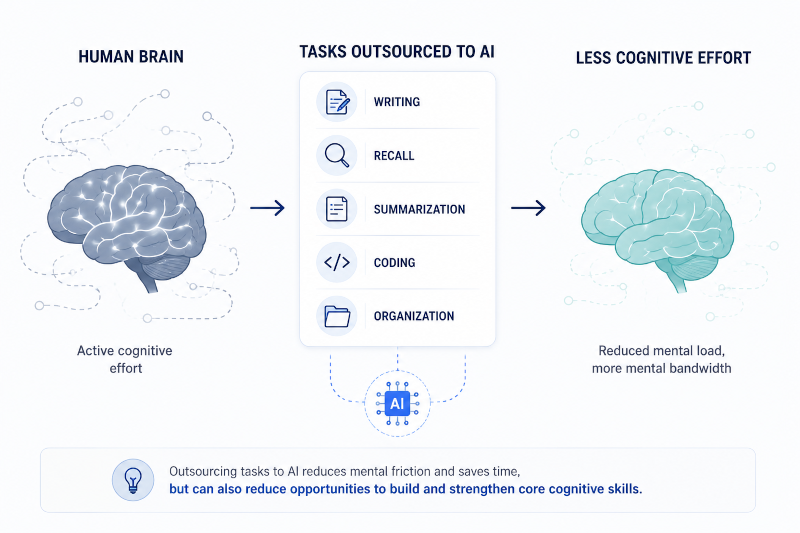
At the same time, this introduces a behavioral shift known in cognitive science as cognitive offloading: the tendency to outsource portions of mental effort to external systems.
In practical terms, this changes how individuals engage with problem-solving itself. Rather than working step-by-step through reasoning processes, users may begin focusing primarily on evaluating or refining machine-generated outputs.
Over time, this can reduce opportunities to practice foundational cognitive skills such as:
- structured reasoning,
- analytical decomposition,
- memory recall,
- and independent verification of logic.
A growing concern raised in research involves automation bias, where individuals begin trusting machine-generated outputs too passively, particularly under workflow pressure or cognitive fatigue.
Early research examining generative AI use in software development has already identified similar patterns. A 2024 study from researchers affiliated with Microsoft Research and several universities found that developers using AI coding assistants often completed tasks faster, but in some cases demonstrated reduced engagement with underlying code comprehension and verification processes during execution.
The issue is not necessarily that people stop thinking entirely.
The deeper concern is that thinking itself gradually shifts from active construction toward passive supervision.
This overlaps closely with themes explored previously in The Silent Productivity Killer: How Knowledge Managers Give You Your Time Back, where operational overload and fragmented systems quietly reduced cognitive capacity long before AI became integrated into workflows directly.
AI may therefore change not only how quickly humans complete tasks, but how deeply they engage with the cognitive processes behind those tasks in the first place.
Memory, External Systems, and the “Extended Mind”
Human memory has always adapted alongside technology.
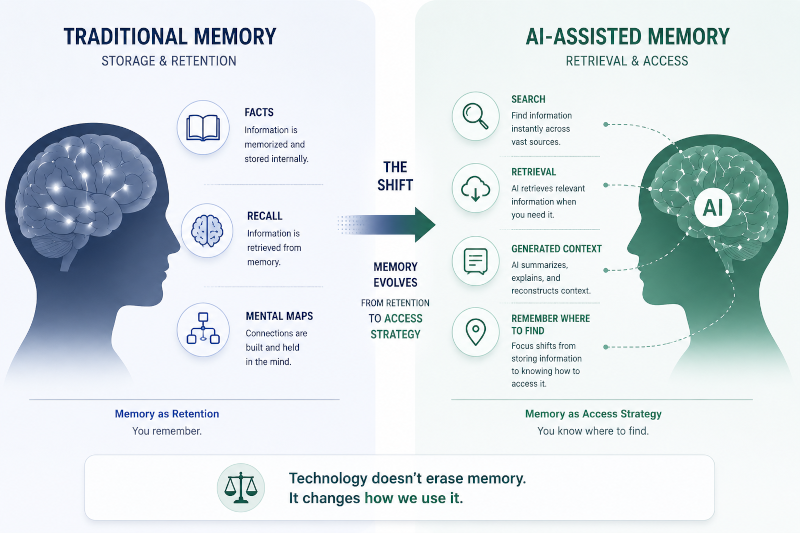
Writing externalized memory from oral tradition. Search engines shifted memory from “remembering facts” toward “remembering where information can be found.” Smartphones transformed navigation, recall, and communication habits across daily life.
AI extends this transition further.
Instead of recalling information independently, users now rely on AI systems to reconstruct context, summarize knowledge, generate explanations, retrieve forgotten information, and synthesize ideas dynamically on demand.
This creates a form of distributed cognition sometimes described in cognitive science as the “extended mind,” where portions of reasoning, recall, and contextual processing become partially externalized across digital systems.
The implication is not necessarily that memory disappears. More often, its role changes.
Memory increasingly shifts from:
- direct retention,
- toward retrieval strategy,
- contextual navigation,
- and information access management.
Some research suggests that frequent dependence on external information systems may alter how strongly certain memory pathways are reinforced, particularly those associated with recall and spatial organization of knowledge structures.
This shift is already visible operationally.
Many employees today no longer attempt to retain large volumes of detailed information internally because enterprise systems, search tools, cloud repositories, and AI retrieval platforms continuously reconstruct context for them. In some cases, this improves efficiency significantly. In other cases, it can weaken deeper familiarity with underlying systems, historical context, or institutional knowledge continuity.
This challenge becomes especially important inside enterprise environments where organizations now depend heavily on searchable knowledge systems, AI retrieval layers, and distributed operational information. As discussed previously in Why Organizational Knowledge Disappears Faster Than Companies Realize, the quality of retrieval systems increasingly influences organizational responsiveness itself.
The broader implication is not that humans stop remembering. It is that memory evolves from storage toward coordination between biological cognition and external digital systems.
Creativity: Expansion at the Individual Level, Compression at the System Level
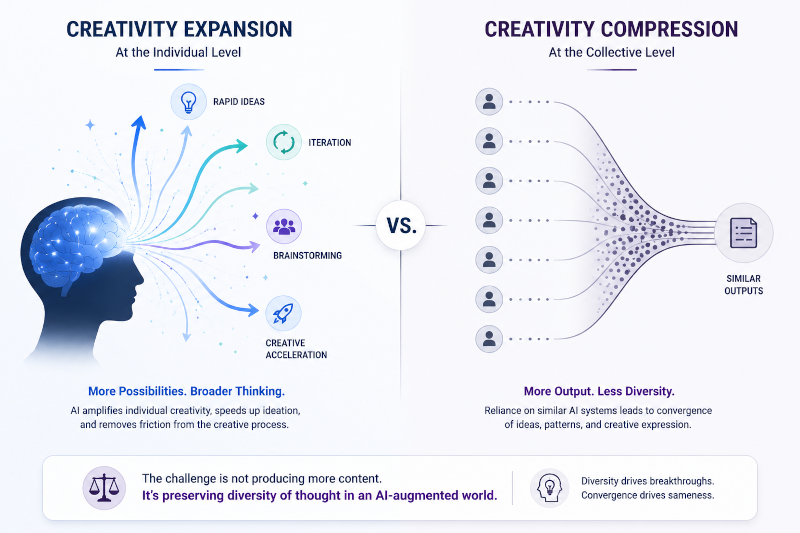
AI also creates a more complicated effect on creativity than many organizations initially expected.
At the individual level, AI often expands creative capability. It lowers barriers to entry, accelerates brainstorming, structures incomplete ideas, and enables rapid iteration across writing, design, coding, and research tasks. For many professionals, this can significantly increase creative productivity.
However, there is a different dynamic emerging at scale.
Because generative AI systems are trained on massive datasets reflecting existing patterns, they often favor statistically common phrasing structures, conceptual relationships, and stylistic conventions. As larger numbers of people begin relying on similar systems for ideation and content generation, outputs can gradually begin converging toward similar patterns.
This creates a subtle but important tension:
- higher productivity per individual,
- but potentially lower diversity of ideas collectively.
Research published in Science Advances during 2024 observed similar effects during AI-assisted creative writing experiments. Researchers found that generative AI support often improved the average quality of outputs, but simultaneously reduced variation between responses as participants gravitated toward similar structures and conceptual directions suggested by the systems.
This matters because breakthrough innovation often depends less on optimization and more on conceptual divergence.
In creative, scientific, and strategic environments, originality frequently emerges from unusual combinations of ideas, independent reasoning, and perspectives that fall outside dominant statistical patterns. AI systems, however, often optimize toward coherence, familiarity, and probable correctness.
Over time, widespread dependence on similar generative systems could create environments where content quality rises while conceptual diversity quietly narrows.
This dynamic is already visible across portions of online publishing, professional communication, and social media environments where AI-generated phrasing patterns increasingly resemble one another structurally.
The long-term challenge may therefore involve preserving diversity of thought inside ecosystems optimized heavily around prediction and probabilistic generation.
Attention Fragmentation and Decision Load
Another emerging effect of AI-assisted environments involves changes in attention, focus, and decision-making patterns.
AI systems frequently increase the number of suggestions, recommendations, summaries, prompts, notifications, and generated outputs presented to users throughout the day. While this improves execution speed, it also introduces a different form of cognitive burden: continuous evaluation.
Instead of reducing thinking entirely, AI can shift cognition toward:
- validating outputs,
- comparing recommendations,
- reviewing machine-generated summaries,
- selecting between multiple generated options,
- and continuously supervising automated systems.
This creates what researchers often describe as fragmented attention, where focus becomes distributed across many small micro-decisions rather than sustained engagement with a single complex problem.
Inside modern knowledge work environments, this can make deep work significantly harder to sustain over long periods.
Employees already operate inside environments filled with:
- meetings,
- notifications,
- context switching,
- fragmented workflows,
- and coordination overhead.
AI systems can either reduce that burden or amplify it depending on how they are integrated operationally.
Poorly governed AI environments may actually increase cognitive overload by generating:
- more information,
- more outputs,
- more recommendations,
- and more verification requirements simultaneously.
Well-designed systems, however, can reduce repetitive cognitive coordination work and create space for higher-level strategic thinking.
This distinction becomes critically important as AI expands across enterprise workflows.
The challenge is not simply whether AI accelerates productivity. It is whether humans retain the ability to sustain deep reasoning and concentrated thought inside environments increasingly optimized around speed, responsiveness, and continuous information flow.
The Core Tension: Resilience vs. Reliance
Across all of these patterns, the central issue is not whether AI is inherently beneficial or harmful.
The deeper question is how dependency becomes structured.
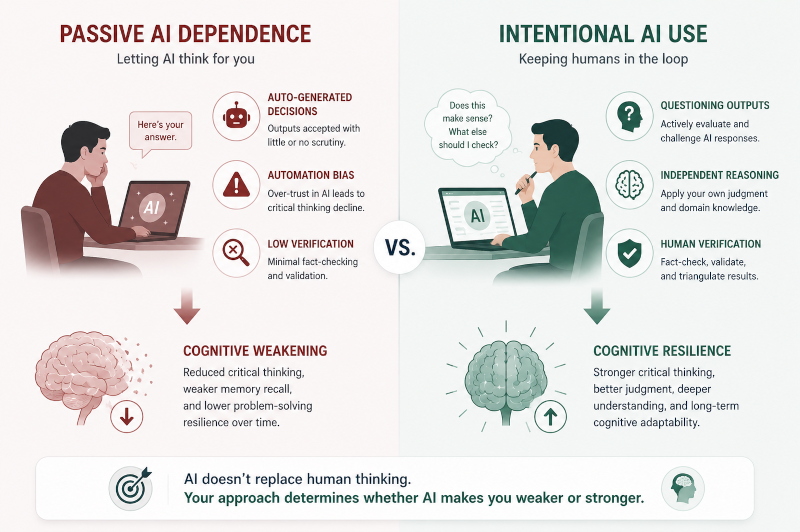
Used passively, AI can gradually reduce cognitive engagement by automating not only execution, but portions of reasoning itself. Used intentionally, however, it can free cognitive capacity for higher-order synthesis, strategic thinking, creativity, and problem-solving.
The distinction often depends on whether humans remain actively engaged in:
- questioning outputs,
- validating assumptions,
- challenging recommendations,
- and making final interpretive decisions independently.
This introduces an important concept frequently discussed in cognitive science and organizational psychology: intentional friction.
In some cases, retaining portions of manual reasoning, independent verification, or deliberate problem-solving may strengthen long-term cognitive resilience even when automation could technically complete the task faster.
This does not mean rejecting AI systems. It means recognizing that some cognitive effort may remain valuable precisely because it strengthens reasoning capability itself.
The organizations adapting most effectively to AI-assisted environments may therefore be the organizations that learn how to balance:
- automation,
- efficiency,
- cognitive engagement,
- and independent reasoning simultaneously.
Conclusion: AI Is Reshaping the Architecture of Human Thinking
Artificial intelligence is not simply changing productivity. It is gradually reshaping the architecture of human cognition itself.
The long-term challenge may not be preserving human relevance in a world filled with intelligent systems, but preserving deep reasoning, independent judgment, and sustained attention inside environments optimized for speed, convenience, and cognitive outsourcing.
AI will almost certainly become embedded across everyday workflows, education systems, enterprise operations, and creative environments. The critical question is not whether humans will rely on these systems. They will.
“AI can accelerate human capability, but only if humans remain actively engaged in reasoning rather than passively accepting machine output.”
The more important question is whether people remain actively engaged in the thinking process itself.
The future of human capability may ultimately depend on maintaining the ability to question outputs, tolerate cognitive friction, sustain attention, and think independently even when automation makes passive acceptance easier.
In that sense, the defining skill of the AI era may not simply be learning how to use artificial intelligence effectively. It may be knowing which parts of thinking humans should never fully delegate in the first place.
1 thought on “Mind vs. Machine: How AI Is Reshaping Human Thinking and Memory”