- Recommendations
- Organizations Were Built for Information Scarcity
- Decision Latency Is Becoming a Competitive Risk
- Technology Is Pushing Decisions Closer to the Work
- Case Study: The Security Incident That Could Not Wait
- Distributed Decisions Require Stronger Guardrails
- The Future Manager May Be a Decision Coach
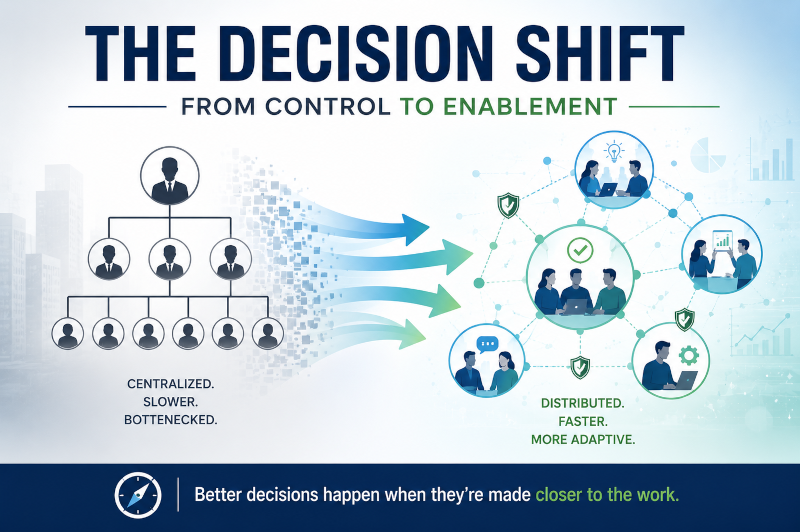
- The Real Shift: From Control to Enablement
- Conclusion
Recommendations
- Identify operational decisions that routinely experience approval delays and measure the business impact of waiting.
- Review approval processes that were created before real-time reporting and determine whether they still serve a meaningful purpose.
- Identify decisions where frontline teams already possess the necessary information and evaluate whether approval requirements can be simplified.
- Document which decisions can be made locally, which require consultation, and which require escalation before ambiguity creates delays.
- Train managers to facilitate decision-making and develop judgment rather than serving primarily as approval checkpoints.
A customer issue emerges on Monday morning.
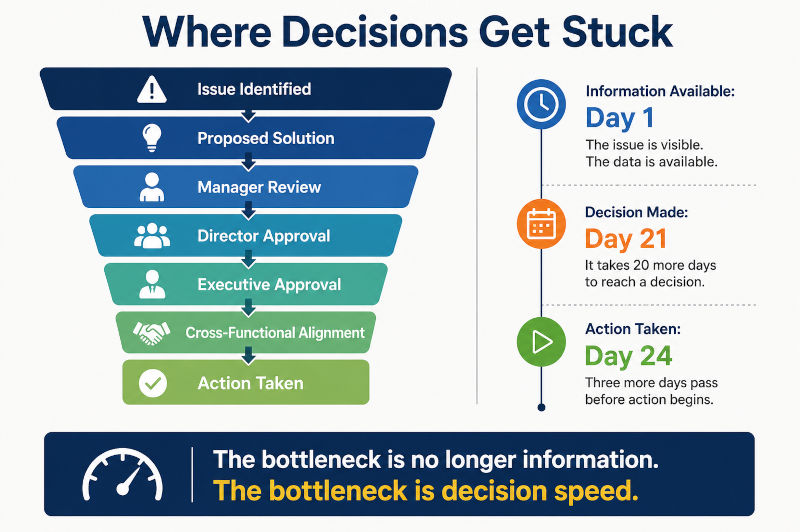
The frontline team sees it immediately. The data is available in real time. The root cause is relatively clear, and the solution is not particularly complicated. Yet the issue remains unresolved for days because the decision must move through multiple layers of approvals before anyone can act.
By the time authorization is granted, customers have already experienced the impact, employees have become frustrated, and what started as a small operational problem has become a larger business problem.
For decades, this type of delay was often unavoidable. Information moved slowly through organizations. Frontline employees had limited visibility beyond their immediate responsibilities, while executives possessed a broader view of the business. Decision-making naturally became concentrated at higher levels because leaders had access to information others did not.
Today, that reality is changing.
Operational dashboards provide real-time visibility. Collaboration platforms allow information to move instantly across teams. AI tools can summarize reports, identify patterns, and surface insights in seconds. In many cases, the people closest to the work now have access to the same information leaders use to make decisions.
As information becomes more widely available, organizations are beginning to confront a different challenge.
The bottleneck is no longer visibility. The bottleneck is decision speed.
This is one reason decision-making is becoming more distributed across modern organizations. It is not necessarily because executives want less control or because hierarchy is disappearing. Rather, organizations are discovering that in fast-moving environments, the cost of waiting for decisions can be higher than the cost of making imperfect ones.
Research reflects this shift. Deloitte’s 2025 Human Capital Trends report highlights adaptability, responsiveness, and organizational agility as critical capabilities for navigating increasingly complex business environments. Similarly, the World Economic Forum’s Future of Jobs Report 2025 identifies analytical thinking, resilience, flexibility, leadership, and systems thinking among the fastest-growing workforce capabilities through the end of the decade.
Taken together, these trends suggest a broader organizational shift. Companies are not simply trying to gather information faster. They are trying to make decisions faster.
Recommendation: Identify operational decisions that routinely experience approval delays and measure the business impact of waiting.
Organizations Were Built for Information Scarcity
To understand why decision-making is becoming more distributed, it helps to understand why it became centralized in the first place.
Historically, information was expensive to collect and difficult to share. Managers spent significant portions of their time gathering updates, preparing reports, consolidating data, and communicating status to senior leadership. Executives often possessed a level of visibility unavailable to frontline teams because organizational structures were designed to move information upward.
Centralized decision-making made sense in that environment.
If information flowed toward leadership, decisions naturally flowed back down.
Many management structures still reflect those assumptions today. Approval chains, reporting hierarchies, and escalation paths were designed for a world where information moved more slowly and uncertainty was often caused by limited visibility.
Technology has changed that equation.
Today, a customer service representative may have immediate access to customer history, service metrics, and operational data. Product teams can monitor usage patterns in real time. Security analysts can identify threats as they emerge. Operations teams can track performance continuously rather than waiting for weekly or monthly reports. The information advantage that once justified centralized decision-making is smaller than it used to be.
That does not mean leadership becomes less important. It means leadership creates value differently.
As explored in our article, “Middle Management Will Change More Than Most Executives Expect,” managers may spend less time collecting information and more time helping teams interpret information, navigate tradeoffs, and make sound decisions. The same forces affecting management are reshaping organizational decision-making.
Many organizations still operate decision structures designed for a world of information scarcity. The challenge is that they now operate in a world where information is often abundant.
Recommendation: Review approval processes that were created before real-time reporting and determine whether they still serve a meaningful purpose.
Decision Latency Is Becoming a Competitive Risk
Organizations measure many forms of speed.
They track project timelines, incident response times, service levels, customer satisfaction metrics, and operational cycle times. Yet one of the most important sources of organizational friction often goes unmeasured.
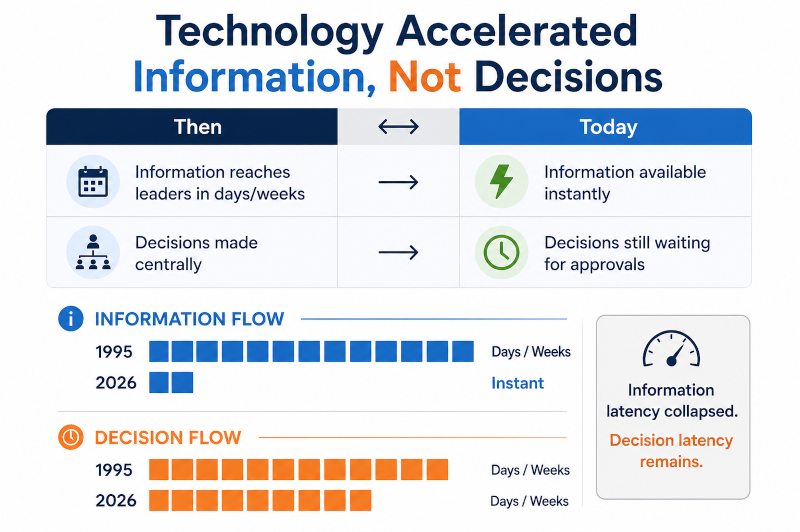
Decision latency. How long does it take to move from identifying a problem to authorizing a response? In many organizations, the answer is longer than leaders realize.
Consider a regional retailer facing recurring customer complaints regarding an operational process. Store managers identify the issue quickly because they interact with customers every day. Potential solutions are proposed within hours. Yet implementation requires review by regional leadership, approval from corporate stakeholders, and alignment across multiple departments.
Weeks pass.
The problem is not a lack of information. The problem is the time required to make a decision.
McKinsey research has found that organizations with high decision-making velocity and quality generate 2.5 times higher growth, 2 times higher profit, and 30 percent higher return on invested capital than their peers. The research also challenges the common assumption that organizations must choose between decision speed and decision quality.
Many organizations still treat decision-making as if the primary goal is avoiding mistakes. Increasingly, the challenge is avoiding paralysis.
A delayed decision can carry costs just as significant as a poor decision. Customer opportunities disappear. Competitive advantages erode. Operational issues grow more expensive to resolve.
This reality is pushing organizations to reconsider where decisions should be made and who should be empowered to make them.
Recommendation: Measure the average time required for operational decisions and identify approval steps that contribute little value relative to the delay they create.
Technology Is Pushing Decisions Closer to the Work
Technology is often discussed in terms of automation, efficiency, and productivity. Less attention is given to how technology changes the location of decision-making.
When information becomes more accessible, the rationale for concentrating decisions at the top of the organization begins to weaken.
Customer service teams can see customer interactions in real time. Security analysts can identify threats immediately. Product managers can observe user behavior as it happens. Operations teams can monitor performance continuously through dashboards and analytics platforms.
The people closest to the work frequently possess the information necessary to act.
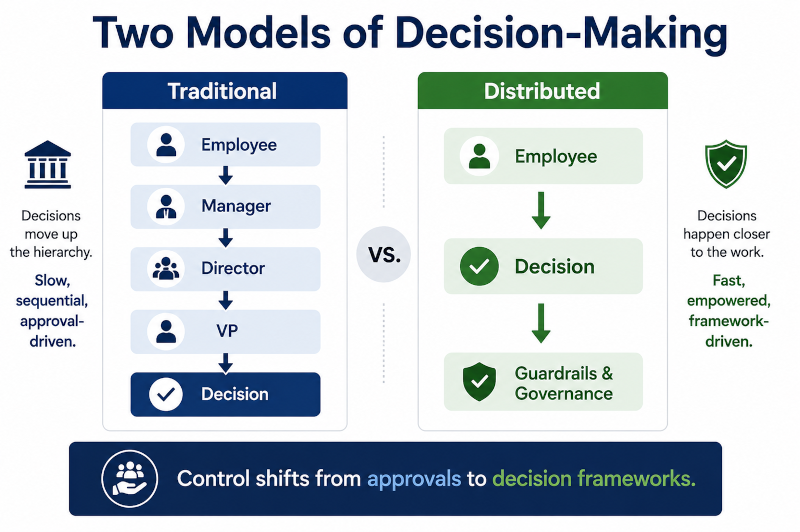
This does not eliminate the need for leadership oversight, but it does raise an important question: Why should every decision travel through multiple organizational layers if the information required to make that decision already exists at the point of execution?
Microsoft’s 2025 Work Trend Index explores a future in which employees work alongside AI agents capable of performing research, analysis, content generation, and portions of operational workflows. As information becomes easier to access and process, employees may be expected to exercise greater judgment and autonomy rather than simply execute instructions.
This trend is not limited to AI.
Organizations have spent years investing in transparency, analytics, collaboration platforms, and digital transformation initiatives. Those investments naturally create pressure to distribute certain decisions closer to where information originates.
As information becomes more distributed, decision-making follows.
Recommendation: Identify decisions where frontline teams already possess the necessary information and evaluate whether approval requirements can be simplified.
Case Study: The Security Incident That Could Not Wait
Few situations expose decision bottlenecks more clearly than cybersecurity incidents.
Imagine a security analyst discovers evidence of an active compromise. The indicators are convincing. The threat is real. Every minute matters.
In a traditional model, the analyst identifies the issue, escalates it to management, waits for approval, and then coordinates a response through multiple layers of leadership. The process may be well-intentioned, but the threat does not pause while approvals move through the organization.
Modern incident response teams often operate differently. Decision authority is defined before an incident occurs. Escalation thresholds are documented. Response teams understand when they can isolate systems, contain threats, or initiate recovery activities without waiting for executive approval.
What changed?
Governance.
Distributed decision-making does not eliminate oversight. In many cases, it requires stronger governance than centralized decision-making. Teams can act quickly because the organization has already established guardrails, decision rights, and escalation paths.
This principle extends far beyond cybersecurity. Organizations that successfully distribute decision-making rarely rely on improvisation. Instead, they invest heavily in clarity. Employees know which decisions they can make, which decisions require consultation, and which decisions require escalation.
As discussed in our article, “Cybersecurity Governance: Turning Risk Into Decisions,” governance becomes more important as organizations distribute authority. The goal is not to eliminate control. The goal is to move control upstream into the design of the decision process itself.
The organizations that respond most effectively to change are often not the ones with the most approvals. They are the ones that establish decision frameworks before pressure arrives.
Recommendation: Define decision thresholds before crises occur so operational teams know when they can act independently and when escalation is required.
Distributed Decisions Require Stronger Guardrails
One of the most common misconceptions about distributed decision-making is that it means reducing governance. The opposite is often true.
When decisions are concentrated at the top of the organization, leaders provide consistency through direct oversight. As decision authority moves closer to operational teams, organizations need alternative mechanisms to maintain alignment.
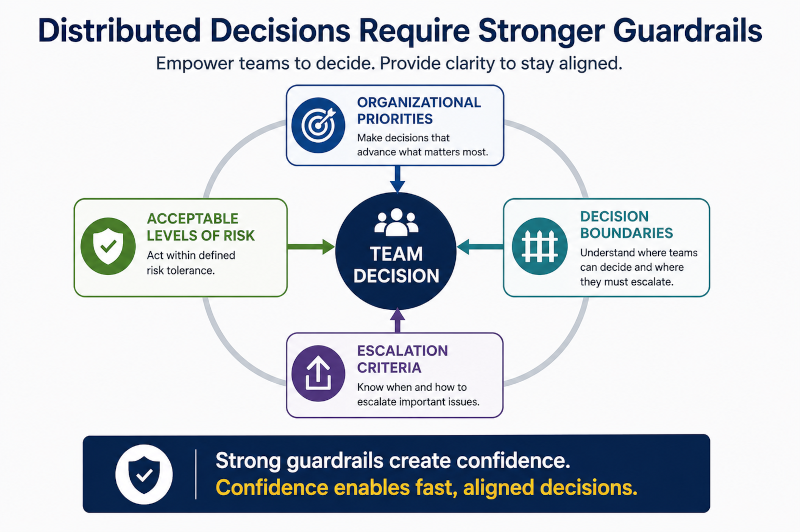
This is where governance, operating principles, and organizational design become critical.
Distributed decision-making works best when teams understand:
- organizational priorities
- acceptable levels of risk
- escalation criteria
- decision boundaries
Without these guardrails, organizations can create inconsistency, duplication, and confusion. Different teams may solve similar problems in different ways. Risk tolerance may vary dramatically across departments. Decisions that appear reasonable locally may create unintended consequences elsewhere in the organization.
This is why systems thinking is becoming such a valuable capability. As explored in our article, “The New Skill Companies Actually Need: Systems Thinking,” decisions rarely exist in isolation. A decision made by one team often affects multiple processes, stakeholders, and business outcomes.
The challenge is not simply empowering people to make decisions. The challenge is ensuring those decisions align with broader organizational objectives.
Organizations that achieve this balance often develop clear operating principles that guide behavior without requiring approval for every action. Employees gain greater autonomy, but they also gain greater responsibility for understanding how their decisions affect the broader system.
Distributed decision-making requires trust. Trust requires clarity.
Recommendation: Document which decisions can be made locally, which require consultation, and which require escalation before ambiguity creates delays.
The Future Manager May Be a Decision Coach
The rise of distributed decision-making may also reshape management itself.
Historically, many managers functioned as organizational checkpoints. Information flowed upward through management layers, while decisions flowed downward. Managers collected updates, reviewed requests, approved actions, and ensured compliance with established procedures.
As information becomes easier to access, that role begins to change.
Teams often possess the information necessary to make many operational decisions. AI tools can generate reports, summarize activity, and identify patterns that previously required significant managerial effort. Dashboards provide visibility that once depended on status meetings and reporting cycles.
Yet none of this eliminates the need for managers. It changes where managers create value.
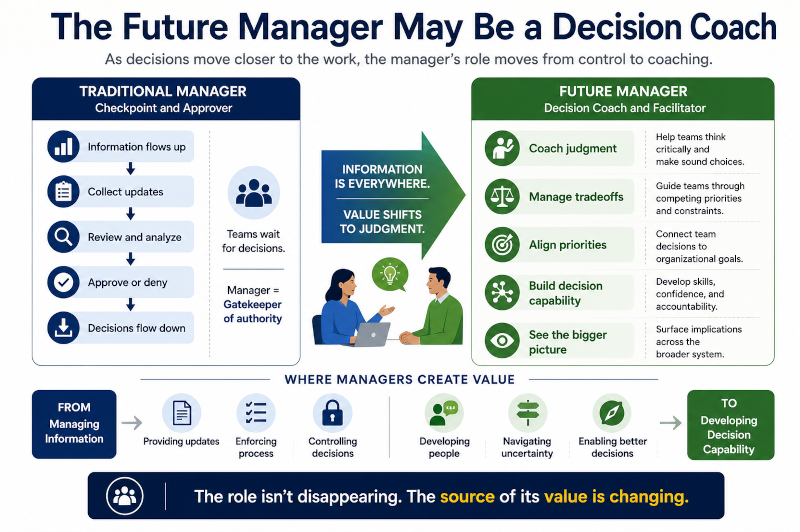
Future managers may spend less time acting as approval authorities and more time helping teams make better decisions. They may focus on coaching judgment, managing tradeoffs, aligning priorities, and helping employees understand the broader implications of their actions.
In many ways, managers become facilitators of decision quality rather than gatekeepers of decision authority.
This aligns with broader workforce trends. Deloitte’s research continues to highlight human capabilities such as judgment, collaboration, adaptability, and leadership as increasingly important in technology-enabled organizations.
As explored in “Middle Management Will Change More Than Most Executives Expect,” the future manager may spend less time managing information and more time helping teams navigate uncertainty.
The role is not disappearing. The source of its value is changing.
Recommendation: Train managers to facilitate decision-making and develop judgment rather than serving primarily as approval checkpoints.
The Real Shift: From Control to Enablement
Perhaps the most significant aspect of distributed decision-making is that it challenges traditional assumptions about leadership.
Many organizations equate control with decision authority. The more decisions leaders approve, the more control they appear to possess.
Yet in fast-moving environments, this model can become a source of friction.
When every meaningful decision requires executive involvement, leaders often become bottlenecks. Teams spend time waiting rather than acting. Opportunities are missed. Problems take longer to resolve. Adaptability declines.
The most effective organizations are beginning to recognize a different leadership model.
Leadership becomes less about making every decision and more about creating conditions for good decisions. This includes establishing governance structures, defining priorities, communicating strategic intent, developing talent, and creating systems that enable employees to exercise sound judgment.
Control does not disappear. It shifts.
Rather than controlling individual decisions, leaders focus on controlling the environment in which decisions are made.
This distinction may become increasingly important as organizations adopt AI, operate across distributed teams, and navigate greater levels of complexity. Leaders cannot personally oversee every decision without slowing the organization. They can, however, create systems that help others make decisions effectively.
The future organization may not belong to the company with the most centralized authority. It may belong to the company that can distribute decisions without losing alignment.
Recommendation: Evaluate leaders based on the quality of decision systems they create rather than the number of decisions they personally approve.
Conclusion
For decades, organizations centralized decision-making because information was difficult to obtain.
Managers gathered updates. Executives consolidated information. Decisions flowed downward through the organization. The model made sense because information was scarce and visibility was concentrated.
Today, information is often available instantly.
Operational teams have access to dashboards, analytics, collaboration tools, and AI-enabled insights that provide visibility unimaginable a generation ago. The challenge is no longer obtaining information. The challenge is acting on it quickly enough to create value.
“The future belongs to organizations that distribute decisions without losing alignment.”
As a result, organizations are distributing more decisions closer to where work happens. Not because hierarchy is disappearing, but because decision latency is becoming a competitive disadvantage.
The organizations that succeed will not be those that eliminate governance. They will be those that combine distributed decision-making with clear guardrails, strong leadership, and thoughtful organizational design.
And the leaders who understand this shift may be better positioned to build organizations that move faster, adapt more effectively, and navigate complexity with greater confidence.