
Recommendations
- Evaluate transformation success based on sustained behavior adoption rather than training completion metrics alone.
- Track post-launch usage, compliance, and workflow behavior for at least 90 days after training rather than relying on completion rates as evidence of adoption.
- Identify operational friction points that make old behaviors easier than new ones and prioritize eliminating those barriers immediately after go-live.
- Design change programs so that the new workflow becomes the easiest path employees can follow during normal work.
- Build reinforcement mechanisms directly into workflows rather than treating support as a temporary post-launch activity.
- Audit post-implementation workarounds and shadow processes to identify where behavior failed to align with the intended workflow.
- Treat employee workarounds as signals that reveal friction inside the transformation rather than evidence of resistance alone.
Build disaster recovery programs around continuous recovery validation, dependency visibility, and operational resilience rather than document maintenance alone.
Why Training Alone Doesn’t Create Lasting Behavior Change
Organizations spend millions on training every year. New systems are launched, workshops are scheduled, e-learning modules are assigned, and attendance is tracked. Leadership reviews completion dashboards, training calendars fill up, and project teams celebrate go-live readiness.
Then a few weeks later, employees quietly return to spreadsheets, old approval paths, side conversations, manual workarounds, and familiar habits.
Sound familiar?
This is one of the most common misconceptions in transformation programs: training is not the same thing as behavior change.
Training builds awareness. It develops knowledge. It teaches employees how a new process or system is supposed to work.
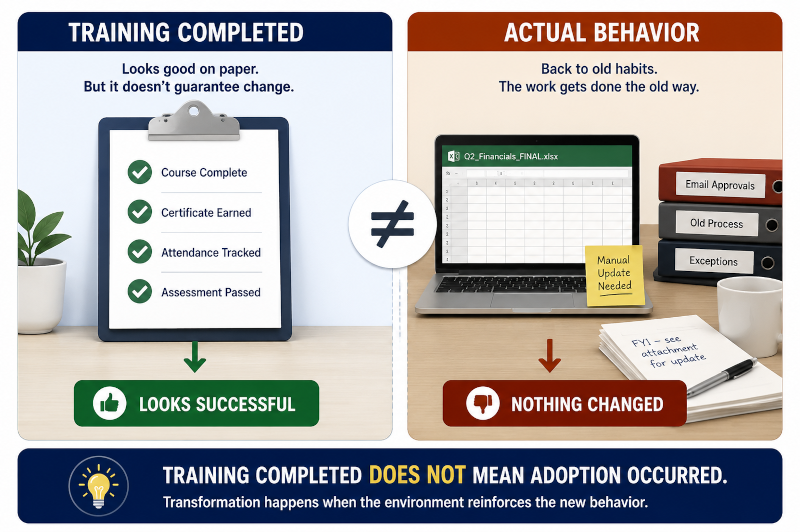
Behavior change is something different entirely.
It requires reinforcement, leadership modeling, environmental support, incentives, process alignment, and time. Without those elements, even well-designed training programs often fade quickly after launch. Research from Prosci continues to identify active sponsorship, reinforcement, and organizational support as some of the strongest contributors to successful change adoption.
The uncomfortable reality is that most organizations do not have a training problem.
They have an environment problem.
Recommendation: Evaluate transformation success based on sustained behavior adoption rather than training completion metrics alone.
Why Training Feels Like Success (But Often Isn’t)
Training creates visible evidence of activity.
Completion rates rise. Attendance reports look strong. Certifications are issued. Project dashboards turn green.
Executives can confidently report:
- 98% of employees completed training.
- All business units attended workshops.
- Go-live readiness requirements were met.
- Change communications were delivered.
Those metrics are useful.
But they mostly measure exposure, not adoption.
An employee can complete a two-hour training course, pass an assessment, and still choose the old process the next day when deadlines become stressful.
Knowing what to do and actually doing it under operational pressure are very different outcomes.
This distinction explains why many transformation initiatives appear successful during launch periods but struggle months later. The organization mistakes awareness for behavioral commitment.
Training can create confidence that change has occurred before the new behavior has actually become part of daily work.
Recommendation: Track post-launch usage, compliance, and workflow behavior for at least 90 days after training rather than relying on completion rates as evidence of adoption.
The Real Problem: Habits Beat Knowledge
Most workplace behavior is habitual.
People naturally gravitate toward what feels familiar, efficient, and low-risk. When deadlines are tight and workloads are high, employees rarely stop to ask what they were taught in training. They fall back on what has worked before.
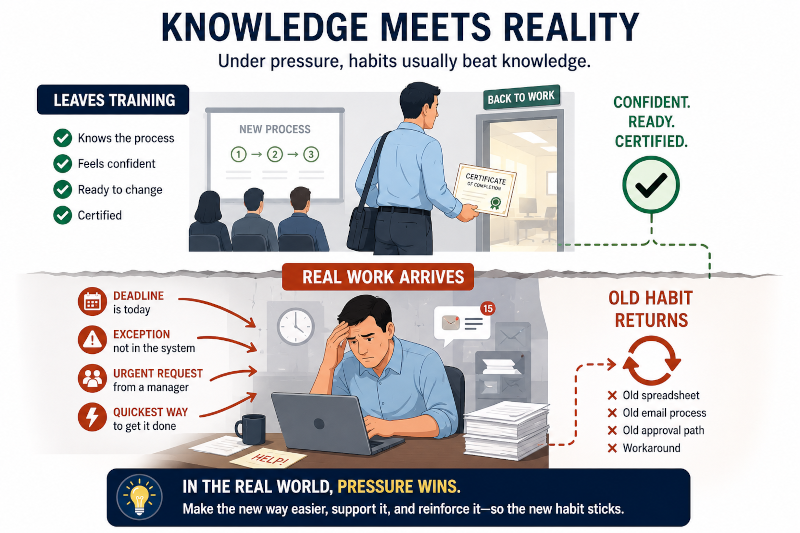
This is where many change programs misdiagnose resistance.
Organizations often assume employees resist change because they do not understand it.
In reality, employees frequently understand the change perfectly well.
They simply operate inside environments that reward different behavior.
Examples include:
- The new system requires five steps instead of two.
- Managers still approve requests through email.
- Legacy templates remain available.
- Performance metrics still reward old workflows.
- Support disappears after launch week.
Under those conditions, reverting to previous behavior is not irrational.
It is logical.
A useful way to think about this is that training changes knowledge, while operating environments determine behavior.
Employees often know exactly what leadership wants them to do.
The problem is that the surrounding systems continue rewarding something else.
Recommendation: Identify operational friction points that make old behaviors easier than new ones and prioritize eliminating those barriers immediately after go-live.
Microsoft Teams Adoption Revealed an Important Change Management Lesson
One of the most interesting examples of behavior change occurred during the rapid adoption of collaboration platforms during the COVID-19 pandemic.
Organizations around the world trained employees on Microsoft Teams, Zoom, and other collaboration tools. Yet training alone was not what ultimately drove adoption.
The environment changed.
The old behavior became impossible.
Employees could no longer walk into conference rooms, stop by desks, or conduct many routine interactions in person. The new collaboration tools became embedded into daily work because they were now required to complete basic operational tasks.
Research examining collaboration patterns among more than 60,000 Microsoft employees found that remote work significantly altered communication structures, collaboration networks, and workflow behavior.
The lesson extends far beyond remote work.
People rarely change behavior simply because they attended training. Behavior changes when the surrounding environment makes the new behavior practical, necessary, and consistently reinforced. Training introduced the tool.
The operating environment drove adoption.
Recommendation: Design change programs so that the new workflow becomes the easiest path employees can follow during normal work.
What Actually Drives Behavior Change
Research and practice in organizational change consistently point to several factors that matter more than training alone.
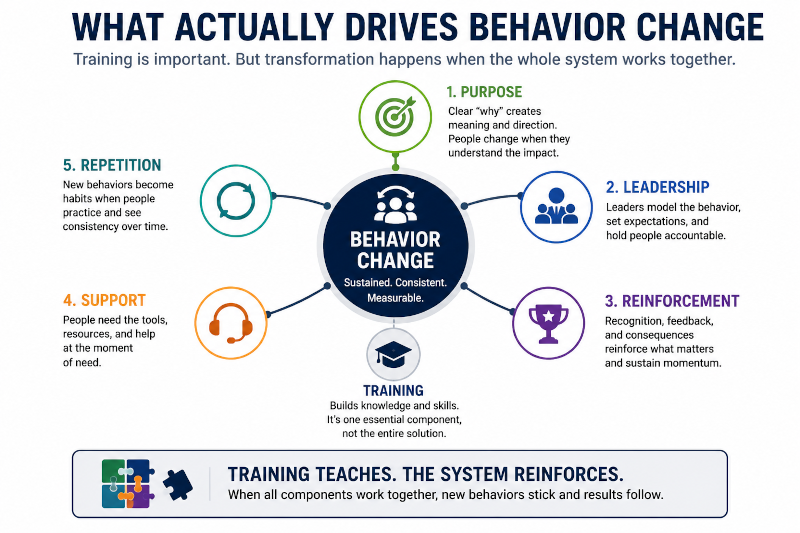
1. Meaning and Purpose
People need to understand why a change matters.
If employees view a new process as additional bureaucracy, adoption drops. If they connect the change to reduced rework, improved customer outcomes, lower risk, or faster execution, motivation improves.
A process change without context often feels like extra work.
2. Leadership Role Modeling
Employees pay closer attention to leadership behavior than training materials.
If managers continue using old workflows, approving exceptions informally, or bypassing new processes, employees quickly learn what behavior is actually acceptable.
Prosci research has consistently identified active and visible sponsorship as one of the strongest predictors of successful change outcomes.
What leaders tolerate often becomes the real process.
3. Reinforcement Systems
Behavior is heavily influenced by incentives. When speed is rewarded more than compliance, shortcuts naturally emerge. When employees receive greater recognition for solving problems quickly than for following established processes, workarounds begin to spread throughout the organization.
This is why sustained behavior change requires more than training alone. Training may communicate expectations, but performance metrics, rewards, leadership attention, and accountability mechanisms ultimately determine priorities. If nobody measures adherence to the new process, behavioral drift becomes almost inevitable over time.
4. Support at the Moment of Need
Most employees forget portions of training quickly unless they immediately apply what they learned.
This is why office hours, quick-reference guides, peer champions, embedded help systems, manager coaching, and workflow support tools often create more long-term value than the training event itself.
5. Time and Repetition
New habits rarely stabilize in a single rollout. Employees need opportunities to practice, make mistakes, ask questions, and gradually normalize new behaviors.
Organizations often underestimate how long sustained adoption actually takes.
Recommendation: Build reinforcement mechanisms directly into workflows rather than treating support as a temporary post-launch activity.
ERP Transformations Show Why Training Alone Is Not Enough
Enterprise Resource Planning (ERP) programs provide one of the clearest examples of the gap between training and behavior change.
Organizations frequently invest millions in ERP implementations. Employees attend workshops. Training materials are distributed. Processes are documented.
Yet months after deployment, many organizations still encounter:
- spreadsheet workarounds,
- side databases,
- manual approvals,
- offline reconciliations,
- and shadow processes.
Research examining ERP adoption continues to identify user adoption, organizational alignment, and process integration as major determinants of implementation success.
The issue is rarely that employees failed to attend training.
More often, the issue is not a lack of training but a disconnect between the new system and the realities of day-to-day work. When employees encounter exceptions, bottlenecks, or process gaps that the new workflow cannot accommodate efficiently, they naturally develop workarounds to keep work moving. In these situations, the training may have been successful—employees understand how the new system is supposed to operate—but the desired behaviors never fully take hold because the system does not align with operational reality. This helps explain why many organizations appear digitally transformed on paper while unofficial workflows, shadow processes, and manual workarounds continue operating beneath the formal system.
Recommendation: Audit post-implementation workarounds and shadow processes to identify where behavior failed to align with the intended workflow.
Why Employees “Go Back to the Old Way”
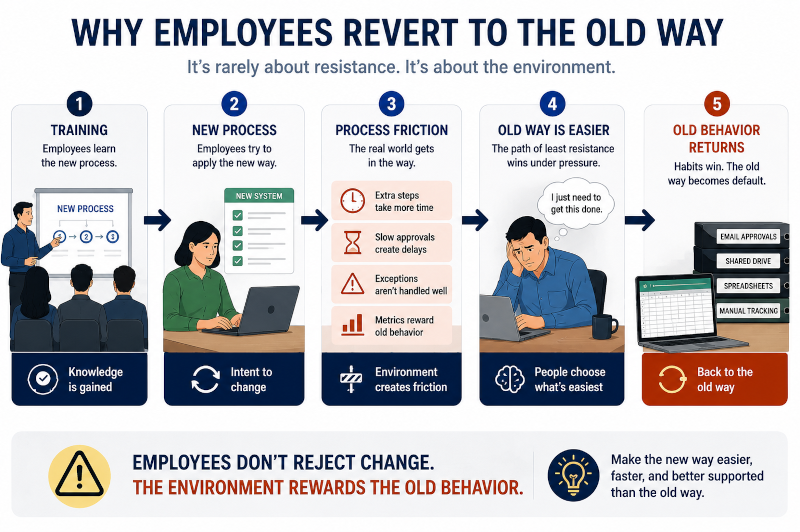
When organizations say employees reverted, what they often mean is:
- The old process remained easier.
- Managers did not reinforce expectations.
- Legacy workflows never disappeared.
- Success metrics rewarded old behavior.
- Support ended too quickly.
- The new process conflicted with operational reality.
This distinction matters.
It shifts the conversation away from blaming employees and toward evaluating the operating environment itself.
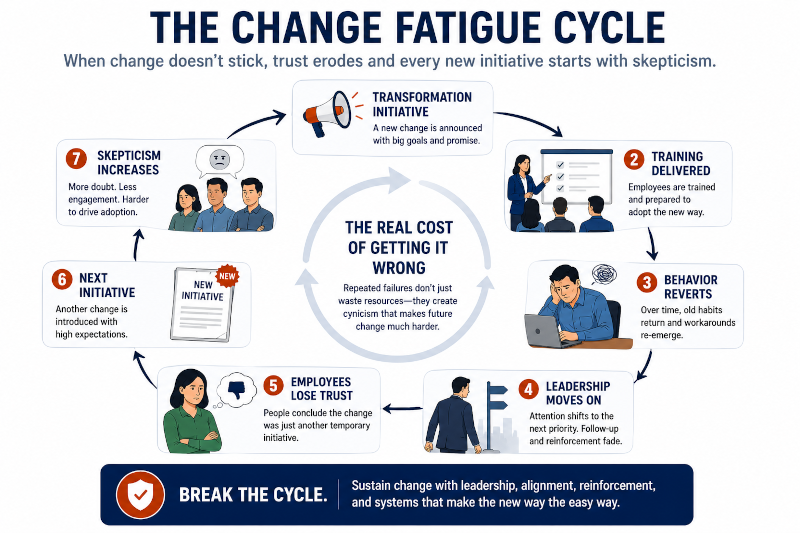
Many organizations unintentionally create conditions where reverting becomes the most efficient choice.
Employees are not rejecting change.
They are responding to incentives, friction, and workflow design.
Recommendation: Treat employee workarounds as signals that reveal friction inside the transformation rather than evidence of resistance alone.
The Hidden Cost of Getting This Wrong
When organizations mistake training for transformation, the consequences extend far beyond adoption metrics. Software investments generate lower returns than expected, duplicate work begins to accumulate, data quality deteriorates, shadow processes emerge, customer service slows, and employees become frustrated as they navigate competing ways of working. While these operational impacts can be significant, there is another consequence that is often more damaging and far less visible: organizational cynicism.
Repeated change initiatives that fail to produce lasting behavior change can gradually erode employee confidence in future transformations. After experiencing enough rollouts that lose momentum shortly after launch, employees begin to assume that every new initiative is temporary. Rather than investing fully in the change, they wait for leadership attention to shift elsewhere before returning to familiar processes and routines. Over time, this pattern creates a trust gap between leadership intentions and employee expectations, making future transformations more difficult, more expensive, and slower to achieve. Unlike software licenses, implementation costs, or consulting fees, this erosion of trust rarely appears on a financial report, yet it can become one of the most significant barriers to organizational change.
Recommendation: Measure employee confidence, adoption sustainability, and signs of change fatigue after major transformations to identify resistance and trust issues before they become embedded in the culture.
Final Takeaway
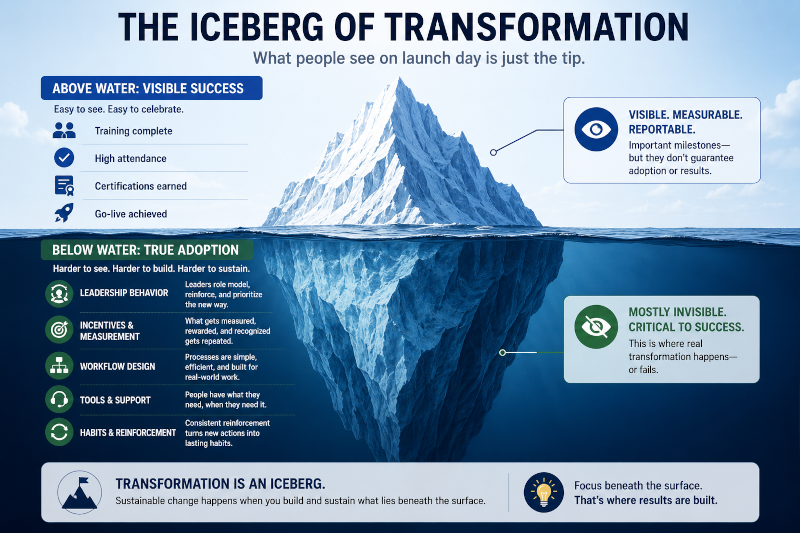
Training is an important part of any transformation effort because it builds awareness, develops skills, and helps employees understand what is expected of them. However, capability alone does not create lasting change. Organizations do not transform simply because employees learn something new; they transform when employees consistently work differently over time. The most successful change initiatives recognize that training is only one piece of a much larger behavior-change equation. Leadership actions, workflow design, performance incentives, reinforcement mechanisms, support resources, and organizational expectations all influence whether new behaviors become embedded in daily operations.
For that reason, leaders should move beyond asking whether employees completed training and focus instead on what conditions make the desired behavior easier, expected, rewarded, and repeatable. Training can change what people know, but the operating environment largely determines what people actually do. In the end, organizations tend to get the behaviors their systems, processes, and leaders reinforce every day.