
Organizations often turn to process mapping when something goes wrong. Work gets delayed, responsibilities are unclear, or an employee leaves and takes critical knowledge with them. The instinct is to document the process. But before improving a process, people need to agree on how it actually works.
When Teams See Different Processes
I once mapped a process within a cybersecurity department involving penetration testing, IT operations, and architecture.
The penetration testing team needed firewall rule updates to conduct its tests. The operations team managed those updates, but changes required approval from the architecture team before implementation.
Each team had its own responsibilities, yet the dependencies between them weren’t fully understood. This created delays and frustration, with teams struggling to understand what was holding up the work.
The problem wasn’t necessarily that anyone was doing their job incorrectly. The teams simply lacked a shared understanding of the end-to-end process.
Making the Workflow Visible
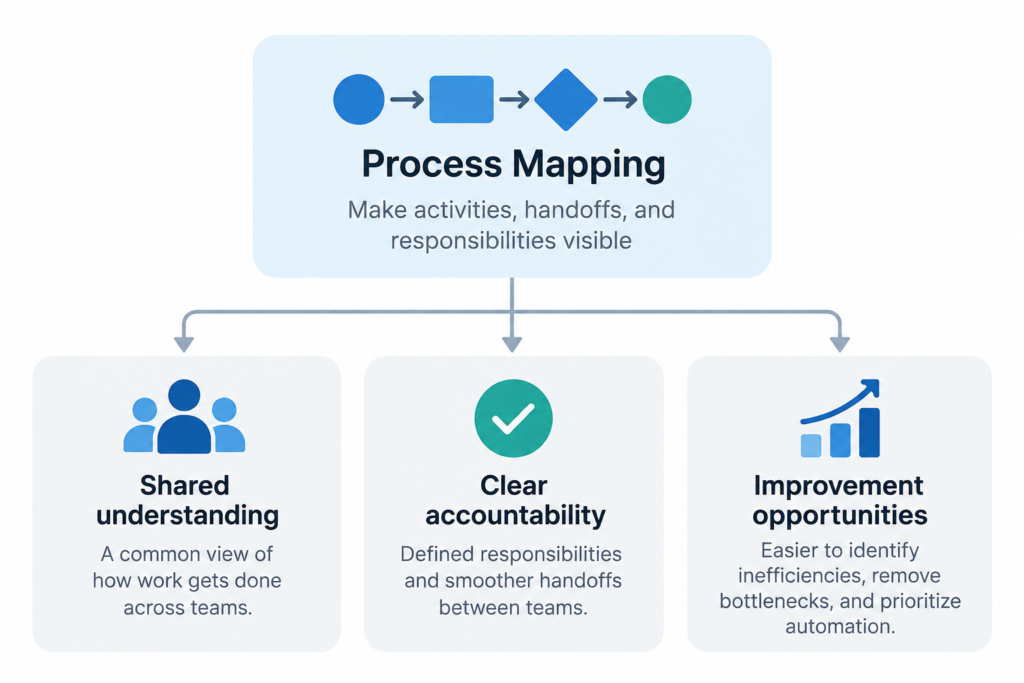
I mapped the workflow and walked through it with the stakeholders, explaining how I understood the activities and handoffs. This gave everyone an opportunity to correct assumptions, clarify responsibilities, and identify gaps in communication.
As the process became visible, the sources of miscommunication became clearer. The workflow began to improve as the teams developed a common understanding of how their work connected.
No major technology investment was required. The first step was simply making the existing process visible to everyone involved.
This is what I consider the primary value of process mapping. A process map isn’t just a diagram or a document. It gives people a common reference point for understanding how work gets done across organizational boundaries.
Once that understanding exists, other improvements become easier to identify. Teams can clarify accountability, eliminate unnecessary steps, consider automation, and document the agreed-upon workflow in a standard operating procedure (SOP). That documentation also helps preserve knowledge when employees leave.
Start With the Right Processes
Of course, organizations don’t need to map every process at once. Managers often want to document everything, particularly after an operational problem exposes gaps in existing procedures.
A better approach is to establish a baseline of core processes and identify which ones deserve attention first. Business importance, operational risk, recurring problems, and dependence on individual employees can all help guide those decisions.
This is where a process landscape assessment can help. Before investing time in detailed process mapping, organizations need a clearer picture of their processes and where improvement efforts are likely to matter most.
As I explored in Why Organizations Keep Investing in Problems They Don’t Understand, effective improvement starts with understanding the problem rather than immediately investing in a solution.
Not sure which processes need attention in your organization?
The free assessment provides an initial view of your organization’s process landscape, helping identify core processes and areas that may require further attention.
If your organization is looking to improve operations but is unsure which processes to prioritize, contact SpirZon to discuss a free Process Landscape Assessment.
Before deciding what to improve, make sure you understand how work gets done.