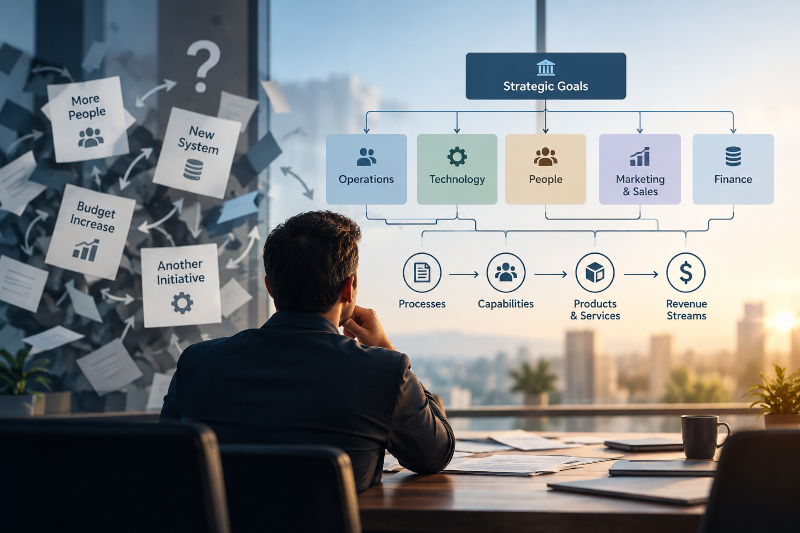
Organizations rarely lack ideas for improvement. They hire more people, purchase new systems, launch process improvement initiatives, and invest in technology. Yet the same operational problems often persist.
I’ve seen this firsthand in an organization of approximately 200 employees. Leadership was willing to invest significant money in improvement efforts, but there was a fundamental problem: they lacked a clear understanding of how the organization actually operated.
The issue wasn’t a lack of effort or willingness to improve. It was the absence of a shared picture of the business—and a systematic way to connect improvement decisions to organizational objectives.
When Every Problem Becomes an Isolated Problem
The organization operated reactively. Issues surfaced, people responded, and solutions were implemented as needed. When something wasn’t working, the response often involved adding resources: hire more staff, acquire a new system, or introduce another improvement initiative.
These responses weren’t necessarily unreasonable. Sometimes additional resources are exactly what an organization needs. The problem was that decisions were being made without sufficient visibility into the underlying causes.
Were employees overwhelmed because there weren’t enough of them, or because processes were inefficient? Was a new system necessary, or was the existing technology poorly integrated into how people worked? Were departments struggling independently, or were problems in one area creating difficulties elsewhere?
Without a clear understanding of how work moved through the organization, it was difficult to distinguish symptoms from causes.
There was also a disconnect between tactical improvements and strategic direction. Individual initiatives might address immediate concerns, but it wasn’t always clear how they contributed to broader organizational objectives or what value the investment would deliver.
This is a familiar pattern in reactive organizations. As I explored in Reactive Organizations Cannot Scale Efficiently, responding to problems as they arise can become an operating model in itself. The organization stays busy addressing issues without necessarily becoming better at preventing them.
The question was how to create a more systematic view of the business.
Connecting the Dots Through Capability Mapping
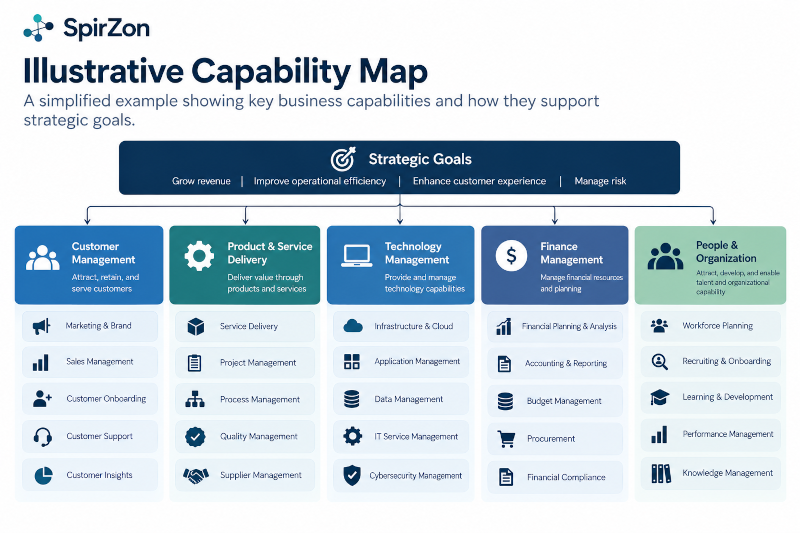
I approached the problem by conducting a capability mapping exercise.
The work began with structured interviews with employees across the organization, including junior staff. Their perspectives helped establish what actually happened in practice, rather than relying exclusively on how leadership believed the organization operated.
I then developed a department-level view through discussions with department heads. Working together, we defined what each department did and examined how its activities connected to the organization’s revenue streams and cash flows.
The goal wasn’t simply to document departments or produce a diagram. It was to connect the different parts of the business into a coherent picture.
A capability map provides a structured view of what an organization does—its core abilities and the activities it must perform to deliver value. It offers a way to examine the organization beyond its departmental boundaries and understand how different capabilities relate to one another.
This is where the idea of systems thinking becomes practical. As discussed in The New Skill Companies Actually Need: Systems Thinking, understanding individual components is not enough. We also need to understand the relationships between them.
The capability mapping exercise helped make those relationships visible.
From Different Perspectives to a Shared Understanding
The most significant outcome wasn’t the map itself. It was the shared understanding that emerged from developing it.
Before the exercise, people had their own perspectives on how the organization worked. Departments understood their responsibilities, but there wasn’t a sufficiently clear, common view of how everything connected.
The mapping exercise gave leadership and department heads a way to discuss the business using a shared structure. They could relate departmental activities to revenue streams, see how different capabilities fit together, and discuss organizational needs with a broader perspective.
That changed the quality of the conversation.
Instead of discussing improvement initiatives as isolated requests, leadership had a foundation for examining what the organization needed, where gaps might exist, and which areas deserved further attention. Those discussions became more productive and informed subsequent quarterly planning.
The map also established a basic structure for the organization’s business architecture. It provided a starting point for examining specific capabilities in greater detail and identifying where additional visibility was needed.
For example, if a capability appeared to be underperforming, the next step could be process mapping to understand how the work was performed, where handoffs occurred, and what was creating friction.
The capability map provided the broader view. More detailed analysis could then focus on the areas where it was most useful.
Better Investment Decisions Start With Better Visibility
Capability mapping doesn’t automatically tell leadership which investments to make. It provides something essential to making those decisions more systematically: context.
When leaders understand what the organization does and how its capabilities connect to business outcomes, they have a stronger basis for evaluating competing needs.
A proposed investment can be examined against several questions:
- Which organizational capability is this intended to strengthen?
- What problem are we actually trying to solve?
- Is the gap related to people, processes, technology, or how they work together?
- How does addressing this gap contribute to organizational objectives?
- Is this the most important area to invest in right now?
These questions don’t eliminate uncertainty, but they help move decisions from reactive spending to deliberate prioritization.
This is particularly important when organizations invest in technology. A new system may be appropriate, but technology alone won’t resolve unclear processes, fragmented responsibilities, or a lack of shared understanding. As explored in Why Your Automation Strategy Is Creating Operational Chaos, improving individual components without understanding the broader operating system can create new problems rather than solve existing ones.
The objective isn’t to map everything or produce documentation for its own sake. It’s to create enough visibility to make better decisions about where to focus resources and why.
Start by Understanding What Your Organization Does
If leadership cannot clearly explain what the organization does, how its different capabilities contribute to business outcomes, and where meaningful gaps exist, prioritizing improvement becomes much harder.
Capability mapping provides a practical starting point. It creates a common view of the organization, connects activities to business objectives, and establishes a foundation for more focused assessment and planning.
You don’t need to begin with a comprehensive business architecture initiative. You can start by identifying the capabilities that matter most, evaluating their current state, and determining where additional analysis would provide value.
At SpirZon, we offer a free Capability Assessment to help organizations take that first step.
The assessment provides an initial view of organizational capabilities, highlighting strengths, gaps, and areas for further consideration.
If you’re struggling to connect improvement initiatives to organizational needs, contact SpirZon to discuss whether the assessment is a useful starting point.
Before deciding what to improve, make sure you understand what you’re working with.