- What Operational Friction Actually Means
- Communication Bottlenecks Create Hidden Coordination Costs
- Process Complexity Quietly Slows Execution
- Decision Latency Quietly Becomes Organizational Drag
- Information Accessibility Determines Organizational Speed
- Cross-Functional Alignment Reduces Organizational Friction
- High-Performing Organizations Simplify Work Intentionally
- Measuring Operational Friction
- Building Low-Friction Organizations
Most organizations are not slowed by one catastrophic operational failure.
They are slowed by accumulated friction.
A delayed approval.
An unclear workflow.
A missing document.
An unnecessary meeting.
A decision waiting three days for validation.
A process that requires employees to navigate six disconnected systems to complete one task.
Individually, these inefficiencies may appear minor.
Collectively, they create operational drag that quietly reduces organizational speed, adaptability, scalability, and execution quality.
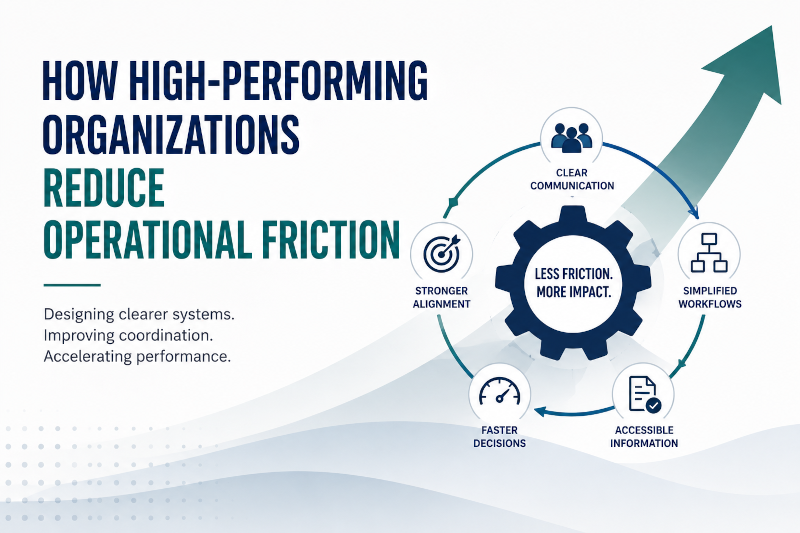
High-performing organizations understand that operational excellence rarely comes from forcing employees to work harder. More often, it comes from designing systems that allow work to move more clearly, consistently, and efficiently across the organization.
This is why many high-performing organizations continue to focus on reducing friction across communication systems, workflows, documentation practices, and decision-making structures rather than simply pursuing more technology or additional automation.
Organizational management literature has long emphasized that workflow coordination and communication quality often influence performance as much as individual productivity itself.
Organizations that reduce operational friction and streamline communication often move faster not because employees are under more pressure, but because fewer barriers interrupt execution.
What Operational Friction Actually Means
Operational friction refers to anything that unnecessarily slows, complicates, interrupts, or burdens organizational execution.
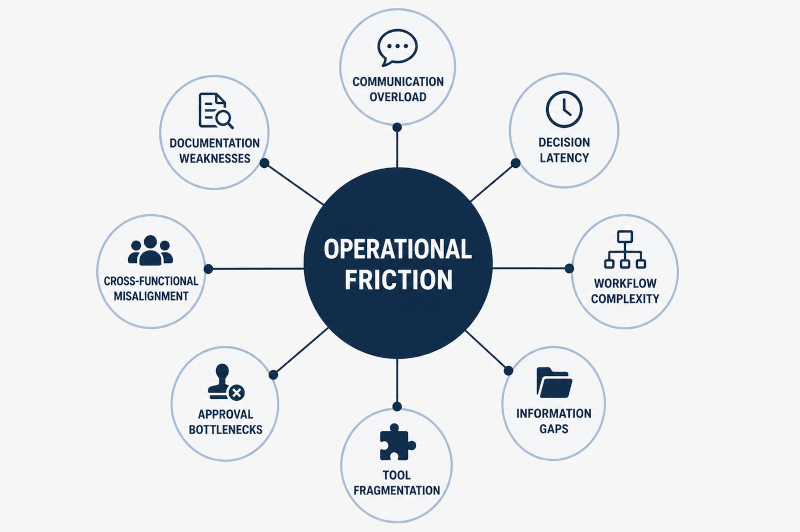
This may include communication bottlenecks, fragmented workflows, excessive approvals, duplicated reporting structures, unclear ownership models, and disconnected operational systems.
Importantly, operational friction is often systemic rather than individual.
Employees frequently compensate for inefficient systems through manual workarounds, excessive meetings, duplicated effort, informal communication practices, and constant clarification requests that temporarily keep operations functioning while quietly increasing organizational complexity.
Many organizations mistakenly interpret these workarounds as operational resilience.
In reality, they often signal deeper coordination problems.
A workflow requiring constant clarification is rarely an efficient workflow.
A process dependent on tribal knowledge is rarely a scalable process.
Operational friction compounds over time.
A process that wastes only five minutes per employee each day can quietly consume thousands of lost operational hours annually across a large organization.
This is one reason high-performing organizations approach operational simplicity as a strategic advantage rather than an administrative preference.
Communication Bottlenecks Create Hidden Coordination Costs
Communication inefficiencies remain one of the largest sources of operational friction inside modern organizations.
As digital collaboration tools expanded, many organizations assumed communication would naturally become more efficient.
In practice, communication often became more fragmented.
Employees largely operate across email platforms, messaging systems, project management tools, documentation repositories, video meetings, and workflow applications simultaneously. The result is constant context switching that reduces operational clarity and increases coordination fatigue.
The Microsoft Work Trend Index similarly found that employees operating inside highly digital work environments increasingly experience communication overload driven by continuous meetings, fragmented collaboration systems, messaging notifications, and digital interruptions. The report noted that many organizations continue struggling to balance flexibility with sustainable coordination practices as hybrid work environments expand across distributed operational systems.
Many organizations successfully distributed work faster than they distributed operational clarity.
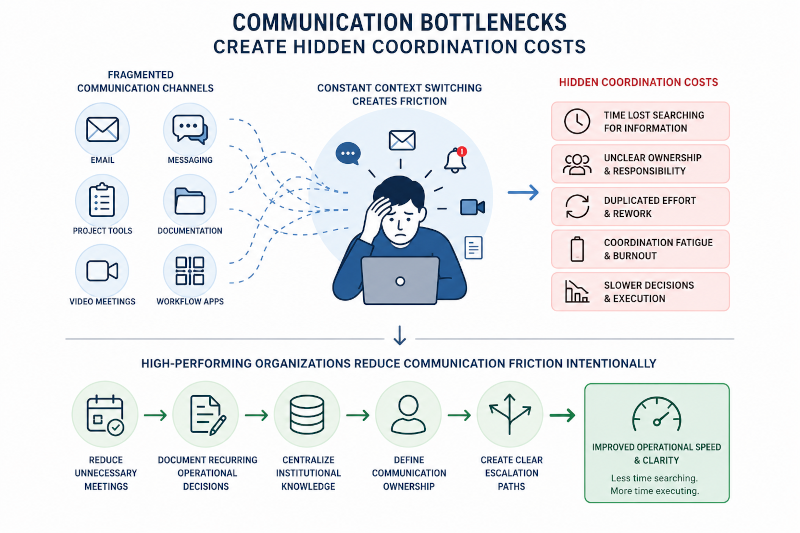
High-performing organizations reduce communication friction intentionally.
Rather than continuously adding new communication channels, they establish clearer coordination structures and standardize how information moves across teams.
In practice, this often means:
- reducing unnecessary meetings,
- documenting recurring operational decisions,
- centralizing institutional knowledge,
- defining communication ownership,
- and creating clearer escalation paths.
Organizations frequently discover that operational speed improves significantly once employees spend less time searching for information or determining who is responsible for resolving issues.
Process Complexity Quietly Slows Execution
Operational inefficiency often develops gradually through accumulated process complexity.
As organizations scale, workflows frequently become layered with approvals, duplicated reporting requirements, fragmented oversight systems, compliance checks, and disconnected operational tools.
Most of these controls are introduced with good intentions.
Over time, however, they often create coordination drag that slows execution significantly.
Organizational systems theory has long warned that increasing process complexity can reduce adaptability, responsiveness, and coordination efficiency across institutions.
The operational risks associated with friction become especially visible during periods of disruption.
In late 2022, Southwest Airlines experienced a major operational collapse that resulted in thousands of canceled flights across the United States. Federal investigations later highlighted how fragmented scheduling systems, coordination limitations, and operational bottlenecks severely restricted the company’s ability to recover efficiently during cascading disruptions.
The incident demonstrated how operational friction inside interconnected systems can rapidly amplify organizational instability during high-stress conditions.
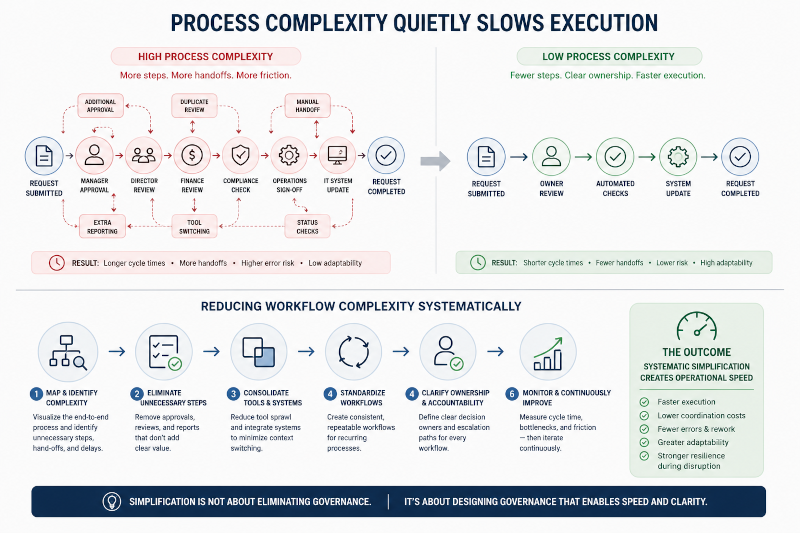
High-performing organizations reduce workflow complexity systematically.
This often includes simplifying approval chains, consolidating redundant tools, removing unnecessary handoffs, standardizing recurring workflows, and clarifying operational ownership between departments.
Importantly, simplification does not mean eliminating governance.
It means designing governance structures that support operational speed rather than unintentionally obstruct it.
Decision Latency Quietly Becomes Organizational Drag
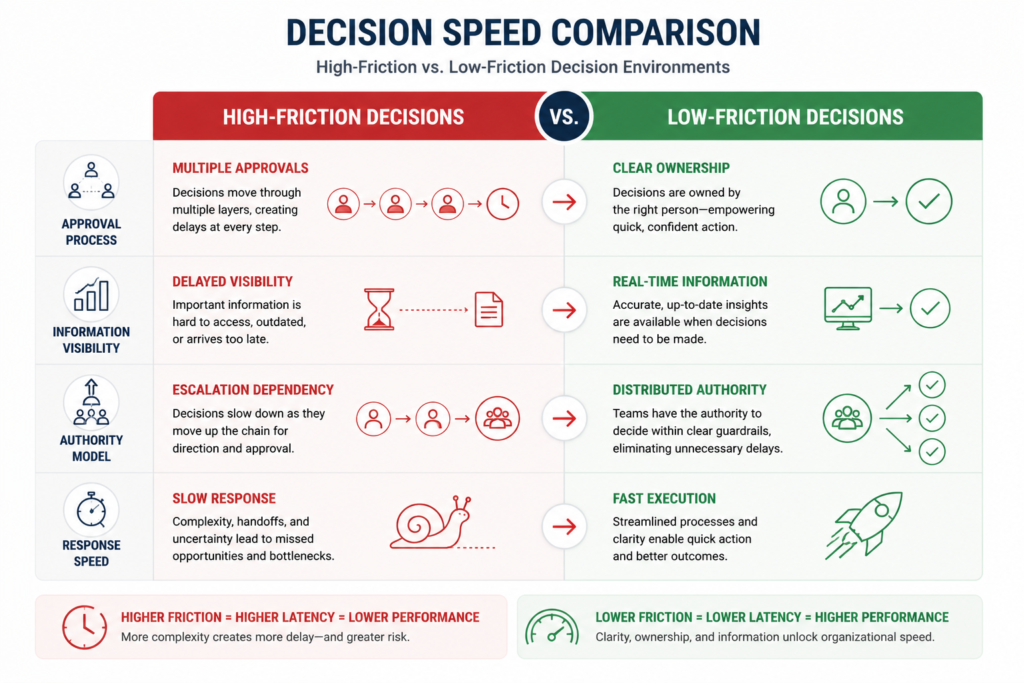
Many organizations underestimate how much operational friction originates from delayed decision-making.
Decision latency often emerges when ownership is unclear, information is fragmented, approvals are layered, or leadership visibility is inconsistent.
As organizations become more operationally complex, employees frequently spend increasing amounts of time waiting for validation, clarification, or executive alignment before moving work forward.
This creates organizational drag that slows responsiveness, execution quality, and adaptability.
Harvard Business Review has similarly noted that organizations with excessive hierarchy and fragmented communication structures often struggle to respond quickly during periods of operational change.
High-performing organizations intentionally reduce decision friction by improving operational clarity.
This often involves:
- defining decision ownership,
- reducing unnecessary approval layers,
- improving access to operational data,
- and establishing clearer escalation frameworks.
Some organizations also establish decision thresholds that allow lower-risk operational issues to be resolved without excessive managerial oversight.
This reduces bottlenecks while improving organizational responsiveness.
Information Accessibility Determines Organizational Speed
Organizations cannot move faster than their ability to access reliable operational knowledge.
One of the largest hidden sources of operational friction is information inaccessibility.
Employees frequently lose time searching for procedures, workflow documentation, operational updates, historical decisions, or ownership responsibilities.
This problem becomes especially dangerous inside organizations that rely heavily on tribal knowledge or undocumented workflows.
Organizations with stronger documentation practices and more accessible operational knowledge often coordinate work more efficiently and adapt more effectively during periods of change. Academic research examining knowledge utilization and coordination similarly found that team performance improves significantly when organizations combine accessible knowledge systems with strong coordination processes.
This challenge becomes even more important as organizations integrate AI-enabled systems into daily operations.
AI retrieval tools, workflow automation systems, and operational analytics platforms depend heavily on structured organizational knowledge. Poor documentation environments frequently create inaccurate retrieval behavior, inconsistent workflows, and operational confusion.
High-performing organizations often treat documentation and knowledge management as operational infrastructure rather than administrative overhead.
Practical implementation strategies often include centralized documentation systems, searchable knowledge repositories, operational playbooks, standardized workflow documentation, and clearly maintained process ownership structures.
Organizations that improve information accessibility often reduce operational delays significantly without requiring major technology investments.
Cross-Functional Alignment Reduces Organizational Friction
Many operational bottlenecks emerge not because employees lack effort, but because teams operate inside disconnected systems with conflicting priorities.
Cross-functional misalignment frequently creates duplicated work, inconsistent workflows, communication gaps, and coordination failures that quietly slow organizational execution.
This becomes especially dangerous as organizations expand across multiple departments, platforms, and operational environments.
High-performing organizations often prioritize cross-functional collaboration because disconnected teams frequently create workflow delays, duplicated effort, and visibility problems at scale. McKinsey & Company has repeatedly highlighted the relationship between operational alignment and organizational adaptability.
Reducing operational friction therefore requires more than improving individual workflows.
It requires improving how workflows connect across the organization itself.
Many organizations reduce coordination friction by standardizing cross-functional workflows, clarifying ownership boundaries, improving operational visibility, establishing shared performance metrics, and reducing dependency confusion between teams.
Operational alignment becomes increasingly important as organizations scale distributed work environments, automation systems, and AI-enabled workflows.
High-Performing Organizations Simplify Work Intentionally
One of the hallmark characteristics of high-performing organizations is intentional simplification.
Many organizations unknowingly create more operational complexity while attempting to improve efficiency. Some organizations compensate for inefficient systems through human effort instead of redesigning the systems themselves.
New tools, reporting structures, approval systems, workflow automations, and communication platforms are frequently introduced faster than organizations update the coordination systems supporting them.
The result is often increased fragmentation rather than improved performance.
High-performing organizations continuously evaluate:
- where friction exists,
- which workflows create unnecessary complexity,
- how information moves across systems,
- and where employees experience coordination drag.
Importantly, they do not treat simplification as a one-time initiative.
They treat it as an ongoing operational discipline.
“The treat it as an ongoing operational discipline.”
This may include workflow audits, meeting reduction initiatives, documentation standardization, governance simplification, and operational analytics designed to identify recurring bottlenecks.
Organizations that intentionally reduce friction often improve execution speed, employee experience, operational scalability, and organizational adaptability simultaneously.
Measuring Operational Friction
Many organizations struggle to reduce operational friction because they do not measure it directly.
Operational friction frequently appears indirectly through symptoms such as:
- slow project execution,
- delayed approvals,
- meeting overload,
- onboarding delays,
- excessive rework,
- workflow interruptions,
- and communication bottlenecks.
High-performing organizations increasingly monitor operational efficiency using measurable coordination indicators.
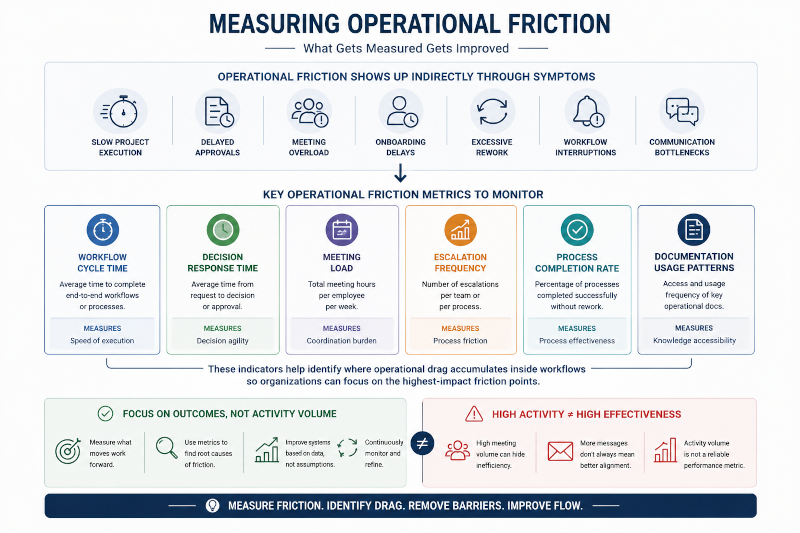
Common operational friction metrics include workflow cycle time, decision response time, meeting load, escalation frequency, process completion rates, and documentation usage patterns.
These indicators help organizations identify where operational drag accumulates inside workflows.
Importantly, organizations should avoid measuring efficiency purely through employee activity volume.
High activity does not necessarily indicate high effectiveness.
In many cases, excessive communication volume or meeting frequency may actually signal coordination inefficiency rather than productivity.
Building Low-Friction Organizations
Reducing operational friction is not about removing all structure.
It is about creating organizational systems that allow work to move more clearly, consistently, and efficiently across the enterprise.
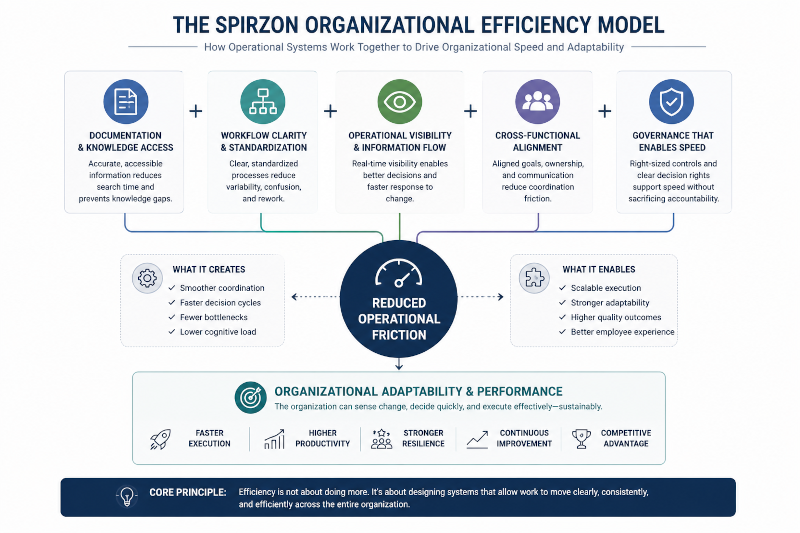
High-performing organizations increasingly recognize that operational speed depends heavily on visibility, workflow clarity, accessible information, coordinated communication, and simplified execution environments.
Organizations that successfully reduce operational friction often begin by simplifying workflows before automating them. They improve documentation quality, clarify operational ownership, reduce unnecessary approvals, standardize communication systems, and strengthen cross-functional coordination structures.
Operational excellence is rarely the result of one major transformation initiative.
More often, it emerges through continuous reduction of small inefficiencies that quietly slow organizational performance over time.
The organizations that scale most effectively are often not the ones with the most technology.
High-performing organizations are rarely frictionless by accident.
They are designed intentionally around clarity, coordination, visibility, and the systematic reduction of operational drag.
10 thoughts on “How High-Performing Organizations Reduce Operational Friction”