- Recommendations
- The Biggest Disaster Recovery Risk Is Organizational Overconfidence
- The CrowdStrike Outage Exposed a Hard Truth About Recovery
- Backups Create Confidence. Testing Creates Resilience.
- Compliance Creates Documentation. Resilience Creates Capability.
- The Future of Disaster Recovery Is Operational Resilience
Recommendations
- Evaluate disaster recovery readiness based on validated recovery performance rather than the existence of documented procedures alone.
- Include cross-functional coordination exercises in disaster recovery testing rather than focusing exclusively on technical restoration activities.
- Test recovery procedures at operational scale to validate whether restoration remains achievable when thousands of systems, users, and dependencies are involved simultaneously.
- Require end-to-end restoration testing that validates applications, identities, integrations, and business workflows—not just backup integrity.
- Track disaster recovery performance using validated recovery outcomes and testing results rather than documentation completion rates.
- Build disaster recovery programs around continuous recovery validation, dependency visibility, and operational resilience rather than document maintenance alone.
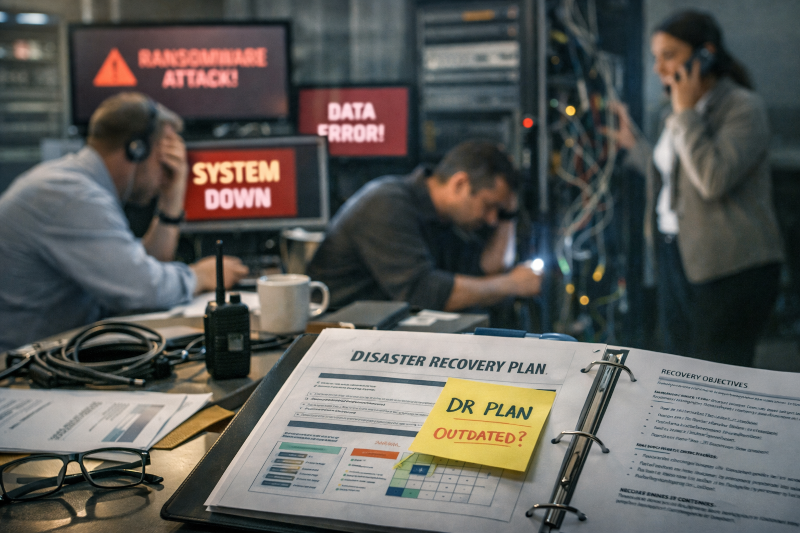
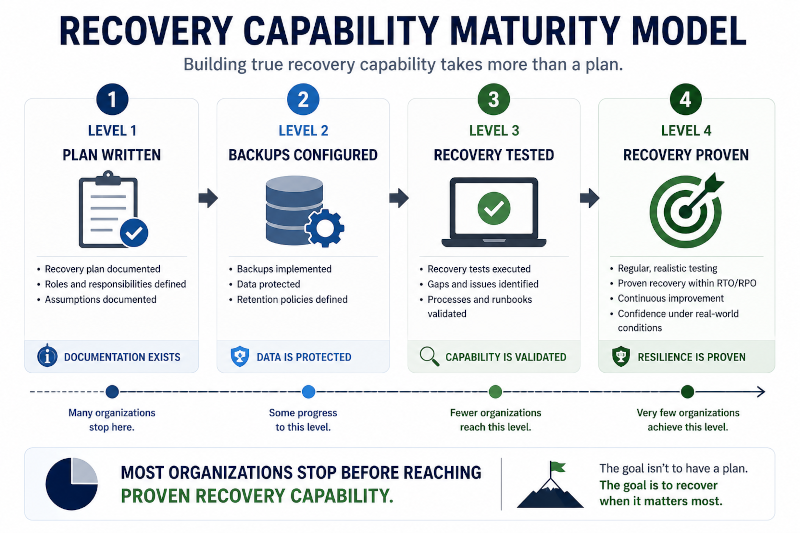
Most organizations believe they are prepared for disaster recovery. They have documented recovery procedures. Backup policies exist. Recovery Time Objectives (RTOs) and Recovery Point Objectives (RPOs) are formally defined. Recovery plans have been reviewed, approved, and stored in internal systems. From a governance perspective, everything appears complete. Yet when major disruptions occur, many organizations discover a very different reality.
Recovery plans exist, but recovery capability does not.
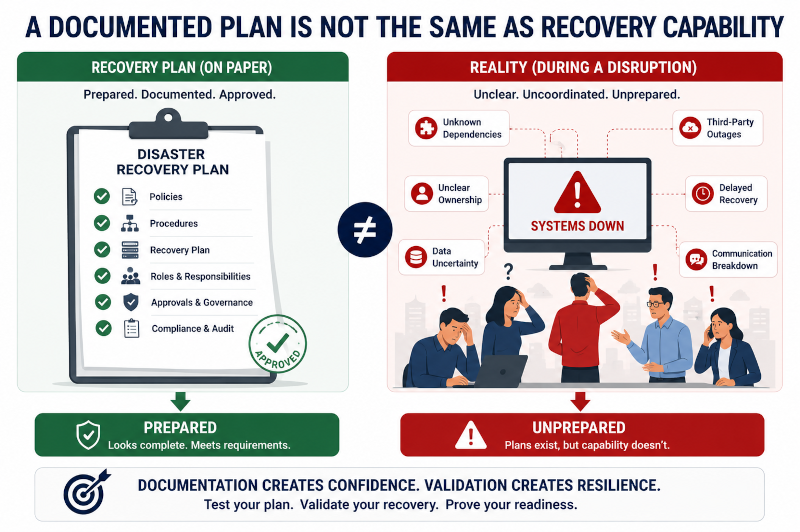
This gap between documentation and execution may be one of the most underestimated operational risks in modern enterprises. Organizations spend substantial effort creating disaster recovery documentation, but far less effort validating whether recovery can actually occur under real-world conditions involving time pressure, incomplete information, system dependencies, and organizational chaos.
The problem is not that organizations fail to plan.
The problem is that many organizations confuse planning with preparedness.
The 2026 Disaster Recovery Preparedness Survey found that while disaster recovery planning remains widespread, testing maturity, operational readiness, and recovery validation continue to lag behind documented recovery objectives. The result is a dangerous form of organizational overconfidence: leadership assumes resilience exists because documentation exists.
As explored previously in Most Organizations Don’t Have Processes — They Have Habits, many enterprises unknowingly substitute documented intent for validated capability. Disaster recovery may be one of the clearest examples of that pattern.
The uncomfortable reality is that a recovery plan is not evidence of resilience.
It is only evidence that someone wrote a plan.
Recommendation: Evaluate disaster recovery readiness based on validated recovery performance rather than the existence of documented procedures alone.
The Biggest Disaster Recovery Risk Is Organizational Overconfidence
Most organizations assume that if backups exist and recovery procedures are documented, systems can be restored successfully during a major disruption.
That assumption often goes unchallenged because serious recovery events occur infrequently. Teams rarely have opportunities to validate recovery under genuine operational pressure, which allows confidence to accumulate without corresponding evidence.
The problem becomes particularly dangerous because modern technology environments have become significantly more complex than the disaster recovery plans originally designed to support them.
Cloud platforms, SaaS applications, third-party APIs, distributed workloads, identity providers, and interconnected vendor ecosystems create recovery dependencies that are difficult to fully understand even during normal operations. During an outage, those dependencies become substantially harder to manage.
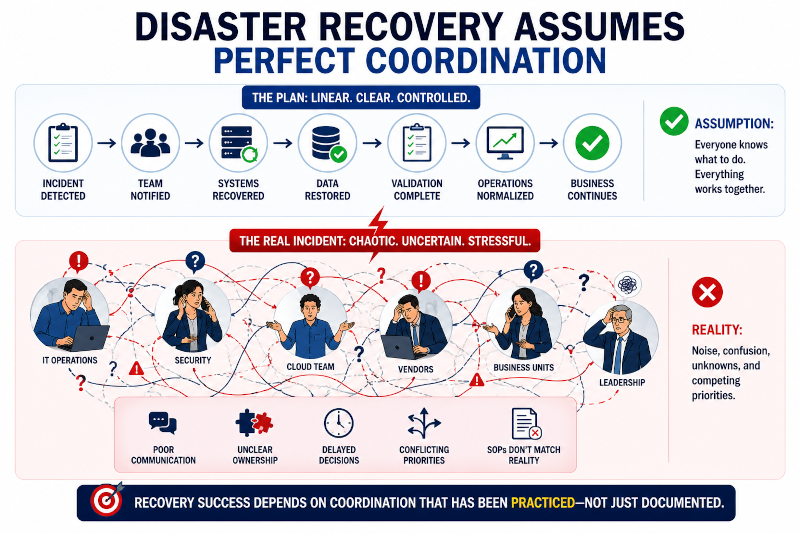
A common misconception is that disaster recovery is primarily a technical challenge. In practice, many recovery failures emerge from coordination problems.
Teams struggle to determine system priorities. Dependencies are discovered late. Recovery sequences become unclear. Escalation paths create confusion. Communication breaks down between infrastructure teams, application owners, security personnel, vendors, and executive leadership.
The recovery plan may be technically correct while remaining operationally impossible to execute efficiently.
This creates a contrarian but important insight: The biggest disaster recovery risk is often not technology failure itself. It is organizational overconfidence about the organization’s ability to coordinate recovery under stress.
Many disaster recovery plans quietly assume a level of operational coordination that has never actually been tested.
Recommendation: Include cross-functional coordination exercises in disaster recovery testing rather than focusing exclusively on technical restoration activities.
The CrowdStrike Outage Exposed a Hard Truth About Recovery
Few events illustrated the gap between documented recovery plans and operational recovery capability more clearly than the 2024 CrowdStrike outage.
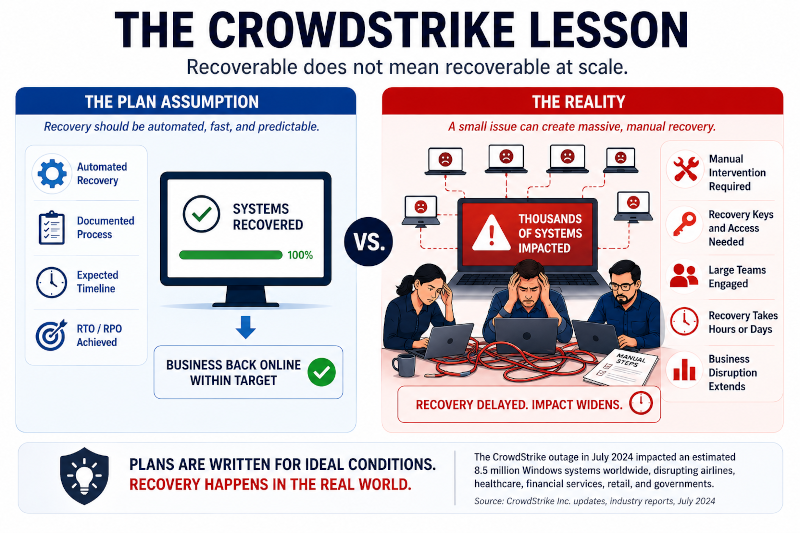
A faulty software update caused approximately 8.5 million Windows systems worldwide to crash, disrupting airlines, healthcare organizations, financial institutions, retailers, and government agencies across multiple countries.
What made the incident particularly instructive was that many affected organizations had disaster recovery plans. Many had backups. Many had business continuity procedures.
Yet recovery remained difficult because restoring operations required substantial manual intervention across large numbers of individual systems. In many environments, technical teams needed to physically access devices, apply fixes manually, retrieve recovery keys, and coordinate restoration efforts across geographically distributed workforces. Recovery often took days rather than hours.
The outage demonstrated something many organizations rarely consider: Recoverability is not the same thing as recoverability at scale.
A system may be technically recoverable while still creating significant operational disruption because the recovery process itself cannot be executed efficiently.
The event also highlighted another critical issue. Many organizations discovered that their documented recovery timelines were based on ideal conditions rather than realistic operating environments. Once manual intervention became necessary, recovery assumptions deteriorated rapidly.
Researchers examining the healthcare response to the outage later described the event as a test of organizational agility and coordination as much as a technical recovery challenge.
The lesson extends well beyond CrowdStrike. Recovery capability cannot be measured solely by whether systems can theoretically be restored. It must also be measured by how effectively organizations can execute restoration under real-world conditions.
Recommendation: Test recovery procedures at operational scale to validate whether restoration remains achievable when thousands of systems, users, and dependencies are involved simultaneously.
Backups Create Confidence. Testing Creates Resilience.
One of the most persistent misconceptions in disaster recovery is the belief that backups equal preparedness. Backups are essential, but they are not sufficient.
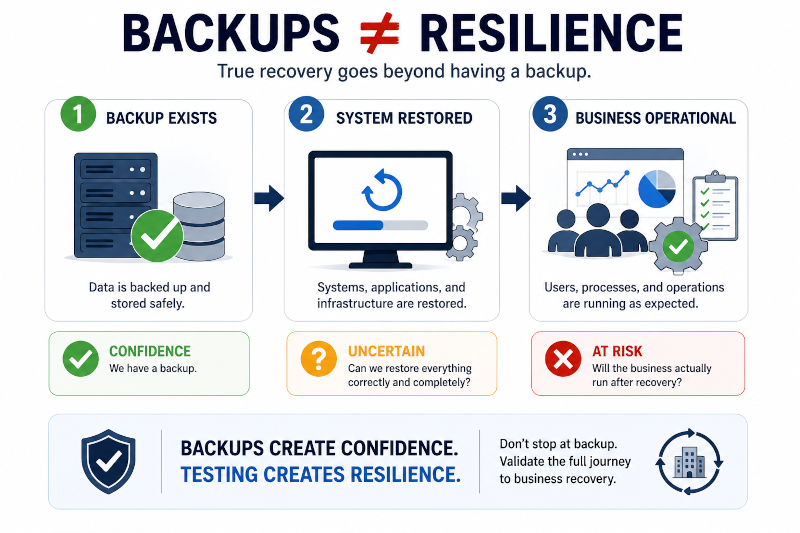
Organizations frequently invest heavily in backup infrastructure while spending comparatively little effort validating whether those backups can support complete operational recovery. This creates a dangerous disconnect between data protection and business resilience.
A backup may successfully preserve data while still failing to restore:
- application functionality,
- system configurations,
- identity services,
- integration dependencies,
- or operational workflows.
This distinction becomes particularly important during ransomware incidents, where organizations often discover that restoring data represents only one portion of a much larger recovery challenge.
Research examining operational resilience consistently highlights recoverability as a core component of resilience maturity rather than simply data preservation alone.
A useful analogy is aviation.
Nobody would certify an aircraft as safe simply because maintenance procedures exist on paper.
Those procedures must be validated repeatedly through inspection, testing, and operational performance. Disaster recovery should be viewed similarly. The existence of backups should not be mistaken for proof of recovery capability. The only meaningful validation occurs when organizations repeatedly demonstrate successful restoration under realistic conditions.
This is why some of the most resilient organizations now treat recovery testing as a continuous operational capability rather than an annual compliance exercise.
The shift may appear subtle. In practice, it changes everything.
Recommendation: Require end-to-end restoration testing that validates applications, identities, integrations, and business workflows—not just backup integrity.
Compliance Creates Documentation. Resilience Creates Capability.
One of the underlying reasons disaster recovery remains problematic is that many recovery programs are built primarily to satisfy compliance requirements rather than improve operational readiness. Auditors require documentation, regulators expect evidence, and governance frameworks mandate policies, procedures, and recovery plans—all of which serve legitimate purposes. The problem arises when organizations begin optimizing for the creation and maintenance of documentation rather than their actual ability to restore systems and operations during a disruption, creating a false sense of preparedness that may not withstand real-world recovery conditions.
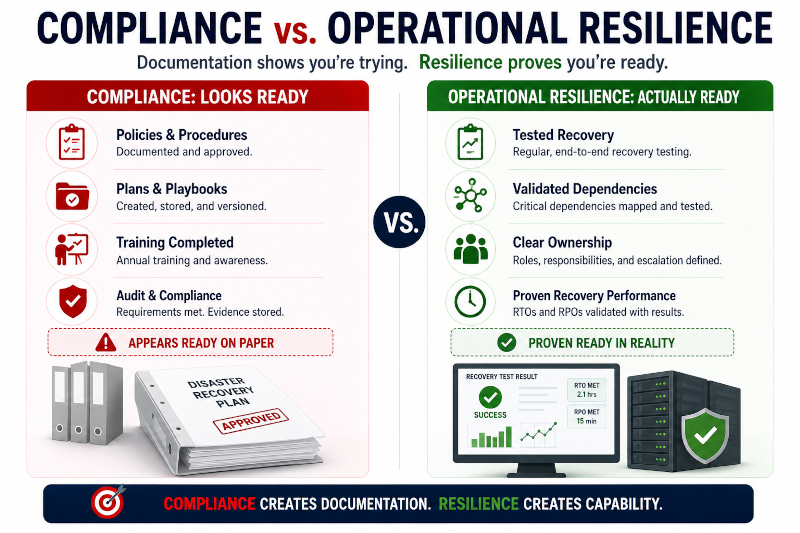
This creates plans that:
- satisfy audit requirements,
- pass governance reviews,
- and appear comprehensive on paper,
while still failing to support effective recovery during actual incidents. Compliance ensures that recovery procedures exist. It does not prove those procedures work.
This distinction mirrors challenges appearing across many enterprise disciplines. As discussed in Your Biggest Cybersecurity Risk May Not Be Inside Your Network, organizations frequently mistake governance visibility for operational control. Disaster recovery suffers from a similar problem when documented readiness is assumed to represent actual resilience.
The strongest organizations increasingly treat recovery metrics as operational performance indicators rather than governance artifacts.
Instead of asking:
“Do we have a disaster recovery plan?”
They ask:
“Can we actually restore critical operations within the recovery objectives we have defined?”
Those are fundamentally different questions.
Only one measures resilience.
Recommendation: Track disaster recovery performance using validated recovery outcomes and testing results rather than documentation completion rates.
The Future of Disaster Recovery Is Operational Resilience
Disaster recovery is becoming more difficult because organizations are becoming more dependent on interconnected systems.
Cloud providers, SaaS platforms, identity services, AI environments, third-party integrations, automation workflows, and vendor ecosystems now form the foundation of daily operations. Every dependency creates additional recovery complexity.
The future challenge may not be recovering individual systems.
It may be recovering interconnected operational environments.
This is why resilience is becoming a broader leadership issue rather than solely an IT responsibility.
When major disruptions occur, the consequences extend beyond technology teams. Revenue generation, customer service, supply chains, regulatory obligations, workforce productivity, and executive decision-making all depend on the organization’s ability to restore operations effectively.
The financial implications continue to grow. IBM’s 2024 Cost of a Data Breach Report found that the global average breach cost reached $4.88 million, reflecting the rising operational consequences associated with disruption, recovery, and business interruption.
The strongest organizations are adapting by treating disaster recovery as part of a broader operational resilience strategy. Recovery testing, dependency mapping, incident coordination, backup validation, and organizational readiness become interconnected capabilities rather than isolated technical activities.
This reflects a larger strategic shift.
The organizations that recover fastest are often not the organizations with the most documentation.
They are the organizations that have repeatedly practiced recovery until execution becomes operationally reliable.
A disaster recovery plan does not restore systems.
Backups do not restore systems.
Documentation does not restore systems.
People, processes, coordination, testing, and execution restore systems.
The future of disaster recovery may depend less on writing better plans and more on proving that recovery can actually happen when the organization needs it most.
Recommendation: Build disaster recovery programs around continuous recovery validation, dependency visibility, and operational resilience rather than document maintenance alone.