
- Recommendations
- Why Stakeholder Alignment in Meetings Often Fails in Real Execution
- Why Change Looks Successful Before It Starts
- Why Stakeholder Alignment Often Creates False Confidence
- Why Ownership Often Disappears at the Last Mile
- Environment Often Matters More Than Alignment
- What Real Change Requires After Alignment
- Healthcare Implementations Reveal the Last-Mile Challenge
- Warning Signs Your Meeting Success Is Hiding Execution Failure
- The Hidden Cost of Confusing Agreement With Change
- Final Takeaway
Recommendations
- Treat stakeholder alignment as a prerequisite for change rather than evidence that change is already underway.
- Define success metrics in terms of behavior and outcomes rather than planning milestones and project activities.
- Treat go-live as the beginning of adoption measurement, not the end of project execution.
- Assign explicit adoption ownership at the team level and define clear accountability for behavioral outcomes.
- Design change initiatives so the desired behavior becomes the easiest and most practical option available to employees.
- Validate implementation plans with frontline teams throughout execution rather than relying solely on leadership alignment.
- Monitor frontline behavior and operational outcomes continuously rather than relying exclusively on project health metrics.
- Measure adoption sustainability and employee confidence after major initiatives to identify change fatigue before it becomes embedded in the culture.
Why Stakeholder Alignment in Meetings Often Fails in Real Execution
The meeting went perfectly.
Leaders aligned. Stakeholders nodded. Concerns were addressed. The presentation was approved. Action items were assigned. Everyone left the room confident that the transformation initiative was moving forward.
Then nothing happened.
No meaningful adoption. No sustained behavior change. No measurable shift in how work was actually performed. Teams quietly returned to familiar workflows while project dashboards continued reporting positive status updates.
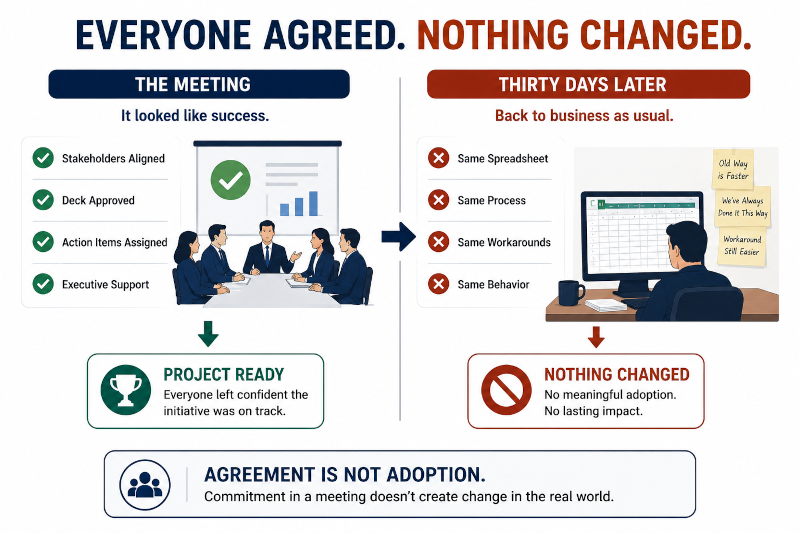
This is one of the most common and costly failures in transformation efforts: organizations mistake stakeholder alignment for execution readiness.
Agreement in a conference room is not the same as operational change in the real world. Many organizations discover too late that consensus during planning can coexist with minimal adoption after launch. Alignment may create direction, but it does not guarantee execution.
Recommendation: Treat stakeholder alignment as a prerequisite for change rather than evidence that change is already underway.
Why Change Looks Successful Before It Starts
Most organizations are structured to reward visible planning activities.
Executive sponsors are identified. Steering committees are established. Stakeholders are consulted. Communications plans are approved. Project timelines are finalized. Risks are documented and governance structures are put in place.
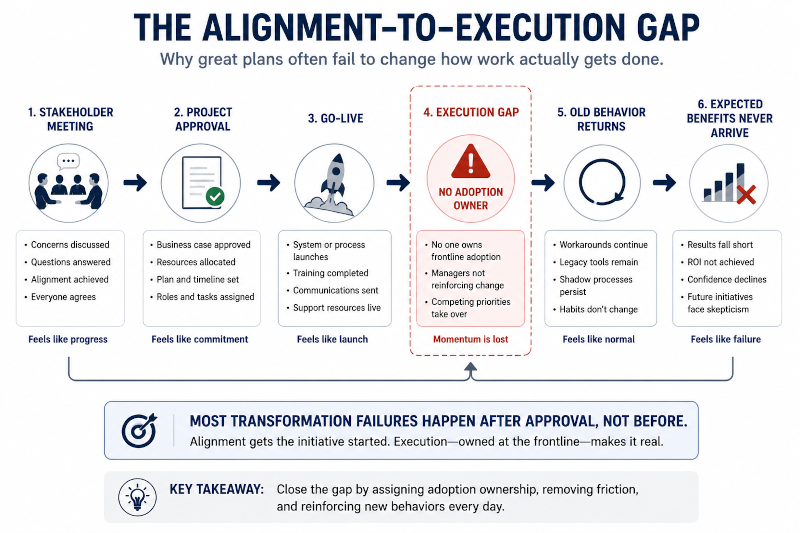
All of these activities matter. They help create clarity, coordination, and organizational support.
The problem is that they are still inputs, not outcomes.
Real transformation is measured by what people do differently after the meeting ends. Are employees using the new process? Are managers reinforcing the change? Are old workarounds disappearing? Are performance metrics improving? Is behavior changing when operational pressure increases?
Research from McKinsey has consistently emphasized that successful transformations depend on capability building, ownership, mindset shifts, and reinforcement mechanisms embedded into daily work rather than planning activities alone.
Organizations often manage agreement better than adoption.
That distinction matters because visible planning can create a false sense of progress long before any meaningful behavioral change occurs.
Recommendation: Define success metrics in terms of behavior and outcomes rather than planning milestones and project activities.
Why Stakeholder Alignment Often Creates False Confidence
Meetings create momentum. Decisions get made. Slides get polished. Approvals are granted. Progress appears visible and measurable.
But meetings can also create the illusion that difficult implementation challenges have already been solved.
In many organizations, meetings are optimized to reduce disagreement rather than surface execution risk.
Public Agreement Isn’t Private Commitment
People agree in meetings for many reasons.
They may support the idea but not the workload it creates. They may assume concerns can be addressed later. They may lack sufficient context to challenge assumptions. Some may simply choose not to slow momentum.
A verbal “yes” often means:
“I can live with this.”
It does not necessarily mean:
“I am committed to making this successful.”
That distinction becomes visible only after implementation begins.
Strategy Gets Lost in Daily Work
Even well-supported initiatives must compete with operational reality.
Employees return to overflowing inboxes, customer requests, staffing shortages, production deadlines, and competing priorities. Under those conditions, last week’s strategic discussion often loses to today’s operational pressure.
Behavior tends to follow immediate demands rather than approved meeting notes.
Research across organizational change disciplines consistently identifies competing priorities and limited execution capacity as major barriers to sustained adoption.
A Lesson from ERP Transformations
Large ERP implementations provide a useful example of the gap between alignment and execution. Months of planning, governance reviews, steering committee meetings, and stakeholder workshops often precede deployment. Business leaders approve budgets, process owners sign off on requirements, and project teams report strong readiness metrics.
Yet after go-live, many organizations discover that spreadsheets, manual approvals, and unofficial workarounds continue operating beneath the new system. Research examining ERP implementation outcomes continues to identify user adoption, organizational alignment, and process integration as major determinants of long-term success, often outweighing technical deployment itself.
The lesson is straightforward: stakeholder agreement can help launch transformation, but it cannot guarantee that employees will change how they work once the system enters real-world operations.
Recommendation: Treat go-live as the beginning of adoption measurement, not the end of project execution.
Why Ownership Often Disappears at the Last Mile
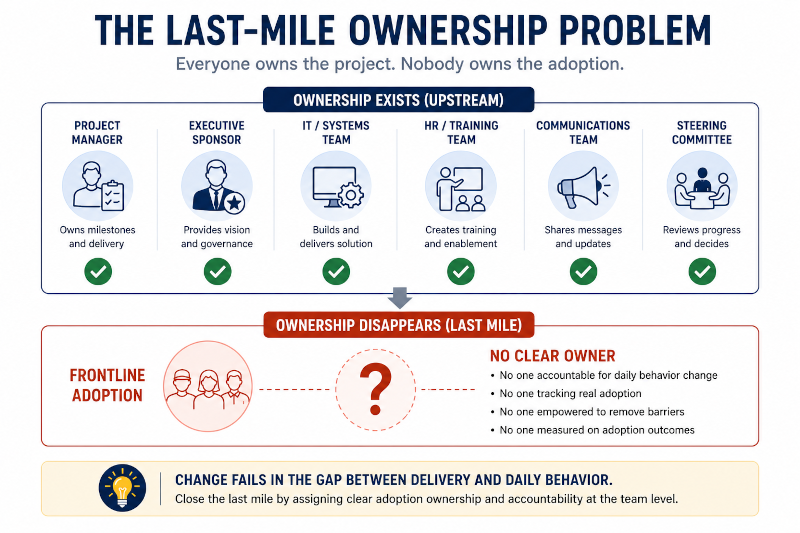
Many transformation initiatives assign ownership for planning but fail to assign ownership for adoption.
Organizations typically have:
- A project manager responsible for milestones.
- A sponsor responsible for governance.
- IT responsible for system delivery.
- HR responsible for training.
- Communications responsible for messaging.
But who owns whether the warehouse supervisor, sales manager, analyst, or service desk employee actually changes behavior next month?
That question often has no clear answer.
Without team-level accountability, enterprise initiatives remain abstract. The closer organizations get to frontline execution, the less clear ownership often becomes.
The most important stakeholder in many transformations may be the frontline employee who never attended the planning meeting but ultimately determines whether the initiative succeeds or fails.
Recommendation: Assign explicit adoption ownership at the team level and define clear accountability for behavioral outcomes.
Environment Often Matters More Than Alignment
One of the clearest examples of this principle emerged during the rapid adoption of collaboration platforms during the COVID-19 pandemic.
Organizations around the world aligned on remote work strategies and trained employees on platforms such as Microsoft Teams and Zoom. Yet training and stakeholder alignment were not the primary drivers of adoption.
The environment changed.
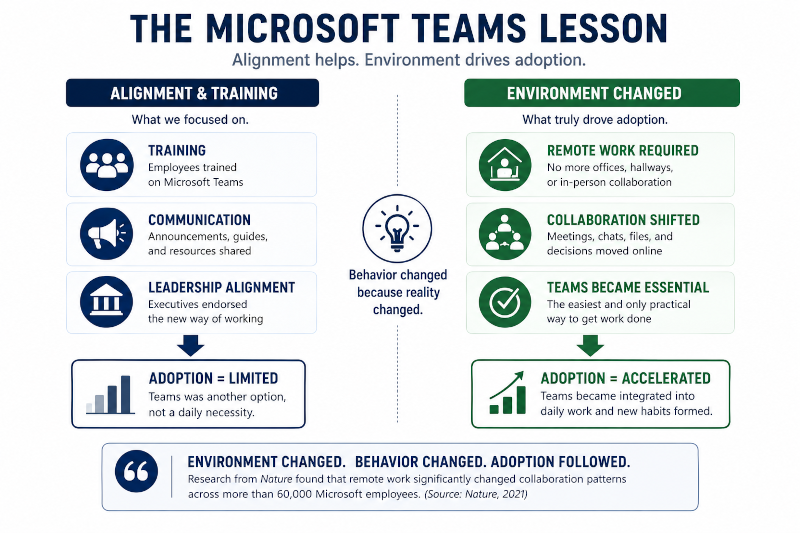
Employees could no longer walk into conference rooms, stop by a colleague’s desk, or rely on face-to-face interactions. Research published in Nature examining more than 60,000 Microsoft employees found that remote work significantly altered communication patterns, collaboration networks, and workflow behavior.
The important lesson is that behavior changed because operational reality changed.
Alignment created direction.
The environment created adoption.
Organizations often assume that agreement produces behavior change. In reality, behavior change occurs when systems, workflows, incentives, and daily work conditions support the new behavior more effectively than the old one.
Recommendation: Design change initiatives so the desired behavior becomes the easiest and most practical option available to employees.
What Real Change Requires After Alignment
Stakeholder agreement is valuable.
It simply should not be confused with execution.
Real change requires several additional conditions.
Clear Operational Ownership
Every impacted team needs a named leader responsible for adoption, not just attendance. That individual should understand what changes, who changes, how success is measured, and what support is available.
Manager Reinforcement
Employees often take behavioral cues from direct managers more than executive communications. When managers reinforce expectations, coach employees, remove obstacles, and model new behaviors, adoption improves significantly.
Friction Removal
Organizations should ask a simple question:
What makes the old way easier?
Then remove it.
That may involve retiring legacy templates, disabling duplicate systems, simplifying approvals, or integrating new tools into existing workflows.
People rarely resist easier work.
They resist harder work labeled as improvement.
Behavior-Based Metrics
Stop measuring only project activities.
Meeting completion, communications sent, and training attendance reveal little about whether transformation is actually occurring.
Instead, measure:
- System usage
- Process adherence
- Cycle-time improvements
- Error reduction
- Quality improvements
- Reduction in shadow processes
These metrics reveal whether change is real.
Follow-Through Beyond Launch
Many organizations focus intensely on pre-launch preparation and provide minimal support afterward.
That approach is backward.
The highest-risk period begins after launch, when employees decide whether the new way is sustainable.
Recommendation: Build structured reinforcement plans for the first 30, 60, and 90 days after implementation.
Healthcare Implementations Reveal the Last-Mile Challenge
Healthcare organizations have faced similar challenges for years during Electronic Health Record (EHR) implementations.
Executive leaders, clinical stakeholders, compliance teams, and technology groups often spend months aligning on implementation plans before deployment. Governance structures are established, workflows are documented, and stakeholders approve the initiative.
Yet many deployments continue to face adoption challenges because clinical workflows, patient demands, documentation requirements, and operational realities create friction at the point of care. Research published through the Journal of the American Medical Informatics Association has repeatedly highlighted workflow integration, usability, and local operational conditions as critical factors influencing successful EHR adoption and utilization.
These examples reinforce a broader truth.
Alignment among decision-makers does not automatically translate into execution among the people doing the work.
Recommendation: Validate implementation plans with frontline teams throughout execution rather than relying solely on leadership alignment.
Warning Signs Your Meeting Success Is Hiding Execution Failure
Organizations often receive early signals that execution is struggling long before project dashboards indicate a problem.
Steering committee updates remain positive. Training completion rates look healthy. Project milestones continue to be marked as complete.
Meanwhile, frontline reality tells a different story.
Legacy spreadsheets continue circulating. Employees describe themselves as too busy to adopt new processes. Managers stop discussing the initiative. Exceptions become routine. Shadow processes remain active. Benefits fail to materialize despite successful project reporting.
These are not isolated issues.
They are often indicators that alignment never converted into adoption.
Recommendation: Monitor frontline behavior and operational outcomes continuously rather than relying exclusively on project health metrics.
The Hidden Cost of Confusing Agreement With Change
When organizations repeatedly celebrate decisions instead of outcomes, the consequences extend beyond individual projects.
Transformation budgets are wasted. Technology investments remain underutilized. Operational inefficiencies persist. Future initiatives become more difficult to implement.
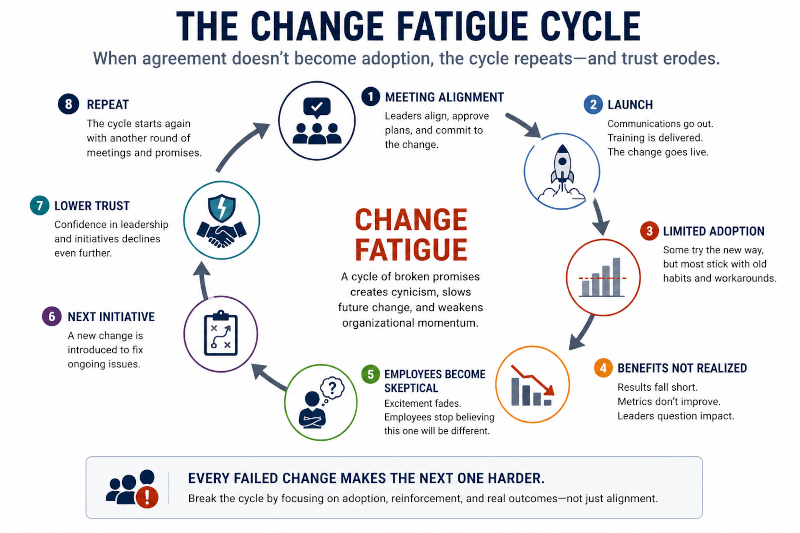
But the most significant cost may be organizational skepticism.
Employees eventually learn patterns. If enough initiatives fail to produce meaningful change, people begin viewing new programs as temporary management priorities rather than lasting improvements. Participation becomes compliance rather than commitment.
Over time, trust erodes.
Future transformations start from a position of skepticism rather than enthusiasm, making adoption slower, more expensive, and harder to sustain.
Eventually, employees learn that “new initiative” means more meetings rather than better work.
Recommendation: Measure adoption sustainability and employee confidence after major initiatives to identify change fatigue before it becomes embedded in the culture.
Final Takeaway
Stakeholder alignment is important. Few successful transformations occur without it. But agreement inside a meeting room does not transform an organization.
Real change occurs when employees consistently behave differently, managers reinforce those behaviors, systems support the new way of working, and operational realities align with the intended outcome.
The next time a meeting ends with unanimous agreement, ask one additional question:
What will actually be different on Monday morning?
Because alignment is an input.
Execution is the outcome.
And organizations do not transform when everyone agrees—they transform when people work differently every day.
1 thought on “Everyone Agreed to the Change—Then Nothing Actually Changed”