
- Organizational Memory Is More Than Documentation
- Tacit Knowledge Quietly Creates Scalability Problems
- AI Quality Depends on Knowledge Quality
- Documentation Debt Quietly Weakens Organizations
- Searchability Is Becoming a Strategic Capability
- AI Hallucinations Often Reflect Organizational Hallucinations
- Building a Scalable Knowledge Ecosystem
- The Future of Organizational Memory
Most organizations are currently focused on adopting AI tools.
Far fewer are evaluating whether their organizational knowledge systems are capable of supporting AI effectively.
That distinction matters more than many leaders initially realized.
AI systems are not independent sources of organizational intelligence. They depend heavily on the quality, accessibility, structure, and consistency of the information surrounding them.
When organizations operate with fragmented documentation, disconnected workflows, siloed knowledge, and inconsistent terminology, AI systems often inherit those same operational weaknesses.
This is one reason many enterprise AI initiatives struggle to scale beyond early experimentation.
The problem is frequently not the model itself.
It is the organizational memory environment supporting it.
As AI becomes increasingly embedded into workflows, operational coordination, decision support, search systems, automation, and enterprise communication, organizational knowledge is gradually transforming from passive documentation into active operational infrastructure.
Organizations that treat knowledge management as a secondary administrative function may struggle to operationalize AI effectively at scale.
Organizations that build strong institutional memory systems are increasingly creating the foundation for scalable organizational intelligence.
Recent knowledge management research similarly argues that generative AI is fundamentally reshaping how organizations create, store, retrieve, transfer, and apply knowledge across the enterprise.
Organizational Memory Is More Than Documentation
Many organizations still think about knowledge management primarily as document storage.
In practice, organizational memory is much broader.
It includes operational workflows, institutional decisions, process history, communication patterns, onboarding knowledge, customer context, technical expertise, governance standards, and the informal operational understanding employees accumulate over time.
Much of this knowledge exists outside formal systems.
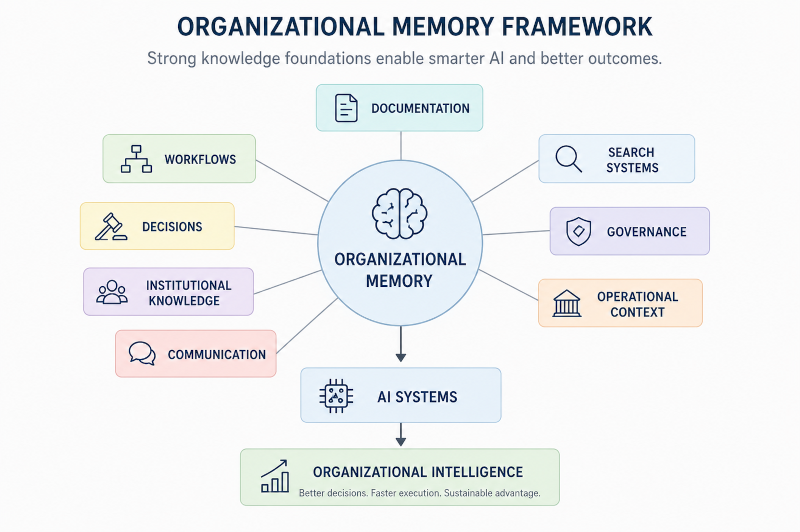
Employees often compensate for weak organizational memory through personal experience, informal conversations, tribal knowledge, and manual coordination.
This becomes increasingly risky as organizations scale.
A practical starting point for organizations is mapping where operational knowledge actually lives today.
Many companies discover that critical institutional knowledge is scattered across:
- email threads,
- Slack conversations,
- PDFs,
- spreadsheets,
- disconnected SaaS platforms,
- meeting recordings,
- and undocumented employee expertise.
That fragmentation creates operational drag even before AI enters the environment.
Once organizations begin deploying AI systems, fragmented knowledge structures often become significantly more visible.
AI systems depend on retrieval quality, consistency, and contextual accuracy. When institutional knowledge remains disconnected, AI outputs frequently become inconsistent as well.
This is one reason organizations increasingly compete not simply on technology access, but on their ability to coordinate and operationalize knowledge effectively.
Tacit Knowledge Quietly Creates Scalability Problems
One of the largest organizational blind spots involves tacit knowledge.
Tacit knowledge refers to operational understanding that employees possess but rarely document formally.
This often includes troubleshooting intuition, workflow shortcuts, customer nuances, decision rationale, and undocumented operational dependencies that teams rely on every day without realizing how fragile those systems actually are.
In many organizations, highly experienced employees carry enormous amounts of operational intelligence that never becomes structurally accessible to the rest of the company.
This creates hidden scalability problems.
A useful exercise for leadership teams is identifying which operational processes depend heavily on specific individuals rather than institutional systems.
Those dependencies often reveal where organizational memory is weakest.
This issue becomes increasingly important in AI environments because AI systems cannot reliably retrieve knowledge that was never operationalized in the first place.
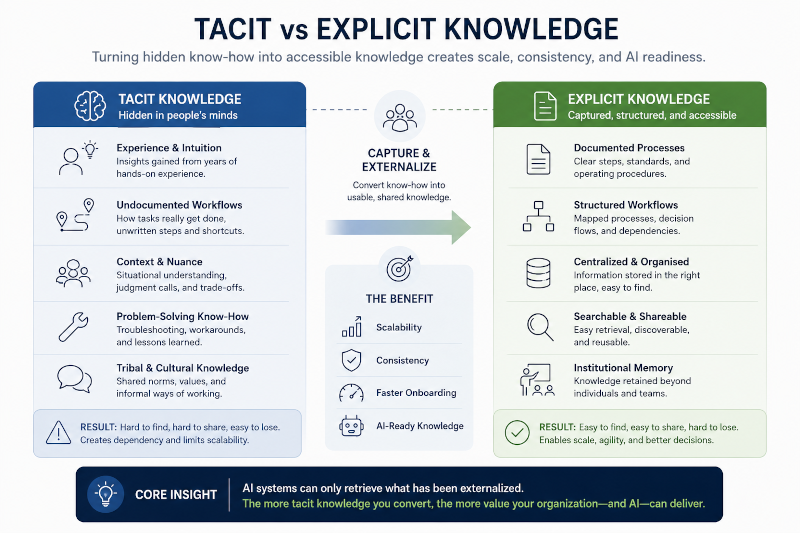
Knowledge management research has emphasized that generative AI changes how organizations balance tacit human knowledge with explicit institutional knowledge, particularly around retrieval, transfer, and organizational learning processes.
High-performing organizations increasingly focus on converting critical tacit knowledge into accessible operational systems before scaling AI initiatives broadly.
In practice, this often means:
- documenting recurring operational decisions,
- reducing dependency on individual employees,
- capturing troubleshooting patterns,
- and standardizing high-friction workflows.
The goal is not documenting everything endlessly.
It is reducing operational vulnerability created by inaccessible institutional knowledge.
AI Quality Depends on Knowledge Quality
One of the biggest misconceptions surrounding enterprise AI is the belief that advanced models can compensate for poor organizational knowledge systems.
In reality, AI often amplifies existing information problems.
Organizations with inconsistent documentation, fragmented terminology, outdated records, disconnected repositories, and weak governance frequently struggle to generate reliable AI outputs.
This is especially visible in enterprise retrieval systems and Retrieval-Augmented Generation (RAG) environments where AI models depend directly on organizational data sources.
If the underlying information environment lacks consistency, the AI system inherits those weaknesses.
Research examining data quality challenges inside enterprise RAG systems found that knowledge quality issues frequently propagate through retrieval pipelines and continue affecting downstream AI outputs across multiple operational stages.
A practical mistake many organizations make is focusing heavily on model selection while underinvesting in information architecture, metadata quality, document standardization, retrieval structure, and governance processes.
Organizations preparing for enterprise AI deployment should evaluate:
- how current documentation is organized,
- whether information ownership is clearly defined,
- how quickly employees can retrieve reliable information,
- and how often operational knowledge becomes outdated.
In practice, enterprise AI quality often depends less on model sophistication and more on whether organizational knowledge systems are operationally usable.
This is one reason many organizations now realize they do not necessarily have an AI problem.
They have a data coordination and organizational memory problem.
Documentation Debt Quietly Weakens Organizations
Many organizations accumulate what could be described as documentation debt.
Over time, workflows evolve, systems change, teams reorganize, and institutional knowledge shifts while documentation environments remain outdated, incomplete, or fragmented.
Employees gradually compensate for these gaps manually.
This compensation often appears through repeated meetings, onboarding delays, duplicated work, dependency on senior employees, inconsistent execution, and operational confusion.
Organizations frequently normalize these inefficiencies because they develop gradually.
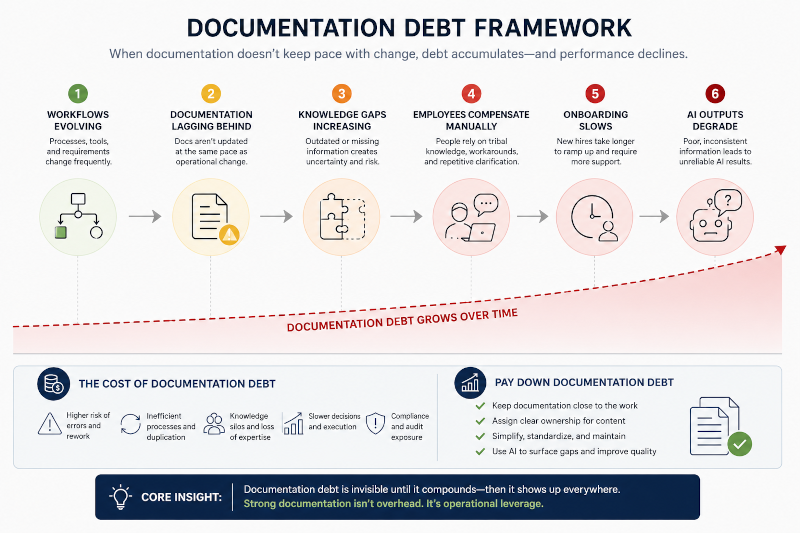
AI systems expose them much faster.
A useful starting point is identifying operational areas where employees repeatedly search for information, recreate work manually, or rely heavily on specific individuals for clarification.
Those patterns often reveal where documentation debt is accumulating operationally.
Organizations preparing for large-scale AI integration should prioritize workflow clarity, documentation consistency, knowledge ownership, and retrieval accessibility before expanding automation aggressively.
This connects closely with the same operational friction problems explored previously on SpirZon in discussions around workflow coordination and fragmented operational systems.
Importantly, documentation quality is no longer simply an administrative concern.
It increasingly functions as operational infrastructure for intelligent systems.
Searchability Is Becoming a Strategic Capability
Many organizations already possess valuable institutional knowledge.
The larger problem is retrieval.
Knowledge that cannot be located operationally has limited organizational value.
This issue becomes increasingly important as organizations deploy AI copilots, enterprise search systems, and internal knowledge assistants.
If employees cannot retrieve reliable information efficiently, AI systems struggle as well.
A practical step organizations can take is evaluating how easily employees can locate operational procedures, customer history, governance policies, troubleshooting guidance, and institutional decisions across systems.
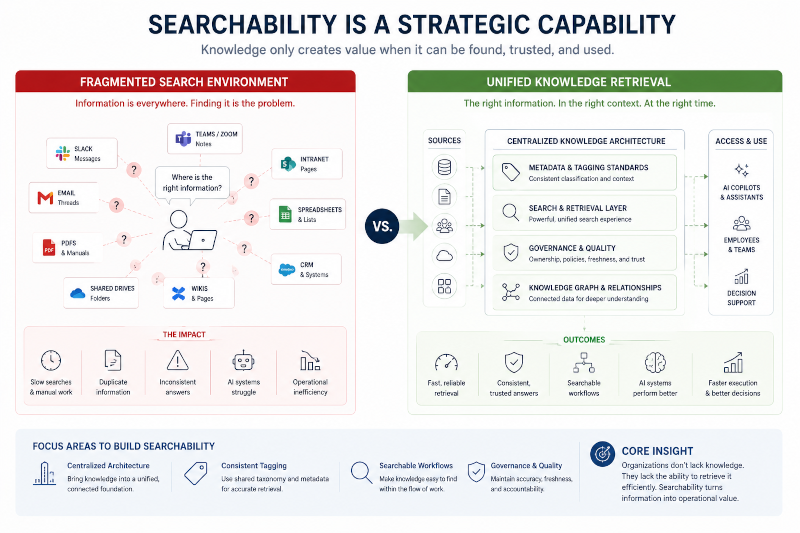
Many organizations discover that search environments are fragmented across departments, repositories, and communication tools.
This creates operational inefficiency long before AI enters the workflow.
The operational risks associated with fragmented retrieval systems are becoming increasingly visible across large enterprises. Internal reporting surrounding Amazon highlighted growing concerns around “AI sprawl,” where teams independently developed overlapping AI tools and disconnected data environments across the organization. The situation reflected a broader enterprise challenge: organizations often scale AI experimentation faster than they scale governance, retrieval architecture, and knowledge coordination systems. Over time, this can increase operational fragmentation rather than reduce it.
Enterprise knowledge management research increasingly emphasizes the importance of searchable knowledge architecture, knowledge graphs, metadata structures, and retrieval systems for modern AI-enabled organizations.
Organizations that scale AI effectively often simplify retrieval systems first.
Rather than continuously adding new repositories, they typically focus on:
- centralized knowledge architecture,
- consistent tagging standards,
- searchable workflows,
- and governance structures that improve retrieval reliability across teams.
AI Hallucinations Often Reflect Organizational Hallucinations
AI hallucinations are often discussed as purely technical failures.
In enterprise environments, many hallucinations actually originate from fragmented organizational memory systems.
When AI systems retrieve inconsistent documentation, outdated policies, conflicting records, incomplete workflows, or poorly governed information, the resulting outputs naturally become unreliable.
This creates a dangerous misconception where organizations blame the AI while ignoring the underlying knowledge environment feeding it.
The operational risks associated with weak knowledge governance became increasingly visible in 2026 when EY withdrew a cybersecurity report after researchers identified multiple AI-generated hallucinations, including fabricated citations and inaccurate references. The incident demonstrated how unreliable retrieval environments and weak verification oversight can rapidly amplify misinformation inside enterprise systems when governance structures fail to keep pace with AI adoption.
A more effective approach is treating hallucinations as signals that operational knowledge systems may require restructuring rather than assuming the problem exists entirely inside the model itself.
Organizations deploying AI internally should regularly audit:
- source reliability,
- document freshness,
- ownership structures,
- retrieval pathways,
- and governance quality.
Many organizations underestimate how much unstructured information exists outside formal enterprise systems.
Industry estimates increasingly suggest that a large majority of enterprise information lives inside emails, PDFs, contracts, messaging systems, and other disconnected repositories that remain difficult for AI systems to interpret consistently.
This is one reason AI readiness increasingly depends on organizational learning capability rather than technology procurement alone.
Building a Scalable Knowledge Ecosystem
Organizations that operationalize AI effectively usually approach knowledge systems differently.
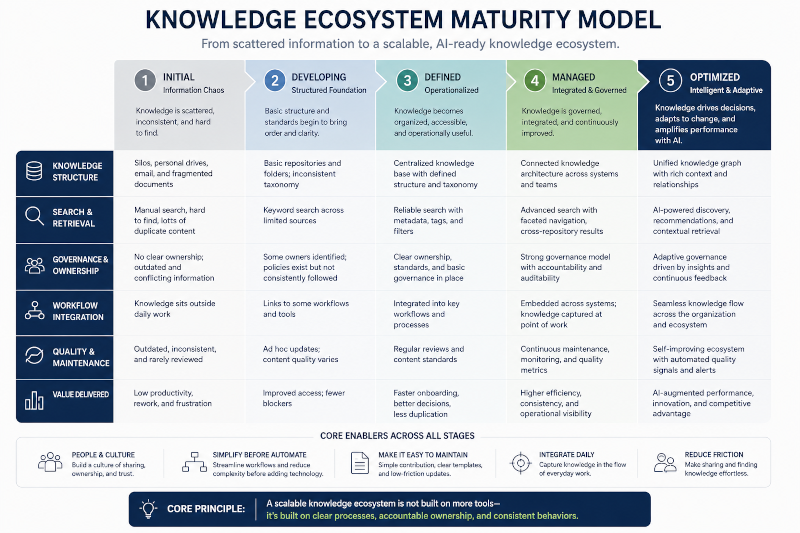
Rather than treating documentation as passive storage, they treat organizational memory as an active operational capability that directly influences coordination, retrieval quality, decision-making, and scalability across the enterprise.
A practical approach often includes:
- standardizing terminology,
- clarifying knowledge ownership,
- centralizing critical workflows,
- improving search architecture,
- reducing duplicate repositories,
- and establishing governance around information quality.
High-performing organizations also recognize that knowledge systems require continuous maintenance.
Operational environments evolve constantly.
Without governance, even well-designed knowledge systems gradually fragment over time.
This is one reason organizations increasingly establish dedicated knowledge operations functions focused on retrieval quality, workflow integration, documentation governance, and institutional visibility.
Importantly, successful knowledge systems are not built entirely around technology.
They are built around operational behavior.
This became increasingly visible in a case study published by Chartered Institute of Personnel and Development examining enterprise AI adoption challenges. The organization found that employees often struggled to integrate AI tools into everyday work when operational processes, training structures, and knowledge-sharing systems lacked clarity. The case reinforced a growing realization across many enterprises: AI adoption frequently breaks down operationally when organizations fail to redesign how knowledge moves through everyday workflows.
Organizations that scale knowledge effectively usually simplify workflows before automating them, make documentation easier to maintain, integrate knowledge capture into everyday operations, and reduce friction around information sharing between teams.
That principle increasingly applies to AI adoption broadly as well.
The Future of Organizational Memory
As AI systems become more integrated into enterprise operations, organizational memory will likely become one of the most strategically important operational assets inside modern institutions.
Future enterprise environments will increasingly depend on AI-assisted retrieval, contextual enterprise search, operational copilots, knowledge graphs, and continuously evolving organizational intelligence systems.
But AI alone will not solve fragmented operational memory automatically.
Organizations with weak knowledge coordination structures may simply scale confusion faster.
“Organizations with weak knowledge coordination structures may simply scale confusion faster.”
Organizations with strong institutional memory systems, however, may gain significant advantages in onboarding, execution speed, operational visibility, decision consistency, and organizational adaptability.
The companies that benefit most from AI will likely not be the ones adopting the largest number of tools.
More often, they will be the organizations that build the clearest operational understanding of how knowledge moves across the enterprise itself.
In the AI era, organizational memory is no longer passive institutional history.
It is increasingly becoming operational infrastructure for scalable intelligence.
4 thoughts on “Why Organizational Memory Matters More Than Ever in the AI Era”