Recommendations
- Treat insider risk as an operational behavior challenge rather than only a malicious employee problem.
- Reduce workflow friction that encourages employees to bypass approved systems and security procedures.
- Implement role-based access controls and formal offboarding procedures even in highly trusted small-team environments.
- Establish clear AI usage policies governing how employees handle organizational, customer, and financial information inside public AI systems.
- Simplify repetitive operational processes and reduce unnecessary workflow complexity that pushes overloaded employees toward insecure shortcuts.
- Design operational systems where secure behavior aligns naturally with efficient execution rather than competing against it.
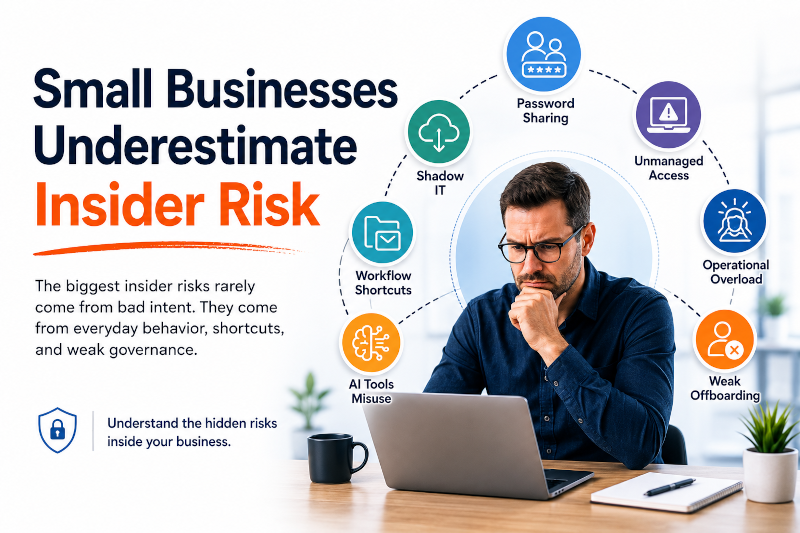
Small businesses often imagine insider threats as dramatic security events involving malicious employees stealing customer databases, sabotaging systems, or intentionally leaking sensitive information. While those incidents do happen, they are far less common than the quieter operational behaviors that create insider risk every day inside normal business workflows.
In reality, many insider incidents emerge unintentionally through convenience-driven behavior, fragmented processes, excessive trust, weak access governance, or operational pressure. Employees share passwords to save time, upload sensitive files into public AI tools, reuse personal devices for work, or bypass security procedures simply because the approved workflow feels too slow or complicated.
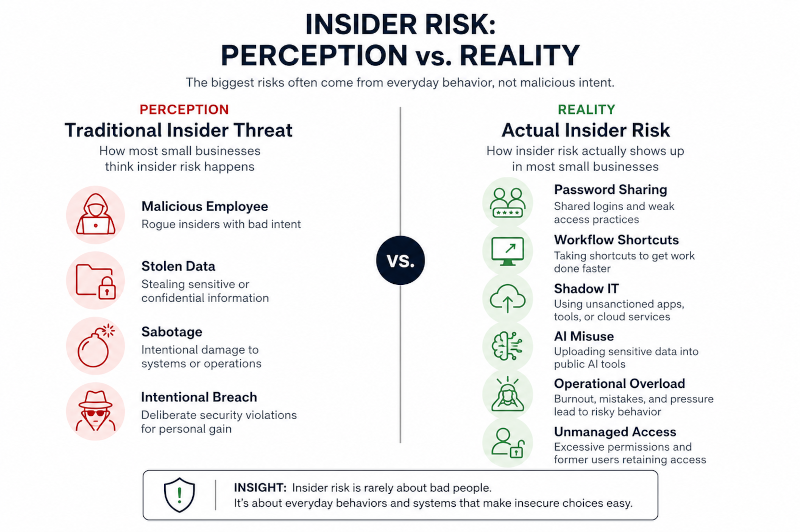
This distinction matters because insider risk is no longer only a cybersecurity problem. It is becoming an operational design problem.
The 2026 Verizon Data Breach Investigations Report found that human involvement remained a major factor across security incidents, including errors, misuse, credential abuse, and social engineering exposure. Small and medium-sized businesses were particularly vulnerable because of limited resources, fragmented security processes, and inconsistent operational controls.
At the same time, the operational impact of security incidents continues rising. IBM’s 2025 Cost of a Data Breach Report found that the average global breach cost climbed to $4.88 million, with shadow data, unmanaged information, and fragmented environments contributing heavily to exposure.
For small businesses, insider risk often develops long before leadership recognizes a security issue exists. It builds gradually through workflow shortcuts, unclear systems, weak offboarding, unmanaged AI adoption, and operational overload.
The strongest organizations are not simply the ones monitoring employees more aggressively. They are the organizations designing operational environments where secure behavior aligns naturally with efficient work.
Recommendation: Treat insider risk as an operational behavior challenge rather than only a malicious employee problem.
Operational Convenience Often Overrides Security
Most employees do not wake up intending to create security risk. They simply want to complete work efficiently.
This becomes one of the biggest insider risk challenges for small businesses because operational friction frequently pushes employees toward insecure workarounds. When approved systems feel slow, confusing, or disruptive to productivity, workers naturally improvise.
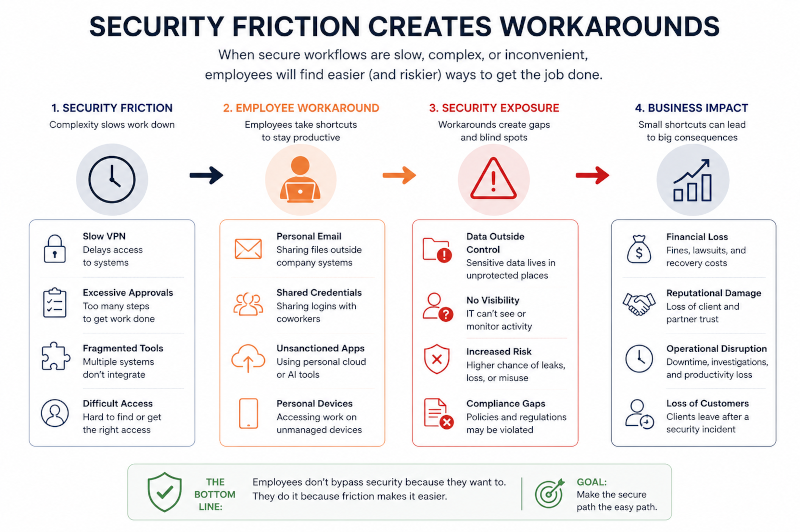
Research from CISA’s Insider Threat Mitigation guidance emphasizes that insider threats frequently emerge through authorized users unintentionally misusing access, bypassing procedures, or exposing information through routine operational behavior.
Inside small businesses, this often appears in subtle ways:
- employees forwarding work documents to personal email accounts,
- teams sharing login credentials,
- staff using unsanctioned cloud storage platforms,
- or workers accessing company systems from unmanaged personal devices.
A small accounting firm provides a realistic example. Employees handling tax documents and financial records may begin forwarding files to personal email accounts simply because the VPN connection feels unreliable or remote access systems slow down client response times during busy periods. From the employee’s perspective, the behavior feels practical and temporary. From a security perspective, it creates unmanaged exposure involving highly sensitive client information.
Retail and hospitality businesses frequently encounter similar patterns through shared point-of-sale credentials. Employees rotate shifts quickly, onboarding processes remain informal, and managers prioritize operational speed over account governance. Over time, shared access eliminates accountability and creates major visibility gaps around who accessed systems, modified records, or handled sensitive customer data.
As explored previously in Why Employees Circumvent Security Policies, employees rarely bypass security controls because they oppose security itself. More often, they bypass systems they perceive as obstructing workflow continuity.
This is one reason insider risk cannot be solved purely through stricter policies. If workflows remain operationally frustrating, employees will continue finding alternative paths around controls.
The problem is not always malicious intent.
It is workflow design that unintentionally rewards insecure behavior.
Recommendation: Reduce workflow friction that encourages employees to bypass approved systems and security procedures.
Small Businesses Often Confuse Trust With Governance
Many small businesses operate through informal trust-based environments. Teams are smaller, relationships are closer, and employees often handle multiple responsibilities simultaneously. While this flexibility can improve agility and collaboration, it also creates hidden governance weaknesses.
In many small organizations:
- access permissions remain overly broad,
- former employees retain accounts,
- passwords are reused,
- and operational responsibilities are poorly documented.
Leaders often assume trust itself functions as a sufficient security model.
It does not.
CISA’s insider threat guidance specifically notes that insider threats can involve both intentional and unintentional harm caused by individuals with authorized access to systems, facilities, or organizational information.
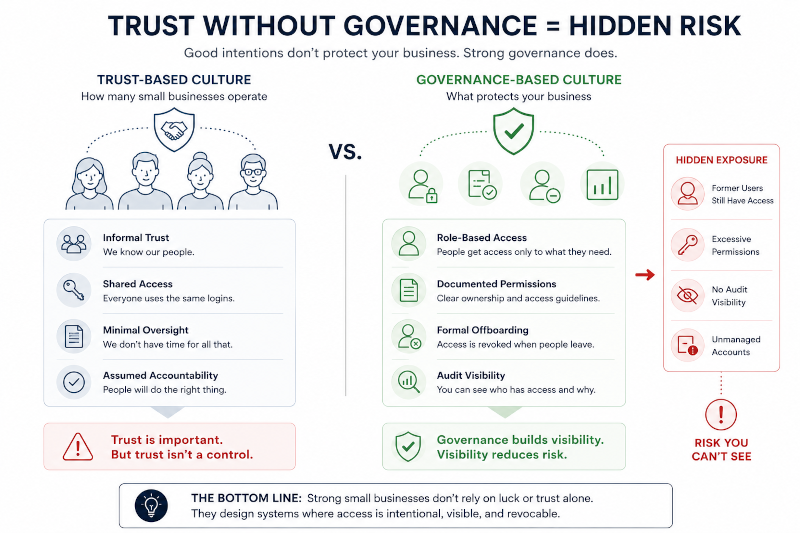
One of the most common examples appears during employee offboarding.
A former employee leaves a company but retains access to cloud applications, vendor portals, CRM systems, or shared drives because no formal deactivation process exists. Months later, the organization discovers that old accounts remain active across multiple platforms, creating unmanaged exposure without any malicious activity necessarily occurring.
Small healthcare clinics frequently encounter similar risks. Shared systems, rotating staff, third-party contractors, and overloaded administrative teams often create environments where credential management becomes inconsistent. In regulated industries involving patient or financial data, even small oversights can create major compliance and operational consequences.
This issue becomes more serious as organizations adopt SaaS platforms rapidly. Many small businesses now operate across dozens of cloud applications simultaneously, yet lack centralized identity governance or visibility into who retains access across systems.
Research examining insider threat mitigation frameworks has repeatedly emphasized that access control maturity and governance visibility play major roles in reducing insider exposure.
Trust matters culturally. But trust is not governance.
The organizations operating most securely are often not the ones with the strictest surveillance. More often, they are the organizations establishing clear access structures, accountability processes, and operational visibility without creating unnecessary friction.
Recommendation: Implement role-based access controls and formal offboarding procedures even in highly trusted small-team environments.
AI Tools Are Quietly Expanding Insider Risk
AI adoption is accelerating across small businesses because employees recognize its productivity benefits immediately. Workers now use AI systems to summarize meetings, generate marketing copy, draft emails, analyze spreadsheets, automate research, and accelerate customer communication.
The challenge is that many organizations have adopted AI tools faster than governance frameworks surrounding them.
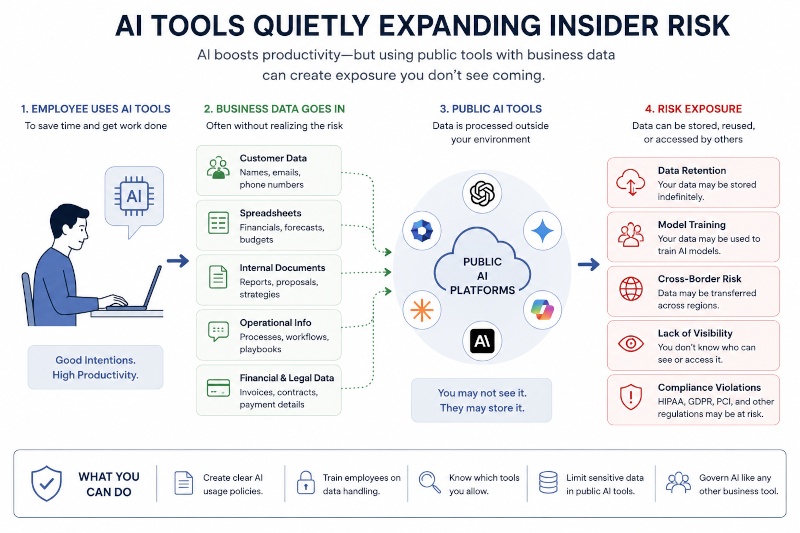
IBM’s 2025 breach research noted that shadow data, unmanaged environments, and fragmented information visibility continue expanding organizational exposure. Public AI systems introduce a new layer of risk because employees often upload sensitive information into external platforms without fully understanding retention policies, access models, or governance implications.
This creates a modern insider risk scenario that many small businesses underestimate completely.
Imagine a small legal office where an employee uploads confidential client notes into a public AI chatbot to generate a case summary more quickly. The employee is not acting maliciously. They are trying to improve productivity. Yet the behavior may expose highly sensitive information outside approved organizational systems.
Marketing agencies, healthcare offices, accounting firms, and consulting companies are all encountering similar risks as employees independently adopt AI tools without clear organizational policies.
Research from IBM also found that organizations dealing with fragmented data visibility and unmanaged environments experienced significantly higher breach costs.
AI does not create insider risk alone. It amplifies operational behaviors already present inside the organization.
As explored previously in AI will amplify both security and circumvention, AI systems tend to accelerate both efficient workflows and broken governance structures simultaneously.
This means small businesses can no longer treat AI usage as an isolated IT issue. It is becoming part of operational governance itself.
Recommendation: Establish clear AI usage policies governing how employees handle organizational, customer, and financial information inside public AI systems.
Burnout and Operational Overload Increase Human Error
Another major insider risk factor receives far less attention than external attacks: employee exhaustion.
Small businesses often operate with lean staffing models where employees manage multiple responsibilities simultaneously under constant time pressure. While this can improve efficiency temporarily, sustained overload gradually increases the likelihood of security mistakes, poor judgment, and workflow shortcuts.
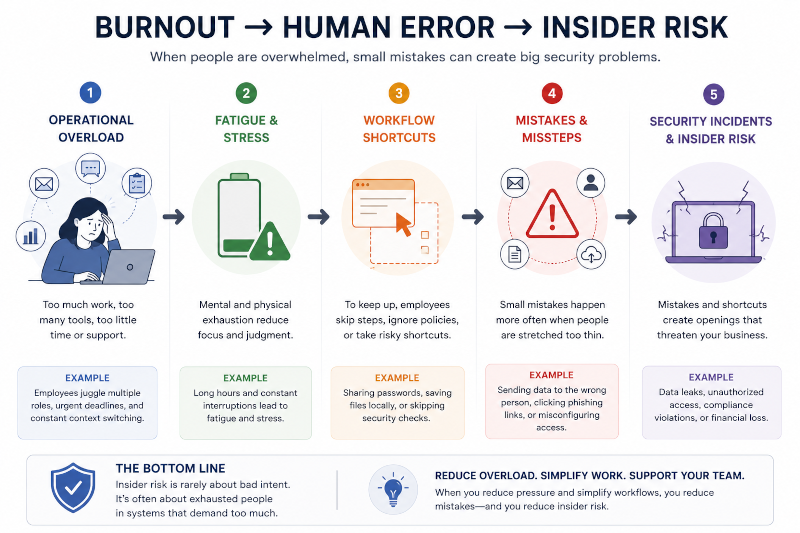
IBM’s 2024 breach report found that security staffing shortages and operational complexity contributed significantly to breach costs and organizational exposure.
The connection between burnout and insider risk is often indirect but operationally significant.
Fatigued employees are more likely to:
- ignore verification steps,
- mishandle sensitive files,
- reuse weak passwords,
- approve suspicious requests,
- or bypass security procedures to save time.
A small medical office provides a realistic example. Administrative employees managing scheduling, billing, insurance coordination, and patient communication simultaneously may begin storing files locally or reusing shortcuts across systems simply to keep pace with workload demands. Over time, operational overload quietly erodes security discipline.
The issue becomes even more serious in environments lacking structured onboarding or standardized workflows. Employees improvise constantly under pressure, creating inconsistent security behavior across teams.
This overlaps directly with themes explored in The Silent Productivity Killer: How Knowledge Managers Give You Your Time Back, where fragmented operational environments forced employees into repetitive coordination work and workflow inefficiency.
Human error is often not carelessness.
It is operational exhaustion expressed through security failure.
The strongest small businesses therefore focus not only on cybersecurity controls, but also on reducing cognitive overload across daily workflows.
Recommendation: Simplify repetitive operational processes and reduce unnecessary workflow complexity that pushes overloaded employees toward insecure shortcuts.
Conclusion: Insider Risk Is Really an Operational Design Problem
Small businesses often prepare extensively for external cyber threats while overlooking the operational behaviors already creating exposure internally.
The most dangerous insider risks are not always malicious employees intentionally stealing information. More often, insider risk develops through workflow shortcuts, weak governance, unmanaged AI adoption, fragmented systems, operational overload, and excessive reliance on informal trust structures.
This is why insider risk cannot be solved through fear-based security culture alone.
Organizations that create overly restrictive environments frequently push employees toward shadow workflows and unsanctioned tools. Organizations with poor governance visibility create confusion around ownership, accountability, and access management.
The strongest security environments are usually the ones where operational efficiency and secure behavior support each other naturally.
“Organizations often underestimate insider risk because operational shortcuts rarely feel dangerous in the moment.”
As businesses continue integrating AI systems, cloud platforms, remote work models, and interconnected workflows, insider risk will become even more closely tied to operational design quality itself.
The future of insider risk management may depend less on monitoring employees constantly and more on building systems where:
- access remains visible,
- workflows remain manageable,
- governance remains clear,
- and secure behavior becomes the easiest path employees can follow consistently.
Small businesses often underestimate insider risk because the problem rarely looks dramatic at first.
It looks like convenience.
It looks like improvisation.
It looks like everyday work.
Recommendation: Design operational systems where secure behavior aligns naturally with efficient execution rather than competing against it.
1 thought on “Small Businesses Underestimate Insider Risk”