Recommendations
- Evaluate whether recent growth has introduced new layers of coordination that were never intentionally designed, and prioritize simplifying those workflows before adding additional technology.
- Identify one recurring operational issue that has resurfaced multiple times over the past six months and address its root cause rather than creating another temporary workaround.
- Identify one business-critical process that relies heavily on institutional knowledge and document it using clear ownership, decision criteria, and measurable outcomes.
- Before approving the next major technology investment, assess whether the underlying business process is standardized enough to produce consistent results once scaled.
- Conduct a quarterly “reactive work” review by identifying recurring issues, executive escalations, and manual workarounds, then prioritize systemic improvements that eliminate those problems rather than repeatedly managing their consequences.
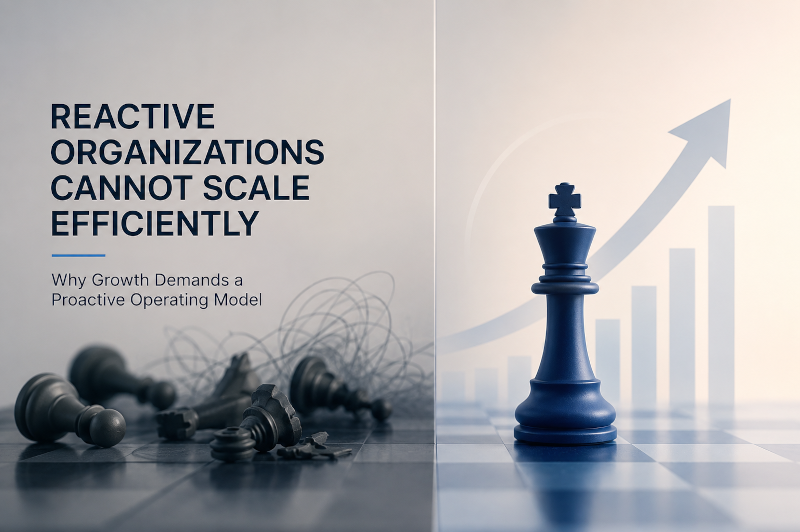
Growth is often celebrated as the ultimate measure of organizational success. New customers, expanding teams, additional product lines, and increasing revenue all signal progress. Yet many organizations discover an uncomfortable reality once they reach a certain size: the practices that enabled early growth begin to hinder future expansion. Decisions take longer, projects stall, communication breaks down, and leaders find themselves spending more time resolving operational issues than pursuing strategic opportunities.
The instinctive response is frequently to invest in new technology. Organizations purchase workflow platforms, implement collaboration tools, or introduce artificial intelligence in hopes of improving efficiency. While these investments can deliver significant value, technology rarely solves the underlying problem when the organization itself operates reactively. Instead, it often accelerates existing inefficiencies by enabling flawed processes to execute faster.
Research consistently shows that organizations capable of sustained growth share a common characteristic. They anticipate change rather than simply responding to it. They build governance before complexity overwhelms decision-making, document critical knowledge before expertise becomes siloed, and establish operating models that allow the organization to adapt without relying on constant executive intervention.
The challenge is not that reactive organizations lack talented employees or dedicated leaders. Rather, they allow complexity to grow faster than their operating model evolves. Every new customer, department, application, and business process introduces additional dependencies. Without deliberate structures to manage those dependencies, the organization gradually shifts from executing strategy to managing exceptions.
Ultimately, organizations do not struggle to scale because they grow too quickly. They struggle because operational maturity fails to keep pace with organizational complexity.
Complexity Is the Real Cost of Growth
Every organization begins with simplicity. A small leadership team communicates informally, employees wear multiple hats, and decisions happen quickly because everyone understands the broader mission. At this stage, flexibility often appears to be a competitive advantage.
As the organization expands, however, that flexibility becomes increasingly difficult to sustain. Additional employees introduce new reporting relationships. Departments develop specialized objectives. Regulatory requirements grow. Customers expect greater consistency, and technology ecosystems become more interconnected.
Growth, therefore, is not simply an increase in workload—it is an increase in organizational complexity.
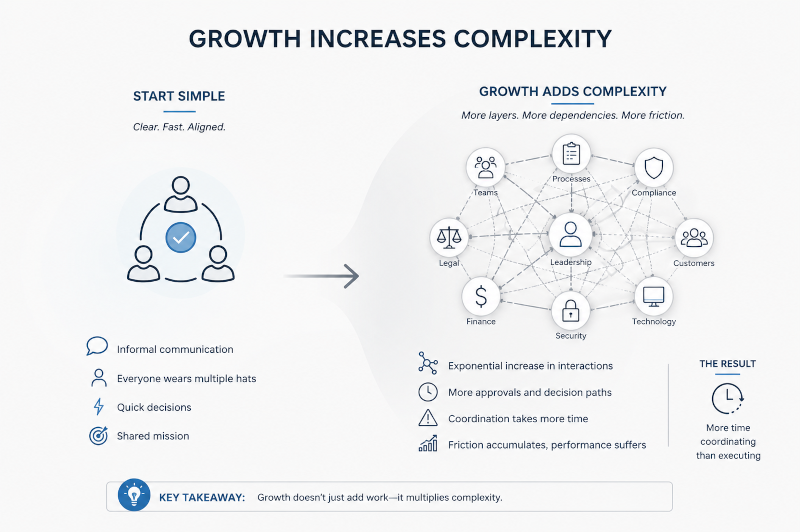
This distinction matters because complexity behaves differently than most leaders expect. Hiring twice as many employees does not merely double communication requirements. The number of interactions, dependencies, approvals, and decision paths expands far more rapidly. What once required a brief conversation between two people may now involve multiple departments, legal review, finance approval, cybersecurity assessment, and executive oversight.
The result is an organization that spends progressively more time coordinating work than performing it.
McKinsey’s State of Organizations 2023 highlights this growing challenge, noting that organizations are operating in an environment characterized by continuous disruption and rising complexity. Those that fail to redesign how they operate often find themselves trapped in cycles of incremental fixes rather than meaningful transformation.
Reactive organizations rarely recognize this transition immediately. Performance metrics may remain stable for months or even years while operational friction quietly accumulates beneath the surface. Projects require additional coordination meetings. Employees create informal workarounds to bypass cumbersome processes. Managers spend increasing portions of their day resolving conflicts instead of developing their teams.
None of these issues appears catastrophic in isolation. Collectively, however, they create a system that becomes progressively harder to manage as growth continues.
This builds on ideas explored in How High-Performing Organizations Reduce Operational Friction, where operational inefficiencies often emerge gradually before becoming visible through declining productivity and slower decision-making.
Recommendation: Evaluate whether recent growth has introduced new layers of coordination that were never intentionally designed, and prioritize simplifying those workflows before adding additional technology.
Firefighting Is a Symptom, Not an Operating Strategy
Many organizations wear their ability to respond quickly to crises as a badge of honor. Employees proudly describe themselves as agile because they can solve problems under pressure, reorganize priorities overnight, or recover from unexpected disruptions.
While resilience is valuable, constant firefighting should not be confused with organizational agility.
True agility is proactive. Firefighting is reactive.
The distinction becomes particularly evident as organizations scale. A reactive organization spends its energy addressing today’s urgent issues. A proactive organization invests time preventing tomorrow’s disruptions.
Consider how this difference influences everyday operations.
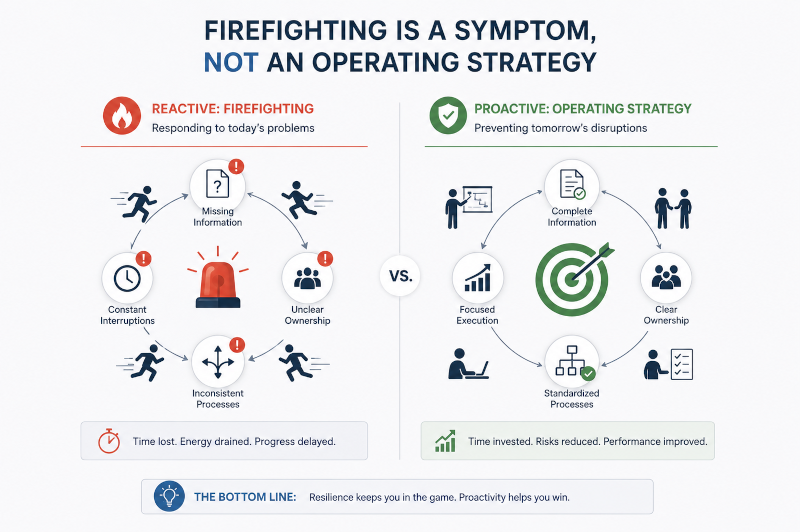
When documentation is incomplete, employees repeatedly interrupt subject matter experts for information. When decision authority is unclear, routine approvals escalate to senior leadership. When business processes vary between departments, each exception requires manual coordination. Individually, these interruptions seem manageable. Together, they consume hundreds of hours that could otherwise support innovation, customer engagement, or strategic planning.
Over time, urgency becomes normalized.
Meetings multiply because nobody is confident they possess the complete picture. Managers hesitate to delegate because institutional knowledge exists primarily within experienced employees. Projects slip because cross-functional dependencies were identified only after work had already begun.
Rather than solving underlying structural issues, reactive organizations become highly proficient at managing recurring symptoms.
Case Study: The CrowdStrike Outage Demonstrated the Cost of Operational Preparedness
The global IT disruption triggered by a faulty software update from CrowdStrike in July 2024 affected airlines, hospitals, financial institutions, and government agencies around the world. While the software defect itself attracted widespread attention, the recovery efforts revealed an equally important operational lesson.
Organizations with mature incident response plans, documented recovery procedures, well-defined communication protocols, and clearly assigned responsibilities restored operations significantly faster than those relying on improvised decision-making. The technical issue was identical, yet organizational preparedness largely determined recovery speed and business impact.
The event illustrated that resilience is not built during a crisis. It is developed long before disruption occurs through governance, documentation, training, and clearly defined operating procedures.
The same principle applies to organizational growth. Companies that invest proactively in scalable operating models spend less time reacting to predictable operational failures as they expand.
As discussed in Why Documentation Is Becoming a Strategic Asset, institutional knowledge becomes a competitive advantage only when it is systematically captured and made accessible across the organization.
Recommendation: Identify one recurring operational issue that has resurfaced multiple times over the past six months and address its root cause rather than creating another temporary workaround.
Scaling Requires Systems, Not Heroics
Many growing organizations unknowingly become dependent on a handful of high-performing individuals. These employees understand undocumented processes, maintain critical relationships across departments, and know how to navigate organizational bureaucracy. When a problem arises, leadership instinctively turns to them because they consistently deliver results.
While this approach can sustain a small organization, it becomes a liability at scale.
Every dependency on a single individual introduces operational risk. Vacations slow projects. Employee turnover creates knowledge gaps. Promotions leave teams scrambling to recreate undocumented expertise. Eventually, growth becomes constrained not by market demand, but by the organization’s ability to transfer knowledge and execute consistently.
This is where operating models begin to matter more than individual performance.
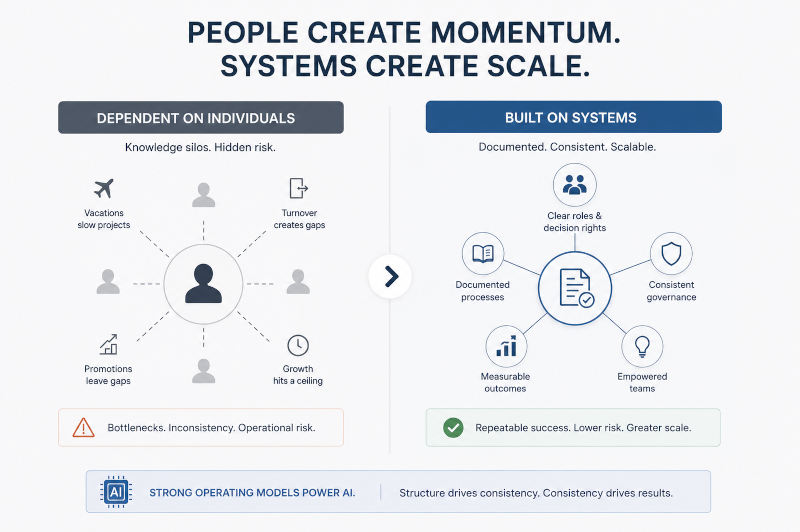
High-performing organizations design systems that make success repeatable. Processes are documented, decision rights are clearly defined, governance provides consistency without excessive bureaucracy, and employees understand not only what to do, but why work is performed a certain way.
This distinction reflects decades of research on organizational capabilities. The theory of dynamic capabilities argues that long-term competitive advantage comes not from responding faster than competitors after disruption occurs, but from continuously sensing change, adapting resources, and evolving organizational capabilities before disruption forces action.
Organizations often view documentation, governance, and process standardization as administrative overhead. In reality, these investments reduce the cognitive burden placed on employees. Rather than reinventing solutions or searching for information, teams can focus their attention on solving new problems and delivering value.
This becomes even more important as organizations adopt artificial intelligence. AI systems depend on structured data, consistent processes, and clearly defined business rules. When organizations automate fragmented or inconsistent workflows, they simply scale inconsistency.
As discussed in How to Fix Broken Automation: Aligning Workflows with Reality, automation should reinforce well-designed operating models—not compensate for their absence.
Case Study: Toyota’s Standardization Enabled Continuous Improvement
Toyota is frequently recognized for its manufacturing excellence, but its enduring success stems from something more fundamental than operational efficiency. The Toyota Production System established standardized work as the foundation for continuous improvement. Employees follow documented processes not because innovation is discouraged, but because consistency makes meaningful improvement measurable.
When work is standardized, deviations become visible. Teams can identify root causes, improve processes systematically, and share successful practices across the organization. Without that baseline, every improvement effort becomes subjective because each team performs the same work differently.
This philosophy has allowed Toyota to grow into one of the world’s largest manufacturers while maintaining operational consistency across global facilities.
The lesson extends far beyond manufacturing. Whether an organization develops software, manages healthcare services, or delivers consulting engagements, scalable growth depends on creating systems that produce reliable outcomes regardless of who performs the work.
Recommendation: Identify one business-critical process that relies heavily on institutional knowledge and document it using clear ownership, decision criteria, and measurable outcomes.
Proactive Organizations Build Capacity Before They Need It
One of the defining characteristics of scalable organizations is their willingness to invest in capabilities before they become urgent.
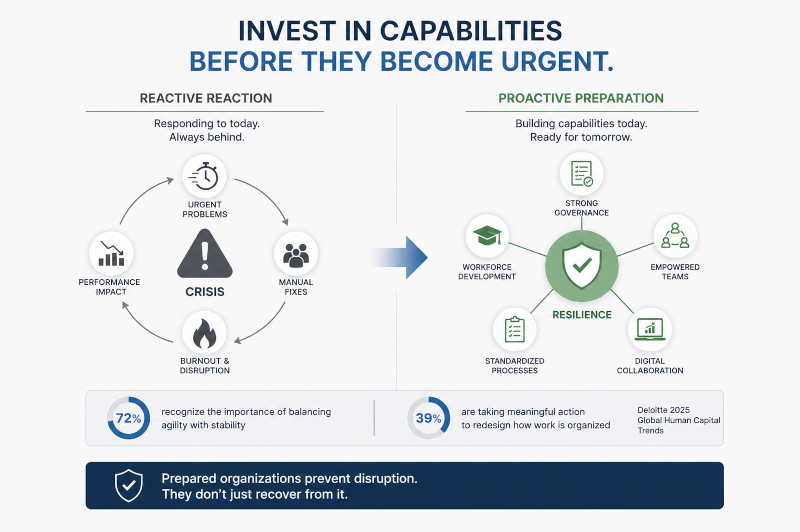
This often feels counterintuitive. Leadership teams naturally focus on today’s priorities, particularly during periods of rapid growth. Budgets are directed toward customer acquisition, product development, and immediate operational needs. Investments in governance, documentation, workforce development, or process redesign can appear difficult to justify because the benefits are not immediately visible.
Yet these are precisely the investments that determine whether growth remains sustainable.
Deloitte’s 2025 Global Human Capital Trends report emphasizes that organizations are operating in an environment where work increasingly crosses traditional functional boundaries. While 72 percent of organizations recognize the importance of balancing agility with stability, only 39 percent report taking meaningful action to redesign how work is organized. This gap reflects a broader challenge: many organizations understand the need for proactive operating models but continue responding primarily through short-term adjustments rather than structural improvements.
The difference becomes particularly evident during periods of disruption.
Organizations that invested early in standardized governance, digital collaboration, and distributed decision-making adapted far more effectively to widespread operational changes than those attempting to build these capabilities while simultaneously responding to crises.
Preparation rarely attracts attention because success often appears uneventful. The absence of disruption is difficult to celebrate. Yet mature organizations understand that resilience is measured not by how dramatically they recover from crises, but by how effectively they prevent routine challenges from becoming organizational emergencies.
Case Study: Microsoft’s Cultural and Operational Transformation
When Satya Nadella became CEO of Microsoft, the company’s transformation extended beyond new technology investments. It required a shift in organizational behavior. Microsoft emphasized cross-functional collaboration, continuous learning, cloud-first operating models, and faster decision-making supported by a culture that encouraged experimentation rather than internal competition.
Technology certainly played a central role, but the broader success came from redesigning how the organization worked together. Cultural change, governance, leadership behaviors, and operational alignment reinforced one another rather than evolving independently.
The result was not simply a more innovative technology company—it became a more adaptive organization capable of responding to changing market conditions without relying solely on executive intervention.
The lesson is clear. Sustainable growth depends as much on organizational architecture as it does on market strategy.
This builds on ideas explored in The New Skill Companies Actually Need: Systems Thinking, where understanding relationships between people, processes, technology, and governance becomes essential for long-term organizational performance.
Recommendation: Before approving the next major technology investment, assess whether the underlying business process is standardized enough to produce consistent results once scaled.
From Reactive Management to Proactive Leadership
Every organization encounters unexpected challenges. Markets shift, customer expectations evolve, regulations change, and technology continues to accelerate the pace of business. Reacting to individual events is unavoidable.
Building an organization that depends on constant reaction is not.
Reactive organizations often mistake activity for progress. Calendars fill with meetings, leaders resolve daily escalations, and employees work tirelessly to overcome operational friction. From the outside, the organization appears productive. Internally, however, much of that effort is consumed by coordinating work that should already be predictable.
Proactive organizations make a different investment. They recognize that sustainable growth is not achieved by asking people to work harder—it is achieved by designing systems that make effective execution repeatable.
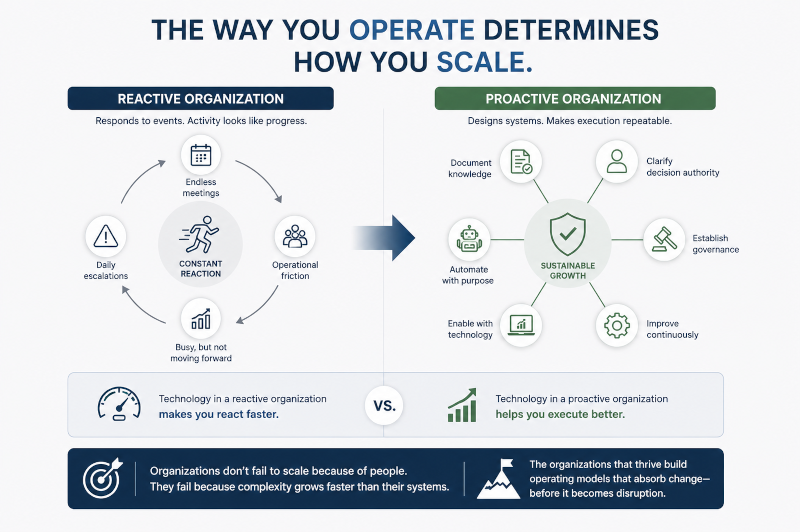
That investment takes many forms: documenting institutional knowledge before it disappears, clarifying decision authority before approvals become bottlenecks, establishing governance before compliance becomes a crisis, and continuously improving operating models before complexity overwhelms the organization.
Technology, automation, and artificial intelligence will undoubtedly shape the future of work. Yet these capabilities amplify the quality of an organization’s operating model rather than replacing it. A reactive organization equipped with advanced technology simply reacts faster. A proactive organization uses the same technology to execute strategy with greater consistency, resilience, and confidence.
Ultimately, organizations do not fail to scale because they lack talented people or ambitious leaders. They fail because complexity grows faster than the systems designed to manage it.
The organizations that thrive over the next decade will not be those that respond to every disruption the fastest. They will be those that build operating models capable of absorbing change before disruption becomes a competitive disadvantage.
Recommendation: Conduct a quarterly “reactive work” review by identifying recurring issues, executive escalations, and manual workarounds, then prioritize systemic improvements that eliminate those problems rather than repeatedly managing their consequences.
4 thoughts on “Reactive Organizations Cannot Scale Efficiently: Why Growth Demands a Proactive Operating Model”