
Recommendations
- Conduct quarterly SaaS usage reviews tied directly to employee activity, role requirements, and renewal timelines rather than relying solely on assigned license counts.
- Build SaaS governance dashboards around feature utilization, business workflow engagement, and role-based activity rather than simple login frequency alone.
- Establish centralized ownership for SaaS governance across procurement, IT, finance, and security teams rather than allowing departments to manage software independently.
- Integrate SaaS license management directly with identity governance and automated offboarding workflows tied to HR systems and role changes.
- Treat SaaS governance as a continuous operational intelligence function with dedicated ownership, automated monitoring, and executive visibility into software utilization trends.
There’s a category of waste inside most organizations that rarely creates urgency because, on paper, everything appears normal. Software licenses renew automatically, contracts feel predictable, applications are officially approved, users remain assigned active seats, and dashboards continue showing adoption activity. From a leadership perspective, the spending appears stable and under control, which is precisely why the inefficiency often goes unnoticed for years while quietly compounding across the enterprise.
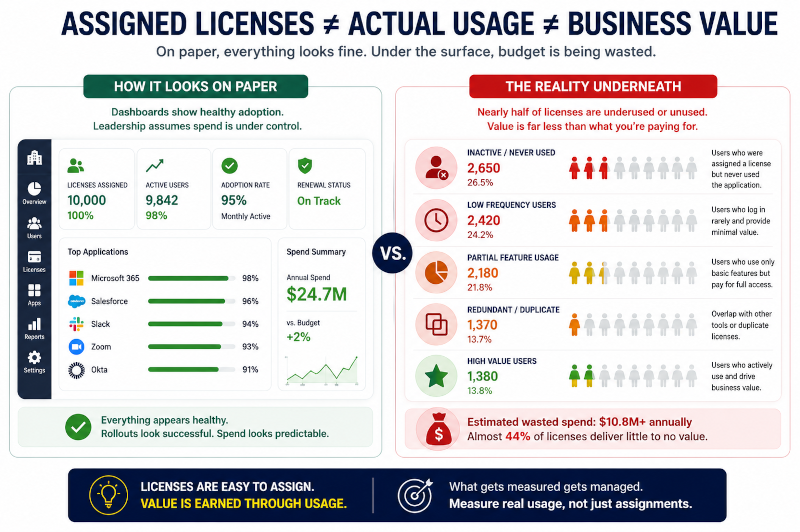
In reality, many organizations are paying millions of dollars annually for software that employees barely use, partially use, or never touch at all.
The scale of the problem is larger than many executives realize. Nexthink research examining more than six million customer environments found that nearly half of installed software and licensed SaaS applications went unused by employees, representing hundreds of millions of dollars in wasted annual spend across observed environments. Zylo’s 2024 SaaS Management Index similarly found that enterprises waste an average of $18 million annually on unused SaaS licenses while maintaining large portfolios of underutilized applications.
This is no longer a minor procurement inefficiency.
Software spending continues rising rapidly as organizations expand SaaS adoption, AI tooling, cloud platforms, collaboration suites, analytics environments, and operational software ecosystems simultaneously. Gartner forecasts global IT spending will surpass $5.6 trillion in 2025, driven heavily by software and AI-related investment growth.
The uncomfortable reality is that many organizations are scaling software complexity faster than they are scaling governance visibility.
As explored previously in Most Organizations Don’t Have Processes — They Have Habits, operational inefficiencies often accumulate quietly through fragmented workflows, informal ownership structures, and normalized organizational behavior. SaaS licensing waste follows the same pattern. It rarely looks dramatic. It looks administrative. Routine. Invisible.
That is precisely why it becomes so expensive.
Recommendation: Conduct quarterly SaaS usage reviews tied directly to employee activity, role requirements, and renewal timelines rather than relying solely on assigned license counts.
The Illusion of Software Adoption
One of the biggest misconceptions inside enterprise IT environments is the assumption that assigned licenses represent meaningful software adoption.
They do not.
A user logging into Microsoft 365 once every few days does not necessarily justify a high-cost E5 license bundle. A Salesforce account assigned to a sales representative who rarely updates opportunities or uses advanced platform functionality is not generating proportional business value simply because the seat remains active.
This creates a critical visibility gap between:
- assigned software,
- active software,
- and valuable software usage.
Many organizations focus heavily on rollout metrics because those numbers appear reassuring. Dashboards show licenses provisioned, users onboarded, and login activity occurring regularly. But those metrics often obscure what is happening underneath:
- partial feature utilization,
- dormant accounts,
- overlapping tools,
- redundant platforms,
- and expensive enterprise bundles used only minimally.
A common example appears inside Microsoft 365 environments. Organizations frequently purchase enterprise-wide E5 licensing packages to standardize deployments and simplify procurement. In practice, however, many employees may use only basic email, document editing, and collaboration functionality while never touching advanced security, compliance, analytics, or voice features embedded inside premium tiers. The result is not necessarily malicious overspending. It is structural overprovisioning driven by convenience and procurement scale.
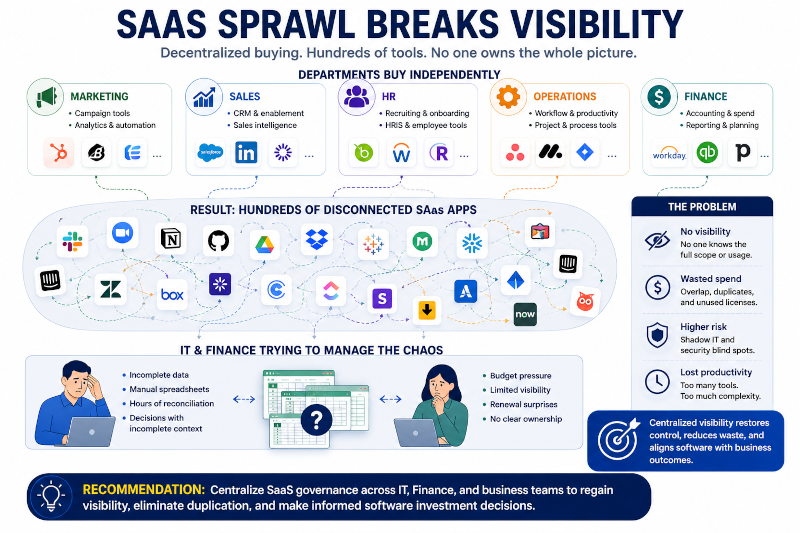
Salesforce environments often experience similar patterns. During rapid hiring periods, organizations provision large volumes of CRM licenses to support sales expansion. Months later, turnover, territory restructuring, or changing operational priorities leave inactive or lightly used seats sitting untouched while renewals continue automatically. Because the licenses remain technically assigned, the waste can remain hidden for long periods.
This is one reason software waste persists even inside highly mature IT organizations:
the appearance of adoption often masks the absence of optimization.
Research from Zylo found that enterprises use only about half of purchased SaaS licenses on average, despite continued expansion in software spending and platform adoption.
The issue is not merely technical. It is operational.
Organizations are often measuring software assignment instead of software value.
Recommendation: Build SaaS governance dashboards around feature utilization, business workflow engagement, and role-based activity rather than simple login frequency alone.
SaaS Sprawl Has Broken Ownership
One of the biggest reasons software waste continues growing is that modern SaaS environments are no longer centrally controlled. Departments routinely purchase tools independently based on immediate operational needs: marketing teams adopt campaign platforms, sales organizations procure CRM integrations, HR deploys onboarding and workforce systems, and operations teams introduce workflow software to improve productivity. At the same time, employees increasingly experiment with AI applications outside formal procurement channels altogether. The result is that IT often inherits responsibility for visibility, governance, and cost management without ever controlling the original purchasing decisions that created the software sprawl in the first place.
This fragmentation creates a dangerous organizational reality: no single team fully owns SaaS efficiency across the enterprise.
Research examining enterprise SaaS management trends shows that organizations now operate with hundreds of SaaS applications simultaneously, many acquired outside centralized governance structures.
The result is not simply higher software costs. It is operational fragmentation.
Different teams may purchase overlapping tools performing nearly identical functions while maintaining separate contracts, disconnected workflows, and inconsistent governance models. Employees often switch between redundant platforms without leadership fully understanding which systems are actually necessary for operational performance.
Visibility becomes even more difficult as AI adoption accelerates. Many organizations are now layering AI copilots, generative AI subscriptions, automation platforms, and workflow assistants onto already fragmented SaaS ecosystems. TechRadar recently reported that enterprise AI spending is becoming a dominant software budget category as organizations rapidly expand AI tooling across departments.
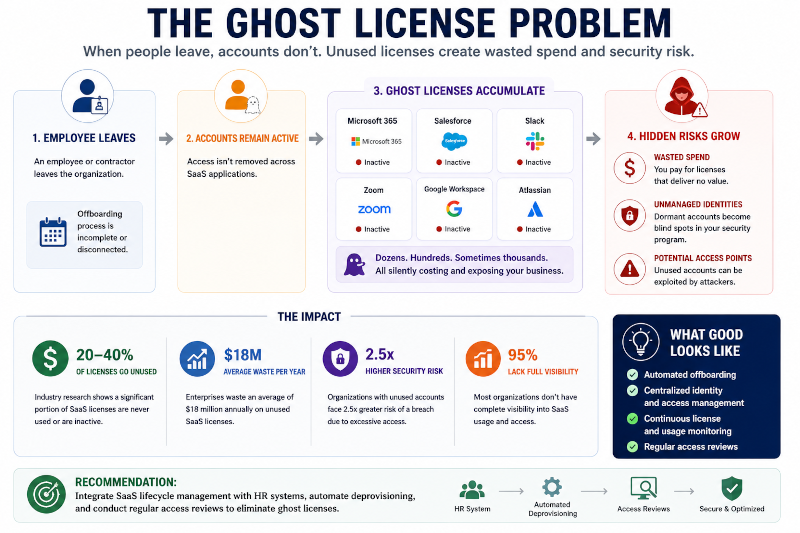
This creates a more contrarian reality than many organizations acknowledge: software waste is often not a procurement problem. It is a governance visibility failure.
Many enterprises now govern cloud infrastructure more rigorously than the SaaS environments employees access daily.
As explored previously in AI Is Becoming an Operational Layer, Not Just a Productivity Tool, modern software ecosystems are becoming deeply embedded into operational coordination itself. Without centralized visibility, organizations lose the ability to understand how tools, workflows, spending, and employee behavior interact across the enterprise.
Recommendation: Establish centralized ownership for SaaS governance across procurement, IT, finance, and security teams rather than allowing departments to manage software independently.
Unused Licenses Are Also Security Exposure
One of the most overlooked aspects of SaaS waste is that unused licenses create more than financial inefficiency.
They create security exposure.
Every inactive or unnecessary account represents:
- an unmanaged identity,
- a potential access pathway,
- and a governance blind spot.
This becomes especially dangerous when organizations fail to connect SaaS lifecycle management with identity governance and employee offboarding processes.
A common example appears during contractor engagements or temporary projects. A consultant receives access to collaboration platforms, analytics dashboards, CRM systems, and cloud-connected tools for a six-month engagement. The project ends, but the accounts remain active across multiple SaaS environments because ownership is fragmented and no centralized review process exists.
Over time, these dormant accounts accumulate quietly.
Many organizations now operate with large numbers of:
- inactive users,
- forgotten permissions,
- overlapping administrator roles,
- and disconnected SaaS identities
that remain operational long after business need disappears.
BetterCloud notes that organizations failing to centrally manage SaaS lifecycles remain substantially more susceptible to cyber incidents and data loss because of incomplete visibility into SaaS usage and configuration.
This connects software governance directly to cybersecurity.
As explored previously in Your Biggest Cybersecurity Risk May Not Be Inside Your Network, modern security exposure increasingly emerges through operational complexity and fragmented trust relationships rather than perimeter weakness alone.
Unused software licenses often become part of that invisible attack surface.
The larger issue is not simply overspending.
It is unmanaged operational complexity accumulating across interconnected systems.
Recommendation: Integrate SaaS license management directly with identity governance and automated offboarding workflows tied to HR systems and role changes.
The Organizations Solving This Treat It as Operational Discipline
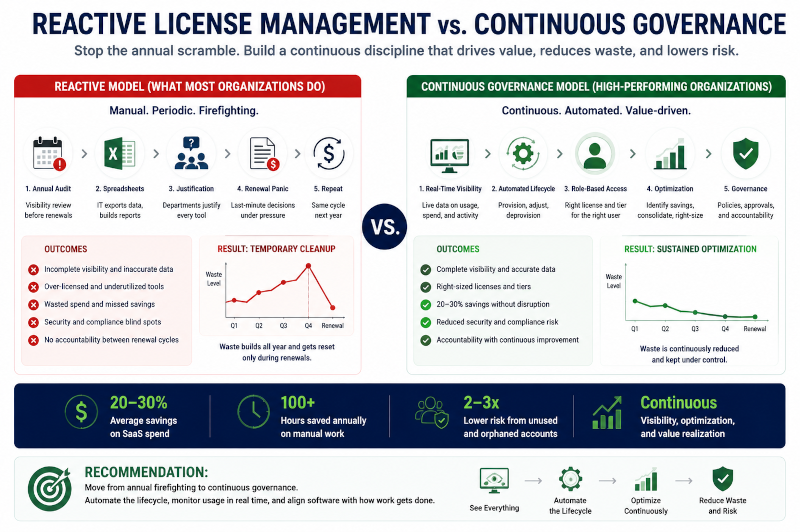
Many organizations still approach license optimization reactively rather than operationally. A review takes place shortly before renewal periods, finance teams push for cost reductions, IT exports spreadsheets to assess usage, and departments scramble to justify why specific platforms or license tiers are still necessary. Once the renewals are completed, attention shifts elsewhere until the same cycle repeats the following year, often without addressing the deeper visibility and governance issues that created the waste in the first place.
High-performing organizations approach the problem differently.
They treat SaaS governance as a continuous operational discipline rather than a periodic budgeting exercise. Usage visibility, license optimization, security governance, procurement alignment, and workflow analysis become interconnected parts of a broader operational intelligence strategy.
Nexthink research found that only a small percentage of organizations report complete visibility into software usage across their environments. That means many enterprises are making multimillion-dollar software decisions using incomplete operational data.
The strongest organizations are beginning to close that gap through:
- continuous monitoring,
- automated provisioning and deprovisioning,
- role-based licensing,
- usage analytics,
- and centralized SaaS management platforms.
Importantly, they also recognize that optimization is not about indiscriminately cutting licenses. It is about aligning software capability with actual operational behavior.
That distinction matters.
Blindly removing software can create productivity disruption, shadow IT adoption, and workflow fragmentation. Mature organizations instead focus on:
- identifying redundant capability,
- right-sizing license tiers,
- consolidating overlapping platforms,
- and improving governance visibility across the enterprise.
This is one reason SaaS governance is becoming strategically important beyond cost savings alone.
Modern organizations operate through software ecosystems. Understanding how those ecosystems are actually used is becoming part of understanding how the organization itself functions operationally.
The future of IT cost optimization may therefore depend less on aggressive budget cuts and more on improving visibility into how work, software, governance, and operational behavior interact continuously across the enterprise.
Software waste rarely looks dramatic. It looks ordinary. It hides inside renewal cycles, fragmented ownership, inactive accounts, and normalized inefficiency.
That is why it compounds so quietly.
Recommendation: Treat SaaS governance as a continuous operational intelligence function with dedicated ownership, automated monitoring, and executive visibility into software utilization trends.