
- Recommendations
- Why IT Is Evolving from Operator to Orchestrator
- Automation Has Reached Its Limits
- The Explosion of Operational Complexity
- From IT Operators to IT Orchestrators
- Governing Autonomous Systems Is Becoming an IT Capability
- The Skills IT Leaders Will Need Next
- The Autonomous IT Department Is an Operating Model, Not a Technology
- Conclusion
Recommendations
- Begin redefining IT roles around supervision, governance, and architectural decision-making rather than routine operational execution.
- Establish an AI operations governance committee before expanding autonomous capabilities beyond low-risk operational tasks.
- Identify operational workflows where engineers spend more time coordinating work than solving technical problems; these often represent the strongest candidates for autonomous execution.
- Expand leadership development programs to include AI governance, operational policy design, and systems thinking alongside traditional technical training.
- Evaluate AI initiatives as operating model transformations rather than isolated technology projects.
Why IT Is Evolving from Operator to Orchestrator
For most of the digital age, the mission of the IT department was relatively straightforward: keep technology running. Whether maintaining servers, deploying software, resolving incidents, or monitoring infrastructure, IT professionals served as the operators behind the organization’s digital backbone. As technology became more complex, the tools evolved, but the operating model remained remarkably consistent. Humans observed systems, interpreted problems, made decisions, and executed solutions.
Artificial intelligence is beginning to break that pattern.
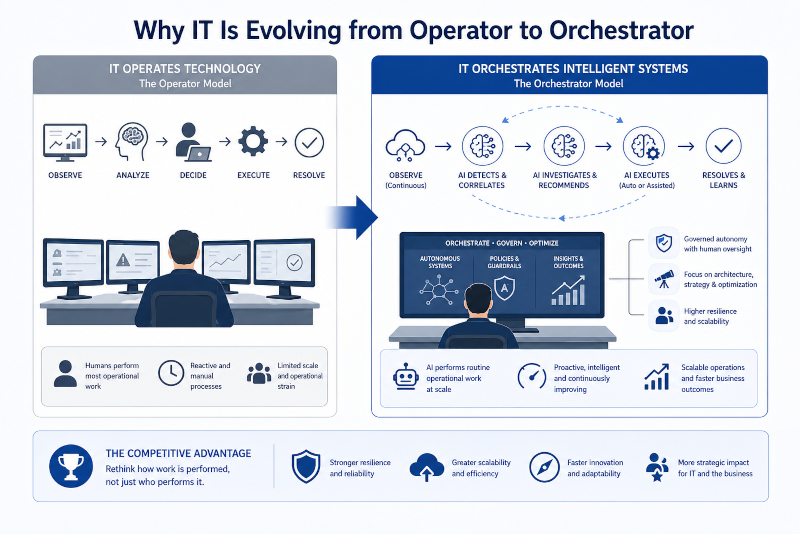
Much of the conversation around AI has focused on personal productivity—writing code faster, summarizing meetings, or generating documents. While those applications are valuable, they represent only the first stage of a much larger transformation. The more profound shift is occurring inside enterprise operations, where AI is moving beyond assisting people and beginning to perform operational work itself.
Across cloud platforms, service management tools, observability platforms, and cybersecurity operations centers, AI systems are being designed to detect anomalies, investigate incidents, correlate telemetry, recommend remediation, and in carefully governed environments, execute corrective actions without waiting for human intervention. This evolution represents more than another wave of automation. It signals a fundamental redesign of how IT departments operate.
The autonomous IT department is not one where humans disappear. Rather, it is one where the nature of human work changes. Routine operational tasks become delegated to intelligent systems, while engineers focus on architecture, governance, optimization, and exception management. The role of IT shifts from operating technology to supervising technology capable of operating itself.
For business leaders, this distinction matters. Organizations that view AI solely as a productivity tool may achieve incremental efficiency gains. Organizations that rethink the operating model of IT have an opportunity to fundamentally improve resilience, scalability, and operational agility. The competitive advantage will belong to those that redesign how work is performed—not simply who performs it.
Automation Has Reached Its Limits
Automation has been part of enterprise IT for decades. Scripts provision servers, workflows onboard employees, monitoring tools generate alerts, and orchestration platforms execute predefined tasks. These capabilities have reduced manual effort, improved consistency, and allowed IT teams to support increasingly complex environments without proportionally increasing headcount.
Yet traditional automation has an inherent limitation.
It performs exactly what it has been instructed to do—and nothing more.
A scripted workflow can restart a failed service because someone anticipated that scenario when writing the automation. It cannot determine whether restarting the service is actually the appropriate response. Nor can it recognize that multiple seemingly unrelated alerts point to a common root cause occurring elsewhere in the infrastructure.
As enterprise environments have expanded across public cloud providers, SaaS platforms, Kubernetes clusters, APIs, edge computing, and hybrid infrastructure, that limitation has become more apparent. Modern systems generate millions of telemetry events every day, producing volumes of operational data that exceed what human operators—or rule-based automation—can reasonably interpret.
Recent academic research on Agentic AIOps describes this transition as a shift from deterministic automation toward adaptive operational reasoning, where AI agents observe environments, analyze relationships across diverse data sources, formulate hypotheses, recommend actions, and continuously learn from operational outcomes.
This distinction is critical because autonomy is not simply “better automation.” It represents a different operating philosophy. Traditional automation executes instructions. Autonomous systems evaluate situations before determining which actions should be taken.
That capability fundamentally changes the economics of IT operations.
Instead of creating hundreds of narrowly defined automation scripts, organizations begin deploying systems capable of handling classes of operational problems rather than individual scenarios. Human expertise becomes embedded within policies and governance frameworks rather than hardcoded workflows.
Recommendation: Identify operational processes that still rely on extensive manual decision-making, as these often represent the greatest opportunities for AI-assisted autonomy.
The Explosion of Operational Complexity
The rise of autonomous operations is not driven by technological curiosity. It is a response to an operational reality that many IT leaders have been experiencing for years.
Enterprise infrastructure has grown exponentially more complex.
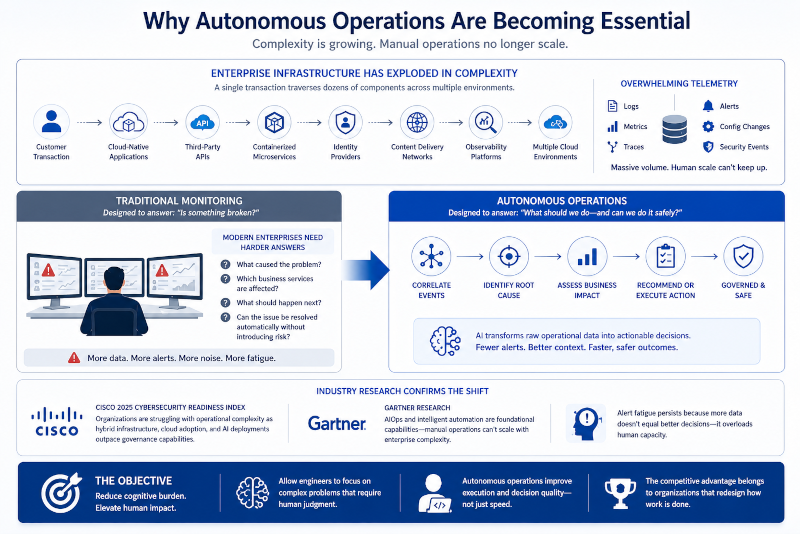
A single customer transaction may now traverse cloud-native applications, third-party APIs, containerized microservices, identity providers, content delivery networks, observability platforms, and multiple public cloud environments before completing successfully. Each component generates logs, metrics, traces, alerts, configuration changes, and security events that collectively create an overwhelming volume of operational telemetry.
Traditional monitoring tools were designed to answer a relatively simple question:
“Is something broken?”
Modern enterprises require answers to much harder questions:
What caused the problem?
Which business services are affected?
What should happen next?
Can the issue be resolved automatically without introducing additional risk?
These questions require reasoning rather than monitoring.
Industry research reflects this growing challenge. Cisco’s 2025 Cybersecurity Readiness Index found that organizations continue struggling with operational complexity as hybrid infrastructure, cloud adoption, and AI deployments expand faster than governance capabilities.
The same trend appears across operations research. Gartner has consistently identified AIOps and intelligent automation as foundational capabilities for managing modern digital operations because manual approaches no longer scale with enterprise complexity.
This growing complexity also helps explain why many organizations experience alert fatigue despite investing heavily in observability tools. More data does not automatically produce better decisions. In many cases, it simply overwhelms the people responsible for interpreting it.
Autonomous IT seeks to reduce that cognitive burden by transforming raw operational data into actionable decisions.
Rather than presenting engineers with hundreds of related alerts, intelligent systems correlate events, identify probable root causes, assess business impact, and recommend—or execute—appropriate responses based on established governance policies.
The objective is not replacing engineers.
It is allowing engineers to focus on solving problems that actually require human judgment.
As discussed in We Automated Ticketing… and Now Everything Is “High Priority”, organizations often mistake automation for operational maturity. Autonomous operations represent the next step because they improve not only execution but also decision quality.
Recommendation: Measure how much time your operations teams spend interpreting alerts versus resolving business problems; the difference often reveals the true cost of operational complexity.
From IT Operators to IT Orchestrators
Perhaps the most significant implication of autonomous operations is not technological but organizational.
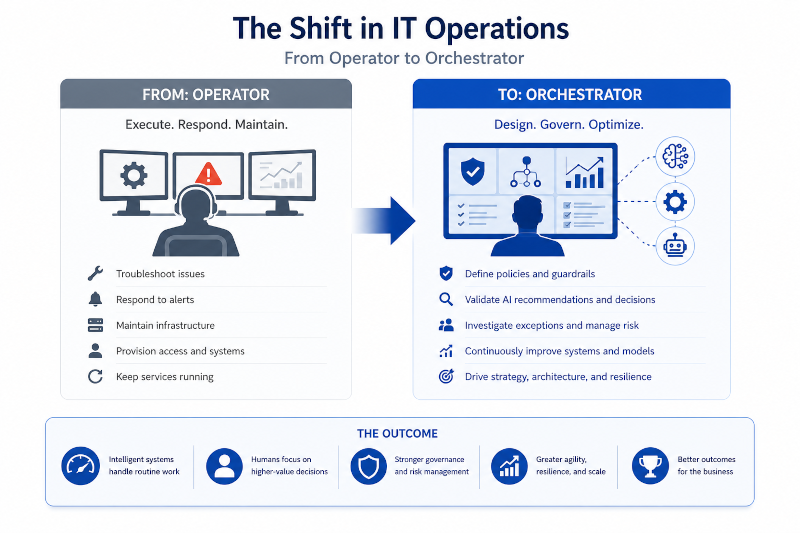
Historically, IT professionals served as operators. Their expertise lay in configuring infrastructure, responding to incidents, provisioning systems, troubleshooting failures, and maintaining stability through direct intervention.
Those responsibilities are beginning to change.
As AI assumes responsibility for repetitive operational activities, the human role moves higher in the decision hierarchy. Engineers increasingly define policies rather than execute procedures. They establish governance boundaries, validate AI recommendations, investigate exceptions, and continuously improve operational models.
This mirrors transformations that have occurred in other industries.
Manufacturing engineers rarely assemble products themselves. Airline pilots rely extensively on automated flight systems while remaining accountable for safe operations. Financial analysts use sophisticated models to process enormous datasets before applying professional judgment to strategic decisions.
IT is entering a similar phase.
Rather than spending hours manually correlating infrastructure alerts, engineers supervise intelligent operational systems capable of performing that analysis continuously. Human expertise shifts toward architectural thinking, risk management, and operational governance.
Several technology vendors have already begun demonstrating this direction.
Microsoft continues expanding Copilot capabilities across Azure administration, security operations, and infrastructure management, enabling AI to assist with diagnosis, configuration, and operational workflows.
ServiceNow has similarly introduced agentic AI capabilities capable of managing incident triage, orchestrating workflows, retrieving organizational knowledge, and automating service management activities under defined governance policies.
These platforms remain human-supervised, but their trajectory is unmistakable.
The autonomous IT department is not eliminating operational work.
It is changing who—or what—performs it.
Recommendation: Begin redefining IT roles around supervision, governance, and architectural decision-making rather than routine operational execution.
Governing Autonomous Systems Is Becoming an IT Capability
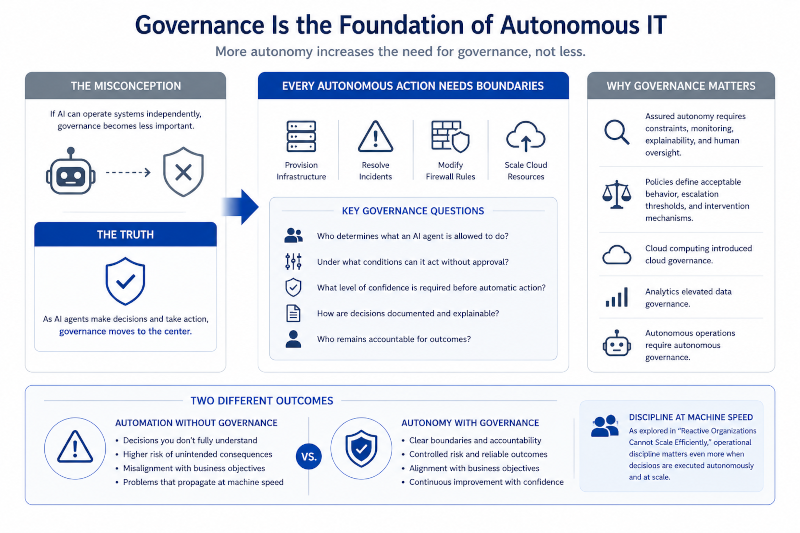
The promise of autonomous IT often leads to an understandable misconception: if AI can operate systems independently, perhaps governance becomes less important.
The opposite is true.
As operational decision-making shifts from humans to AI agents, governance moves from the background to the center of the operating model. Every autonomous action—whether provisioning infrastructure, resolving an incident, modifying firewall rules, or scaling cloud resources—must occur within clearly defined business and technical boundaries.
In practice, this means organizations must answer questions that previously received far less attention.
Who determines what an AI agent is allowed to do? Under what conditions can it act without approval? What level of confidence is required before remediation is executed automatically? How are decisions documented? Who remains accountable if an autonomous action creates unintended consequences?
These are governance questions before they are technical ones.
Recent research on assured autonomy emphasizes that autonomous systems require explicit constraints, continuous monitoring, explainability, and human oversight to maintain operational reliability. As autonomy increases, so too does the need for policies that define acceptable behavior, escalation thresholds, and mechanisms for intervention.
This evolution mirrors previous shifts in enterprise technology. Cloud computing did not eliminate infrastructure governance—it introduced cloud governance. Data analytics did not eliminate data management—it elevated data governance into a strategic capability.
Autonomous operations are following the same trajectory.
Organizations adopting AI without establishing governance frameworks may automate decisions they do not fully understand. Organizations that combine autonomy with disciplined governance create systems capable of improving operational performance while remaining aligned with business objectives.
This builds on ideas explored in Reactive Organizations Cannot Scale Efficiently. As organizations become more autonomous, operational discipline matters even more because poor decisions can now propagate at machine speed.
Recommendation: Establish an AI operations governance committee before expanding autonomous capabilities beyond low-risk operational tasks.
Case Study: Google’s Site Reliability Engineering Philosophy
Long before generative AI entered mainstream business discussions, Google was quietly redefining IT operations through its Site Reliability Engineering (SRE) practices.
The goal was never simply to automate repetitive work. Google’s engineers sought to eliminate what they describe as “toil”—manual, repetitive operational activities that consume engineering time without creating lasting business value.
Rather than repeatedly responding to the same operational problems, engineers developed systems capable of detecting, diagnosing, and correcting many issues automatically. Human expertise shifted toward designing resilient architectures, improving reliability, and refining automation rather than manually operating infrastructure.
Generative AI accelerates this philosophy.
Instead of automating isolated operational procedures, organizations can now build intelligent systems capable of interpreting documentation, correlating telemetry, analyzing incidents, and recommending remediation based on organizational knowledge.
The important lesson is that Google’s competitive advantage did not come from automating individual tasks. It came from redesigning the operating model around continuous operational improvement. Autonomous IT represents the next logical step in that evolution.
Case Study: ServiceNow’s Vision for Agentic Enterprise Operations
Service management platforms illustrate another practical example of autonomous operations.
Historically, incident management followed a familiar sequence. Monitoring systems generated alerts, support teams investigated issues, engineers determined root causes, and service desks documented each step manually.
Modern agentic AI platforms are beginning to compress that workflow.
ServiceNow’s recent AI capabilities can classify incidents, retrieve relevant knowledge articles, summarize historical cases, recommend remediation, coordinate workflows across teams, and automate portions of operational response under predefined governance policies.
Notice what changes.
The service desk does not disappear. Engineers do not disappear.
Instead, routine coordination and administrative effort diminish, allowing specialists to focus on complex engineering decisions and customer impact rather than repetitive operational work.
This distinction is critical for executives evaluating AI investments. The greatest return rarely comes from replacing people. It comes from reducing the amount of work that requires expert human attention.
Recommendation: Identify operational workflows where engineers spend more time coordinating work than solving technical problems; these often represent the strongest candidates for autonomous execution.
The Skills IT Leaders Will Need Next
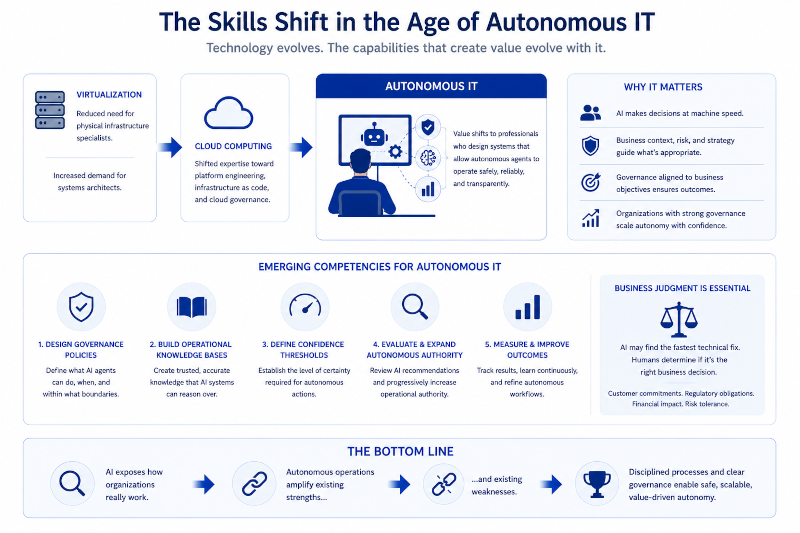
Every major technological shift reshapes the capabilities organizations value.
Virtualization reduced the need for physical infrastructure specialists while increasing demand for systems architects. Cloud computing shifted expertise toward platform engineering, infrastructure as code, and cloud governance.
Autonomous IT will drive another transition.
The most valuable engineers will not necessarily be those who perform operational tasks the fastest. They will be the professionals who understand how to design systems that allow autonomous agents to operate safely, reliably, and transparently.
Several emerging competencies illustrate this shift:
- Designing governance policies for AI agents.
- Building reliable operational knowledge bases that AI systems can reason over.
- Defining confidence thresholds for autonomous decision-making.
- Evaluating AI-generated recommendations before expanding operational authority.
- Measuring operational outcomes and continuously improving autonomous workflows.
These responsibilities require technical expertise, but they also demand business judgment.
An autonomous agent may determine that shutting down a production application is the fastest way to contain a cybersecurity incident. Whether that decision is appropriate depends on customer commitments, regulatory obligations, financial impact, and organizational risk tolerance.
Those considerations cannot be derived from telemetry alone. They require governance informed by business strategy.
As discussed in AI Is Not Changing Business Operations. It’s Exposing How They Really Work, AI often reveals organizational maturity more than it creates it. Autonomous operations amplify existing strengths—and existing weaknesses. Organizations with disciplined processes and clear governance will scale autonomy more successfully than those attempting to automate fragmented operations.
Recommendation: Expand leadership development programs to include AI governance, operational policy design, and systems thinking alongside traditional technical training.
The Autonomous IT Department Is an Operating Model, Not a Technology
One of the biggest mistakes organizations can make is treating autonomous IT as another software implementation.
Technology matters.
Operating models matter more.
Purchasing an AIOps platform does not automatically create autonomous operations, just as implementing cloud infrastructure did not automatically produce digital transformation.
Organizations must redesign how decisions are made.
Incident management changes because AI performs first-level investigation. Change management evolves because AI can assess deployment risks using historical operational data. Knowledge management becomes more valuable because autonomous systems rely on accurate organizational information to make reliable decisions. Governance becomes continuous because operational authority is increasingly shared between humans and intelligent systems.
Viewed through this lens, autonomous IT resembles previous enterprise transformations.
Enterprise Resource Planning (ERP) systems standardized financial operations.
Customer Relationship Management (CRM) systems standardized customer engagement.
Autonomous operations will standardize—and eventually optimize—how organizations manage technology itself.
That transformation will extend well beyond IT.
Business units will expect faster service delivery. Security teams will coordinate with autonomous remediation platforms. Finance leaders will evaluate operational efficiency through new productivity metrics. Executive leadership will oversee digital workforces composed of both employees and AI agents.
The IT department becomes less of a service provider and more of an orchestrator for enterprise-wide digital operations.
Recommendation: Evaluate AI initiatives as operating model transformations rather than isolated technology projects.
Conclusion
For decades, the success of an IT department depended largely on its ability to operate increasingly complex technology environments. Engineers monitored systems, responded to incidents, provisioned infrastructure, and maintained stability through expertise developed over years of operational experience.
Artificial intelligence is beginning to redefine that work.
Autonomous systems are taking responsibility for activities that once required constant human attention: correlating telemetry, diagnosing failures, recommending remediation, documenting operational events, and, in carefully governed environments, executing corrective actions independently.
“The future IT department will not be defined by how well it operates technology, but by how well it designs, governs, and improves systems capable of operating themselves.”
This evolution should not be viewed primarily as a workforce reduction strategy.
It represents a shift in organizational design.
The IT departments that thrive over the next decade will not be those that simply automate more tasks. They will be those that redesign their operating models around human judgment, AI-driven execution, and governance that ensures autonomous systems remain aligned with business objectives.
History suggests that every major technology transition changes the role of the people responsible for managing it. Cloud computing transformed infrastructure teams into cloud architects. DevOps reshaped development and operations into integrated delivery organizations.
Autonomous IT will produce another transition.
The most valuable technology organizations will no longer be measured by how effectively they operate systems.
They will be measured by how effectively they design, supervise, and continuously improve systems capable of operating themselves.
The future IT department is not disappearing.
It is evolving from an operator of technology into the architect of autonomous enterprise operations.