Recommendations
- Measure AI adoption by business outcomes rather than usage—such as cycle-time reduction, error reduction, decision quality, or capacity released—and review whether the implementation is actually improving the process it was intended to change.
- Before introducing AI into a workflow, document the current process, ownership, decision points, and expected outcomes to determine whether the underlying operation is mature enough to support automation.
- Establish clear rules for approved AI use, including what information employees can enter into AI tools, which tools are authorized, and which decisions require human review, to reduce Shadow AI and inconsistent practices.
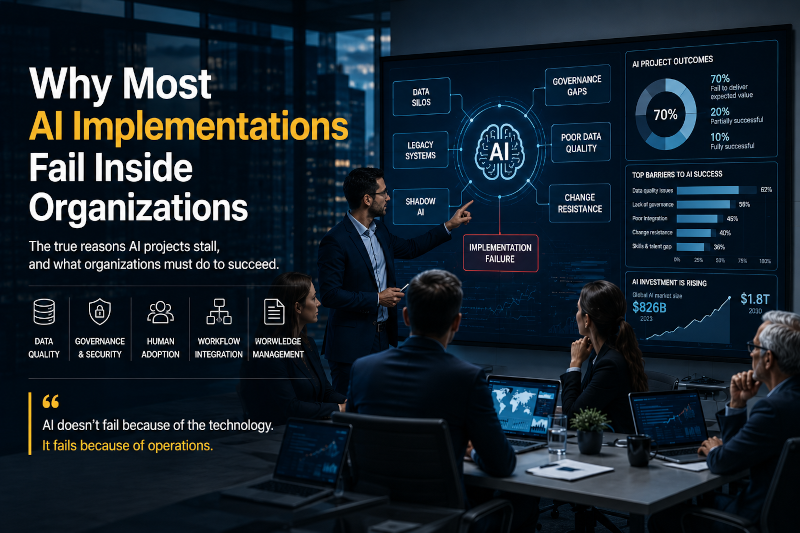
Artificial Intelligence has rapidly evolved from an experimental technology into a boardroom priority. Organizations across nearly every industry are investing heavily in AI-driven tools to automate workflows, improve decision-making, reduce operational costs, and gain competitive advantages.
Yet despite the enormous investment and enthusiasm surrounding enterprise AI adoption, a large percentage of implementations struggle to deliver meaningful long-term value.
According to research published by RAND Corporation, McKinsey, and IBM, many AI initiatives fail to progress beyond pilot stages or fail to achieve expected business outcomes. The reasons are rarely technological alone.
In most cases, AI implementation failures originate from operational complexity, fragmented knowledge systems, poor governance structures, unrealistic expectations, and organizational misalignment.
The challenge is not simply deploying AI tools.
The challenge is building organizations capable of effectively integrating them.
The AI Adoption Hype Cycle
The rapid acceleration of generative AI has created an environment where organizations often feel pressure to adopt AI technologies before fully understanding how those technologies fit into operational systems.
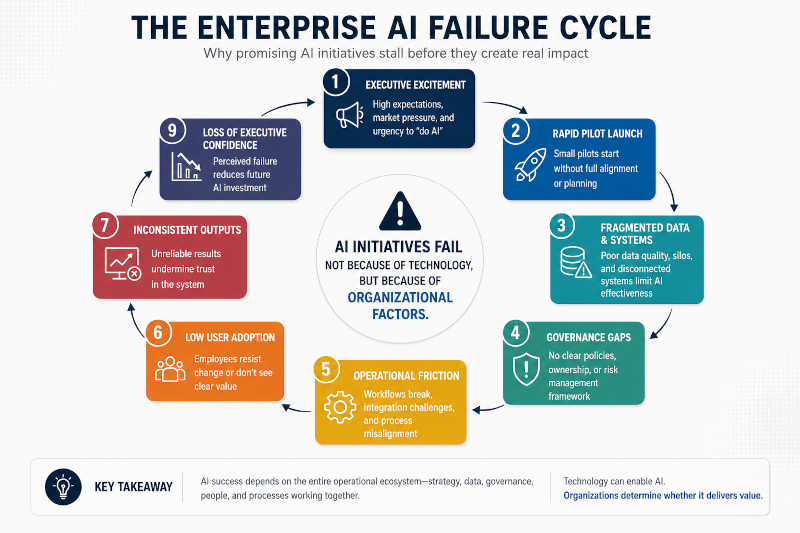
This creates what analysts frequently describe as an “AI hype cycle”:
- executive excitement,
- rushed experimentation,
- inflated expectations,
- fragmented pilot programs,
- eventual operational friction.
A study published in Harvard Business Review noted that organizations frequently underestimate the institutional and operational changes required to successfully scale AI systems.
Many organizations begin AI adoption with a narrow focus on:
- automation,
- productivity gains,
- cost reduction.
However, enterprise environments are significantly more complex than isolated AI demonstrations.
An AI model may perform impressively in a controlled environment, but scaling that model across real organizational workflows introduces challenges involving:
- governance,
- compliance,
- data quality,
- interoperability,
- human adoption,
- operational accountability.
This is where many organizations discover that AI implementation is not simply a technology initiative — it is an operational transformation effort.
Organizations already struggling with fragmented workflows and poorly aligned systems often discover that AI simply amplifies those inefficiencies rather than solving them. Similar operational issues can already be seen in enterprise automation environments where workflows drift away from real operational processes over time.
Why Pilot Projects Rarely Scale
One of the most common patterns in enterprise AI adoption is the “successful pilot that never scales.”
Organizations frequently launch isolated AI initiatives within individual teams:
- chatbot prototypes,
- reporting automation,
- predictive analytics tools,
- workflow assistants.
The pilot may initially show promising results under controlled conditions. However, once organizations attempt to scale implementation across broader operational environments, new problems emerge.
Researchers from MIT Sloan Management Review have emphasized that scaling AI successfully requires organizational alignment rather than isolated technical experimentation.
These operational problems often include:
- inconsistent data standards,
- disconnected systems,
- fragmented ownership,
- unclear governance,
- insufficient documentation,
- resistance from operational stakeholders.
Many organizations also focus heavily on automation while failing to maintain operational clarity around how those automations actually function. Over time, this creates environments where critical systems become poorly understood, undocumented, and difficult to govern.
A successful AI pilot demonstrates technical possibility.
It does not demonstrate organizational scalability.
Data Quality: The Hidden Foundation of AI
Artificial Intelligence systems are only as reliable as the data environments supporting them.
Unfortunately, many organizations operate with fragmented, inconsistent, or poorly governed data ecosystems.
Common enterprise problems include:
- duplicated information,
- siloed departments,
- outdated documentation,
- inconsistent terminology,
- incomplete records,
- disconnected platforms.
When these problems exist, AI systems often amplify operational inefficiencies instead of solving them.
This becomes especially dangerous in environments where AI outputs influence:
- strategic decisions,
- compliance reporting,
- customer interactions,
- operational forecasting.
Research published by the National Institute of Standards and Technology (NIST) highlights the importance of data governance, traceability, and reliability in trustworthy AI systems.
Without strong knowledge management practices, organizations create environments where AI systems retrieve inaccurate information, generate misleading recommendations, and reinforce flawed assumptions.
The operational consequences of fragmented organizational knowledge are already visible across many enterprise environments where employees struggle to locate accurate information quickly enough to support effective execution.
In many cases, AI implementation failures are actually knowledge management failures.
Shadow AI and Governance Risks
The rise of publicly accessible generative AI tools has created a new operational challenge often referred to as “Shadow AI.”
The risks associated with Shadow AI are no longer theoretical.
In early 2026, reports emerged that the acting director of the U.S. Cybersecurity and Infrastructure Security Agency (CISA), Madhu Gottumukkala, had uploaded sensitive government contracting documents marked “For Official Use Only” into a public version of ChatGPT, triggering internal security warnings and a Department of Homeland Security review.
Although the documents were reportedly not classified, the incident highlighted a growing enterprise governance problem: employees — including senior leadership — increasingly use AI tools outside formally governed operational environments.
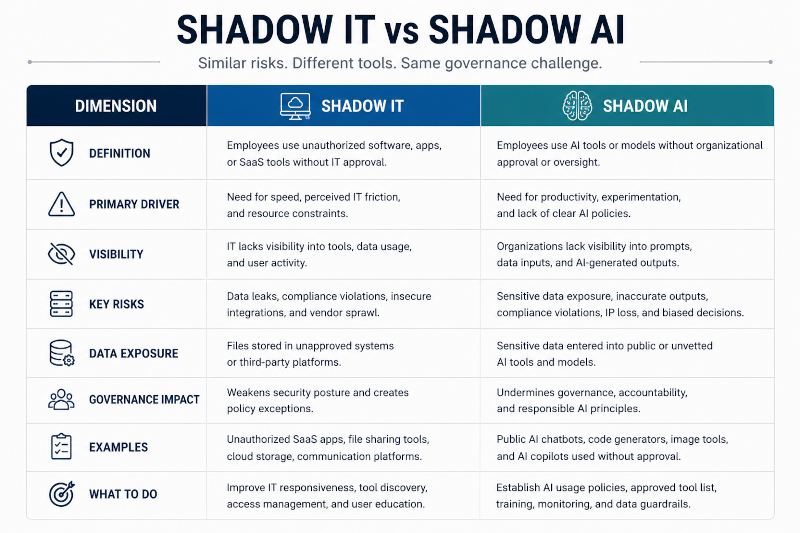
The case demonstrates the evolving difference between traditional Shadow IT and modern Shadow AI.
Similar to Shadow IT, employees increasingly adopt AI tools independently without formal oversight from IT, cybersecurity, compliance, or governance teams. However, unlike traditional Shadow IT, Shadow AI can directly influence operational decisions, recommendations, reporting, and business outcomes through unverified or externally processed outputs.
This creates several organizational risks:
- unauthorized data exposure,
- compliance violations,
- inconsistent or misleading outputs,
- intellectual property concerns,
- fragmented operational practices,
- reduced visibility into how information is processed externally.
Employees under productivity pressure may unintentionally upload sensitive internal data into external AI systems without fully understanding how that data is stored, retained, or used for future model training.
According to guidance from organizations such as NIST and emerging regulatory frameworks like the European Union AI Act, governance and transparency are becoming central requirements for responsible AI deployment.
The rapid expansion of SaaS ecosystems has already shown how quickly organizations lose centralized visibility once technology adoption outpaces governance structures. Shadow AI introduces many of those same visibility challenges — but with the added risk of influencing operational decisions and organizational knowledge flows.
Organizations that fail to establish clear AI governance structures risk:
- operational inconsistency,
- legal exposure,
- reputational damage,
- regulatory complications,
- and long-term erosion of organizational trust.
The challenge is not merely restricting AI usage.
The challenge is building governance models that balance:
- innovation,
- security,
- operational efficiency,
- and organizational trust.
Human Resistance and Organizational Friction
Technology adoption is ultimately a human systems problem.
Many AI initiatives fail because organizations underestimate how operational culture influences adoption behavior.
Employees may resist AI systems because they:
- fear job displacement,
- distrust automated recommendations,
- lack training,
- view new systems as operational burdens rather than improvements.
Additionally, poorly integrated AI systems often increase cognitive load instead of reducing it.
Research in organizational psychology and digital transformation consistently shows that successful transformation initiatives require communication, leadership alignment, and employee engagement.
“Transformation initiatives require communication, leadership alignment, and employee engagement.”
Organizations already struggling with generational workplace alignment and communication complexity may encounter even greater friction when introducing AI-driven operational changes.
Without organizational buy-in, even technically capable AI systems struggle to generate sustained value.
Cybersecurity and Operational Resilience
As organizations integrate AI into operational workflows, cybersecurity increasingly becomes intertwined with operational resilience.
Modern AI systems introduce:
- expanded attack surfaces,
- new identity risks,
- third-party dependencies,
- automated decision vulnerabilities,
- complex governance requirements.
The transition from “AI experimentation” to “AI operational reality” is already reshaping enterprise risk models and forcing organizations to rethink resilience, governance, and recovery strategies.
Successful organizations treat cybersecurity not as a separate technical function, but as an integrated operational discipline that supports long-term organizational stability.
Building AI-Ready Organizations
Successful AI adoption requires significantly more than purchasing AI tools.
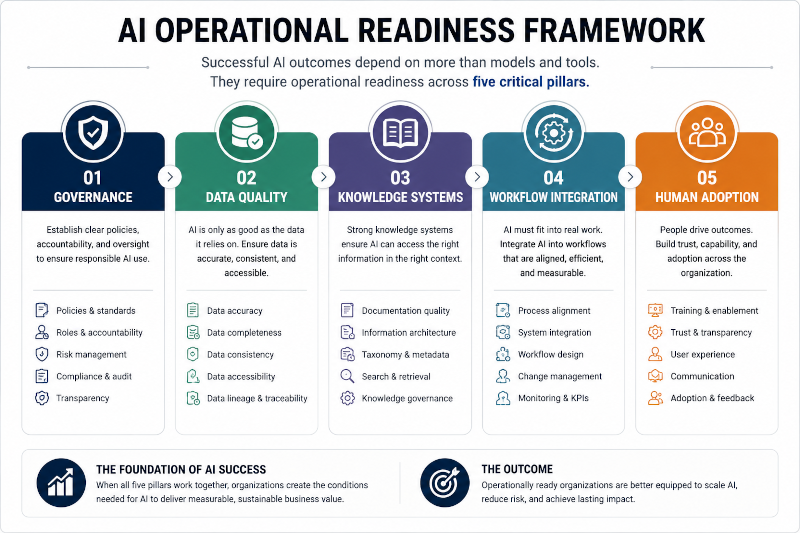
Organizations must build operational environments capable of integrating intelligent systems responsibly and sustainably.
This includes:
- strong governance frameworks,
- standardized operational processes,
- mature documentation systems,
- cross-functional collaboration,
- employee education,
- cybersecurity oversight,
- scalable knowledge infrastructure.
Leaders should focus less on chasing AI trends and more on strengthening the operational foundations that enable intelligent systems to function effectively.
In many cases, the organizations most prepared for AI are not necessarily the most technologically advanced.
They are the most operationally disciplined.
McKinsey research has similarly found that organizations generating the most value from AI are those that successfully integrate AI into broader operational and organizational systems rather than treating it as an isolated technology initiative.
Final Thoughts
AI will undoubtedly continue reshaping how organizations operate.
However, the long-term winners will not simply be the companies adopting AI the fastest.
They will be the organizations capable of integrating AI into coherent operational systems built on:
- governance,
- knowledge quality,
- process maturity,
- organizational alignment.
Most AI implementation failures are not failures of artificial intelligence itself.
They are failures of operational readiness.
As enterprise adoption accelerates, organizations that prioritize operational intelligence alongside technological innovation will likely be best positioned to scale AI successfully in the years ahead.
3 thoughts on “Why Most AI Implementations Fail Inside Organizations”