Recommendations
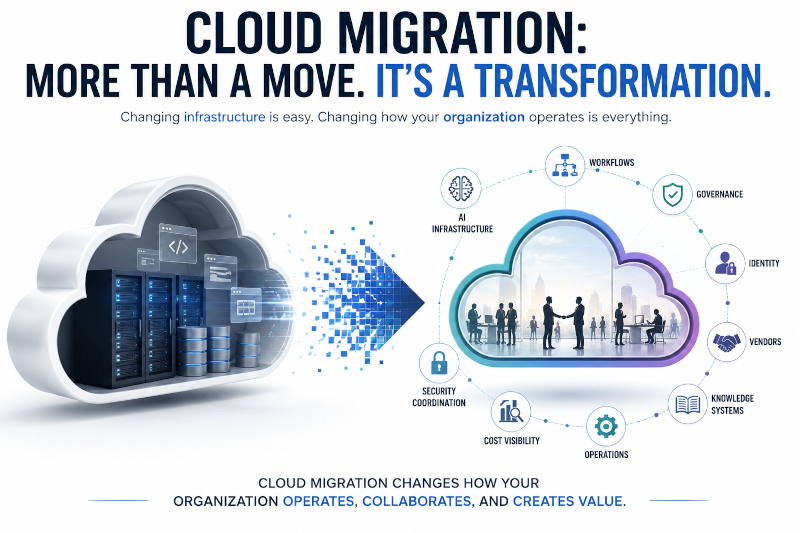
- Treat cloud migration as an organizational operating model transformation rather than a standalone infrastructure modernization initiative.
- Conduct dependency mapping across workflows, integrations, reporting systems, and operational ownership structures before migration planning begins.
- Preserve institutional knowledge by documenting operational workflows, downstream dependencies, and system-specific decision logic before migration activities begin.
- Establish operational governance, ownership accountability, and identity management standards before scaling cloud infrastructure broadly across teams.
- Build continuous workload-level cost visibility and cloud financial governance into operational management processes rather than treating optimization as a periodic review exercise.
- Evaluate whether cloud environments can support long-term AI governance, retrieval integrity, operational resilience, and scalable coordination requirements before expanding automation initiatives.
- Measure cloud transformation success through operational resilience, governance maturity, execution continuity, and organizational adaptability rather than migration speed alone.
Cloud migration is often framed as a technology modernization initiative. Organizations discuss scalability, elasticity, infrastructure efficiency, and cloud-native transformation as though migration is primarily a technical challenge.
In practice, cloud migration is usually an operational transformation disguised as an infrastructure project.
The systems themselves are often easier to move than the workflows, governance structures, institutional knowledge, and coordination models surrounding them. Many organizations discover this too late, after migration projects begin exposing hidden operational complexity that had existed quietly for years inside legacy environments.
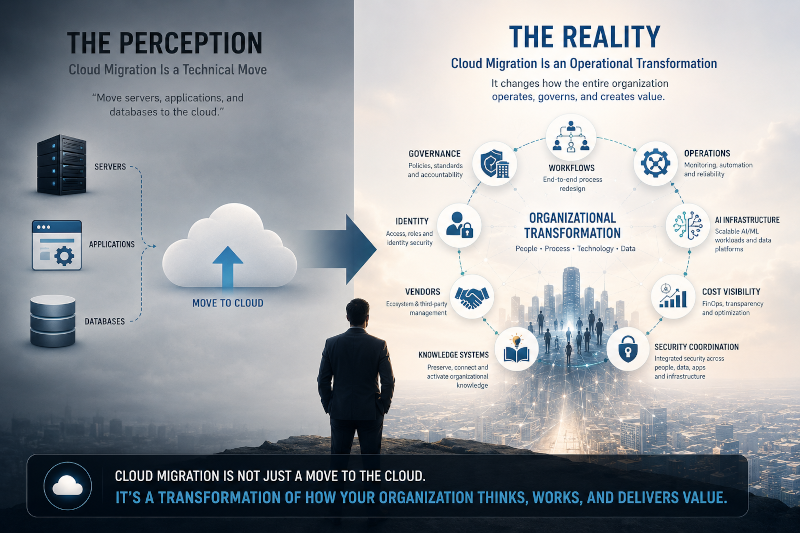
Research from McKinsey & Company noted that cloud transformations frequently require organizations to rethink operating models, governance structures, cost visibility, and cross-functional coordination rather than simply relocating infrastructure.
This becomes especially important as enterprises scale AI workloads, distributed systems, real-time analytics, and interconnected operational environments that depend heavily on resilient cloud infrastructure.
The issue is rarely:
“Can the systems move?”
The real question is:
“Can the organization operate effectively after they move?”
Recommendation: Treat cloud migration as an organizational operating model transformation rather than a standalone infrastructure modernization initiative.
Hidden Operational Complexity Expands Rapidly
One of the largest risks organizations underestimate during cloud migration is operational dependency complexity.
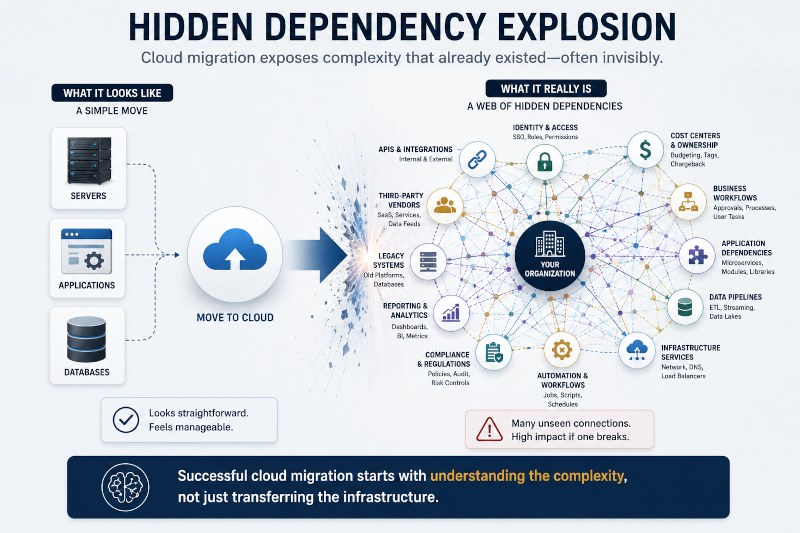
Legacy environments often contain years of undocumented integrations, embedded workflows, manual workarounds, custom scripts, identity dependencies, reporting logic, vendor connections, and operational assumptions spread across departments. Many of these relationships remain invisible until migration planning forces organizations to examine how systems actually function together.
Cloud migration therefore acts as a form of organizational stress test.
A seemingly straightforward ERP migration, for example, may quietly involve:
- procurement systems,
- finance approvals,
- vendor integrations,
- identity management,
- analytics pipelines,
- compliance reporting,
- customer portals,
- and downstream automation workflows.
When organizations migrate infrastructure without fully understanding those interdependencies, operational disruption becomes much more likely.
Research from McKinsey & Company emphasized that successful cloud modernization requires visibility into applications, operational dependencies, migration sequencing, governance structures, and organizational operating models simultaneously.
Lincoln Financial Group’s large-scale migration effort illustrates this complexity well. During its migration of approximately 120 systems into cloud environments, leadership noted that undocumented legacy technologies, missing source code, and embedded operational dependencies created major coordination and planning challenges throughout the transformation process.
The important insight is that cloud migration rarely creates organizational complexity from scratch. More often, it exposes complexity that already existed invisibly across fragmented operational systems.
This overlaps closely with themes explored previously in The Hidden Cost of Manual Internal Processes, where operational coordination layers quietly reduced execution quality long before organizations recognized the scale of internal friction itself.
Recommendation: Conduct dependency mapping across workflows, integrations, reporting systems, and operational ownership structures before migration planning begins.
Institutional Knowledge Loss Becomes a Major Risk
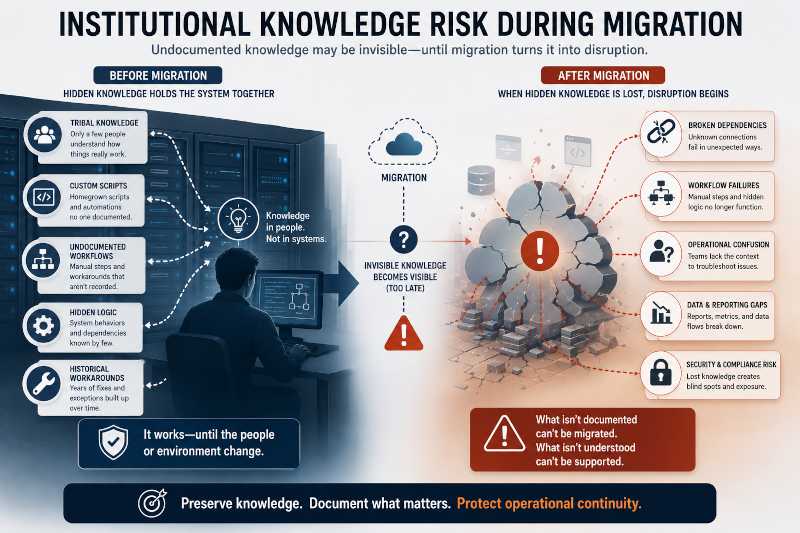
Another cloud migration risk organizations frequently underestimate involves institutional knowledge loss.
Many legacy systems continue functioning effectively not because they are well documented, but because specific employees understand years of undocumented operational logic surrounding them. Over time, organizations often become dependent on:
- tribal knowledge,
- historical workarounds,
- embedded manual processes,
- undocumented integrations,
- and operational assumptions known only by small groups of employees.
Cloud migration can destabilize those hidden knowledge systems rapidly.
Organizations may discover that nobody fully understands:
- why certain workflows exist,
- how integrations behave under specific conditions,
- which systems act as unofficial sources of truth,
- or how downstream processes depend on historical operational behaviors.
This challenge becomes particularly dangerous when experienced administrators, engineers, or operational staff leave during transformation efforts.
Research from APQC and enterprise knowledge management studies has repeatedly emphasized that organizations frequently underestimate the operational risk associated with undocumented institutional knowledge and fragmented retrieval environments. Similar concerns have also been discussed publicly by NASA in the context of preserving operational continuity across highly specialized technical environments.
This is one reason cloud migration frequently intersects with broader organizational knowledge management challenges.
As explored previously in Why Organizational Knowledge Disappears Faster Than Companies Realize, fragmented institutional knowledge often weakens operational resilience long before failures become visible organizationally.
The migration itself therefore becomes less about servers and applications and more about preserving operational continuity during structural change.
Organizations that migrate successfully often spend significant time documenting workflows, validating dependencies, clarifying ownership structures, and preserving historical operational context before decommissioning legacy systems.
Recommendation: Preserve institutional knowledge by documenting operational workflows, downstream dependencies, and system-specific decision logic before migration activities begin.
Cloud Governance Often Lags Behind Migration Speed
Cloud adoption frequently scales faster than governance maturity.
This creates one of the most overlooked risks in modern enterprise cloud environments:
organizations expand cloud infrastructure rapidly while operational accountability, visibility, and governance structures struggle to keep pace.
Research from Gartner warned that traditional governance models often fail to adapt effectively as organizations scale public cloud adoption, creating operational, financial, and security risks across enterprise environments.
As cloud environments expand, organizations frequently encounter:
- identity sprawl,
- fragmented access management,
- duplicated workloads,
- inconsistent provisioning,
- unclear ownership,
- unmanaged resources,
- and reduced operational visibility.
These problems compound quickly because cloud infrastructure allows teams to provision resources at machine speed.
Without strong governance, scalability itself can amplify operational risk.
Research from Flexera found that 84% of organizations continue struggling to manage cloud spend effectively, while many enterprises exceed cloud budgets and experience difficulty maintaining cost visibility across distributed environments.
This challenge becomes especially severe inside multi-cloud environments where governance responsibilities span multiple providers, teams, and operational domains simultaneously.
Capital One’s cloud transformation is often viewed positively because the organization paired infrastructure modernization with major investments in governance, security engineering, automation, and operational accountability. The migration was not treated merely as infrastructure relocation. It involved redesigning how technology operations functioned organizationally.
The strongest cloud environments therefore do not simply scale infrastructure.
They scale:
- governance,
- accountability,
- operational visibility,
- and resilience simultaneously.
Recommendation: Establish operational governance, ownership accountability, and identity management standards before scaling cloud infrastructure broadly across teams.
Cloud Cost Optimization Is Often Misunderstood
One of the most persistent misconceptions surrounding cloud migration is the assumption that cloud adoption automatically reduces operational costs.
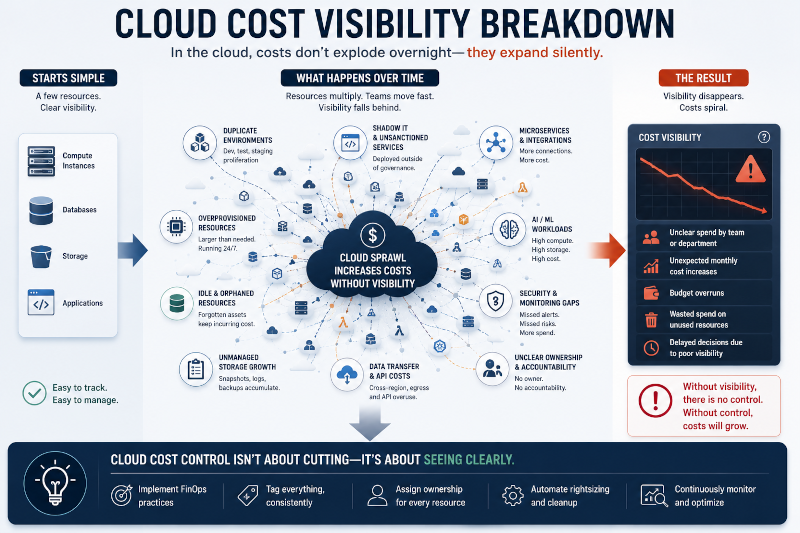
In reality, cloud environments often shift organizations from predictable fixed infrastructure spending toward continuous consumption-based operational spending.
Without governance maturity, those costs can scale rapidly and unpredictably.
Research from Flexera found that cloud spending is expected to continue rising significantly, while organizations still report substantial levels of wasted or underoptimized cloud expenditure.
This happens because cloud environments make it operationally easy to:
- duplicate environments,
- overprovision workloads,
- retain idle resources,
- expand storage continuously,
- and deploy services without centralized visibility.
The issue is rarely cloud technology itself.
The issue is uncontrolled operational scaling.
Research examining cloud migration economics has also shown that organizations frequently underestimate the cost impact of:
- database architecture,
- licensing structures,
- inefficient integrations,
- API overuse,
- and poorly optimized system behavior after migration.
Dropbox provides an important example of this complexity. While the company successfully leveraged cloud infrastructure for growth, it later repatriated portions of its infrastructure back into internally managed environments after determining that certain workloads could operate more efficiently under hybrid infrastructure models.
This reflects a broader shift occurring across enterprise environments: cloud strategy is becoming more nuanced.
Organizations are beginning to realize that successful cloud adoption depends less on migrating everything and more on understanding which workloads benefit operationally, financially, and strategically from cloud environments.
This is also one reason FinOps practices are expanding rapidly across enterprise environments. Organizations increasingly recognize that cloud infrastructure requires continuous financial governance rather than periodic infrastructure budgeting alone.
Recommendation: Build continuous workload-level cost visibility and cloud financial governance into operational management processes rather than treating optimization as a periodic review exercise.
AI and Automation Are Increasing Cloud Dependency
Cloud migration is becoming even more strategically important because AI systems now depend heavily on scalable cloud infrastructure.
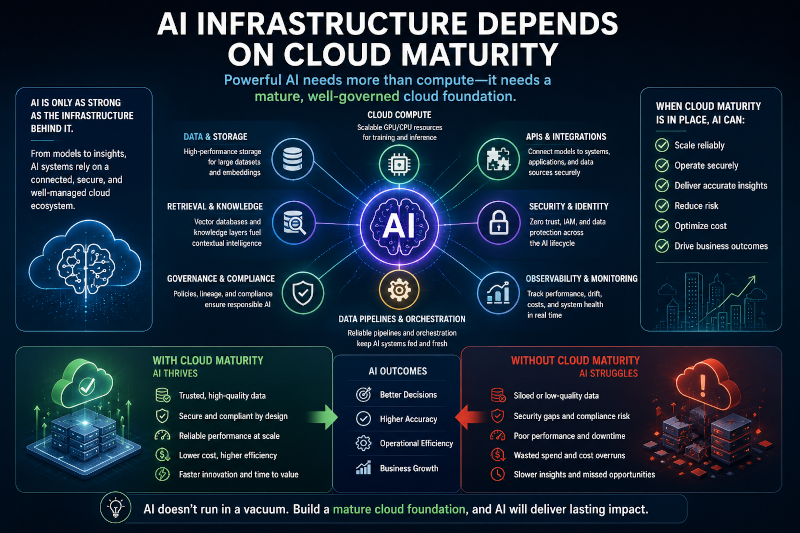
Modern AI environments require:
- distributed compute,
- retrieval systems,
- large-scale storage,
- API coordination,
- scalable processing,
- and resilient data pipelines.
This means cloud architecture increasingly functions as foundational enterprise infrastructure rather than simply outsourced hosting.
Flexera found that adoption of AI-related cloud services has accelerated rapidly across enterprises, with organizations scaling machine learning, generative AI, and data-intensive workloads directly inside cloud environments.
This creates a major strategic implication: AI amplifies both resilient systems and fragmented systems.
Inside well-governed cloud environments, AI can improve:
- retrieval,
- automation,
- operational coordination,
- and decision speed.
Inside poorly governed environments, however, AI can accelerate:
- operational inconsistency,
- governance fragmentation,
- security visibility gaps,
- and unreliable automation.
This overlaps directly with themes explored previously in The Future of Operational Intelligence in AI-Driven Organizations, where AI scalability depended heavily on governance maturity, operational visibility, and workflow coordination quality.
The organizations benefiting most from AI may therefore not necessarily be the organizations deploying the most AI tools.
More often, they may be the organizations building infrastructure environments mature enough to support AI operationally at scale.
Recommendation: Evaluate whether cloud environments can support long-term AI governance, retrieval integrity, operational resilience, and scalable coordination requirements before expanding automation initiatives.
Conclusion: Cloud Migration Is Really Organizational Transformation
Cloud migration succeeds or fails operationally long before infrastructure migration itself is complete.
The organizations struggling most are often not the organizations lacking cloud expertise. More often, they are the organizations underestimating how deeply cloud migration affects workflows, governance structures, institutional knowledge, operational visibility, and coordination models across the enterprise.
McKinsey & Company noted that only a relatively small percentage of organizations fully capture expected cloud transformation value because infrastructure modernization alone does not automatically produce operational maturity.
“Cloud migration is rarely just a technology project. It is a redesign of how the organization coordinates, governs, and operates at scale.”
The strongest cloud transformations therefore focus not only on:
- technical migration,
but also on: - governance maturity,
- operational resilience,
- workflow continuity,
- knowledge preservation,
- and organizational coordination simultaneously.
Cloud migration is ultimately not just about moving systems. It is about redesigning how organizations operate inside interconnected digital environments.
Recommendation: Measure cloud transformation success through operational resilience, governance maturity, execution continuity, and organizational adaptability rather than migration speed alone.