
Recommendations
- Focus AI deployment on operational workflows with measurable coordination, decision, or execution bottlenecks rather than deploying AI broadly without workflow redesign.
- Integrate AI into clearly defined operational workflows with human verification, escalation, and accountability layers built into execution environments.
- Redesign employee roles around decision quality, workflow coordination, and AI oversight rather than measuring productivity primarily through repetitive task output.
- Establish centralized governance standards for AI validation, escalation pathways, retrieval integrity, and operational accountability before scaling AI broadly across departments.
- Prioritize AI deployment inside operational environments with clear governance ownership, measurable workflow bottlenecks, and structured performance metrics before scaling experimentation further.
- Treat AI adoption as an operational redesign initiative involving workflows, governance, coordination systems, and organizational structure rather than a standalone technology deployment project.
For the past several years, most organizations approached artificial intelligence through experimentation. Teams tested copilots, executives explored automation pilots, and departments deployed isolated AI tools in search of productivity gains. But across enterprise environments, the conversation is now shifting away from experimentation toward operational execution.
The central question is no longer whether AI can generate content, summarize meetings, or automate isolated tasks. The more important question is whether organizations can redesign workflows, governance systems, and operational structures around AI-assisted work in a sustainable way.
This marks a major transition in enterprise technology strategy. AI is gradually becoming operational infrastructure embedded directly into workflows, coordination systems, decision environments, and enterprise knowledge architecture. Research from the Microsoft 2024 Work Trend Index found that 75% of knowledge workers already use AI at work, while many organizations continue struggling to redesign processes, governance models, and operational structures around that reality. Microsoft also noted that employees are often adopting AI tools faster than organizations are formally governing them.
This transition is beginning to reshape how enterprises think about:
- operational coordination,
- workforce structure,
- decision-making,
- governance,
- cybersecurity,
- and organizational scalability itself.
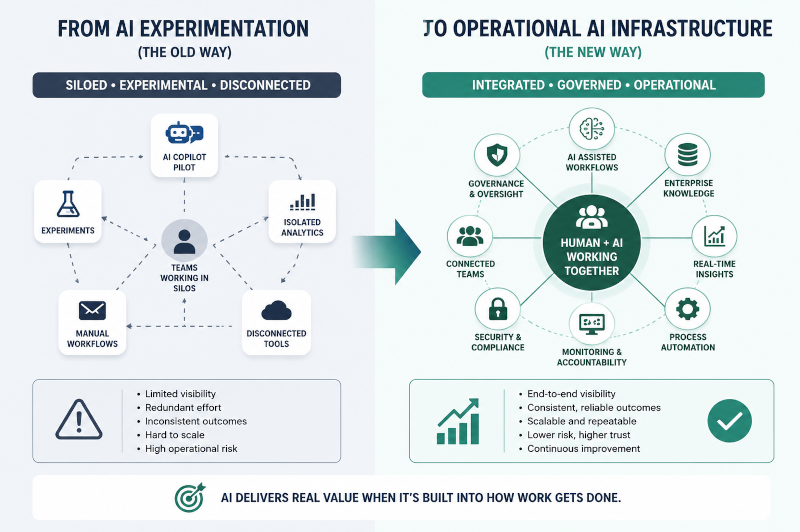
The organizations benefiting most from AI are often not the ones deploying the largest number of tools. More often, they are the organizations redesigning operational systems to integrate human judgment, machine-assisted analysis, and workflow coordination effectively at scale.
This overlaps closely with themes explored previously in The Future of Operational Intelligence in AI-Driven Organizations, where operational intelligence increasingly depended on real-time coordination between analytics, automation, institutional knowledge, and decision infrastructure rather than isolated reporting systems alone.
Recommendation: Focus AI deployment on operational workflows with measurable coordination, decision, or execution bottlenecks rather than deploying AI broadly without workflow redesign.
AI Is Becoming Operational Infrastructure
One of the biggest misconceptions surrounding enterprise AI adoption is the assumption that AI functions primarily as a standalone productivity layer. In practice, AI is gradually becoming embedded directly into operational systems themselves.
Customer service environments now use AI-assisted routing and response systems. Cybersecurity platforms prioritize anomalies automatically. Supply chains continuously adjust forecasting models. Legal departments increasingly use AI-assisted document analysis and retrieval systems. Finance teams deploy AI copilots for reporting, reconciliation, and operational analysis.
This changes the role of enterprise technology entirely.
Historically, most analytics systems supported human interpretation. Modern AI systems increasingly participate directly inside operational execution environments themselves. Research from McKinsey’s Technology Trends Outlook 2025 emphasized that agentic AI systems are rapidly evolving from experimental pilots into operational tools capable of executing multistep workflows and interacting autonomously across enterprise environments.
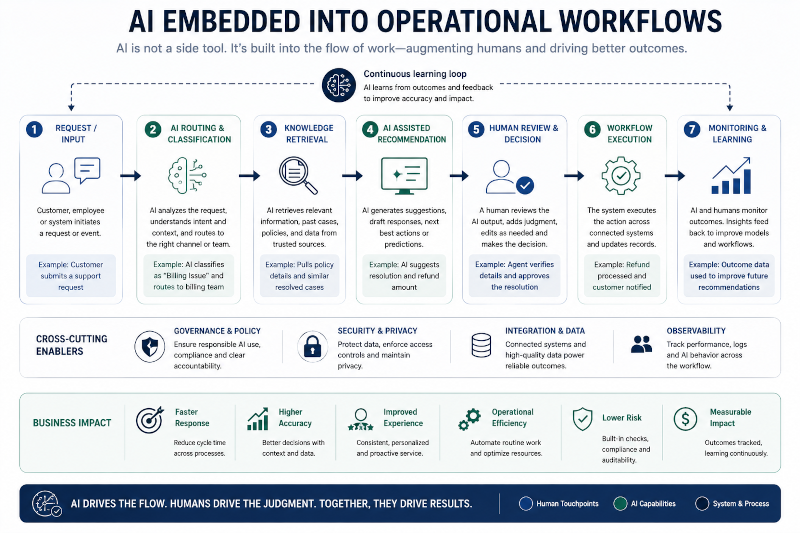
This does not necessarily mean fully autonomous organizations are emerging immediately. Instead, enterprises are gradually building hybrid operational environments where humans and AI systems function together continuously across workflows.
The shift becomes particularly visible inside organizations redesigning coordination systems around AI-assisted work rather than merely adding AI on top of existing processes.
JPMorgan Chase, for example, has publicly expanded AI deployment across fraud detection, operational analytics, risk monitoring, and internal workflow systems while simultaneously strengthening governance oversight around explainability, model accountability, and operational verification layers. The company’s broader strategy reflects a growing enterprise recognition that AI effectiveness depends heavily on governance quality and workflow integration rather than model capability alone.
This mirrors broader operational coordination themes explored in The Hidden Cost of Manual Internal Processes, where fragmented workflows and disconnected systems quietly reduced organizational responsiveness long before technology limitations appeared.
The organizations scaling AI most effectively are often redesigning workflows structurally rather than treating AI as a disconnected productivity add-on.
Recommendation: Integrate AI into clearly defined operational workflows with human verification, escalation, and accountability layers built into execution environments.
The Workforce Is Shifting From Task Execution to Coordination
One of the most significant changes underway across enterprise environments is the evolution of human work itself.
As AI systems absorb more repetitive cognitive tasks, employee value increasingly shifts toward coordination, contextual judgment, oversight, governance, and decision quality rather than raw information processing alone.
This does not mean traditional knowledge work disappears. It means the nature of knowledge work changes.
Research from Microsoft’s Work Trend Index found that many employees already rely heavily on AI systems for drafting, summarization, retrieval, and analytical support while organizations continue struggling to redesign roles, expectations, and workflow structures around those changes.
The result is the emergence of what many organizations now describe as hybrid intelligence environments where employees increasingly supervise, validate, coordinate, and refine AI-assisted outputs rather than performing every task manually themselves.
This transition creates growing demand for operational capabilities such as:
- workflow orchestration,
- governance oversight,
- contextual reasoning,
- escalation management,
- and cross-functional coordination.
Many organizations still frame AI primarily as a labor reduction tool. But in practice, many of the most successful enterprise deployments focus more heavily on operational augmentation than replacement.
Research from Deloitte’s State of Generative AI in the Enterprise report similarly found that organizations are now moving beyond experimentation toward operational scaling, although governance uncertainty, risk management, workforce adaptation, and process redesign remain major barriers to sustainable deployment.
This shift also changes management itself. Middle managers increasingly spend less time gathering information manually and more time resolving ambiguity, coordinating decisions, maintaining operational alignment, and managing organizational adaptation under rapidly changing conditions.
The organizations adapting most successfully are often the ones redefining human roles around coordination quality and operational judgment rather than purely repetitive execution.
Recommendation: Redesign employee roles around decision quality, workflow coordination, and AI oversight rather than measuring productivity primarily through repetitive task output.
Governance Is Becoming the Real Enterprise AI Challenge
Many organizations initially approached AI adoption as a technology deployment challenge. In practice, the larger challenge increasingly revolves around governance.
As AI systems become embedded into workflows, enterprises must answer operational questions that extend far beyond model performance itself:
- Who validates AI-assisted decisions?
- Which workflows require human escalation?
- How are outputs audited?
- Which data sources remain trustworthy?
- How are retrieval systems secured?
- Who owns accountability when AI-generated recommendations influence operational outcomes?
These governance problems become more complex as enterprises scale AI deployment across multiple departments simultaneously.
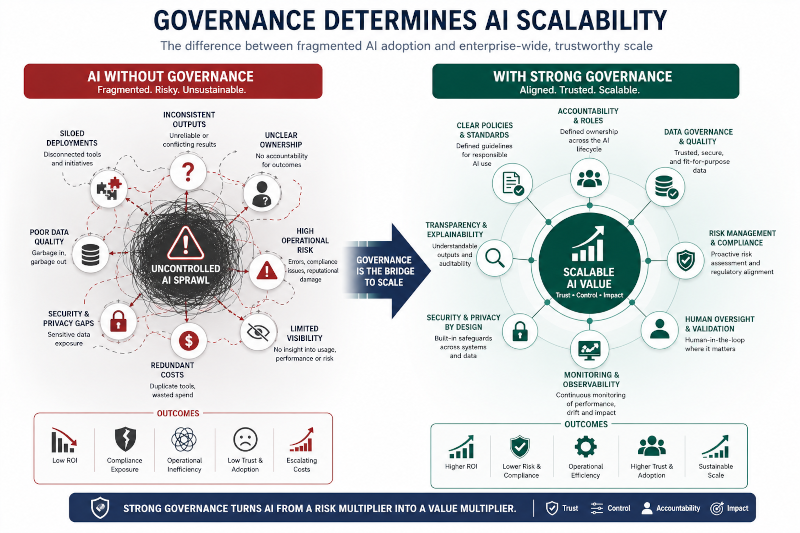
Research from Deloitte’s enterprise AI survey found that regulatory uncertainty, governance maturity, data quality, and operational risk management remain among the largest barriers preventing organizations from scaling AI successfully across enterprise environments.
The challenge becomes even more significant as organizations experiment with agentic AI systems capable of executing multistep operational tasks autonomously.
McKinsey’s 2025 technology trends analysis similarly emphasized that agentic AI systems are evolving rapidly, but organizations still require governance structures capable of managing explainability, operational alignment, oversight, and organizational accountability as these systems scale.
This challenge increasingly overlaps with cybersecurity, operational resilience, and institutional knowledge management simultaneously.
For example, organizations deploying AI copilots into fragmented documentation environments often discover that AI systems inherit the same inconsistencies already embedded inside enterprise workflows. Poor retrieval quality, outdated institutional knowledge, and fragmented governance structures frequently produce operational instability long before technical failures become visible.
This mirrors broader coordination problems explored previously in Why Organizational Knowledge Disappears Faster Than Companies Realize, where fragmented institutional memory systems quietly weakened operational continuity and execution consistency over time.
The organizations scaling AI most effectively are often the ones building governance infrastructure as aggressively as they build AI capability itself.
Recommendation: Establish centralized governance standards for AI validation, escalation pathways, retrieval integrity, and operational accountability before scaling AI broadly across departments.
AI Adoption Is Becoming an Operational Discipline
One of the clearest enterprise patterns emerging in 2026 is that AI success depends less on experimentation volume and more on operational discipline.
During the early wave of generative AI adoption, many organizations pursued broad experimentation. But across enterprise environments, leaders are now recognizing that sustainable AI value emerges when deployment aligns closely with operational workflows, governance maturity, and organizational readiness.
Research from Deloitte found that while many organizations remain optimistic about AI’s long-term potential, relatively few experimental initiatives scale successfully into production environments without substantial workflow redesign and governance alignment.
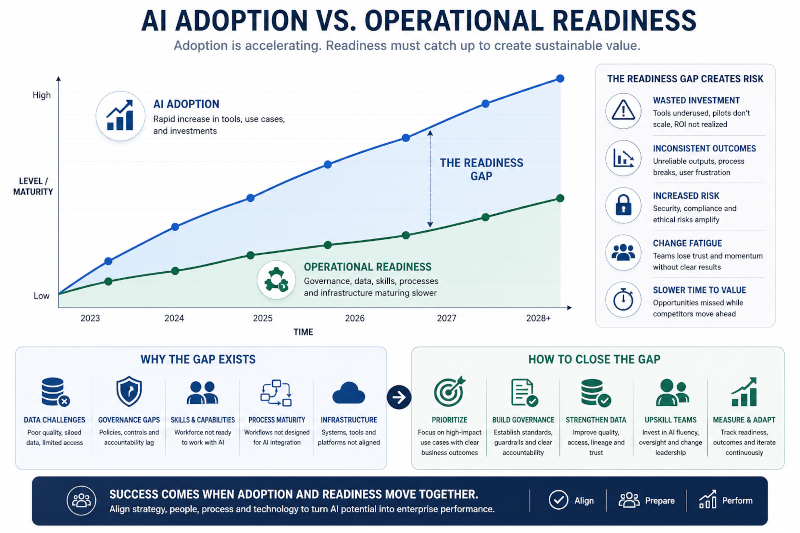
McKinsey similarly reported that organizations generating the strongest returns from AI often focused deployment on a relatively small number of operational areas rather than attempting broad, unfocused transformation efforts.
This reflects a broader reality: AI implementation increasingly resembles operational transformation rather than software deployment.
Organizations now confront practical infrastructure questions involving:
- workflow redesign,
- coordination systems,
- cloud cost management,
- cybersecurity,
- retrieval architecture,
- operational resilience,
- and enterprise scalability.
The infrastructure implications are becoming significant as well. Research examining AI supercomputing environments found that AI infrastructure power requirements, hardware costs, and operational resource demands continue expanding rapidly as organizations scale AI workloads globally.
This also helps explain why FinOps, cloud optimization, governance maturity, and operational simplification are becoming strategically important again. Organizations increasingly recognize that scaling AI across fragmented operational systems can amplify complexity faster than productivity if workflows remain poorly coordinated.
The most successful enterprises are gradually shifting from:
“Where can we deploy AI?”
toward:
“Which operational systems should AI improve first?”
That distinction matters enormously.
Recommendation: Prioritize AI deployment inside operational environments with clear governance ownership, measurable workflow bottlenecks, and structured performance metrics before scaling experimentation further.
The Organizations That Adapt Fastest Will Redesign Work Itself
The transition from AI hype to operational execution ultimately reflects a larger transformation underway across enterprise environments.
AI is no longer functioning primarily as a novelty tool layered on top of existing workflows. It is gradually becoming embedded into coordination systems, operational infrastructure, decision environments, and enterprise knowledge architecture itself.
This means the competitive advantage in 2026 may no longer depend primarily on access to AI tools. Increasingly, it may depend on how effectively organizations redesign operational systems around human-machine collaboration.
Research from Microsoft’s more recent workplace analysis noted that the organizations seeing the strongest AI impact are often the ones restructuring workflows, governance models, and organizational coordination around AI-assisted work rather than simply deploying tools broadly across departments.
The organizations adapting most successfully are often:
- simplifying workflows,
- strengthening governance,
- redesigning operational roles,
- improving institutional knowledge retrieval,
- and building operational systems capable of supporting continuous coordination between humans and AI environments.
This increasingly resembles the emergence of a new enterprise operating model rather than a temporary technology cycle.
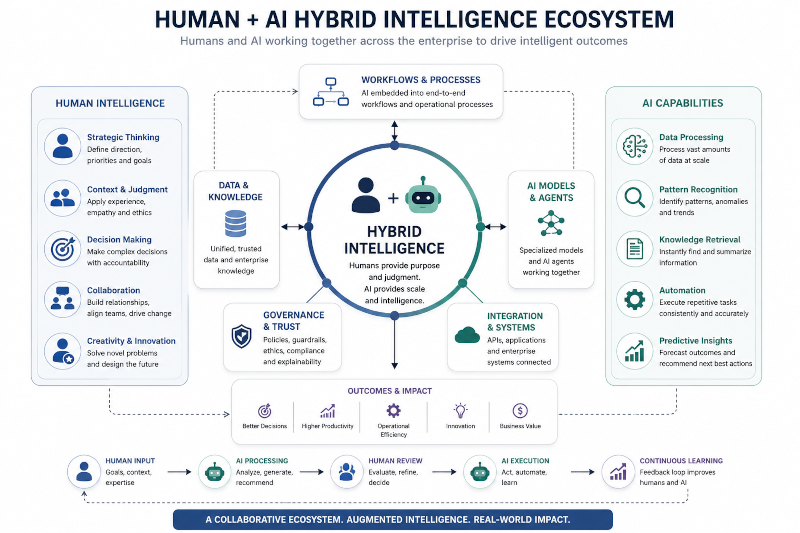
The transition from AI hype to operational execution is therefore not simply about adopting better tools. It is about redesigning how organizations coordinate work, govern decisions, manage complexity, and scale operational intelligence across increasingly interconnected environments.
The organizations that succeed in the next phase of enterprise AI may not be the ones automating the most work. More often, they may be the organizations redesigning operational systems well enough for humans and AI to coordinate effectively at scale.
Recommendation: Treat AI adoption as an operational redesign initiative involving workflows, governance, coordination systems, and organizational structure rather than a standalone technology deployment project.