- Recommendations
- AI Is Only as Effective as the Knowledge It Operates On
- Knowledge Sharing Directly Impacts Organizational Performance
- Knowledge Systems Strengthen Innovation and Organizational Resilience
- Knowledge Management Is Becoming Operational Infrastructure
- Conclusion: Knowledge Systems Are Becoming Organizational Intelligence Systems
Recommendations
- Evaluate KM systems based on how effectively they support operational execution, retrieval quality, and decision-making speed rather than document volume alone.
- Standardize knowledge taxonomies, ownership structures, and retrieval governance before scaling AI copilots across operational environments.
- Measure how quickly employees can locate trusted operational information needed to execute recurring workflows consistently.
- Build knowledge systems that allow lessons learned, operational insights, and experimentation outcomes to remain reusable across teams and future initiatives.
- Treat Knowledge Management as part of the organization’s execution infrastructure and align KM strategy directly with workflow coordination, AI governance, and operational resilience goals.
- Build KM environments designed to support operational execution speed, AI-assisted coordination, and long-term organizational learning rather than passive information storage alone.
In 2026, competitive advantage is no longer determined solely by who possesses the most data, the largest cloud infrastructure, or the newest artificial intelligence tools. Most enterprises already operate in environments saturated with information, collaboration platforms, analytics systems, and automation technologies.
The real differentiator is becoming something far more operational: the ability to transform knowledge into coordinated execution across people, systems, workflows, and AI-assisted environments.
This shift is quietly redefining the role of Knowledge Management (KM) inside modern organizations. What was once treated primarily as a documentation or compliance function is now evolving into a core layer of enterprise infrastructure that directly affects operational responsiveness, AI reliability, innovation capacity, and organizational resilience.
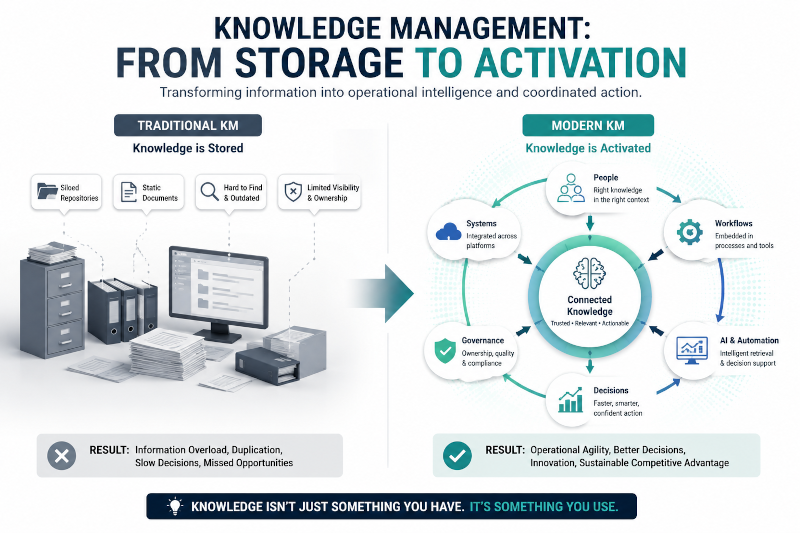
Recent research supports this transition clearly. Studies examining AI-enabled knowledge systems, organizational learning, and enterprise performance consistently show that organizations with mature knowledge environments adapt faster, coordinate more effectively, and generate more reliable operational outcomes than organizations operating with fragmented knowledge structures.
This matters because modern organizations no longer compete only on access to information. They compete on retrieval speed, knowledge activation, operational coordination, and execution consistency.
As explored previously in The Silent Productivity Killer: How Knowledge Managers Give You Your Time Back, operational friction often accumulates quietly when employees cannot locate trusted information quickly enough to execute work effectively.
Knowledge Management is therefore becoming less about storing information and more about enabling organizational intelligence at scale.
Recommendation: Evaluate KM systems based on how effectively they support operational execution, retrieval quality, and decision-making speed rather than document volume alone.
AI Is Only as Effective as the Knowledge It Operates On
As organizations scale generative AI across operational environments, one reality is becoming difficult to ignore: AI systems are only as effective as the knowledge ecosystems surrounding them.
Artificial intelligence does not inherently understand organizational context. It reflects the quality, structure, accessibility, and consistency of the information it retrieves.
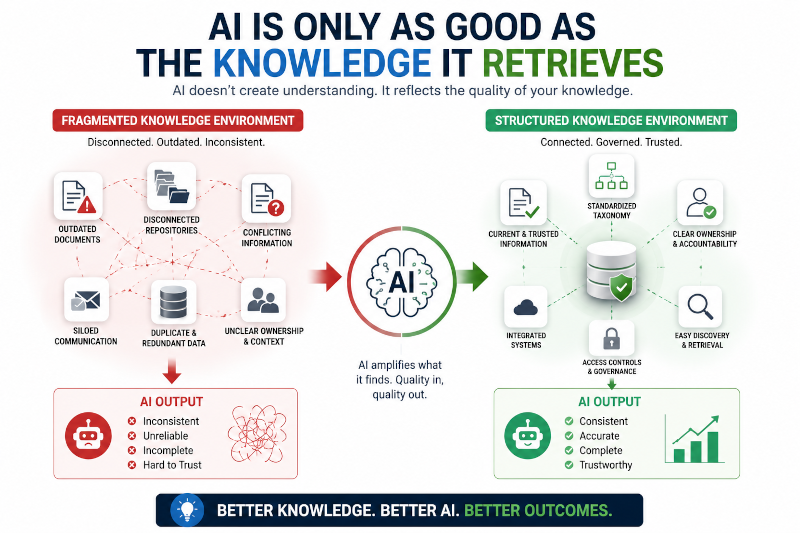
Research by Kirchner (2025) examining AI-enabled knowledge systems found that organizations achieve meaningful performance improvements only when AI deployment is paired with structured governance, consistent taxonomies, and clearly defined knowledge ownership models.
Without these foundations, AI often amplifies operational inconsistency rather than reducing it.
This becomes especially visible in enterprise retrieval environments where AI copilots pull information from outdated documents, fragmented repositories, disconnected workflows, or conflicting operational guidance. In those situations, the issue is not that AI lacks intelligence. The issue is that the organization lacks coherent operational knowledge structures.
Microsoft has encountered this challenge directly while expanding enterprise AI copilots across organizations. Microsoft executives have repeatedly emphasized that Copilot performance depends heavily on retrieval quality, permissions management, and organizational knowledge hygiene rather than the AI model alone. Organizations with poorly governed knowledge systems frequently experience inconsistent outputs and reduced trust in AI-assisted workflows.
JPMorgan Chase provides another important example. The company has expanded AI systems across fraud detection, operational analytics, and workflow environments while simultaneously investing heavily in governance, retrieval integrity, explainability, and operational oversight. The focus is not simply deploying AI broadly. It is ensuring that AI systems operate on trusted and well-governed organizational knowledge structures.
This is one reason AI governance and knowledge management are becoming strategically interconnected disciplines.
AI does not fix broken knowledge systems. It exposes them.
Organizations with fragmented knowledge environments often discover that AI accelerates duplication, operational confusion, inconsistent outputs, and workflow fragmentation. Organizations with mature knowledge systems, however, are able to use AI as a force multiplier for operational coordination and decision-making speed.
Recommendation: Standardize knowledge taxonomies, ownership structures, and retrieval governance before scaling AI copilots across operational environments.
Knowledge Sharing Directly Impacts Organizational Performance
Knowledge management affects organizational performance through one critical mechanism:
knowledge flow.
Most organizations already possess enormous amounts of information. The operational problem is rarely a lack of data. More often, it is the inability to move trusted knowledge efficiently across teams, workflows, and decision environments.
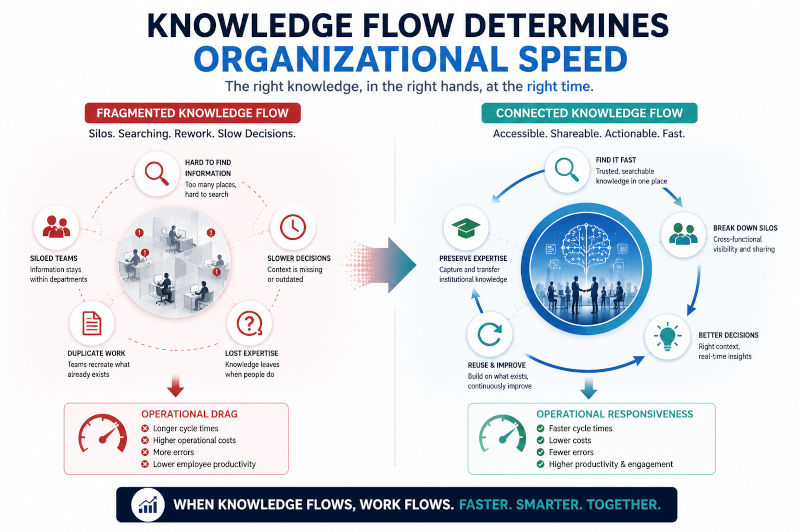
The key distinction is important.
Knowledge only becomes valuable operationally when employees can retrieve it, understand it, trust it, and apply it quickly.
In many organizations, valuable operational knowledge exists somewhere inside the enterprise but remains functionally inaccessible because it is buried across shared drives, ticketing systems, email threads, legacy databases, disconnected wikis, and tribal knowledge environments.
The result is cumulative operational friction.
Employees spend time searching for context, validating information, recreating previous work, clarifying ownership, or locating historical decisions that already exist somewhere else in the organization. This slows execution quality significantly.
Toyota’s production system offers one of the clearest long-term examples of operational knowledge flow functioning strategically. Toyota historically treated process knowledge, operational learning, and continuous improvement systems as reusable organizational assets embedded directly into workflows rather than passive documentation repositories. This enabled operational consistency, rapid problem-solving, and scalable learning across global production environments.
NASA has also publicly discussed institutional knowledge preservation challenges for years, particularly in highly specialized technical environments where operational continuity depends heavily on preserving historical expertise across generations of engineers and contractors.
The strongest organizations therefore do not simply store knowledge. They operationalize it.
This overlaps directly with themes explored previously in Knowledge Retrieval as Enterprise Infrastructure, where retrieval speed and operational accessibility increasingly influenced execution quality itself.
Knowledge Management functions less like an archive and more like a circulation system for organizational intelligence.
Recommendation: Measure how quickly employees can locate trusted operational information needed to execute recurring workflows consistently.
Knowledge Systems Strengthen Innovation and Organizational Resilience
Knowledge Management also plays a major role in determining how effectively organizations innovate and adapt under changing conditions.
Research by Rainaa et al. (2025) published in the Journal of Innovation & Knowledge found that AI-enabled knowledge systems significantly improved organizational adaptability, innovation capability, and responsiveness during periods of technological and operational disruption.
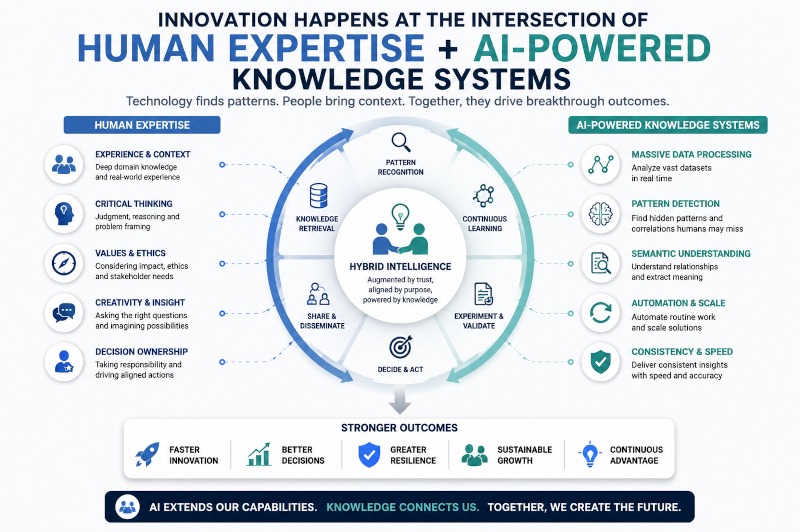
This happens because mature knowledge environments allow organizations to reuse prior insights, identify operational patterns, reduce duplicated experimentation, and accelerate learning cycles across teams. Innovation therefore becomes cumulative rather than isolated.
Organizations with fragmented knowledge systems frequently repeat the same mistakes because lessons learned fail to transfer effectively across departments, projects, or operational environments.
Research by Narang and Chatterjee (2025) similarly emphasized that innovation outcomes improve most when AI-enabled knowledge systems operate alongside human expertise rather than independently from it.
This distinction matters because AI systems remain limited in areas involving contextual judgment, organizational nuance, conflicting priorities, ethical tradeoffs, and strategic interpretation.
The strongest innovation environments therefore combine machine-driven retrieval and pattern recognition with human reasoning, operational experience, and contextual understanding.
Pharmaceutical companies provide strong examples of this dynamic. Organizations using AI-assisted research platforms alongside expert scientific collaboration environments are accelerating discovery workflows while still relying heavily on domain expertise to validate findings, interpret anomalies, and guide strategic research direction.
The strategic implication is significant: innovation does not emerge from automation alone.
It emerges from the interaction between structured organizational knowledge, human expertise, and intelligent systems operating together.
Organizations that treat KM as a strategic capability rather than a documentation exercise are often better positioned to adapt during periods of uncertainty and operational change.
Recommendation: Build knowledge systems that allow lessons learned, operational insights, and experimentation outcomes to remain reusable across teams and future initiatives.
Knowledge Management Is Becoming Operational Infrastructure
Across all of these trends, one conclusion is becoming difficult to ignore: Knowledge Management is evolving into operational infrastructure.
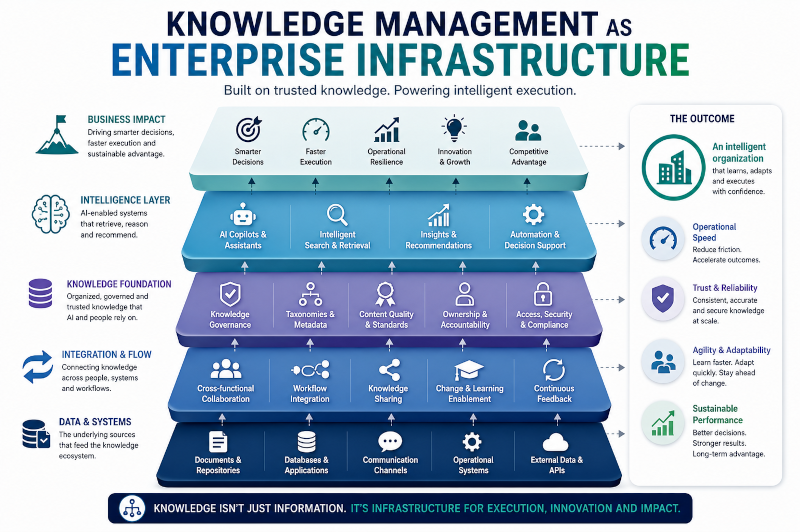
Traditional KM systems focused heavily on document storage, repository management, compliance support, and archival preservation. Those functions still matter, but modern operational environments now require much more.
Organizations increasingly depend on knowledge systems capable of supporting:
- real-time retrieval,
- cross-functional coordination,
- AI integration,
- and workflow continuity.
This transition changes how organizations think about productivity itself.
Productivity is no longer determined solely by employee effort or output volume. It is shaped by how much operational friction organizations remove from retrieval, coordination, onboarding, and decision-making environments.
This is why Knowledge Management is becoming closely tied to operational resilience, enterprise intelligence, AI scalability, and organizational adaptability.
The organizations leading in the next phase of enterprise transformation may not necessarily be the organizations generating the most information or deploying the largest number of AI systems.
More often, they may be the organizations building knowledge environments capable of supporting coordinated execution, operational trust, and scalable decision-making across interconnected systems.
Knowledge is no longer simply something organizations possess. It is something organizations must continuously activate operationally.
Recommendation: Treat Knowledge Management as part of the organization’s execution infrastructure and align KM strategy directly with workflow coordination, AI governance, and operational resilience goals.
Conclusion: Knowledge Systems Are Becoming Organizational Intelligence Systems
The role of Knowledge Management is changing fundamentally.
KM is no longer simply a support function responsible for storing documents and preserving historical information. It is becoming part of the organization’s intelligence layer — influencing how effectively enterprises retrieve knowledge, coordinate workflows, scale AI systems, preserve operational continuity, and execute decisions under pressure.
The organizations gaining the greatest advantage from AI and digital transformation are often not the organizations deploying the most tools.
More often, they are the organizations building operational environments where trusted knowledge remains accessible, retrieval remains fast, coordination remains scalable, and institutional learning remains reusable across teams and systems.
This is the strategic shift underway: competitive advantage is moving from information possession toward knowledge activation.
“Competitive advantage is shifting from information possession to the ability to transform knowledge into coordinated action.”
The future of enterprise performance may depend less on how much information organizations store and more on how effectively they transform knowledge into coordinated action across increasingly interconnected operational environments.
Recommendation: Build KM environments designed to support operational execution speed, AI-assisted coordination, and long-term organizational learning rather than passive information storage alone.
this made the situation feel less like a dead end
that sentence about progress… yeah, keeping that one
Your writing style is so engaging and easy to follow I find myself reading through each post without even realizing I’ve reached the end
Thank you, I try to keep it simple.