- Recommendations
- Work Is No Longer Defined by the Traditional 9-to-5 Structure
- Leadership Is Moving From Oversight Toward Enablement
- Meaning, Identity, and Well-Being Are Becoming Workforce Priorities
- The Future Manager Will Be Part Coach, Part Workflow Architect
- Conclusion: The Employer-Employee Relationship Is Being Renegotiated
Recommendations
- Evaluate workforce strategy based not only on compensation competitiveness, but also on development opportunities, flexibility, managerial trust, and employee well-being outcomes.
- Build performance systems around measurable outcomes, coordination quality, and execution reliability rather than physical presence or fixed-hour visibility alone.
- Train managers to function as coaches, workflow coordinators, and development facilitators rather than primarily as supervisors of task execution.
- Align workforce strategy around sustainable performance, employee growth, mental well-being, and organizational trust rather than relying exclusively on compensation incentives.
- Redesign manager training around coaching, workflow coordination, AI-assisted collaboration, and employee development rather than compliance management alone.
The global workforce is undergoing a structural transformation that extends far beyond generational preferences or remote work debates. By the end of the decade, Gen Z and Millennials will represent the overwhelming majority of the labor market, and their expectations are reshaping how organizations think about leadership, culture, career development, and the purpose of work itself.
What is changing is not simply where people work. It is the psychological contract between employees and employers.
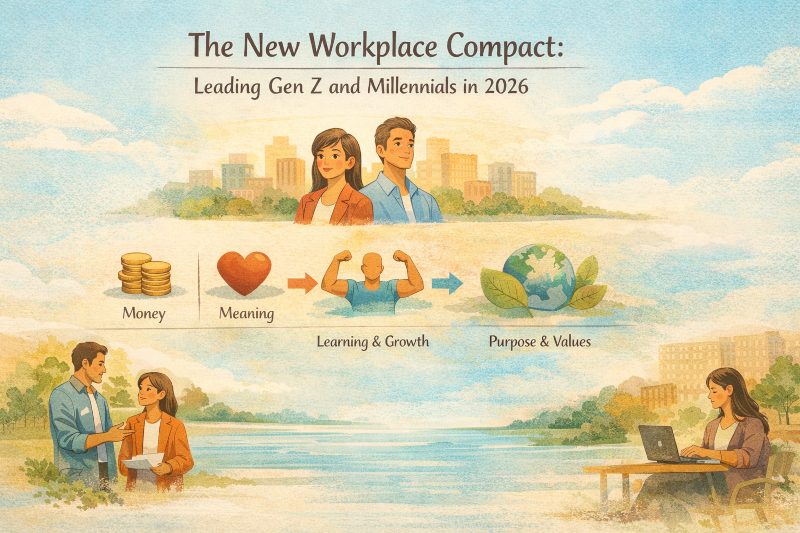
For decades, organizations largely operated around a transactional model: employees exchanged time and labor for compensation, stability, and career progression. Today, younger workers still care deeply about compensation and advancement, but workforce research consistently shows that they also evaluate employers through additional lenses including flexibility, well-being, development opportunities, autonomy, and organizational values.
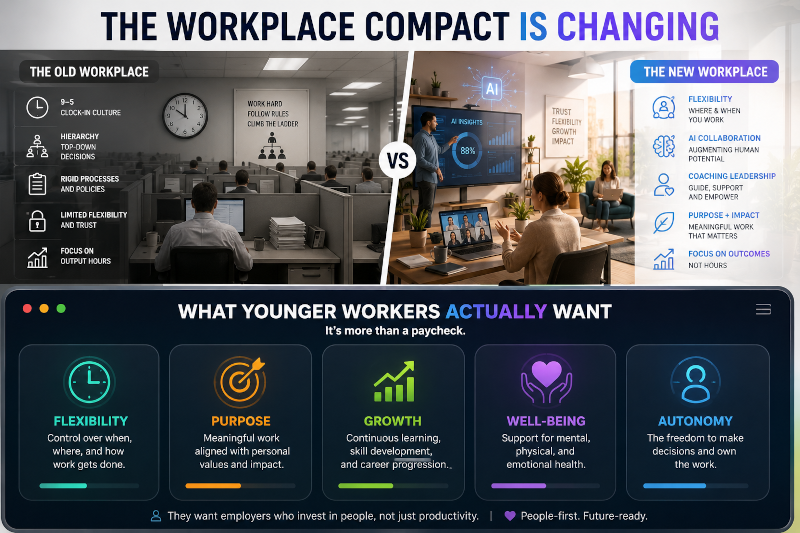
Deloitte’s 2025 Gen Z and Millennial Survey found that younger workers increasingly prioritize what the firm describes as the “trifecta” of money, meaning, and well-being when evaluating employers and career paths. The study also found that mentorship, learning opportunities, flexibility, and purpose strongly influence retention and engagement decisions.
This shift is creating pressure across enterprise environments because many organizations still operate using management systems designed for a different workforce era. Traditional leadership models centered primarily around oversight, compliance, and fixed organizational structures are becoming less effective in environments where employees expect transparency, flexibility, rapid feedback, and continuous growth.
As explored previously in The Managers New Playbook: Thriving in the Human-Agent Hybrid World of 2026, the role of management itself is evolving from supervising output toward coordinating increasingly dynamic human-AI work environments.
The workplace compact is changing alongside it.
Recommendation: Evaluate workforce strategy based not only on compensation competitiveness, but also on development opportunities, flexibility, managerial trust, and employee well-being outcomes.
Work Is No Longer Defined by the Traditional 9-to-5 Structure
For many younger employees, workplace flexibility is no longer perceived as a premium benefit. It is viewed as a baseline expectation.
This does not simply mean employees prefer remote work. The larger shift involves autonomy over how work is structured, coordinated, and integrated into daily life. Many Gen Z and Millennial employees now prioritize environments that allow them to manage productivity more independently rather than adhering rigidly to traditional time-based work models.
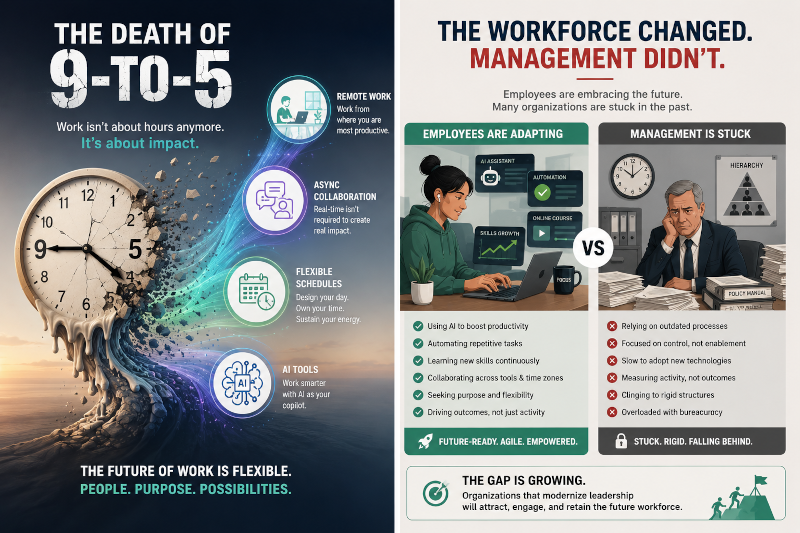
Research from Deloitte’s 2025 survey found that work-life balance remains one of the top priorities for younger workers globally, while rigid return-to-office mandates continue generating resistance across multiple industries.
This reflects a broader workforce transition: employees increasingly evaluate work based on sustainability rather than endurance.
Amazon provides a visible example of this tension. The company’s return-to-office policies generated significant employee pushback, particularly among workers who had normalized hybrid collaboration and greater autonomy during remote operations. The conflict was not simply about commuting. It reflected competing philosophies regarding trust, productivity, flexibility, and organizational control.
At the same time, AI adoption is also reshaping how younger workers approach career development. Many Gen Z employees now use AI tools independently for:
- skill acquisition,
- workflow automation,
- writing support,
- research,
- and productivity enhancement.
Deloitte found that younger workers are actively preparing for AI-assisted environments by pursuing both technical and soft skill development simultaneously. Interestingly, respondents rated communication, empathy, leadership, and interpersonal capabilities as even more important for long-term career success than purely technical AI skills.
This creates an important organizational challenge: employees are adapting to the future of work faster than many management systems are adapting to employees.
The structure of work itself is becoming more fluid, asynchronous, and self-directed. Organizations that continue measuring performance primarily through physical visibility or rigid schedules may struggle to retain workers who increasingly associate autonomy with trust and professional respect.
Recommendation: Build performance systems around measurable outcomes, coordination quality, and execution reliability rather than physical presence or fixed-hour visibility alone.
Leadership Is Moving From Oversight Toward Enablement
One of the most significant workforce shifts underway involves changing expectations around leadership itself.
Traditional command-and-control management structures evolved during periods where work was:
- centralized,
- hierarchical,
- predictable,
- and heavily process-driven.
Modern work environments are different. Distributed teams, AI-assisted workflows, rapid communication cycles, and continuous learning environments require leadership models that prioritize adaptability, coaching, and trust-building over rigid supervision.
Research examining Gen Z leadership preferences consistently shows strong alignment toward transformational, servant, and authentic leadership styles. Younger workers tend to respond more positively to managers who provide:
- developmental guidance,
- transparency,
- mentoring,
- and psychological safety
rather than purely transactional oversight.
This shift becomes especially important because many younger employees now view managers as career accelerators rather than authority figures.
Deloitte’s 2025 survey found that large portions of Gen Z and Millennial employees want stronger mentorship and coaching from managers, yet many report not receiving enough developmental support in practice.
Microsoft has adapted to this trend by investing heavily in internal learning culture, coaching structures, and AI-assisted skill development programs designed to support continuous workforce learning rather than static career progression models. The company increasingly frames managers as facilitators of growth and collaboration rather than supervisors of isolated tasks.
This transition changes what effective leadership looks like operationally.
Managers are now expected to:
- provide context,
- reduce ambiguity,
- support learning,
- coordinate distributed workflows,
- and maintain engagement across hybrid environments simultaneously.
As explored previously in Why Employees Circumvent Security Policies, employees often bypass systems they perceive as obstructive or disconnected from operational reality. Leadership operates similarly. Workers disengage when management structures feel overly rigid, opaque, or disconnected from how modern work actually happens.
The organizations adapting most successfully are often the ones redesigning management systems around enablement rather than control.
Recommendation: Train managers to function as coaches, workflow coordinators, and development facilitators rather than primarily as supervisors of task execution.
Meaning, Identity, and Well-Being Are Becoming Workforce Priorities
Another major shift involves how younger workers define meaningful employment.
For previous generations, professional identity was often tied closely to stability, organizational loyalty, or long-term advancement within a single company. Gen Z and Millennial employees still care deeply about financial security and career growth, but many now expect work to align more closely with personal values, mental well-being, and broader life priorities outside the workplace.
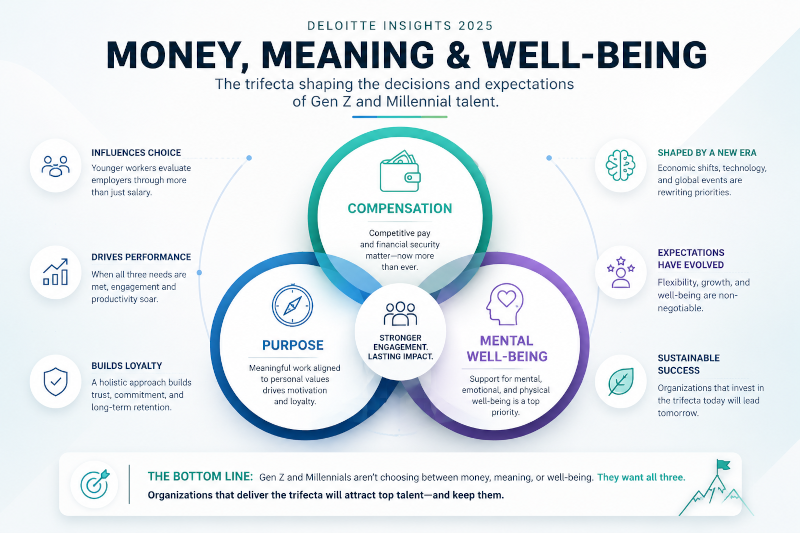
Deloitte’s global workforce research found that purpose, well-being, and meaningful contribution remain major drivers of job satisfaction for younger generations. Employees who reported stronger mental well-being were also significantly more likely to describe their work as meaningful and socially valuable.
This shift is not simply idealism or generational preference. It reflects broader economic and cultural conditions shaping younger workers over the past decade, including economic instability, rapid technological change, rising living costs, burnout culture, and the post-pandemic reassessment of work-life balance. Many younger employees entered the workforce during periods defined by uncertainty and continuous disruption, which has changed how they evaluate long-term career sustainability.
Research published in Frontiers in Psychology similarly found that Gen Z workers place strong emphasis on fairness, autonomy, flexibility, mentorship opportunities, and psychologically supportive workplace environments rather than purely hierarchical structures or rigid authority models.
Large organizations such as PwC and Deloitte have already begun adapting to these expectations through expanded workforce learning programs, internal mobility initiatives, mental health investments, and flexible work arrangements designed to support long-term employee sustainability instead of short-term productivity alone.
The important insight is that younger workers are not rejecting ambition. More often, they are redefining how ambition fits into life. Many employees no longer measure success exclusively through hierarchy, title accumulation, or excessive work centrality. Instead, they evaluate whether organizations can support professional growth, flexibility, purpose, financial stability, and sustainable performance simultaneously.
This creates a significant leadership challenge because organizations that fail to address these expectations often experience higher turnover, lower engagement, weaker retention, and growing distrust between employees and management.
The workplace compact is becoming more relational and psychologically complex than the purely transactional employment models that dominated previous workforce eras.
Recommendation: Align workforce strategy around sustainable performance, employee growth, mental well-being, and organizational trust rather than relying exclusively on compensation incentives.
The Future Manager Will Be Part Coach, Part Workflow Architect
The role of the manager is now undergoing one of the most significant transformations in decades.
Historically, managers primarily coordinated tasks, monitored performance, enforced policies, and maintained organizational control structures. Those responsibilities still exist, but modern work environments now require managers to operate across far more complex coordination systems.
Today’s managers increasingly function as:
- coaches,
- communication hubs,
- workflow coordinators,
- conflict navigators,
- culture translators,
- and AI-era adaptation leaders.
This shift becomes even more important as organizations integrate AI systems into everyday workflows. Managers are now responsible not only for coordinating people, but also for helping employees navigate hybrid human-AI environments where automation changes how work is distributed, evaluated, and executed.
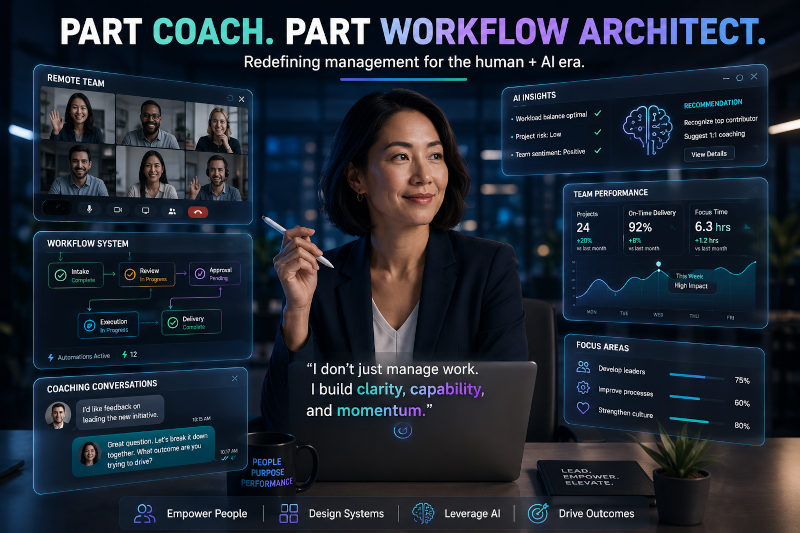
Research examining transformational leadership and team effectiveness suggests that leadership models emphasizing trust, empowerment, and developmental support produce stronger collaboration and engagement outcomes across dynamic work environments.
This is one reason traditional management systems built around visibility and control are becoming less effective.
Modern employees often expect:
- faster feedback,
- clearer communication,
- more autonomy,
- transparent leadership,
- and individualized development support.
Managers who fail to adapt may experience growing friction between organizational expectations and workforce behavior.
At the same time, managers themselves are under growing pressure. Hybrid coordination, distributed communication, AI adoption, and continuous change management have significantly increased managerial cognitive load across many organizations.
The future manager therefore becomes less of a command authority and more of a systems coordinator responsible for maintaining alignment, engagement, and execution continuity inside increasingly fluid work environments.
Organizations that recognize this transition early may gain major advantages in retention, adaptability, and workforce resilience over the next decade.
Recommendation: Redesign manager training around coaching, workflow coordination, AI-assisted collaboration, and employee development rather than compliance management alone.
Conclusion: The Employer-Employee Relationship Is Being Renegotiated
The modern workplace is no longer defined by a one-size-fits-all employment model centered primarily on salary and organizational hierarchy.
A new workplace compact is emerging — one shaped by flexibility, growth, autonomy, well-being, transparency, and meaningful work.
“Gen Z and Millennials aren’t rejecting work. They’re rejecting outdated systems that confuse control with leadership.”
Gen Z and Millennials are not rejecting work itself. They are redefining what sustainable and worthwhile work looks like inside rapidly changing economic and technological environments.
Organizations that continue operating with rigid management systems designed for previous workforce eras may struggle to attract and retain talent in environments where employees increasingly expect:
- flexibility,
- development,
- trust,
- and purpose alongside compensation.
The companies adapting most successfully are often not the organizations offering the most perks. More often, they are the organizations redesigning leadership, communication, and operational structures around how modern employees actually work and develop.
The future of workforce strategy may depend less on enforcing legacy workplace models and more on building environments where employees can grow, coordinate, and perform sustainably over time.
The workplace compact is changing. The question is no longer whether organizations should adapt. It is how quickly leadership systems can evolve alongside the workforce itself.
1 thought on “The New Workplace Compact: How Gen Z and Millennials Are Redefining Work in 2026”