
Recommendations
- Review the last six months of major incidents and identify recurring patterns rather than treating each event as an isolated occurrence.
- Identify every process that depends on a single individual and establish documented backups within the next quarter.
- Establish a quarterly review of technical debt, knowledge management gaps, and deferred modernization efforts, and evaluate them as operational risks with measurable business impact.
- Conduct anonymous quarterly pulse surveys that measure workload sustainability, cognitive load, and employee perceptions of organizational support.
- Before launching new AI initiatives, assess the maturity of your documentation, governance, and core business processes to ensure technology is improving operations rather than accelerating existing inefficiencies.
At 11:47 PM on a Thursday, a senior systems engineer receives yet another alert. A critical application has gone offline. Within minutes, a familiar pattern unfolds: conference bridges are opened, Slack channels become active, and a handful of individuals begin working through what has become a routine crisis.
By Friday morning, the issue is resolved. Leadership thanks the team for their responsiveness. Another fire has been extinguished.
What rarely happens is a discussion about why the fire occurred in the first place.
Across the technology industry, perpetual firefighting has become normalized. Teams are celebrated for their ability to recover from outages, security incidents, failed deployments, and last-minute executive requests. Heroics are rewarded. Availability is mistaken for resilience. Meanwhile, burnout quietly accumulates beneath the surface.
Recent research paints a troubling picture. A 2026 study of Security Operations Center (SOC) practitioners found that 71% reported experiencing burnout, while nearly a quarter indicated they were considering leaving the profession entirely. Similarly, researchers examining cybersecurity professionals found that 44% reported severe stress and burnout, with two-thirds describing cybersecurity as more stressful than other IT disciplines.
These findings should concern every executive—not simply because burnout affects employee well-being, but because burnout is often an indicator of deeper operational dysfunction.
Organizations rarely fail because of a single catastrophic event. More often, they accumulate small inefficiencies, deferred decisions, and unmanaged technical debt until a constant crisis becomes part of the operating model.
The silent burnout crisis in IT is not fundamentally a people problem. It is a systems problem.
When Firefighting Becomes the Operating Model
Most organizations experience incidents from time to time. The difference is that high-performing organizations treat them as exceptions, while others quietly build entire operating models around responding to them.
There is a significant distinction between being prepared for disruption and becoming dependent on it.
Spend enough time around technology organizations, and certain phrases begin to surface repeatedly:
- “Everything is a priority.”
- “We’re doing more with less.”
- “The business moves too fast to document.”
- “We’ll fix it properly next quarter.”
- “We’ve always operated this way.”
Individually, these statements sound reasonable—perhaps even familiar. Taken together, however, they paint a picture of an organization that has normalized urgency.
Over time, teams stop challenging the conditions that created the problem. Instead of asking why outages continue to occur, why onboarding takes months, or why the same individuals are consistently pulled into incident response efforts, they accept these realities as unavoidable consequences of working in IT.
At some point, firefighting ceases to be an occasional responsibility and becomes part of the organization’s identity.
This creates a dangerous illusion. Calendars remain full, tickets continue moving through the queue, and incidents are resolved quickly enough to keep the business running. From the outside, the organization appears productive.
But activity and effectiveness are not the same thing.
Many organizations have inadvertently optimized for responsiveness rather than sustainability. Their success depends less on resilient systems and more on the willingness of their people to repeatedly compensate for operational shortcomings.
Recommendation: Review the last six months of major incidents and identify recurring patterns rather than treating each event as an isolated occurrence.
The Hidden Economics of Burnout
Burnout carries a cost that rarely appears on financial statements.
Leadership teams can measure labor utilization, infrastructure expenses, and project delivery metrics with remarkable precision. However, few organizations actively measure cognitive load, institutional dependency, or operational fatigue.
The result is predictable.
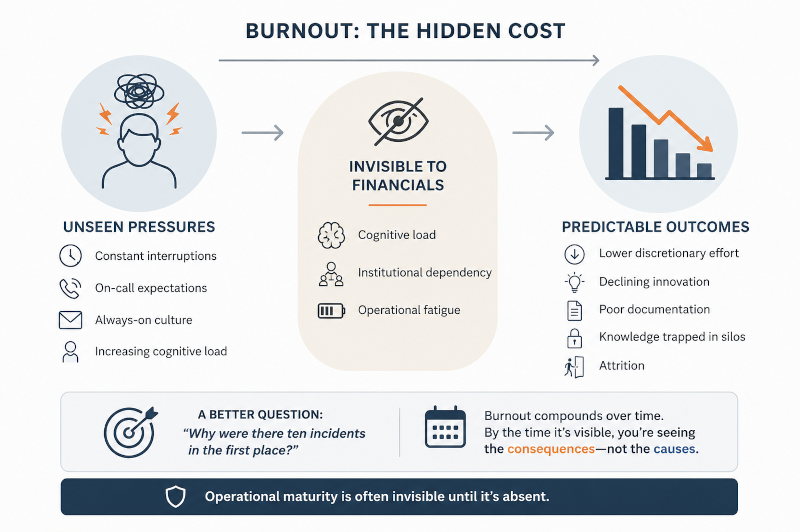
Employees begin contributing less discretionary effort. Innovation declines. Documentation becomes an afterthought. Knowledge remains trapped in the minds of experienced personnel. Eventually, attrition follows.
Recent workplace surveys found that nearly two-thirds of employees report experiencing burnout multiple times per week. While burnout spans industries, IT professionals face a unique challenge: their work often involves persistent interruptions, on-call responsibilities, and the expectation of constant availability.
Organizations frequently mistake resilience for capacity.
A team that successfully responds to ten incidents in a month is often viewed as high performing. A more useful question would be: Why were there ten incidents in the first place?
This distinction matters because burnout compounds over time. Unlike a hardware failure or application outage, burnout rarely announces itself through a single event. It manifests gradually through disengagement, reduced creativity, slower decision-making, and increased turnover.
By the time executives recognize the problem, they are often observing its consequences rather than its causes.
This builds on ideas explored in Why Documentation Is Becoming a Strategic Asset and How High-Performing Organizations Reduce Operational Friction, both of which emphasize that operational maturity is frequently invisible until it is absent.
Recommendation: Add employee turnover, incident frequency, and after-hours support metrics to quarterly operational reviews.
Hero Culture Is Not a Strategy
Every organization has its heroes.
They are the individuals who know which server to restart, which database query to run, and which undocumented workaround prevents a critical application from failing. They answer calls on vacation. They postpone time off. They routinely absorb responsibilities that were never intended to belong to a single person.
Leaders often view these individuals as indispensable. In reality, their indispensability represents organizational risk.
Case Study: The CrowdStrike Outage
The 2024 CrowdStrike incident serves as a useful reminder of how quickly operational disruptions can cascade across industries. A faulty software update impacted millions of Windows devices globally, affecting airlines, healthcare providers, financial institutions, and government agencies.
While the root cause was technical, the recovery effort highlighted another reality: countless IT professionals worked extended hours to restore systems under extraordinary pressure. For many organizations, the outage was not merely a technology event. It was a stress test of operational resilience.
The companies that recovered most effectively were not necessarily those with the largest IT budgets. They were often the organizations with established incident response plans, documented procedures, and distributed ownership models.
Heroics may save the day, but they should never be required to sustain normal business operations.
Recommendation: Identify every process that depends on a single individual and establish documented backups within the next quarter.
Technical Debt Is Burnout Debt
Technical debt is often framed as a software engineering problem, but its impact extends far beyond technology. Over time, it becomes a workforce issue, an operational issue, and ultimately a business issue.
Every temporary workaround creates future work that someone will eventually have to perform. Undocumented processes force employees to rely on memory rather than systems. Deferred modernization initiatives may reduce costs in the short term, but they also transfer risk to the people responsible for maintaining aging platforms and increasingly complex environments.
What makes technical debt particularly dangerous is that its effects are rarely immediate. Organizations can operate for years with outdated documentation, unsupported applications, and fragile processes. Because the consequences emerge gradually, leaders often underestimate the true cost of delaying improvements.
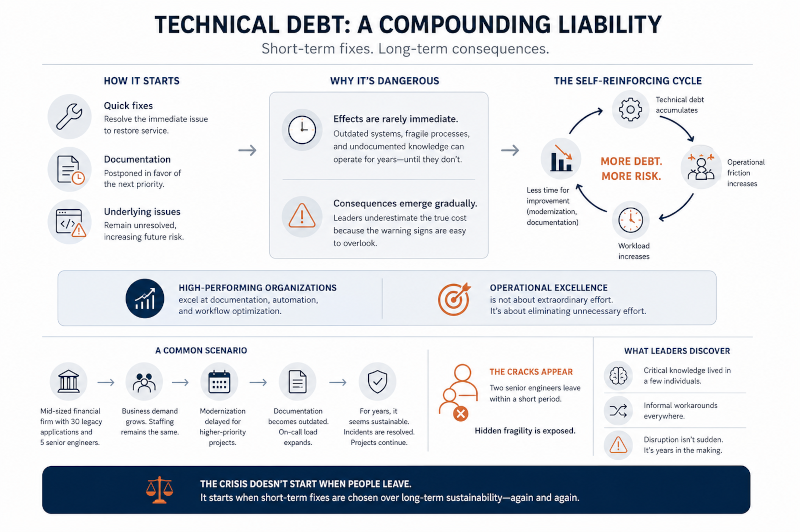
The pattern is remarkably consistent. An incident occurs and a quick fix is implemented to restore service. Documentation is postponed because the team is focused on the next priority. The underlying issue remains unresolved, making future incidents more likely. As interruptions increase, teams spend more time reacting and less time improving the systems that generated the problem in the first place.
Over time, a self-reinforcing cycle begins to emerge. Technical debt creates operational friction. Operational friction increases workload. Increased workload leaves less time for modernization and documentation. The result is even more technical debt.
Research from Google’s 2025 State of DevOps Report found that high-performing organizations consistently demonstrate stronger capabilities in areas such as documentation, automation, and workflow optimization. The implication is straightforward: operational excellence is not primarily the result of extraordinary effort. It is the result of systematically eliminating unnecessary effort.
Consider a common scenario.
A mid-sized financial services company supports thirty legacy applications with a team of five senior engineers. As business demand grows, staffing remains unchanged. Modernization initiatives are repeatedly delayed to accommodate higher-priority projects. Documentation becomes outdated, and on-call responsibilities gradually expand as systems become more difficult to maintain.
For years, the arrangement appears sustainable. Incidents are resolved, projects continue moving forward, and the business experiences few visible disruptions.
The fragility of the model only becomes apparent when two senior engineers leave within a short period of time.
What leadership discovers is not simply a staffing problem. They discover that years of undocumented knowledge, informal workarounds, and operational expertise existed almost entirely in the minds of a handful of individuals. The resulting disruption may appear sudden, but the underlying causes were years in the making.
The crisis did not begin when employees resigned. It began when the organization repeatedly chose short-term fixes over long-term sustainability.
Recommendation: Establish a quarterly review of technical debt, knowledge management gaps, and deferred modernization efforts, and evaluate them as operational risks with measurable business impact.
The Rise of Quiet Cracking
Burnout does not always look the way it once did.
Historically, leaders associated burnout with visible signs of exhaustion—employees who were overwhelmed, openly frustrated, or struggling to keep up with their responsibilities. Increasingly, however, the warning signs are far less obvious.
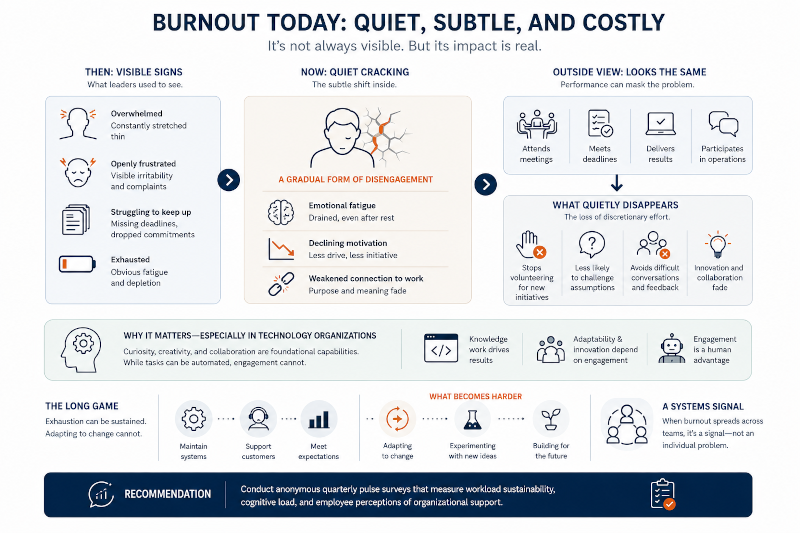
Researchers and workplace analysts have begun using the term “quiet cracking” to describe a gradual form of disengagement marked by emotional fatigue, declining motivation, and a weakened connection to work.
From the outside, very little appears to have changed. Employees still attend meetings, meet deadlines, and participate in day-to-day operations. In many cases, performance remains entirely acceptable.
The shift is more subtle.
People stop volunteering for new initiatives. They become less willing to challenge assumptions or engage in difficult conversations. The discretionary effort that once fueled innovation and collaboration quietly disappears.
This is particularly concerning in technology organizations, where success depends heavily on knowledge work. Curiosity, creativity, and collaboration are not optional inputs—they are foundational capabilities. While organizations can automate many tasks, they cannot automate engagement.
Leaders often ask why innovation has slowed or why transformation initiatives fail to gain traction despite having talented teams in place. More often than not, the issue is not capability; it is capacity.
Employees can continue operating in a state of exhaustion for surprisingly long periods of time. They can maintain systems, support customers, and deliver against expectations. What becomes much more difficult is adapting to change, experimenting with new ideas, or building for the future.
As discussed in The New Skill Companies Actually Need: Systems Thinking, organizations are complex systems. When burnout begins appearing across multiple teams, it should be viewed less as an individual issue and more as a signal that something within the broader operating environment requires attention.
Recommendation: Conduct anonymous quarterly pulse surveys that measure workload sustainability, cognitive load, and employee perceptions of organizational support.
AI Will Amplify Existing Operating Models
There is a growing assumption among business leaders that artificial intelligence will alleviate burnout by taking over repetitive and time-consuming tasks. In many cases, that assumption is valid. AI has enormous potential to reduce administrative overhead, accelerate decision-making, and free employees to focus on higher-value work.
However, technology rarely fixes operational problems on its own.
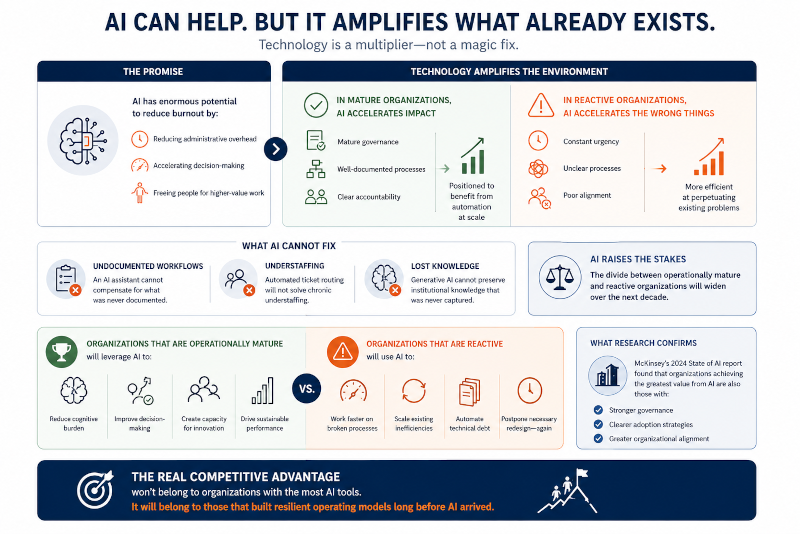
AI tends to amplify the characteristics of the environments in which it is deployed. Organizations with mature governance, well-documented processes, and clear accountability structures are already positioned to benefit from automation at scale. Those operating in a constant state of urgency may find that they have simply become more efficient at perpetuating existing problems.
An AI assistant cannot compensate for undocumented workflows. Automated ticket routing will not solve chronic understaffing. Generative AI cannot preserve institutional knowledge that was never captured in the first place.
In many respects, AI raises the stakes rather than lowers them.
Over the next decade, the divide between operationally mature organizations and reactive ones is likely to become more pronounced. One group will leverage AI to reduce cognitive burden, improve decision-making, and create capacity for innovation. The other will use the same technology to accelerate work that should have been redesigned years earlier.
This pattern is reflected in broader industry research. McKinsey’s latest State of AI report found that organizations achieving the greatest value from AI are also those demonstrating stronger governance, clearer adoption strategies, and greater organizational alignment.
Ultimately, the competitive advantage will not belong to the organizations with the largest number of AI tools. It will belong to those that invested in building resilient operating models long before AI arrived.
Recommendation: Before launching new AI initiatives, assess the maturity of your documentation, governance, and core business processes to ensure technology is improving operations rather than accelerating existing inefficiencies.
Moving From Reactive to Resilient
Addressing burnout requires more than adding another wellness initiative or encouraging employees to use their vacation time. Those efforts have value, but they often treat the symptoms rather than the underlying conditions that produced them.
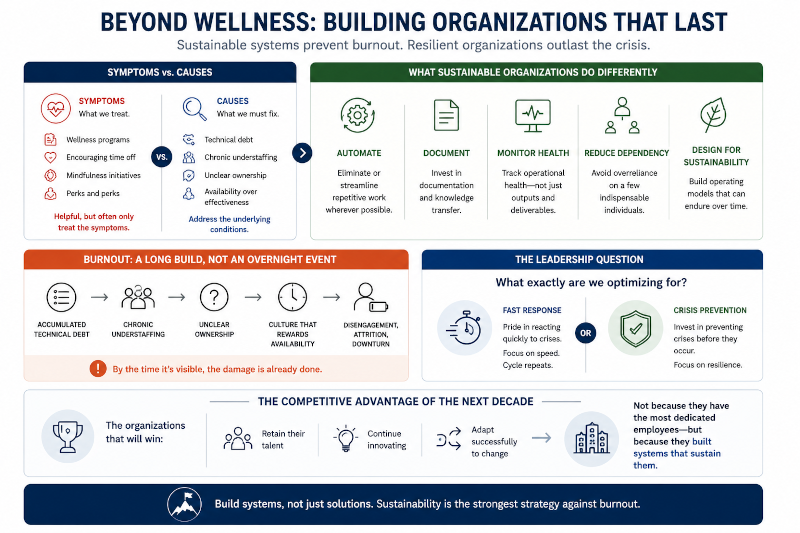
Organizations that consistently avoid burnout tend to have something else in common: they have built operating models designed for sustainability. They automate repetitive work wherever possible, invest in documentation and knowledge transfer, monitor the health of their operations—not just their outputs—and intentionally reduce dependence on a handful of indispensable individuals.
Burnout rarely appears overnight. It is usually the result of years of accumulated technical debt, chronic understaffing, unclear ownership, and a culture that quietly rewards availability over effectiveness. By the time employees begin disengaging or leaving, the organization is often experiencing the downstream effects of decisions made long ago.
This leaves leaders with an important question: What exactly are they optimizing for?
Some organizations take pride in their ability to respond to crises quickly. Others invest the time and discipline required to prevent those crises from occurring in the first place.
Over the next decade, that difference is likely to become a meaningful competitive advantage. The organizations that retain their talent, continue innovating, and adapt successfully to change will not necessarily be those with the most dedicated employees. They will be the ones that built systems capable of sustaining them.
Recommendation: Establish an executive-level operational resilience scorecard that includes incident trends, documentation health, employee retention, and after-hours support metrics.
Conclusion
The silent burnout crisis in IT is not the result of weak employees or unrealistic expectations from a single manager. It is the cumulative effect of organizations that have normalized perpetual firefighting.
For years, the technology industry has celebrated endurance. We praise the engineer who works through the night, the analyst who skips vacation, and the manager who absorbs impossible workloads without complaint.
“Sustainable organizations are not built on heroics. They are built on systems.”
Yet sustainable organizations are not built on heroics. They are built on systems. Burnout should be viewed as a business metric. Every after-hours incident, every undocumented process, and every recurring outage tells a story about how an organization operates.
The teams that thrive in the years ahead will not be the ones capable of fighting the most fires. They will be the ones that quietly and systematically eliminate the conditions that create them.