Recommendations
- Treat cybersecurity planning as part of enterprise operational resilience strategy rather than limiting it to isolated infrastructure or compliance functions.
- Introduce structured human verification and governance checkpoints into AI-assisted workflows before expanding autonomous operational decision-making.
- Build mandatory secondary verification checkpoints into workflows involving privileged access, financial approval, identity recovery, and executive communications.
- Measure cyber readiness using recovery speed, dependency visibility, operational continuity, and escalation effectiveness alongside traditional prevention metrics.
- Build cross-functional cyber coordination structures involving operations, legal, communications, identity management, and executive leadership before major incidents occur.
Cybersecurity Has Entered a Machine-Speed Era
For years, many organizations approached cybersecurity primarily as a technical discipline focused on perimeter defense, endpoint protection, vulnerability management, and compliance controls. Those capabilities still matter. But the operational environment entering 2026 looks fundamentally different from the landscape most enterprises were originally designed to manage.
Cyber risk no longer develops at purely human speed.
Modern threat ecosystems now operate with AI-assisted reconnaissance, automated credential abuse, adaptive malware development, scalable phishing infrastructure, and attack coordination capable of evolving dynamically during active operations. Research from the IBM X-Force Threat Intelligence Index 2025 found that identity abuse and credential theft continued expanding rapidly across enterprise environments, while attackers increasingly relied on automation and AI-assisted techniques to accelerate intrusion activity. IBM also reported an 84% rise in phishing emails delivering infostealers during 2024 as attackers shifted toward stealthier identity-focused operations.
This creates a structural shift in how organizations experience cyber risk itself.
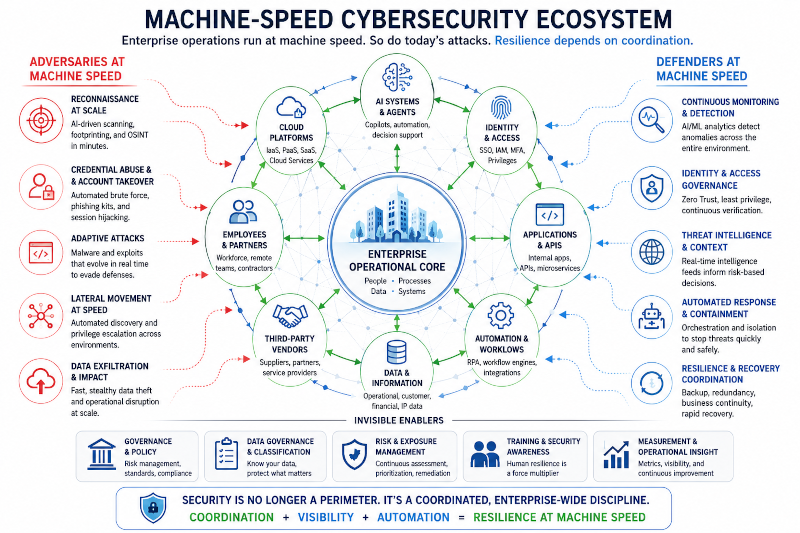
Modern enterprises now operate inside highly interconnected ecosystems where cloud platforms, APIs, AI systems, SaaS providers, identity infrastructure, remote work environments, and third-party vendors continuously exchange operational data in real time. Security failures no longer remain isolated technical events confined to a single department or system. They increasingly create operational disruption that cascades across workflows, communications, vendors, customers, and business operations simultaneously.
This overlaps closely with themes explored previously in Cybersecurity Is No Longer Just a Technical Problem, where operational coordination and governance maturity became just as important as technical defense capabilities themselves.
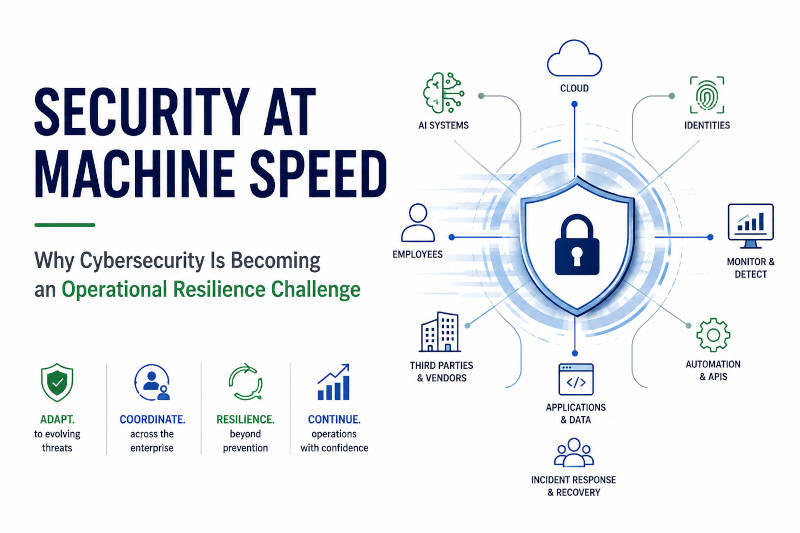
The challenge facing enterprise leaders is therefore no longer simply preventing intrusion. It is maintaining operational control in environments where both attackers and defenders operate at machine speed.
Recommendation: Treat cybersecurity planning as part of enterprise operational resilience strategy rather than limiting it to isolated infrastructure or compliance functions.
AI Systems Are Becoming Part of the Attack Surface
One of the largest enterprise shifts underway involves the rapid expansion of AI systems directly into operational workflows.
Organizations now deploy AI copilots, retrieval systems, workflow automation, fraud detection systems, and autonomous agents across customer service, analytics, software development, onboarding, finance operations, and internal coordination environments. As these systems become embedded into daily execution, they also become part of the enterprise attack surface itself.
This introduces entirely new categories of operational risk.
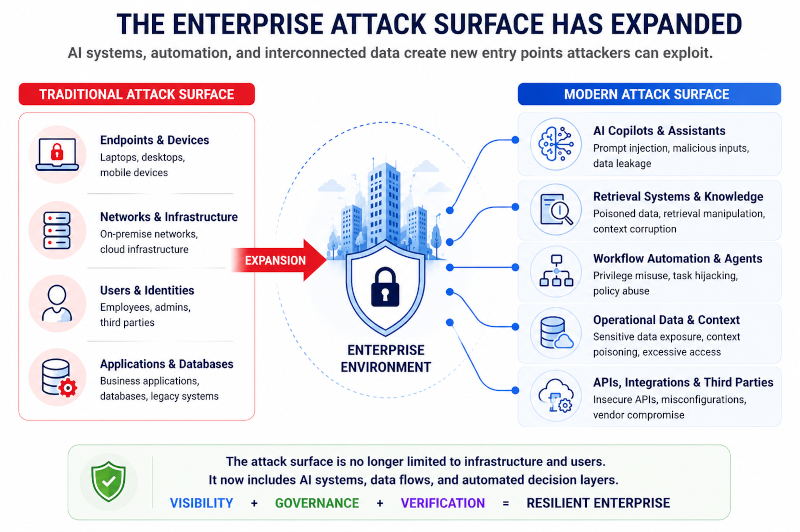
Unlike traditional applications, AI systems frequently rely on probabilistic reasoning, dynamic retrieval, evolving operational context, and machine-generated outputs. That creates opportunities for attackers to manipulate workflows indirectly through poisoned data, malicious prompts, deceptive retrieval context, or adversarial input manipulation.
Research from the Stanford AI Index Report 2024 emphasized that organizations are deploying AI systems faster than governance, accountability, and explainability frameworks are maturing around them. The report also highlighted growing concern surrounding responsible AI standards, operational oversight, and transparency across enterprise deployments.
The risk is not simply inaccurate AI output. The larger issue is operational dependency.
Managers increasingly need visibility into:
- where AI systems influence decisions,
- how retrieval systems source information,
- who validates outputs,
- and how workflows escalate exceptions under abnormal conditions.
JPMorgan Chase provides an important enterprise example. The bank has expanded AI deployment across fraud detection, operational analytics, and internal workflow environments while simultaneously strengthening governance oversight, explainability standards, and operational accountability structures around those systems.
This is one reason many organizations are beginning to treat AI agents less like software tools and more like digital actors operating inside enterprise systems with scoped permissions, monitored access, and governance oversight.
The organizations deploying AI most effectively may not necessarily be the organizations automating the greatest number of workflows. More often, they are the organizations building operational safeguards capable of preserving trust as AI becomes embedded across execution environments.
This mirrors themes explored previously in The Future of Operational Intelligence in AI-Driven Organizations, where governance, retrieval quality, workflow integration, and institutional knowledge architecture became central to operational reliability.
Recommendation: Introduce structured human verification and governance checkpoints into AI-assisted workflows before expanding autonomous operational decision-making.
Social Engineering Has Become Hyper-Realistic
One of the most disruptive cybersecurity shifts entering 2026 is the evolution of social engineering itself. Traditional phishing attacks often relied on suspicious emails, poor grammar, or obvious impersonation attempts. Modern attacks now use AI-generated communication, synthetic voice cloning, deepfake video, and real-time conversational manipulation to create highly believable interactions across multiple communication channels simultaneously.
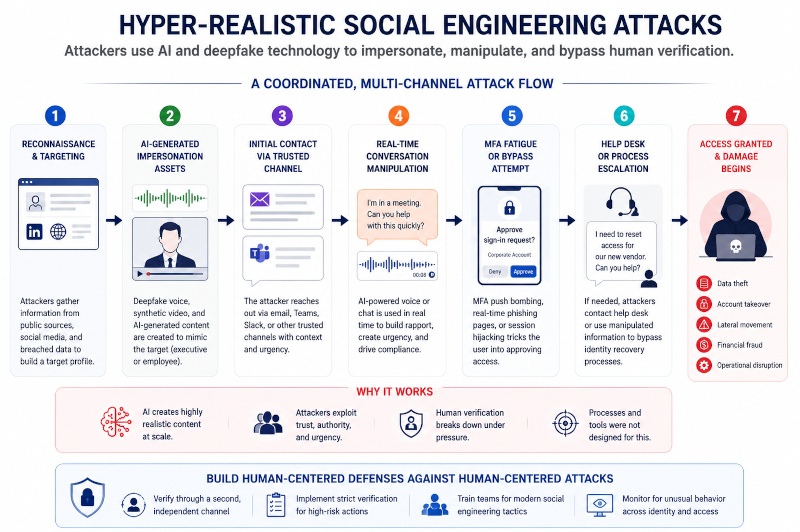
This changes the nature of enterprise verification entirely.
Attackers increasingly target:
- help desk employees,
- financial approval workflows,
- executive communications,
- identity recovery processes,
- and operational escalation pathways.
The MGM Resorts breach demonstrated how operational processes themselves can become attack vectors when human verification systems fail under pressure. Attackers reportedly used social engineering against internal support personnel to gain access to enterprise systems, highlighting how identity and trust workflows can become vulnerable under modern attack conditions.
Research from the World Economic Forum Global Cybersecurity Outlook 2025 warned that AI-assisted cybercrime is accelerating the sophistication and scalability of deception-based attacks across enterprise environments. The report also noted that supply chain complexity, AI expansion, and digital interdependence are creating a far more unpredictable cyber risk environment for organizations globally.
This challenge becomes especially dangerous inside organizations already operating under workflow overload, fragmented communications, meeting fatigue, and high coordination complexity.
In those environments, attackers often succeed not because employees lack intelligence, but because operational conditions make verification difficult to sustain consistently.
This overlaps closely with operational coordination issues discussed previously in The Hidden Cost of Manual Internal Processes, where fragmented workflows and overloaded coordination environments quietly reduced organizational responsiveness long before failures became visible.
The strongest defense against modern social engineering may not simply be awareness training alone. It may be redesigning operational processes so verification becomes easier to sustain under real-world conditions.
Recommendation: Build mandatory secondary verification checkpoints into workflows involving privileged access, financial approval, identity recovery, and executive communications.
Operational Resilience Matters More Than Prevention Alone
Many organizations still measure cybersecurity effectiveness primarily through prevention-based metrics such as threats blocked, malware detected, vulnerabilities patched, or attacks prevented.
Those measurements remain important. But modern enterprise environments now require something broader: operational resilience.
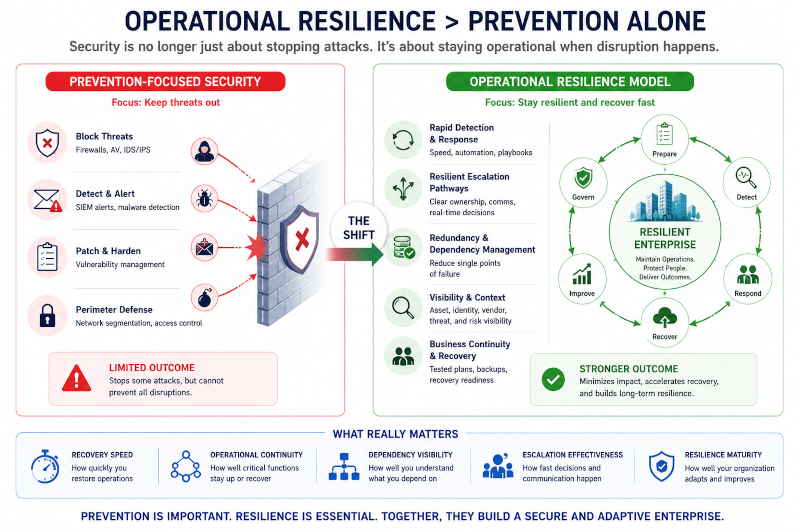
The 2024 CrowdStrike outage demonstrated how deeply interconnected digital ecosystems can create cascading operational disruption even when incidents do not originate from malicious attacks. A faulty software update disrupted airlines, hospitals, banks, emergency services, retailers, and enterprise operations globally, exposing how dependent many organizations have become on centralized digital infrastructure and shared operational platforms.
The incident exposed a larger structural reality.
Modern enterprises now operate inside ecosystems where operational dependencies often extend far beyond internal infrastructure visibility.
Research from the Cloud Security Alliance later emphasized that the outage revealed weaknesses involving change management, dependency mapping, operational continuity planning, and incident coordination across interconnected systems.
This matters because operational disruption now spreads rapidly across:
- cloud providers,
- identity systems,
- endpoint platforms,
- APIs,
- AI services,
- SaaS environments,
- and external vendors simultaneously.
The organizations recovering fastest are often not simply the organizations with the strongest technical controls. More often, they are the organizations with:
- resilient escalation pathways,
- operational redundancy,
- governance clarity,
- coordinated response structures,
- and decision-making systems capable of functioning effectively under pressure.
Cybersecurity therefore increasingly becomes a form of operational coordination capability rather than purely defensive technology management.
This mirrors themes explored previously in The Future of Operational Intelligence in AI-Driven Organizations, where operational resilience depended heavily on governance quality, workflow coordination, and enterprise-wide visibility across interconnected systems.
Recommendation: Measure cyber readiness using recovery speed, dependency visibility, operational continuity, and escalation effectiveness alongside traditional prevention metrics.
Security Teams Are Becoming Enterprise Coordination Centers
One of the clearest implications of machine-speed cyber environments is that siloed security operations models no longer scale effectively.
Modern incidents often involve security teams, legal departments, operations, communications, vendors, cloud providers, identity systems, regulators, and executive leadership simultaneously. This creates coordination complexity that many organizations still underestimate.
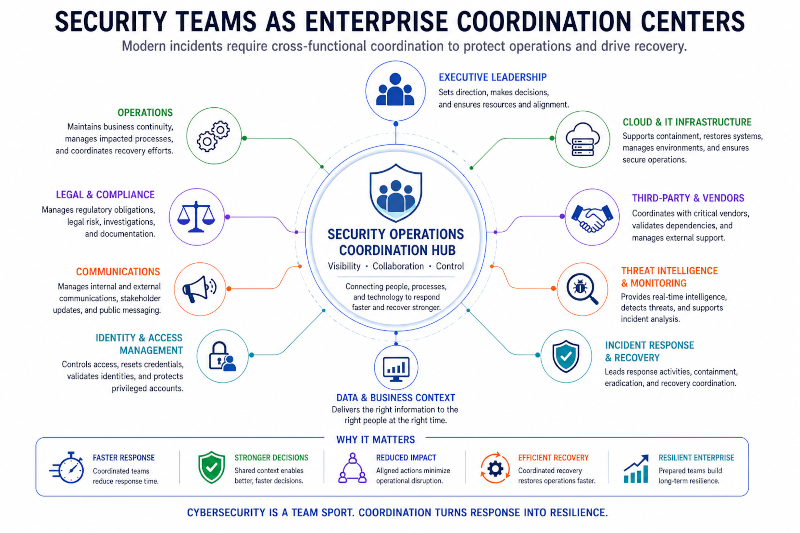
The Change Healthcare ransomware disruption demonstrated how cyber incidents can rapidly evolve into enterprise-wide operational crises affecting hospitals, pharmacies, insurers, healthcare providers, and customers across interconnected ecosystems. The operational consequences extended far beyond compromised infrastructure itself.
Security leaders therefore increasingly function less like isolated technical defenders and more like enterprise coordination managers responsible for maintaining operational continuity across highly interconnected environments.
This includes:
- coordinating incident response,
- validating dependencies,
- managing escalation pathways,
- aligning vendor communication,
- and maintaining business continuity during rapidly evolving incidents.
Research from the Deloitte Future of Cyber Survey similarly emphasized that cyber resilience now depends heavily on cross-functional coordination, governance maturity, and enterprise-wide operational visibility rather than isolated tooling alone.
The defining challenge of 2026 is therefore not simply stopping cyberattacks. It is maintaining organizational control in environments where AI systems, automation, third-party dependencies, and digital coordination now operate continuously at machine speed.
The organizations adapting most effectively may not necessarily be the organizations deploying the largest number of security products. More often, they are the organizations redesigning operational resilience around the realities of highly interconnected digital ecosystems.
Recommendation: Build cross-functional cyber coordination structures involving operations, legal, communications, identity management, and executive leadership before major incidents occur.
2 thoughts on “Security at Machine Speed: Why Cybersecurity Is Becoming an Operational Resilience Challenge”