
- Recommendations
- Knowledge Friction Quietly Consumes Operational Capacity
- Knowledge Management Is Becoming Part of Operational Intelligence
- The Best Knowledge Managers Reduce Organizational Cognitive Load
- Knowledge Retrieval Is Becoming a Competitive Advantage
- Knowledge Systems Now Shape Organizational Scalability
Recommendations
- Identify operational workflows where employees repeatedly search for information, reconstruct context, or duplicate work and prioritize those areas for knowledge system improvement first.
- Audit where employees lose the most time searching for information and consolidate high-value operational knowledge into searchable, workflow-accessible systems.
- Integrate operational knowledge directly into workflows, ticketing systems, collaboration environments, and AI retrieval systems rather than isolating documentation inside disconnected repositories.
- Design knowledge systems that minimize repetitive clarification requests, context reconstruction, and duplicate decision-making across operational workflows.
- Treat operational knowledge retrieval as a strategic infrastructure capability and measure how quickly employees can locate trusted information needed to execute work consistently.
- Build knowledge environments designed for operational execution speed, retrieval quality, and long-term institutional continuity rather than passive document storage alone.
Most organizations assume productivity problems originate from workload itself. Employees appear overwhelmed, meetings multiply, inboxes grow, and operational delays become normalized across teams. But inside many enterprises, the larger issue is not simply volume of work. It is the growing amount of time employees spend searching for information, reconstructing context, clarifying ownership, and navigating fragmented systems before meaningful work can even begin.
This is one reason knowledge management is quietly evolving from an administrative support function into a form of operational infrastructure.
In practice, modern enterprises lose enormous amounts of productive capacity to operational friction created by disconnected documentation, inconsistent workflows, duplicated information, fragmented communication systems, and institutional knowledge scattered across departments. Research from the Microsoft 2024 Work Trend Index found that employees increasingly rely on AI systems and digital tools to manage workload complexity, while many organizations continue struggling with fragmented workflows and information overload. Microsoft reported that 75% of knowledge workers already use AI at work, largely because employees are attempting to reduce the operational friction surrounding modern knowledge work itself.
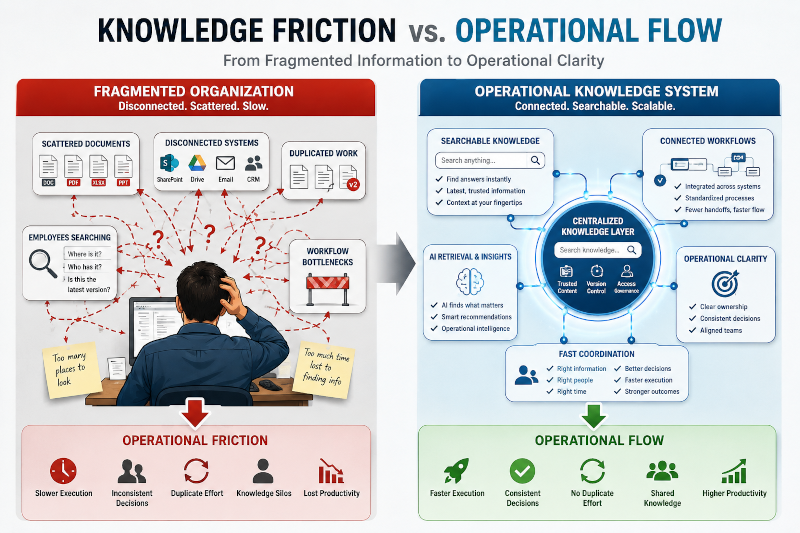
The problem is becoming more important as organizations scale AI deployment, remote collaboration, automation, and cross-functional operations simultaneously. In many enterprises, productivity no longer depends simply on employee capability. Increasingly, it depends on whether employees can retrieve reliable operational knowledge quickly enough to execute consistently.
This overlaps closely with themes explored previously in Why Organizational Knowledge Disappears Faster Than Companies Realize, where fragmented institutional memory systems quietly weakened operational continuity long before failures became visible organizationally.
The organizations operating most effectively today are often not the ones with the largest amount of information. More often, they are the organizations that operationalize knowledge effectively across workflows, systems, and teams.
Recommendation: Identify operational workflows where employees repeatedly search for information, reconstruct context, or duplicate work and prioritize those areas for knowledge system improvement first.
Knowledge Friction Quietly Consumes Operational Capacity
One of the most underestimated operational costs inside modern organizations is knowledge friction.
Employees frequently spend substantial portions of the workday:
- locating documentation,
- searching for previous decisions,
- clarifying ownership,
- validating information,
- or rebuilding operational context that already exists somewhere else inside the organization.
These delays rarely appear directly on financial statements, yet they quietly shape execution quality across the enterprise.
Research from APQC’s 2024 Knowledge Management Priorities and Predictions report emphasized that organizations increasingly view knowledge management as essential for operational effectiveness, collaboration, and organizational adaptability rather than merely documentation storage.
The issue becomes especially visible inside large enterprises where workflows span multiple departments, vendors, systems, and communication environments simultaneously. A relatively simple operational question may require employees to search SharePoint repositories, internal chat histories, emails, ticketing systems, spreadsheets, legacy databases, and undocumented tribal knowledge spread across teams.
The result is not simply slower work. It is cumulative organizational drag.
This challenge also compounds over time because fragmented knowledge environments increase:
- duplicate effort,
- inconsistent decision-making,
- onboarding delays,
- workflow confusion,
- and dependency on specific individuals.
NASA has publicly discussed similar institutional knowledge preservation challenges for years, particularly in highly specialized operational environments where undocumented expertise and historical operational context become difficult to replace quickly across generations of employees and contractors.
This is one reason knowledge retrieval is becoming strategically important again. Modern organizations increasingly recognize that operational execution depends heavily on how quickly employees can access trusted information without disrupting workflow continuity repeatedly throughout the day.
“The hidden cost inside many organizations is not lack of effort — it is the operational drag created when employees spend too much time searching for information instead of executing work.”
The strongest knowledge systems therefore do not simply store information. They reduce coordination friction across operational environments.
Recommendation: Audit where employees lose the most time searching for information and consolidate high-value operational knowledge into searchable, workflow-accessible systems.
Knowledge Management Is Becoming Part of Operational Intelligence
Historically, knowledge management often focused on documentation repositories and archival storage. Modern operational environments require something much more dynamic.
Today, knowledge systems increasingly overlap directly with:
- operational coordination,
- workflow execution,
- AI retrieval,
- decision support,
- onboarding,
- and enterprise analytics.
This transition is becoming more important as organizations deploy AI copilots, retrieval-augmented systems, and automation workflows more broadly across operations. AI systems are only as reliable as the operational knowledge environments supporting them.
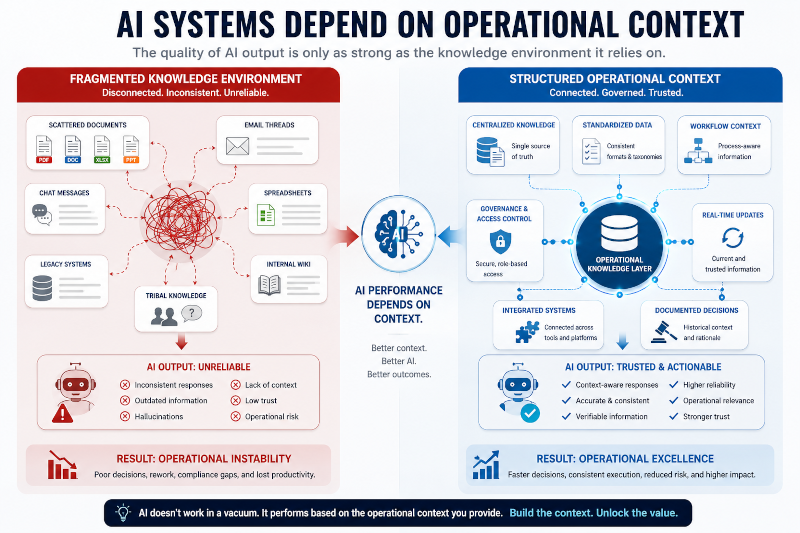
Research from Deloitte’s State of Generative AI in the Enterprise 2024 found that governance maturity, organizational readiness, data quality, and operational alignment remain among the largest barriers preventing enterprises from scaling AI successfully.
This becomes particularly visible when organizations deploy AI systems on top of fragmented operational environments.
Many enterprises attempt to implement AI copilots while workflows remain:
- poorly documented,
- inconsistently governed,
- disconnected across systems,
- or dependent on undocumented institutional knowledge.
As a result, AI systems frequently inherit the same operational inconsistencies already embedded inside organizations.
JPMorgan Chase provides an important counterexample. The company has expanded AI deployment across fraud detection, operational analytics, and workflow systems while simultaneously strengthening governance, retrieval integrity, explainability standards, and oversight structures around those environments. The emphasis is not simply on deploying AI tools broadly. It is on ensuring operational trustworthiness at scale.
This shift increasingly turns knowledge management into part of enterprise operational intelligence architecture itself.
This mirrors themes explored previously in The Future of Operational Intelligence in AI-Driven Organizations, where operational intelligence increasingly depended on the convergence of analytics, workflows, governance, institutional knowledge, and AI-assisted decision systems.
Organizations scaling effectively increasingly operationalize knowledge instead of treating documentation as passive storage.
Recommendation: Integrate operational knowledge directly into workflows, ticketing systems, collaboration environments, and AI retrieval systems rather than isolating documentation inside disconnected repositories.
The Best Knowledge Managers Reduce Organizational Cognitive Load
One of the least discussed benefits of strong knowledge systems is reduced cognitive overload across the workforce.
In fragmented operational environments, employees continuously carry unnecessary mental burden because they must remember:
- where information lives,
- who owns decisions,
- which systems contain accurate data,
- and how workflows actually operate across teams.
Over time, this creates decision fatigue and operational inefficiency.
Research from the Microsoft Work Trend Index 2024 similarly found that employees increasingly experience digital overload driven by meetings, fragmented communications, and information complexity.
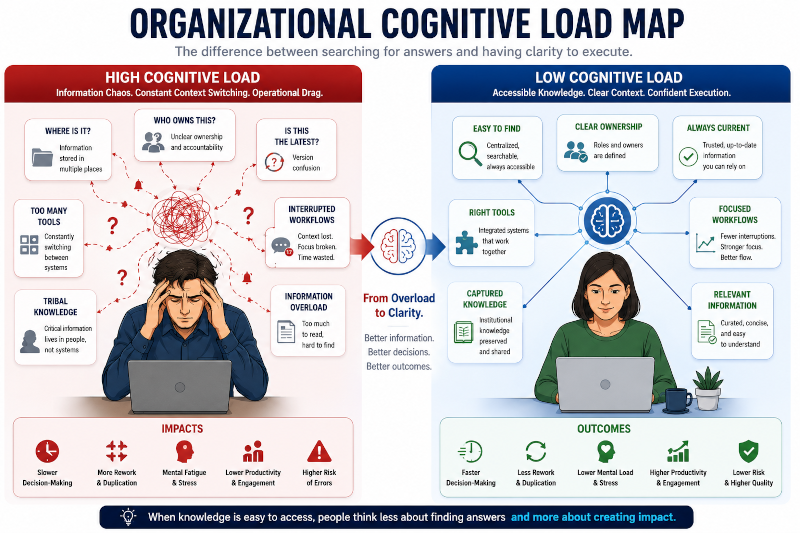
Strong knowledge systems reduce this burden by making operational context easier to retrieve consistently.
This changes how employees work in practice.
Instead of:
- rebuilding context repeatedly,
- interrupting coworkers for clarification,
- or manually verifying fragmented information,
employees can execute work more consistently because institutional knowledge becomes operationally accessible.
The impact is especially visible inside onboarding environments. Organizations with mature knowledge systems often reduce onboarding friction significantly because employees gain access to:
- searchable operational guidance,
- documented workflows,
- decision context,
- troubleshooting patterns,
- and institutional memory earlier in the learning process.
ServiceNow has emphasized similar operational benefits in workflow automation environments where integrated knowledge retrieval systems reduce service resolution times and improve workflow consistency across enterprise operations.
This is why knowledge management increasingly overlaps with workforce scalability itself. The organizations that adapt fastest are often the organizations where operational knowledge becomes reusable across teams instead of remaining trapped inside individuals.
Knowledge managers therefore increasingly function less like archivists and more like operational enablement architects responsible for reducing organizational cognitive friction.
Recommendation: Design knowledge systems that minimize repetitive clarification requests, context reconstruction, and duplicate decision-making across operational workflows.
Knowledge Retrieval Is Becoming a Competitive Advantage
As organizations become more digitally interconnected and AI-assisted, knowledge retrieval now plays a direct role in operational responsiveness. Modern enterprises operate inside environments where workflows move continuously, decisions occur rapidly, operational coordination spans multiple systems, and employees rely heavily on real-time context to execute work effectively. Organizations that retrieve operational knowledge quickly often onboard employees faster, resolve issues more efficiently, adapt to change more effectively, and coordinate work across departments with far less friction. Organizations with fragmented knowledge environments, however, frequently experience slower execution, repeated operational confusion, inconsistent customer experiences, and heavier dependency on specific individuals to maintain continuity.
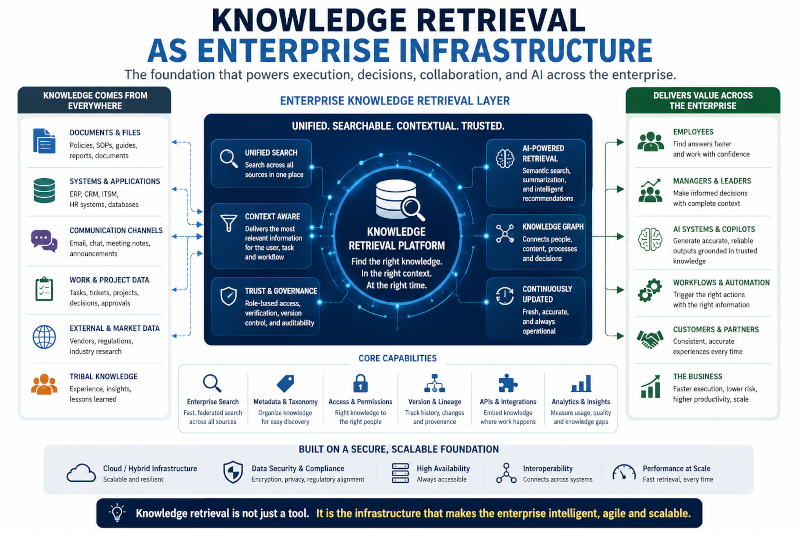
Research examining enterprise AI adoption suggests that many organizations struggle less from lack of AI capability and more from workflow fragmentation, governance inconsistency, and unreliable operational context. This challenge becomes even more significant as AI systems begin participating directly inside operational workflows themselves. Retrieval quality now shapes AI reliability, operational consistency, governance visibility, and enterprise decision quality across increasingly interconnected systems.
The organizations operating most effectively at scale are often not the ones generating the largest amount of information. More often, they are the organizations building environments where knowledge remains reusable across workflows, systems, teams, and AI-assisted processes without requiring employees to constantly reconstruct context manually. This is one reason knowledge retrieval is gradually becoming part of enterprise infrastructure itself. In many organizations, the competitive advantage no longer comes simply from possessing expertise alone, but from making that expertise structurally accessible across the enterprise.
Recommendation: Treat operational knowledge retrieval as a strategic infrastructure capability and measure how quickly employees can locate trusted information needed to execute work consistently.
Knowledge Systems Now Shape Organizational Scalability
One of the clearest enterprise shifts underway is the recognition that knowledge systems now play a direct role in organizational scalability itself. As enterprises expand across distributed teams, remote operations, AI-assisted workflows, automation environments, and interconnected digital ecosystems, institutional knowledge can no longer remain dependent on tribal memory alone.
The organizations scaling most effectively are often building environments where operational knowledge remains searchable, workflow guidance stays accessible, decision context can be reused across teams, and institutional memory persists beyond individual employees. This transition fundamentally changes how organizations think about productivity.
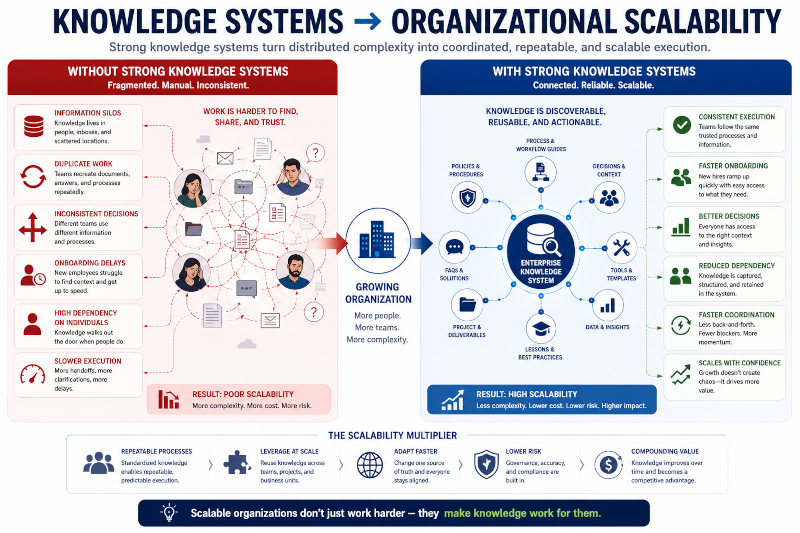
Productivity is no longer simply about employee output volume. In many enterprise environments, it now depends on how much operational friction organizations remove from knowledge retrieval, workflow coordination, and decision execution. Knowledge management therefore functions simultaneously as operational infrastructure, workforce enablement, coordination architecture, and enterprise intelligence capability.
The organizations that scale effectively in the next phase of enterprise operations may not necessarily be the organizations generating the most data or deploying the most AI tools. More often, they are the organizations building operational knowledge systems reliable enough to support consistent execution across highly interconnected environments.
The silent productivity killer inside many organizations is not lack of effort. It is the hidden operational friction created when employees cannot retrieve reliable information quickly enough to execute work efficiently.
Recommendation: Build knowledge environments designed for operational execution speed, retrieval quality, and long-term institutional continuity rather than passive document storage alone.
5 thoughts on “The Silent Productivity Killer: Why Knowledge Systems Are Becoming Operational Infrastructure”